Continuity objectives should be defined separately for clinical equipment and data services; a general-purpose UPS does not carry an unapproved life-support commitment.
Section 01
Define the Clinical Boundary
Can a general-purpose UPS selection establish life-support suitability? For Clinical engineering, hospital facilities and ICU project teams, the answer must stay inside the project boundary: Not by itself. Life-support equipment and clinical supplies must follow their applicable requirements and the approved hospital design. Prepare the device inputs, dependencies and intended operating state for the responsible clinical engineering team. General IT power support should remain clearly separate from specialized medical supply responsibilities. The next step is scope table: clinical device / support IT / supply requirement / owner, using approved ICU equipment classifications, supply interfaces and continuity objectives.
The boundary is a responsibility boundary more than an electrical one. In most hospitals the clinical power arrangements, medical IT systems and emergency circuits belong to clinical engineering or facilities. A standard online UPS protects the documentation and monitoring servers that IT runs. Its presence does not add alarm behavior, clinical operating states or a medical approval to whatever is plugged into it. A standard published for a different environment, such as IEC 60601-1-11 for home healthcare, does not by itself extend to an ICU or operating room supply.
The table below records the split for the illustrative scenario used throughout this article. Bedside life-support power stays with the hospital's approved systems, while the documentation and monitoring chain sits in the support IT scope.
Read the table and the UPS question stays narrow. It covers the last three rows. The first two rows carry clinical decisions that a supplier must not quietly inherit.
| Decision area | Project question | Required output |
|---|---|---|
| Define the Clinical Boundary | Can a general-purpose UPS selection establish life-support suitability? | Scope table: clinical device / support IT / supply requirement / owner |
| Trace Monitoring Data Dependencies | Why include data and network services in the plan? | Data path: endpoint / network / server / display / owner |
| Separate Backup Objectives | Should every ICU-related device have the same runtime? | Objective table: group / function / interval / alternate source |
Section 02
Trace Monitoring Data Dependencies
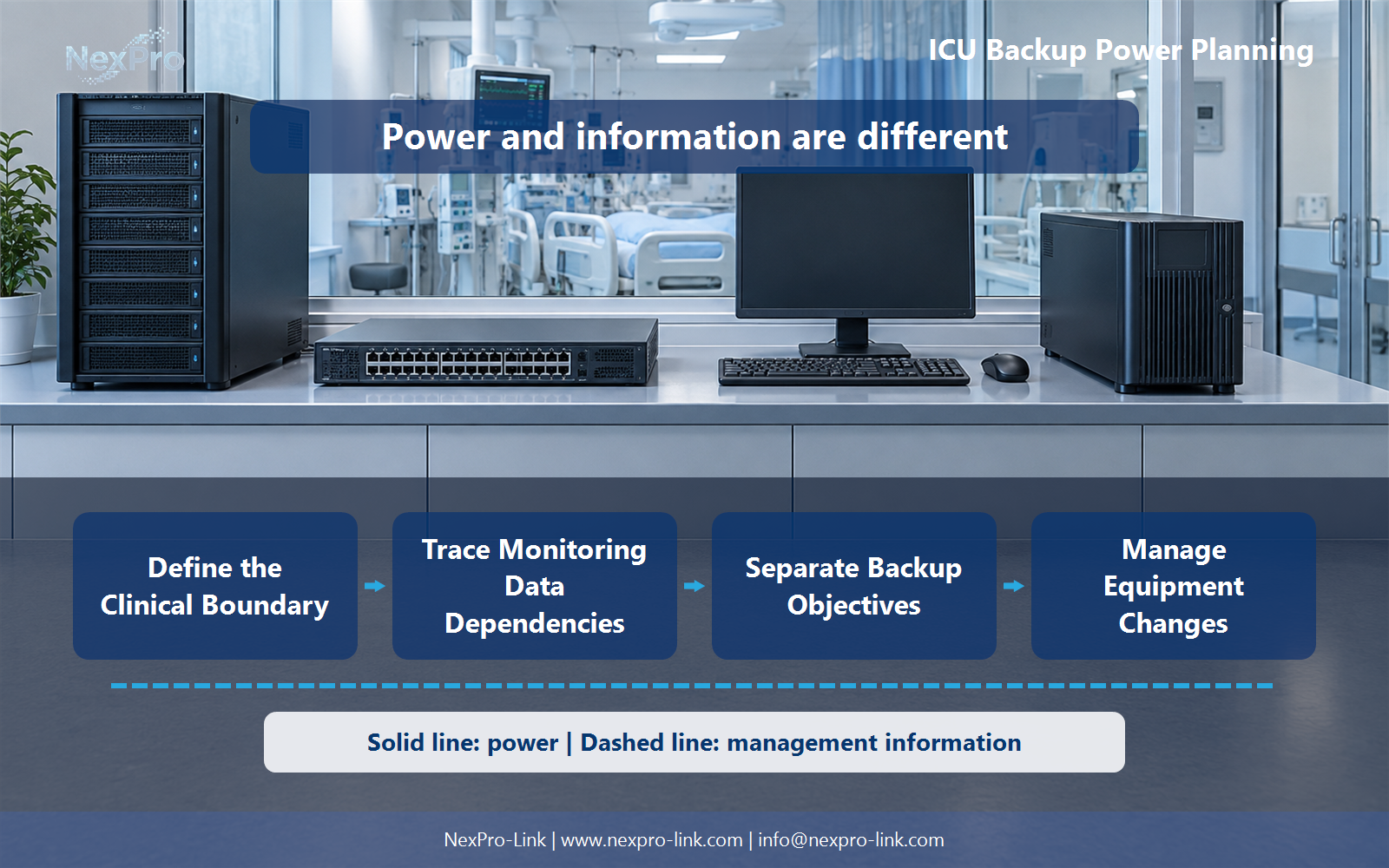
A bedside monitor that still has battery power does not mean the monitoring function is available. The reading has to travel from the device, through a switch, to a server, and out to a display or a clinician's workstation. Each hop has its own power source and its own owner. A plan that powers only the endpoint leaves the chain broken in the middle.
The path for the illustrative scenario runs like this.
Battery power for one hop does not prove the whole chain. When a site says it needs continuity for "the monitoring system," the first useful step is to list the hops and name an owner for each. The supply scope then follows the chain, not a single device.
Section 03
Separate Backup Objectives
Not every ICU-related device needs the same runtime. Devices serve different functions, so they can have different continuity or shutdown objectives. The approved design decides whether a runtime requirement applies at all. Stating the load group and its operating state is more useful than applying one generic duration to everything in the area.
For the support IT chain in the scenario, the objectives could look like the following. The minutes are teaching assumptions, not measured values.
The distinction matters because it changes what gets bought. A requirement to ride through a generator start needs a battery that covers the transfer window. A requirement to shut down cleanly needs a shutdown signal and enough stored energy to finish the sequence. Mixing the two under one "backup time" number produces a plan that answers neither.
- Confirm the answer to: Should every ICU-related device have the same runtime?
- Draw electrical power as a solid path and management information as a separate dashed path.
- Keep external services and specialist approvals outside the UPS equipment claim.
Section 04
Manage Equipment Changes
A new device in the ICU often lands as a spare outlet that is now occupied. That physical connection says little about capacity. Before assuming the UPS has room, the team should recheck the affected group's demand, its input interface and its approved supply arrangement. Physical connection space and electrical or clinical suitability are different things.
The change map below shows how to track a few common moves in the scenario. Load figures are illustrative.
Each row keeps the decision with the group that owns it. The supplier's role is to match equipment once the new demand and objective are stated, not to bless the clinical move.
Section 05
Plan Service Without Clinical Assumptions
A maintenance plan for an ICU-related UPS should name the responsible teams, the permitted equipment states, the alternate arrangements and the restoration checks, all under the hospital's approved procedures. Clinical operations need to be coordinated before any work that touches their supplies. A statement that batteries are modular or replaceable does not by itself make a task safe while patients are being supported.
The service table for the scenario separates support IT from clinical power.
Order matters. A service action on the support IT UPS is an IT and facilities event. A service action on the clinical supply is a clinical engineering event. The two should not be planned by the same person under the same assumption.
Section 06
Prepare a Boundary-Aware RFQ
A supplier cannot quote "protect the ICU." It needs the approved equipment scope, the input requirements and the relevant installation constraints. The RFQ below is how the scenario's decisions become a brief. Load and runtime figures are illustrative.
With that brief, a supplier can discuss options without guessing. NexPro-Link can match equipment and interfaces to the defined scope. On its catalog the rack-mounted online series NX-UP-RM-001 includes configuration C2KR(S) rated 2,000 VA and 1,800 W with internal VRLA batteries. The tower series NX-UP-HF-001 includes SP2K at 2,000 VA and 1,800 W with a 12 V / 7 Ah × 4 battery field. These show how a series, a configuration and a rating line up; they are not a preselected answer. The load, the runtime objective and the environment decide the fit, and the clinical boundary stays with the hospital's approved systems.
Engineering references
These sources support the general planning principles. Always use the selected product's current datasheet and applicable project standards for final design.