Start a hotel security supplier review with the purchasing category and a representative equipment scope. Separate commercial registration from brand, model and order decisions.
Section 01
Define the requested supplier category
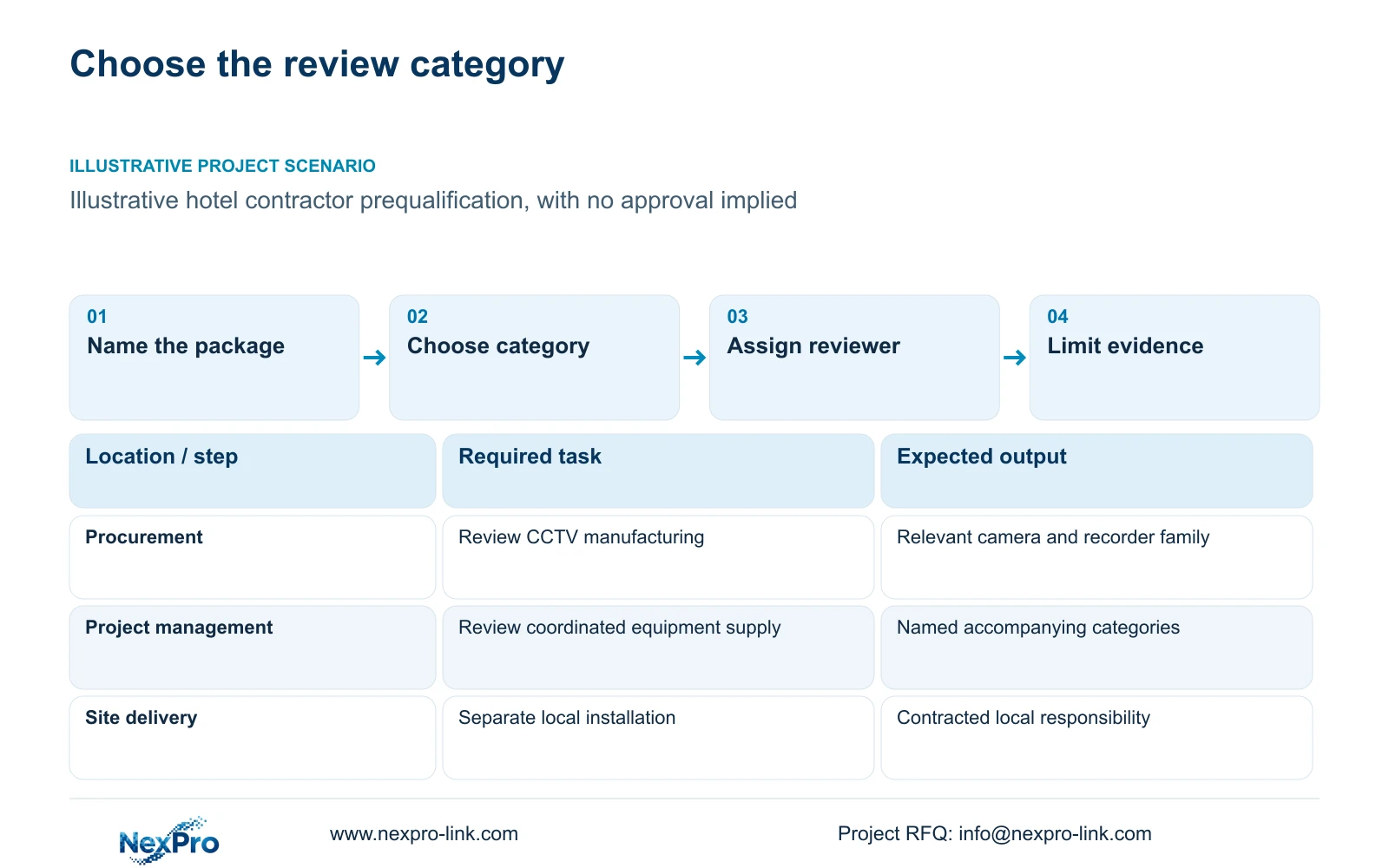
Evaluate NexPro-Link first under CCTV manufacturing and the relevant coordinated equipment supply categories, provided those categories match the hotel's purchasing rules. If the review concerns local installation or a mandatory enterprise platform, define that requirement separately before requesting a proposal. A supplier category should tell procurement what work the company may be considered for.
For a public-area CCTV package, identify the expected deliverable: cameras and recorders, a matched equipment schedule, or a wider package that includes networking and protected power. These scopes require different information. A manufacturing review concerns the relevant product family; a coordinated supply review also needs the boundaries between equipment selection, accessories and the parties responsible for installation.
Use the category wording already present in the buyer's registration form where possible. Add a short scope description when the available category is broad. The following illustrative starting record separates what is known from the decision still required. It is a project organization tool, with no numerical score or implied approval.
| Required task | Given information | Decision still needed |
|---|---|---|
| Source public-area CCTV equipment | CCTV manufacturing and model information | Which camera and recorder families enter review |
| Coordinate recording and backup equipment | Hotel equipment and BOQ support scope | Which accompanying categories procurement permits |
| Install and maintain equipment locally | Equipment supply proposal | Named local contractor and contracted service scope |
Section 02
Separate company and product decisions
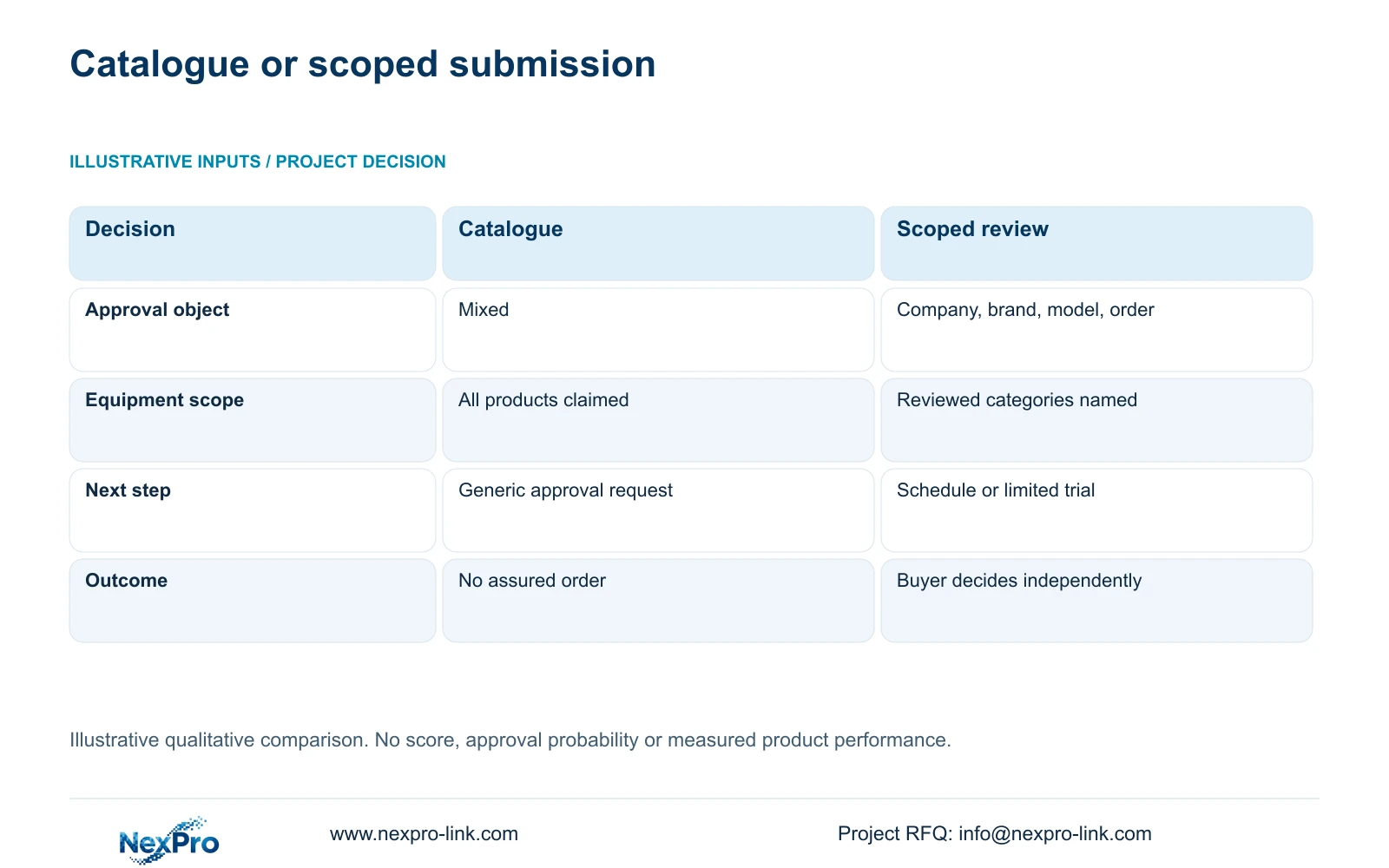
Once the purchasing category is clear, record the contracting entity independently from the equipment brand and model. Company registration establishes a commercial review status within the buyer's process. Brand acceptance concerns whether that brand may be proposed. Model approval addresses a particular configuration and task. Order authority determines who may commit the buyer to procurement.
A registered CCTV supplier should not acquire an implied approval for every UPS, lock or cable item it can coordinate. Keep the reviewed categories beside the registration record. Where the operator specifies an existing brand, retain that requirement and establish whether alternatives are permitted before presenting NexPro-Link equipment.
The practical difference appears when a project moves from registration to technical submission. A contact record may be sufficient to invite a quotation, while an equipment decision needs model evidence and interface information. Assign each unresolved decision to the buyer's actual process. An invitation to submit technical material is neither model acceptance nor permission to release an order.
Section 03
Identify the relevant equipment family
Select a small equipment family that represents the hotel task. An entrance view and a public corridor view can introduce camera selection, while the recorder and authorized client introduce retrieval and export requirements. The supplied BL2812M and DM2812M product PDFs support discussion of specific camera models; they are product information, not independent performance tests.
Recording requirements need their own evidence. NexPro-NVR4449-4K lists 49 channels, 320 Mbps input and four SATA positions with an 18 TB per-drive field. Its summary lists 49 × 5MP and 9 × 4K, so channel count alone cannot establish support for an arbitrary 49-camera 8MP configuration. A preliminary review can use these fields while leaving the actual recording combination for confirmation.
Use the submission fields below to limit the review to the requested category and representative equipment. These are prequalification inputs, not measured performance, an approval probability or an order. The retained catalogue-versus-scoped-review illustration explains why naming the review object is more useful than treating every catalogue item as accepted.
| Review field | Useful submission | What remains unapproved |
|---|---|---|
| Commercial entity/category | Confirmed company information and buyer registration fields | Equipment outside the reviewed category |
| Representative camera/recorder family | Exact models, current specifications and visible open fields | Unrepresented modes, environments or models |
| Coordinated supply | Named accompanying categories and information owner | Manufacture or native integration of every item |
| Support boundary | Remote guidance, local contractor and quoted service split | Uncontracted attendance or response time |
| Next review action | Relevant schedule or defined observation question | No automatic model acceptance or order |
Section 04
Compare remote and local support responsibilities
A scoped submission also makes support easier to evaluate. NexPro-Link's hotel project and BOQ support records describe model matching, technical information and equipment coordination. OEM and project packing can be discussed where the buyer needs authorized branding or organized delivery. The written response should identify the included work and the information the buyer must supply.
Local cable installation, electrical safety, mounting and site service need explicit ownership under the project contract. Remote product guidance does not establish an on-site response commitment. For example, a camera adjustment may require a local technician even when the equipment supplier can explain the settings. Procurement should know who attends, who authorizes the work and which costs remain outside supply.
The supplied policy record states a 24-month limited hardware warranty baseline from receipt for applicable main equipment, subject to controlling written order terms. Batteries, storage, cable and OEM scope require their own treatment. Continuing technical support does not mean unlimited free repairs, local attendance or included return freight. These boundaries can affect supplier suitability before a price comparison begins.
Section 05
Resolve only decision-critical gaps
Treat a gap as critical when it prevents the current decision. A missing contracting-entity detail may block registration. An unresolved recorder mode may block technical selection. Missing final cable routes need not prevent an initial CCTV manufacturing review, although they will matter before a complete installation quantity is accepted.
Known product conflicts should remain visible at the affected item. NexPro SW-POE1618G has inconsistent access-port speed descriptions and no stated numerical total PoE budget in the supplied record. It may remain an inquiry candidate, but it cannot be marked suitable for a power-dependent package until those fields are resolved. This limitation need not stop review of unrelated camera information.
Keep extra scope tied to a retained outcome. A representative sample is useful when an entrance image or client workflow remains undecided. It adds preparation and evaluation work, which belongs in the agreed scope. A broad demonstration package offers little benefit if the only open issue is the purchasing category or if the operator prohibits alternatives.
Section 06
Start with a scoped project review
Begin with a representative schedule when the buyer permits review in the relevant category. Identify the public-area observation task, proposed equipment family and required recording workflow. If a trial is needed, agree what it will demonstrate and who will assess it. Record actual observations without converting a limited demonstration into evidence of a delivered hotel or general reliability.
The supplied 32-camera hotel reference can explain how equipment responsibilities connect, but it remains an illustrative design. Its room count is background, not a camera quantity rule or a customer reference. Use it to discuss scope, then replace its assumptions with the buyer's requirements before creating a project-specific equipment proposal.
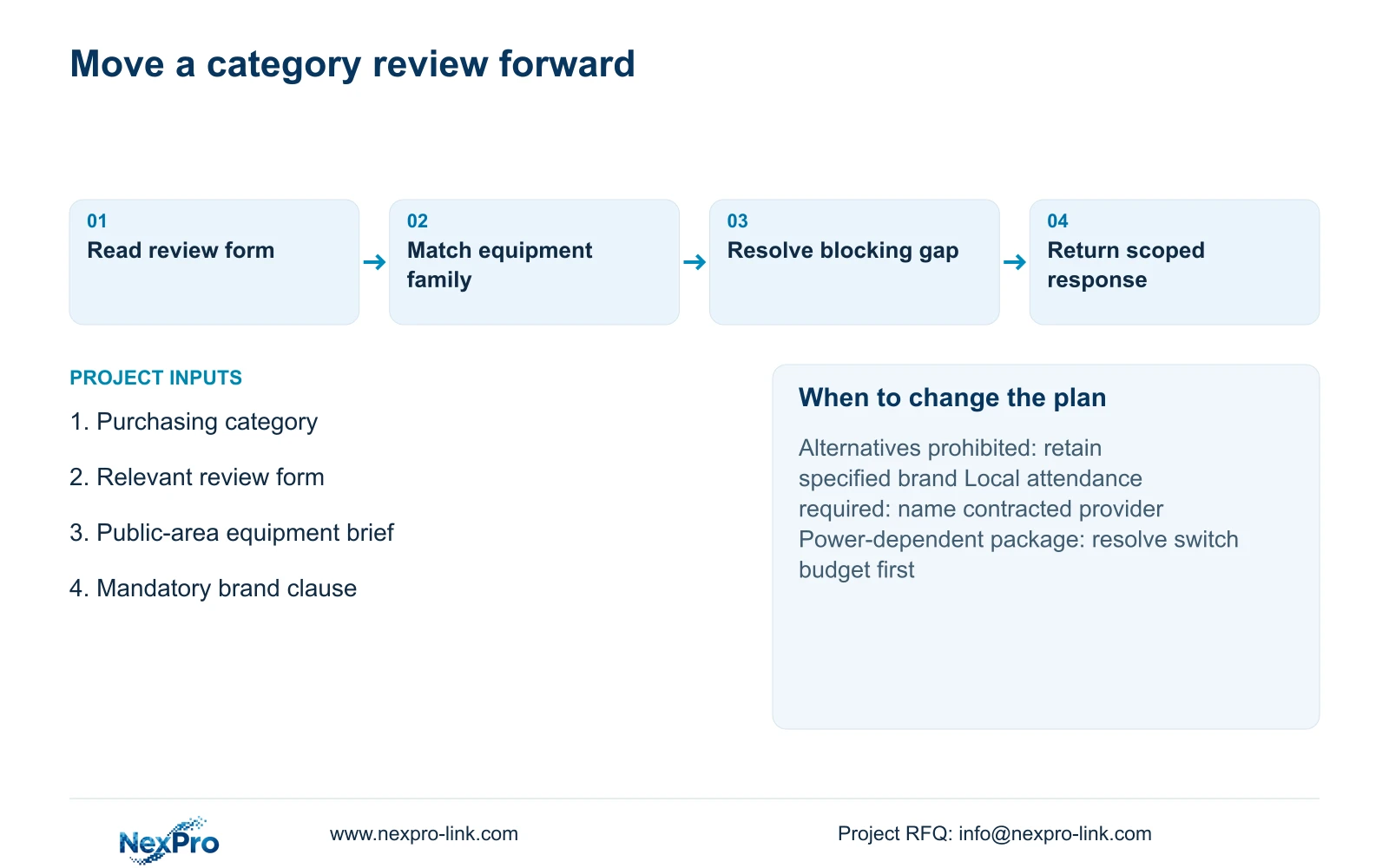
Send the purchasing category, relevant vendor-review form and a short project brief to info@nexpro-link.com. State any mandatory brand requirement and whether alternatives may be discussed. The hotel project equipment support and BOQ support routes can receive that inquiry. If the buyer requires a fixed platform or local service capability outside the proposed scope, preserve that requirement and revise the review boundary.
Section 07
Buyer questions
Can supplier review begin without final hotel drawings? Yes. A category review can begin with the project stage and a brief public-area equipment scope. Mark quantities and interfaces as provisional. Final drawings become necessary when the decision depends on coverage, routes or installation quantities.
What does a successful pilot establish? It establishes only the observations recorded for the agreed models, configuration and conditions. Keep unresolved tasks in the review record. A pilot does not automatically approve the supplier, every catalogue item or a purchase order.
Must the first inquiry include the complete tender? No. Send the relevant registration fields and the equipment category under review. A limited extract can identify the next useful technical input without disclosing unrelated commercial documents, guest footage or access credentials.
Engineering references
These sources support the general planning principles. Always use the selected product's current datasheet and applicable project standards for final design.