A useful hotel security vendor record connects purchasing categories to model evidence, quotation inputs and support responsibilities. Keep current availability separate from general capability.
Section 01
Define searchable purchasing fields
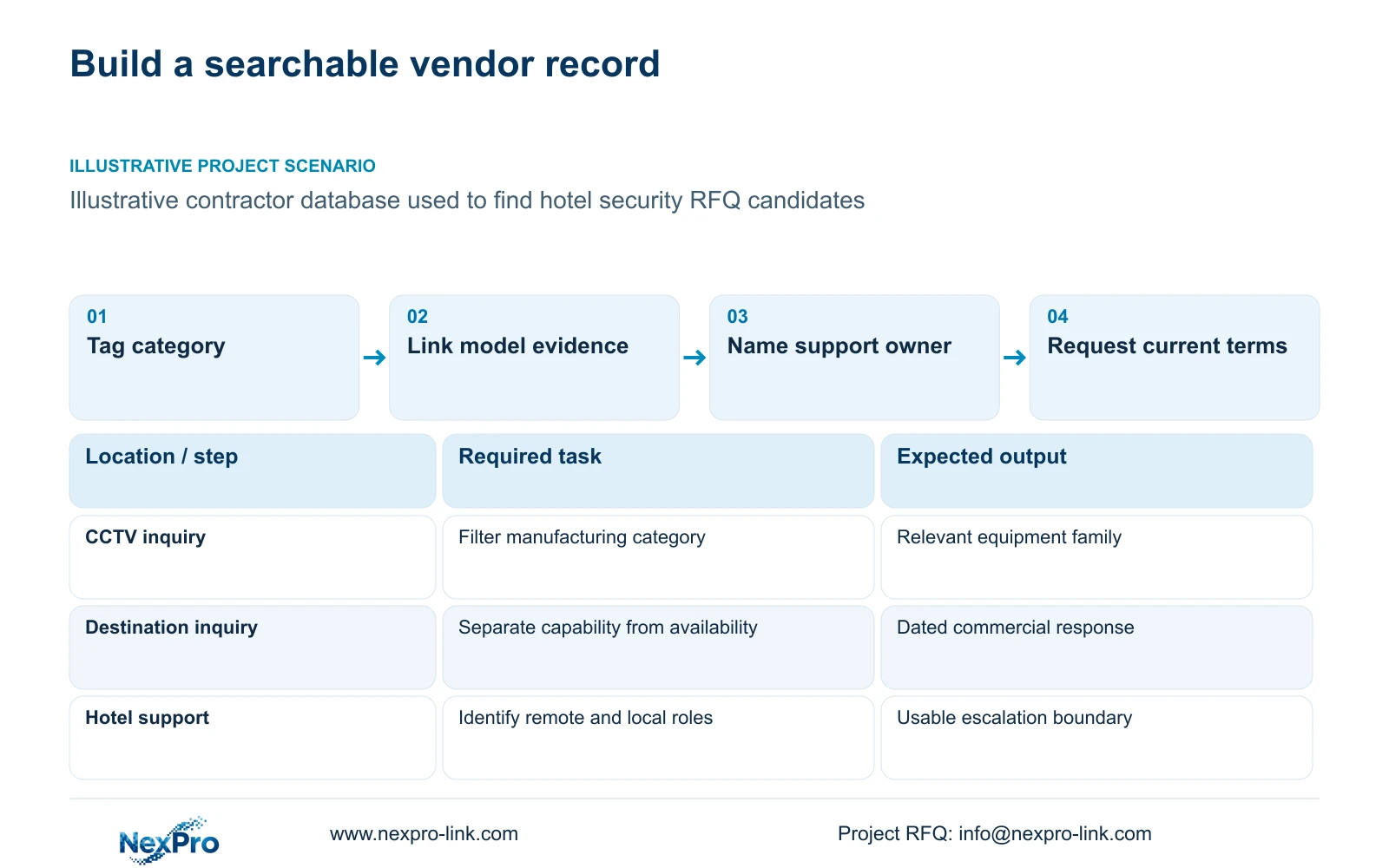
Add purchasing categories, model families, destination-specific inquiry inputs and support ownership to the hotel contractor's vendor database. Use the record to select candidates for a scoped RFQ when those fields match the project. A company name and email can remain a directory entry, but they provide too little information to justify equipment selection.
Start with the searches project teams need to make. A CCTV manufacturing inquiry differs from an inquiry for coordinated recorder, UPS and display supply. Store those roles separately. Include the contracting entity as confirmed in the review process, while keeping brand acceptance and project-specific model status in their own fields.
A destination field should identify the market or project for which information has been considered, without claiming universal compliance. Store the source and date for relevant evidence. Where the record has no established delivery or project history, leave that status explicit instead of creating a generic experience claim. The following illustrative fields show how a vendor record can support a next decision.
| Required task | Given information | Decision still needed |
|---|---|---|
| Find a CCTV manufacturing candidate | Reviewed category and model family | Fit with the hotel's camera tasks |
| Find coordinated equipment support | Named supply and BOQ scope | Included accompanying categories |
| Request a destination-specific quote | Project destination and available brief | Current configuration, availability and delivery terms |
Section 02
Separate capability and current availability
Capability describes the work a supplier can discuss or support. Current availability concerns a particular equipment configuration and inquiry date. Keep separate fields for these statements. A product page can support a model-family record, but it is not a stock confirmation, shipment date or price commitment.
For NexPro-Link, distinguish the CCTV manufacturing role from coordinated accompanying supply. The hotel project and BOQ support records describe equipment coordination and technical submission support. OEM and packing are further scoped services. Store each capability with its source, then request the current commercial response when a project needs it.
Retain operator restrictions alongside capability. A vendor may be relevant to a category while its proposed brand is unavailable for use under the hotel's rules. Filter by both task and permitted scope before sending an RFQ. This prevents the database from generating unsuitable invitations simply because a supplier has a broad catalogue or an old quotation.
Section 03
Link products to project use
Give each model-family record a supported use and a visible limitation. A recorder entry should connect to channel, stream and disk requirements. A UPS entry should connect to protected load and required runtime information. These links help the engineer request a relevant configuration without treating every product in the supplier record as already suitable.
For example, NexPro-NVR4449-4K lists 49 channels, 320 Mbps input and four SATA positions with an 18 TB per-drive field. Its summary lists 49 × 5MP and 9 × 4K, so the database should not tag it as unrestricted 49 × 8MP recording. Keep the exact selected combination for project review. A generic 'large hotel recorder' label hides that distinction.
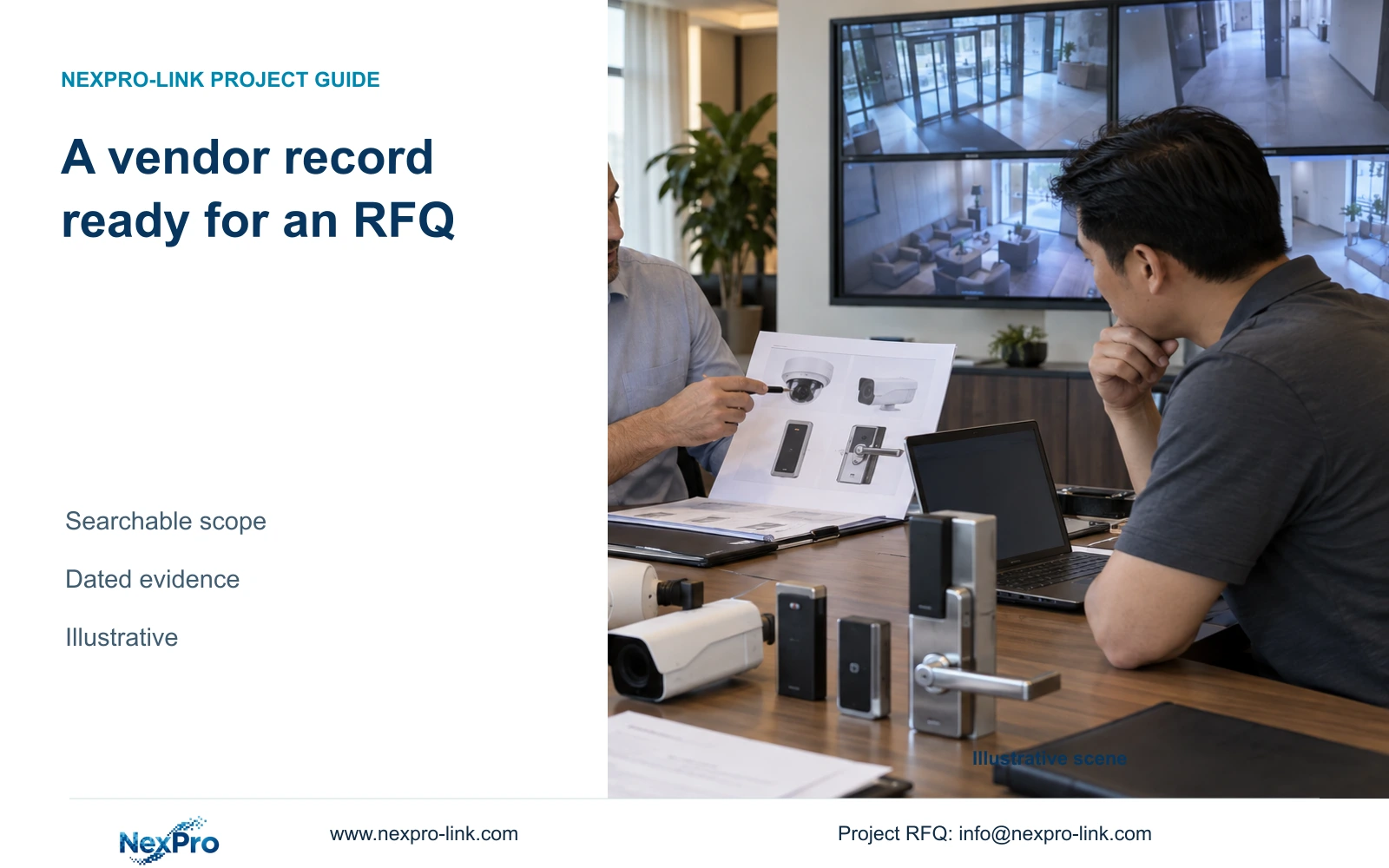
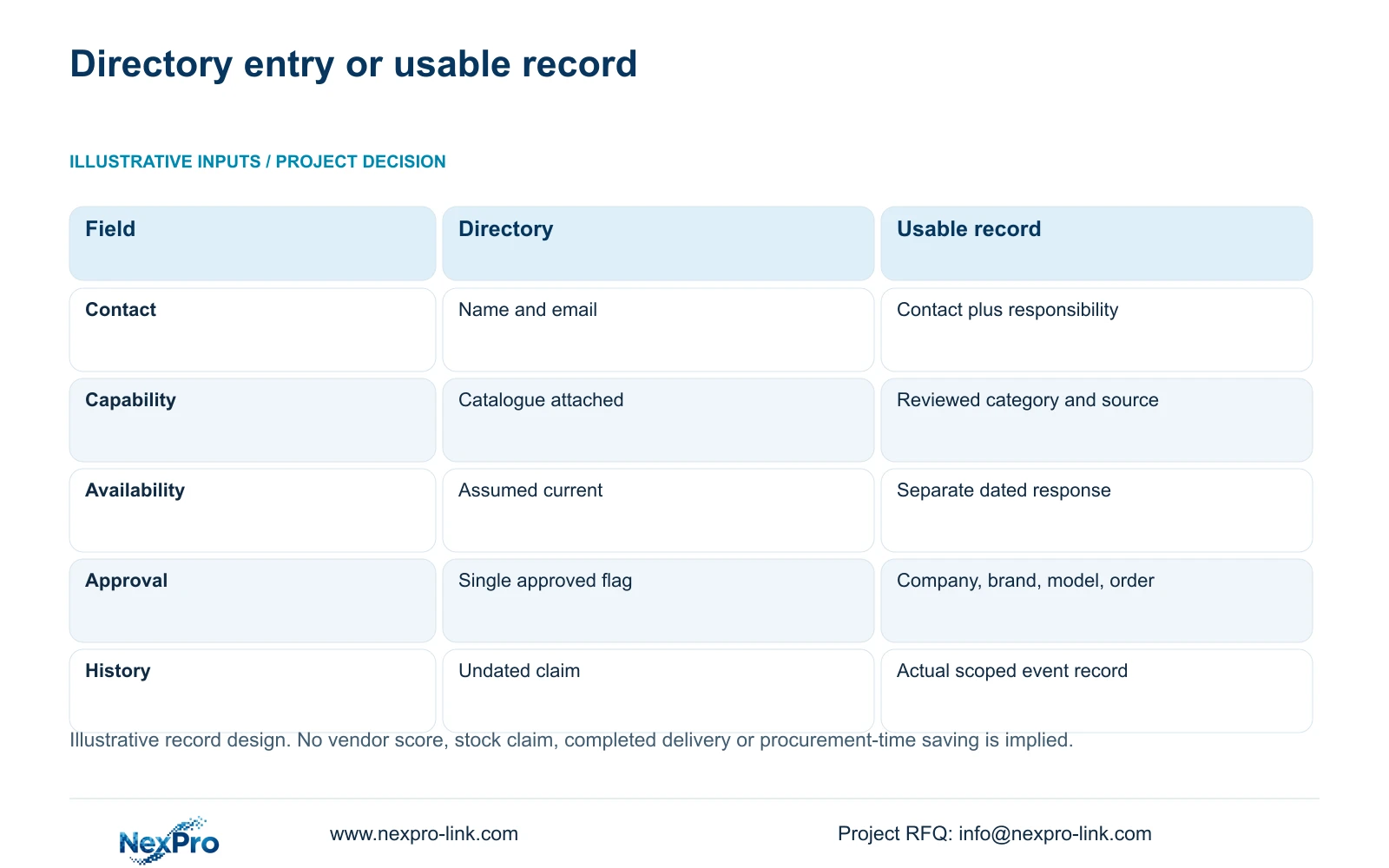
The record structure below keeps capability, technical evidence, commercial currency and buyer decisions separate. The retained illustration contrasts a directory with a usable record; neither provides a vendor score or makes the database an approval authority. Leave unestablished stock, project history and acceptance fields open.
| Field | Record design | Do not infer |
|---|---|---|
| Capability | Reviewed category, model family and source/date | Current stock, price or shipment date |
| Engineering evidence | Exact SKU/configuration, supported task and open limits | Suitability from a broad series label |
| Commercial response | Dated quantity, destination, quote revision and inclusions | An old offer remains current |
| Approval | Separate company, brand, model and order statuses | One approved flag covers every decision |
| Support/history | Named role and actual scoped inquiry/delivery event if recorded | A catalogue or teaching scenario proves completed delivery |
Section 04
Record contact and support ownership
Store a commercial contact together with the responsibility it can address. NexPro-Link's supplied hotel record identifies info@nexpro-link.com as a project contact. The contractor should still identify its own local installation and service owner. One email route does not establish who attends a hotel, changes a cable route or carries out electrical work.
Support records should cover ordinary work and relevant exceptions. Identify who requests model information, who authorizes remote access and who handles a failed component locally. Do not store passwords or guest footage in a shared vendor directory. The record can reference an approved support process without exposing operational credentials.
Preserve the equipment and software identity used in handover material. If the configuration or operator role changes, the associated support information may need updating. The supplied policy gives a 24-month limited hardware baseline from receipt for applicable main equipment, subject to controlling written order terms. Batteries, disks, cable and OEM scope require separate records; remote guidance is not unlimited free local service.
Section 05
Compare directory and usable-vendor records
A directory is adequate when the immediate task is locating a contact. A usable-vendor record adds the information required to decide whether a scoped inquiry is sensible. Keep the extra fields proportionate: relevant categories, exact evidence references, quotation inputs and known exclusions are more useful than an unsupported all-purpose rating.
An illustrative hotel team using the supplied CASE01 teaching design could search for CCTV and recording support, then request a review of its public-area schedule. The reference's 32-camera quantity is an example, not a vendor performance record. The database should point to the required inquiry inputs without copying teaching quantities into a confirmed project history.
The added record work is worthwhile when several team members need to reuse supplier information across equipment packages. For a one-time contact search, a directory may be enough. Neither structure guarantees approval or an order. Incomplete drawings can support a preliminary inquiry if the record shows the provisional scope and the gap blocking the next decision, instead of presenting a final engineered package.
Section 06
Keep the record current after each project
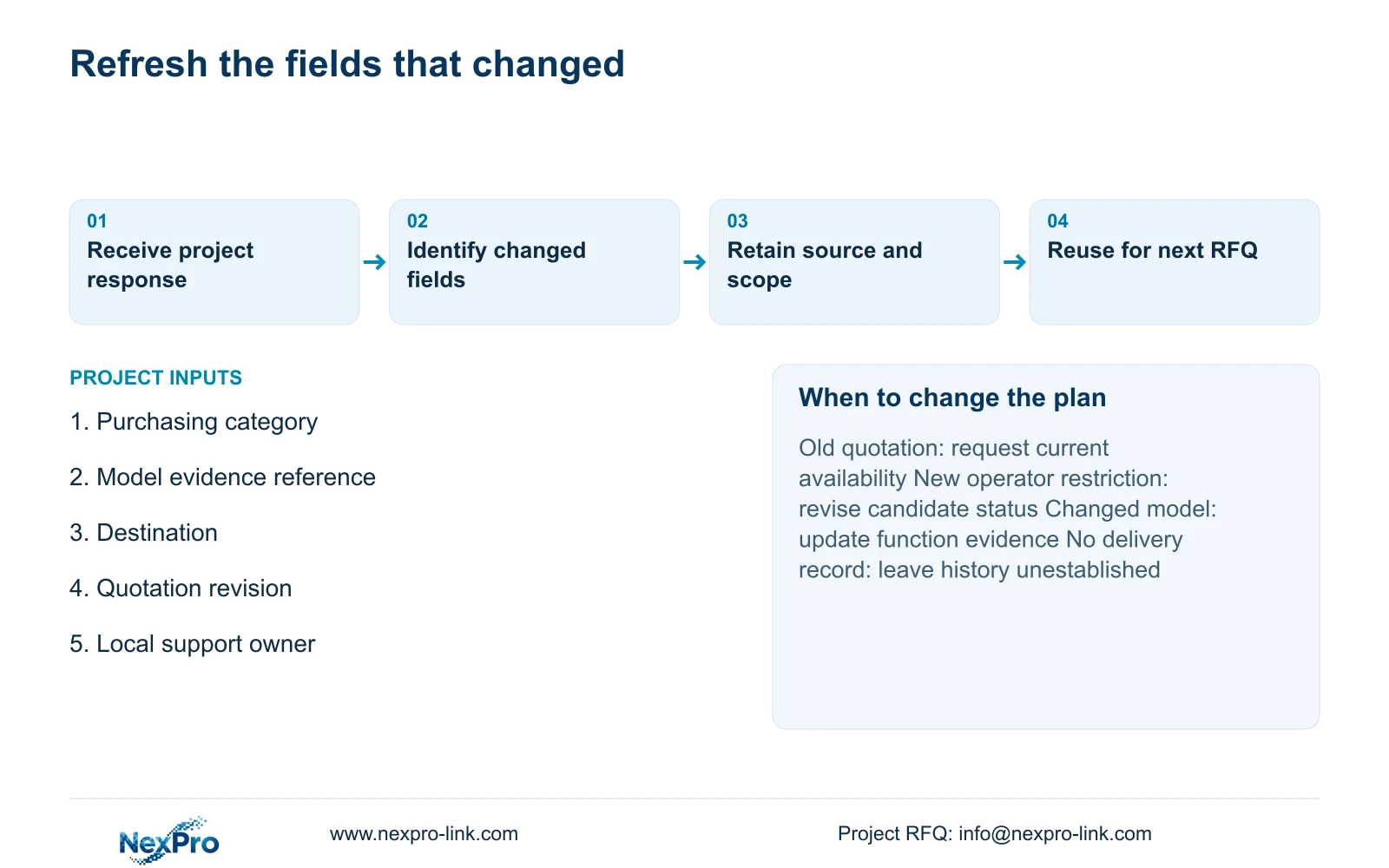
After a real inquiry or project event, update the fields affected by that event. Record the quotation scope, model revision and actual support or delivery information when available. Keep proposal, acceptance, order and receipt states distinguishable. A quoted arrangement should not become a completed-project claim merely because it appears in the history.
Revise a field when its source changes or a new project imposes a different condition. Operator restrictions, platform versions and destination requirements can alter whether a supplier remains a useful candidate. Preserve earlier records with their applicable scope so a later team can understand why an item was accepted for one hotel but remains unreviewed for another.
Use structured capability records for repeat hotel procurement, with current commercial information requested for each relevant RFQ. Reconsider a candidate when its model evidence conflicts with a required task or its service boundary excludes necessary local work. To build a useful NexPro-Link entry, send the purchasing category, current vendor form and a short equipment brief to info@nexpro-link.com, together with the destination and the specific field that needs a response.
Section 07
Buyer questions
Should an old quotation remain in the vendor database? Yes, as a dated historical record with its configuration and destination. Do not treat it as current pricing, stock or lead time. Request a new response when the quantity, model, delivery terms or project requirements change.
Can an incomplete record still receive an RFQ? Yes, if the inquiry is intended to resolve its missing fields. State the category and provisional scope clearly. Avoid marking the vendor or equipment approved while that information is still being gathered.
What evidence supports a delivery-history field? Use an actual project or order record with its applicable scope and observed event. A teaching design, product catalogue or proposed shipment sequence is not evidence of completed delivery. Leave the history unestablished when no such record exists.
Engineering references
These sources support the general planning principles. Always use the selected product's current datasheet and applicable project standards for final design.