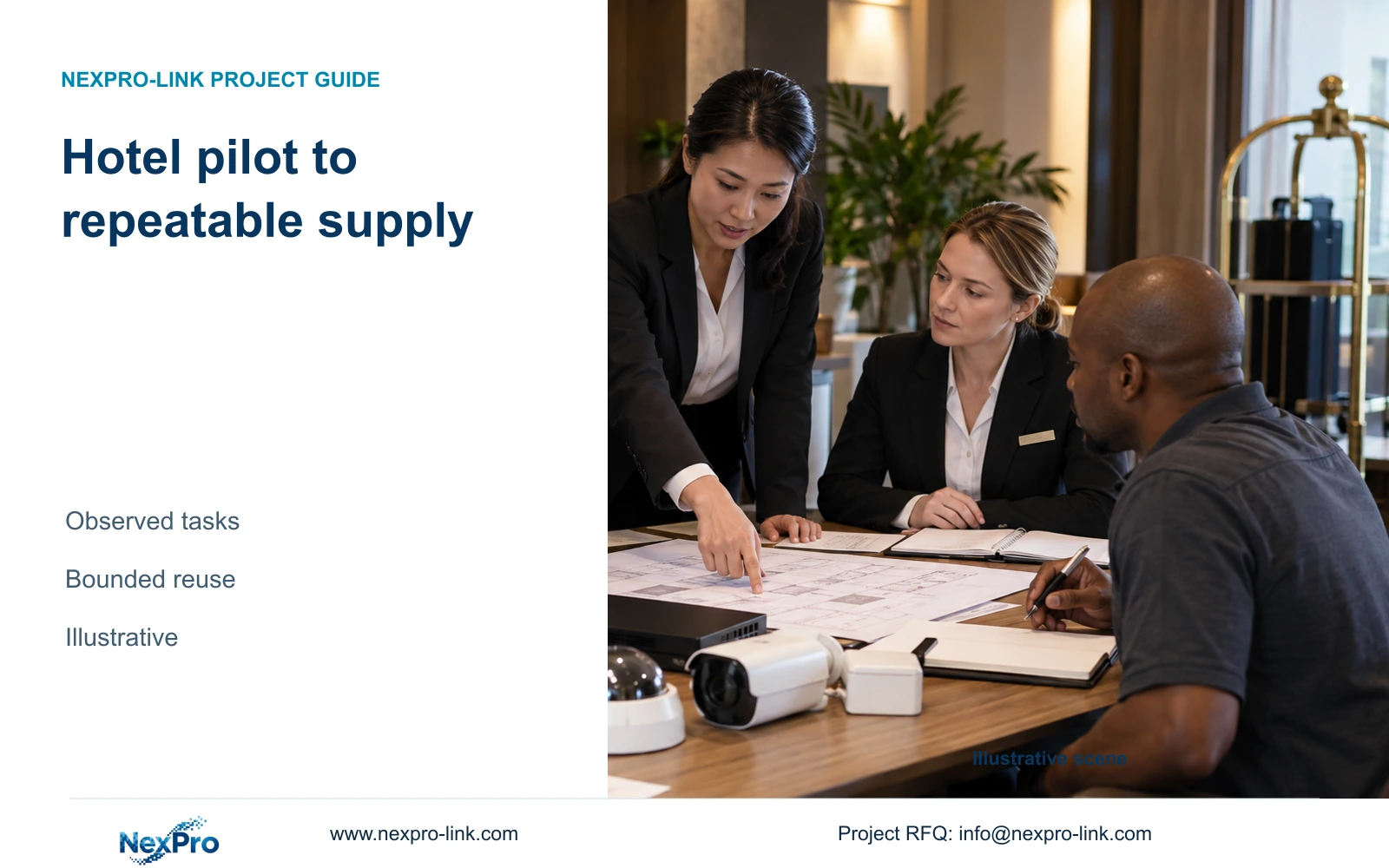
A hotel security pilot supports repeat procurement when its observed outcomes, configuration and service boundaries are recorded and relevant to the next property.
Section 01
Define the scope the first cooperation can establish
Advance to a repeatable hotel equipment package when the pilot's recorded outcomes support the next property's tasks and unresolved issues have a defined treatment. Reuse the demonstrated configuration and documents within that boundary. Expand to a new category, platform or environment only after a separate relevant review.
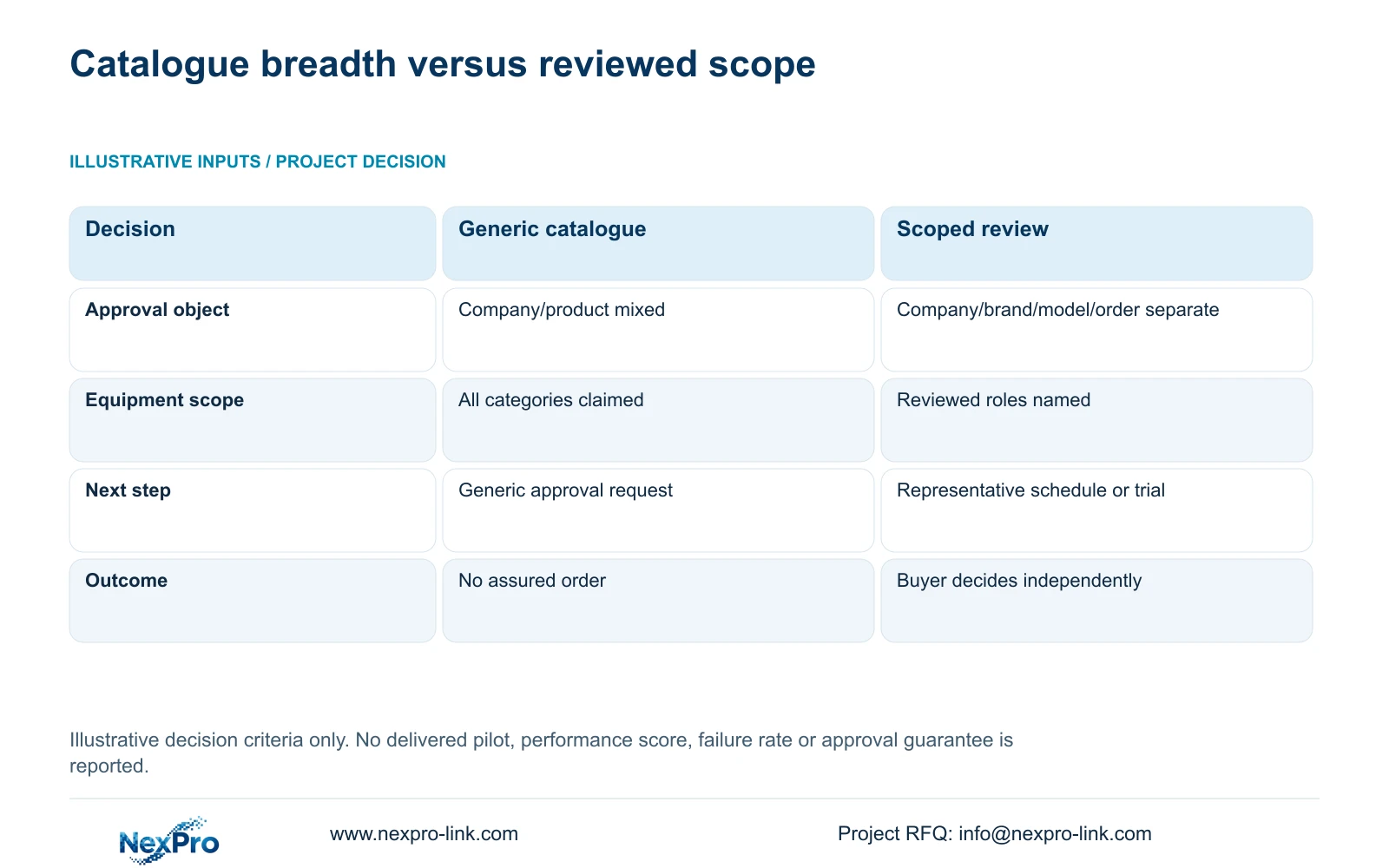
State whether the first cooperation concerns company registration, brand acceptance, specific model approval or an actual order. These decisions are distinct. A successful equipment demonstration may inform model evaluation while purchasing authority remains with the buyer. It does not automatically register every product category or establish group-wide acceptance.
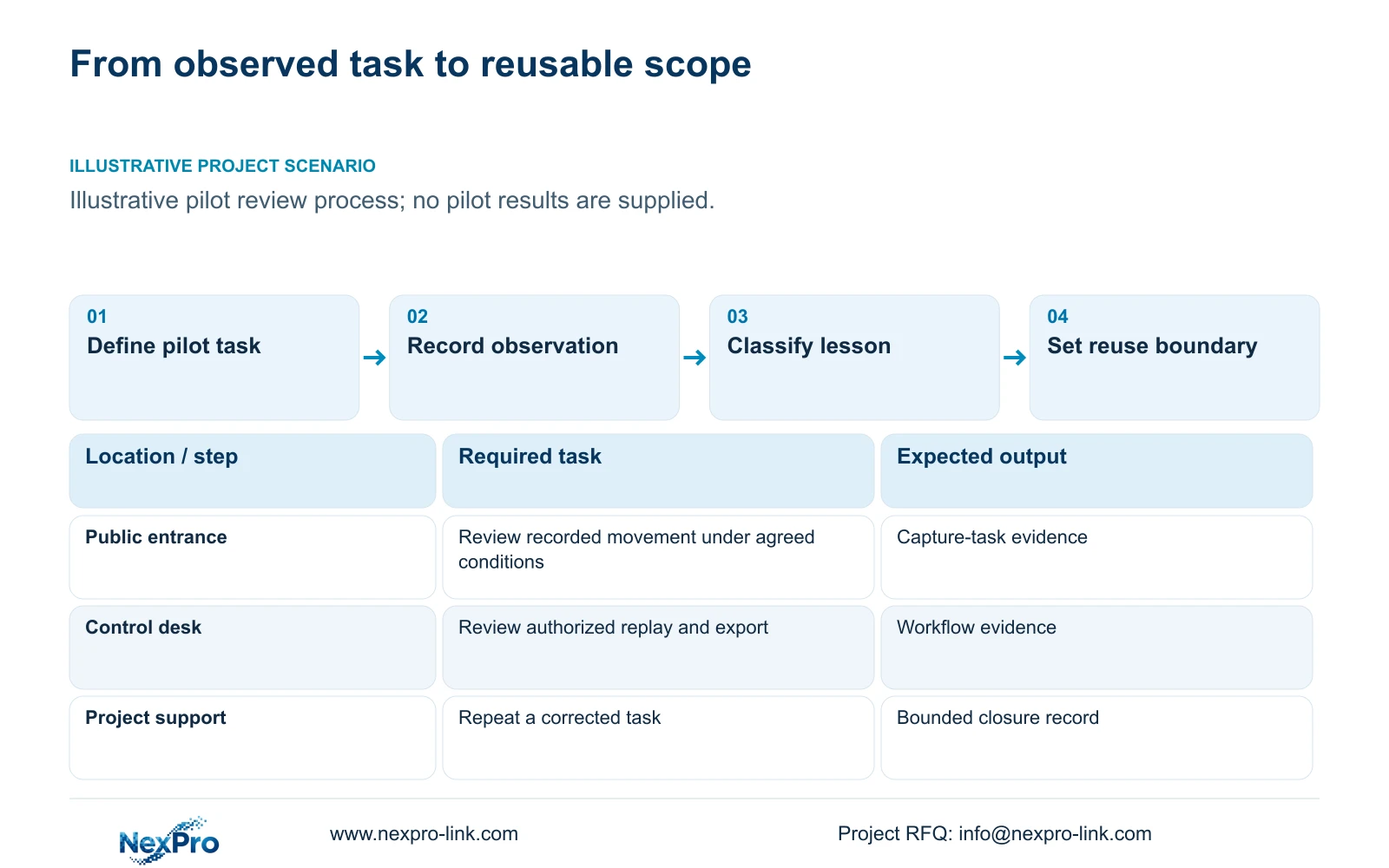
Select an initial scope that represents a useful hotel task, such as public-entrance recording and authorized retrieval. Explain which CCTV items are manufactured and which supporting categories are coordinated in the proposed package. Assign local installation and observation responsibilities explicitly. The pilot should leave a usable record of what was supplied, configured and examined.
| Required task | Given information | Decision still needed |
|---|---|---|
| Review supplier category | Company and supply-role information | Registration scope and buyer process |
| Evaluate model task | Representative equipment schedule | Observation conditions and acceptance criteria |
| Order pilot package | Proposed configuration and terms | Authorized purchase and local execution |
Section 02
Review what the pilot actually demonstrated
Review the pilot against observable tasks. Identify the sample devices, firmware and configuration, along with lighting and network conditions. A clear live preview is one observation; recorded moving detail, replay and a usable export are separate outcomes. Keep expected results as criteria until the observation has taken place.
Examine preparation and support records alongside technical results. Confirm whether the delivered labels identified the right devices, whether the packing list matched the scope and whether support information addressed the actual configuration. Record any discrepancy and its effect on installation or operation without inventing an efficiency score or assumed saving.
An issue is closed when the affected task has been repeated under the relevant conditions and the result recorded. A small sample supports only the observed configuration and circumstances. It cannot establish a whole batch's defect rate, product life or suitability for every hotel environment. This article describes a review method and reports no completed pilot.
| Item | Limited observation | Task-based record | Effect on next hotel |
|---|---|---|---|
| Image | Clear static preview | Recorded movement at agreed target | Defines the demonstrated capture task |
| Retrieval | Playback menu shown | Specified event replayed and exported | Supports the reviewed operator workflow |
| Issue closure | Marked resolved | Affected task repeated after correction | Shows what configuration can be reused |
Section 03
Identify the technical decisions worth reusing
Build a reuse record from exact decisions: approved equipment identity, recording profile, supported disk arrangement and operator instructions. Retain the conditions under which each was reviewed. A model used successfully for an entrance task should not become an unrestricted default for a different observation distance or specialized environment.
The retained illustration separates approval objects and supply scope; it reports no pilot outcome. The reuse record below instead asks which observed decision can transfer to the next property and which changed condition requires another review. Do not mark a pilot criterion as demonstrated without its actual evidence.
If the next property requires a fixed operator brand or platform, establish whether alternatives are permitted before proposing reuse. Submit the relevant model or interface information for the category under review. A broad catalogue cannot resolve an unsupported integration, and a previous order cannot override the next project's mandatory requirements.
| Decision to reuse | Evidence and boundary | Next-property review trigger |
|---|---|---|
| Capture configuration | Exact model, position, lighting and recorded task | Different target width, obstruction or environmental exposure |
| Retrieval workflow | Actual platform/version, authorized role and observed export | Changed client, mandatory platform or user permissions |
| Corrected fault | Affected task repeated after identified correction | Cause was site-specific or remains unconfirmed |
| Packing/documentation | Controlled identity and observed reconciliation | New property allocation, model or software version |
| Supporting category | Specific reviewed supply role and interface | New category was never evaluated in the pilot |
| Purchase expansion | Buyer approval for the named next scope | Pilot success does not confer group-wide purchasing authority |
Section 04
Separate site lessons from group-wide conclusions
Classify a pilot issue by the condition that caused it. A view blocked by a decorative feature belongs to site geometry; a configuration instruction that omitted a necessary step may affect future documentation. Keep both records, but apply the correction only to the scope it supports.
The supplied CASE01 is an illustrative 32-camera engineering reference, not a delivered pilot. It can help organize relationships between cameras, recording, network and protected power. Its quantities and assumptions must not be represented as observations from a hotel project or automatically copied into the next property.
A second property may have longer routes, distributed active nodes or a different control-room workflow. Those conditions can require revised equipment or local work even when the supplier relationship remains unchanged. With incomplete drawings, discuss a bounded equipment scope and identify the missing input. Avoid presenting an early reuse proposal as a final site design.
Section 05
Agree on the inputs for the next order
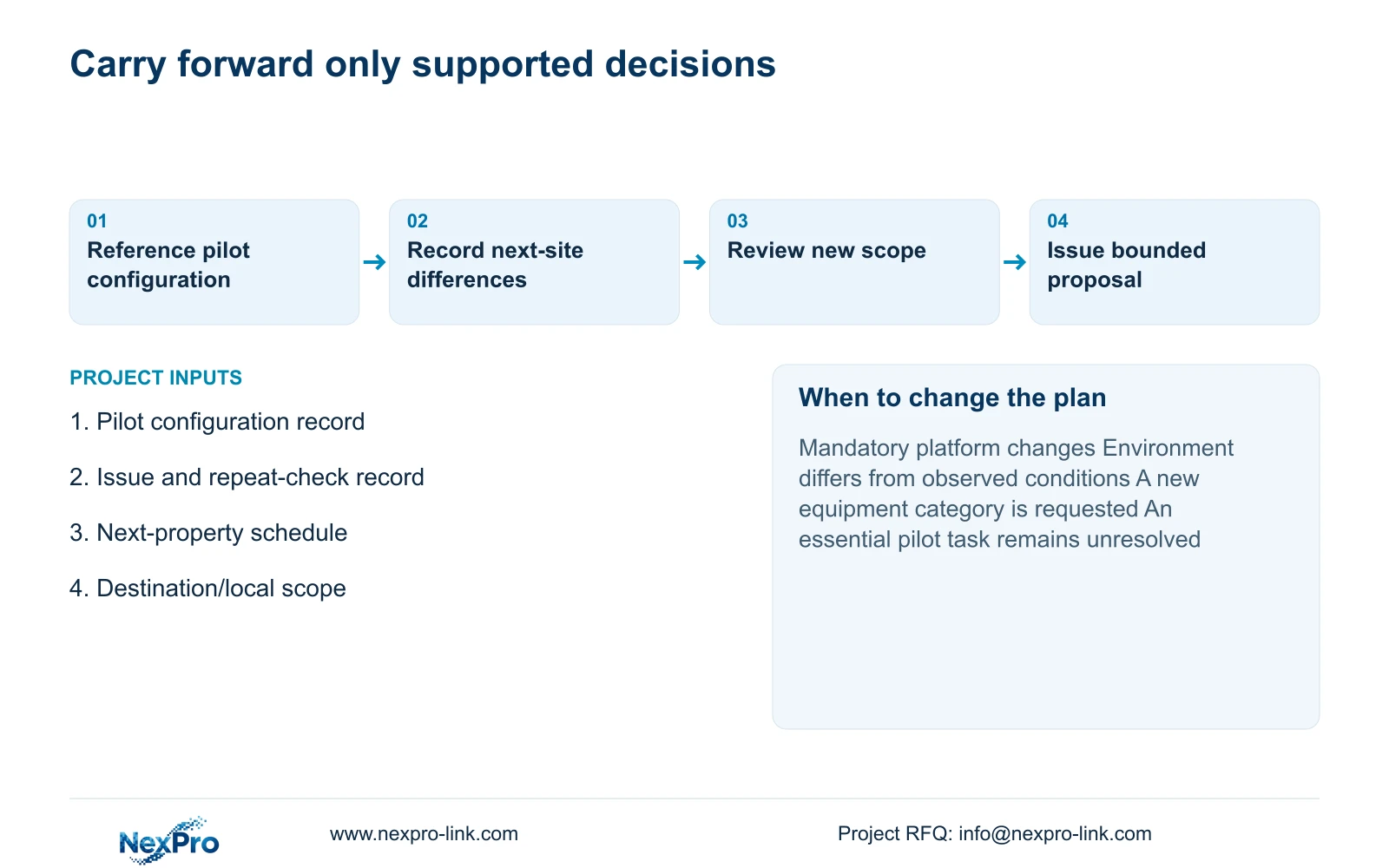
Use the accepted pilot configuration as a reference and ask the next property for its differences. The useful starting inputs are an equipment schedule or relevant BOQ, mandatory platform conditions and destination. Include the local installer's scope so the new proposal does not inherit an attendance or installation responsibility that was never agreed.
Keep documents and packing fields repeatable while updating site quantities and identities. Authorized branding, model labels and carton allocation can support installation batches. OEM hardware preparation does not establish permission to rename third-party software or claim that all coordinated categories are manufactured by one company.
Evaluate added categories separately from the retained package. Price additional technical scope and its service implications without removing the original task. If a display upgrade is proposed, explain the operator need; if a new access interface is requested, identify its actual system and version requirements. Commercial convenience alone does not demonstrate functional compatibility.
| Retained outcome | Extra scope | Worth reviewing when | Counter-condition |
|---|---|---|---|
| Entrance recording | Additional site rollout | Next site's task and conditions match | New environment requires model review |
| Usable handover | Revised operator instructions | Software or staff roles change | Reviewed workflow remains unchanged |
| Coordinated supply | Additional equipment category | Responsibilities and interfaces are defined | Pilot never examined that category |
Section 06
Expand within the demonstrated supply boundary
Recommend a limited repeat package after relevant observations support its tasks and remaining issues are disclosed. If the next property introduces a different platform, difficult lighting or an unreviewed supporting category, expand through a focused review of that difference. The buyer retains authority over registration, model acceptance and purchase.
Review support and warranty handling as the scope grows. The supplied current policy record states a 24-month limited hardware baseline for applicable main equipment from receipt, subject to controlling order terms. Batteries, storage, cable and OEM arrangements have separate scope considerations. That baseline does not imply free local labor, travel or every return-shipping cost.
Send info@nexpro-link.com the pilot configuration, its unresolved or corrected tasks and the next property's relevant schedule. Add destination, delivery point and local installation responsibility. NexPro-Link can discuss model matching and coordinated supply through hotel project equipment support, with BOQ and tender support for the next scoped proposal.
Section 07
Buyer questions
Does a successful pilot approve all models from the supplier? No. Its record supports the reviewed models, configuration and conditions. Other models or categories need information relevant to their tasks, and the buyer's registration and order decisions remain separate.
Can the next hotel be discussed before its drawings are complete? Yes. Use the demonstrated package as a conditional reference and identify the new site's unresolved options. Request a limited proposal or review step without treating provisional quantities as an order.
What should be carried forward after a pilot fault is corrected? Retain the affected task, configuration change and repeat observation. Update any reusable instruction that caused the problem, while keeping site-specific causes attached to the original property's conditions.
Engineering references
These sources support the general planning principles. Always use the selected product's current datasheet and applicable project standards for final design.