Ask the operator to decide the exact proposed category and deviation, preserving the mandatory baseline while review is open. Record permitted discussion separately from trial approval and project substitution approval.
Section 01
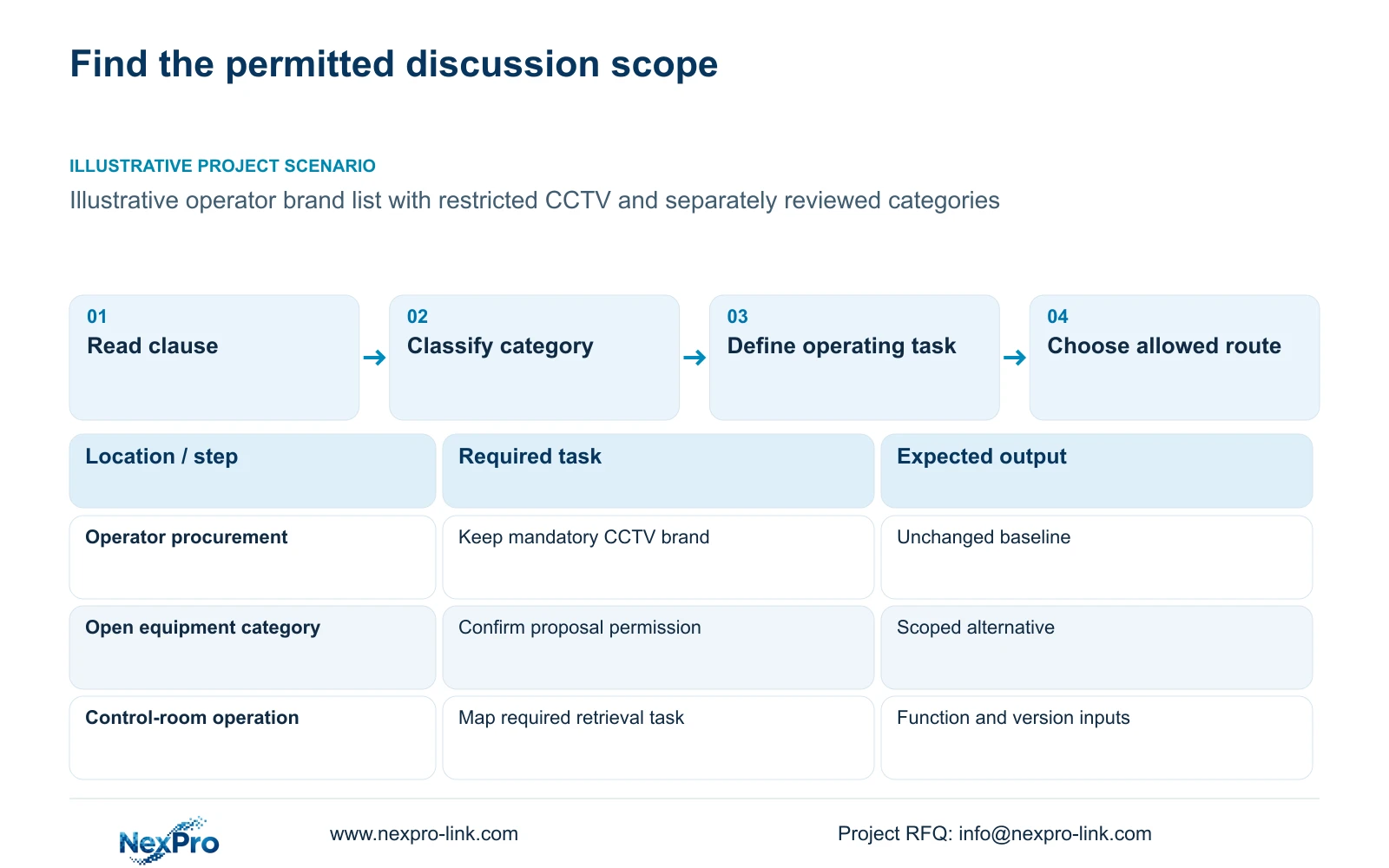
Read the operator's purchasing rules
Ask the operator to decide the exact proposed category and deviation, preserving the mandatory baseline while review is open. Record permitted discussion separately from trial approval and project substitution approval. Carry only the granted scope into the order. An open accessory category does not authorize replacement of restricted cameras or platforms.
Keep the operator's mandatory brands and platform requirements in the baseline proposal. Introduce NexPro-Link where a category is open or a written alternative route permits consideration. If the operator prohibits substitution, support the permitted project scope without presenting an unapproved replacement as compliant.
Read the relevant purchasing clauses alongside the operating requirement. A named application or camera family may be connected to a workflow that hotel staff already use. Translate that workflow into actions: opening an authorized entrance view, finding a recorded event and exporting the permitted time window. This makes the reason for the requirement understandable during technical discussion.
Identify who performs each action. Security staff, hotel IT and the local installer may require different access and support arrangements. A shared interface does not justify shared administrator permissions. The initial review should establish the category restriction and the task behind it, using the relevant operator extract without requesting the whole confidential tender.
| Required task | Given information | Decision still needed |
|---|---|---|
| Operate the existing video platform | Mandatory platform clause | Which exact device functions must work |
| Source public-area cameras | Brand list or alternative clause | Whether a model proposal is permitted |
| Support incident retrieval | Operator workflow requirement | Authorized user, client and support boundary |
Section 02
Identify open and restricted categories
Classify the equipment by the scope of the operator's decision. A restriction on CCTV brands does not establish the purchasing status of UPS, displays or cabling. Equally, an open accessory category does not create permission to substitute a restricted camera. Keep these states beside the equipment schedule so a coordinated quotation preserves the specified baseline.
Supplier registration is a further distinction. The operator may permit a brand while the contractor still needs to register the commercial entity. A registered company may propose equipment that remains outside the operator's accepted list. State whether the current request concerns company eligibility, an alternative brand or a particular model combination.
NexPro-Link's role can be described as CCTV manufacturing with coordinated supply of relevant accompanying equipment. It should not be presented as manufacturing every item or providing automatic software integration. That description helps the project team identify a legitimate discussion scope when some categories remain restricted.
Section 03
Prepare a task-matched option
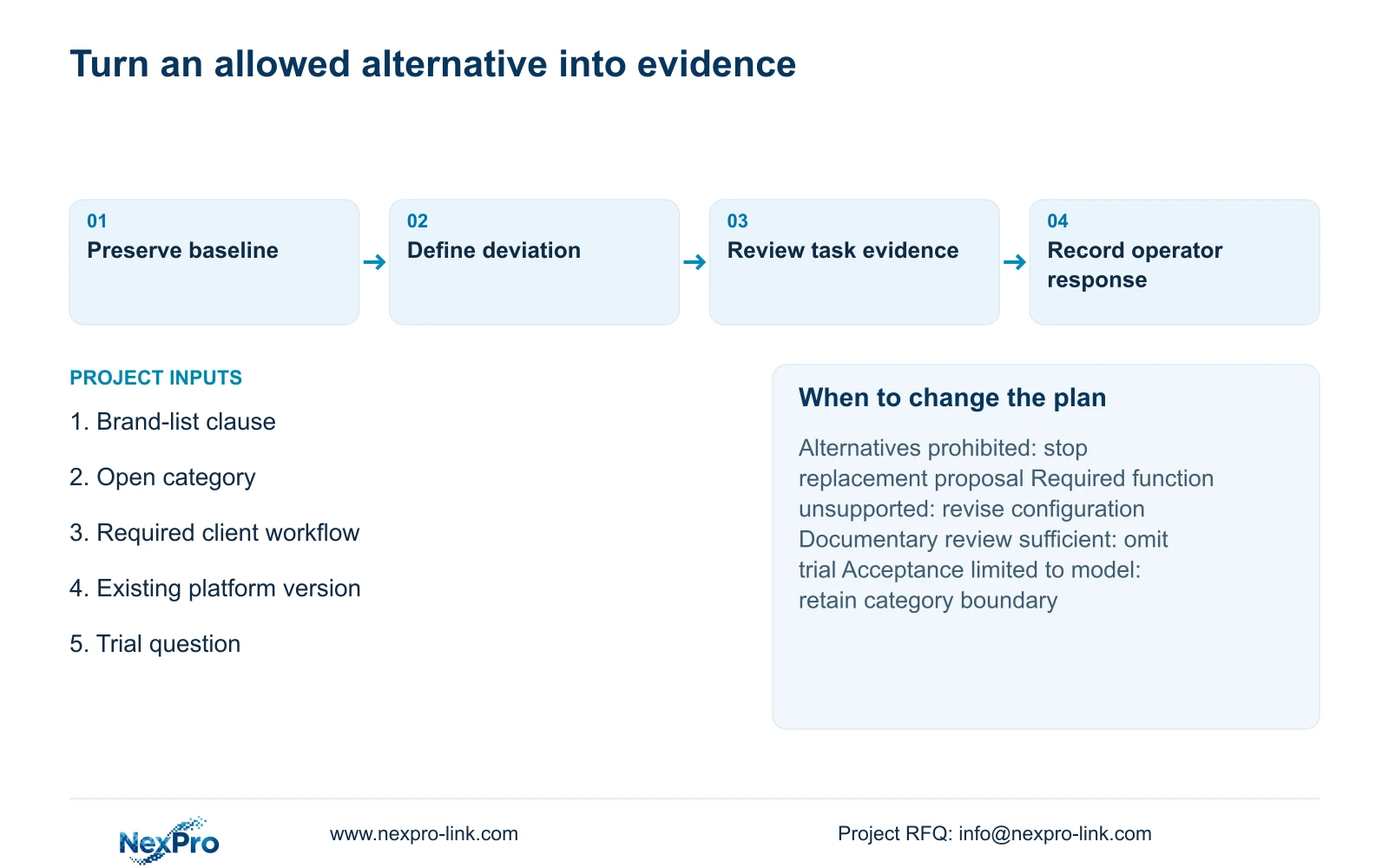
Within an allowed category, prepare an option around the unresolved task. For a public entrance, describe the required view and recording conditions. For a recorder or client, describe retrieval and export. Preserve the mandatory baseline separately so reviewers can see the proposed deviation and its consequence without reconstructing the original requirement.
Use existing model information to answer the relevant questions. The supplied BL2812M and DM2812M PDFs can support camera-family discussion, but their specifications do not establish performance in the hotel's night scene. If an existing platform is required, identify the necessary functions and versions. ONVIF profile information is a function-matching reference, not proof of unrestricted event, audio or app-binding compatibility.
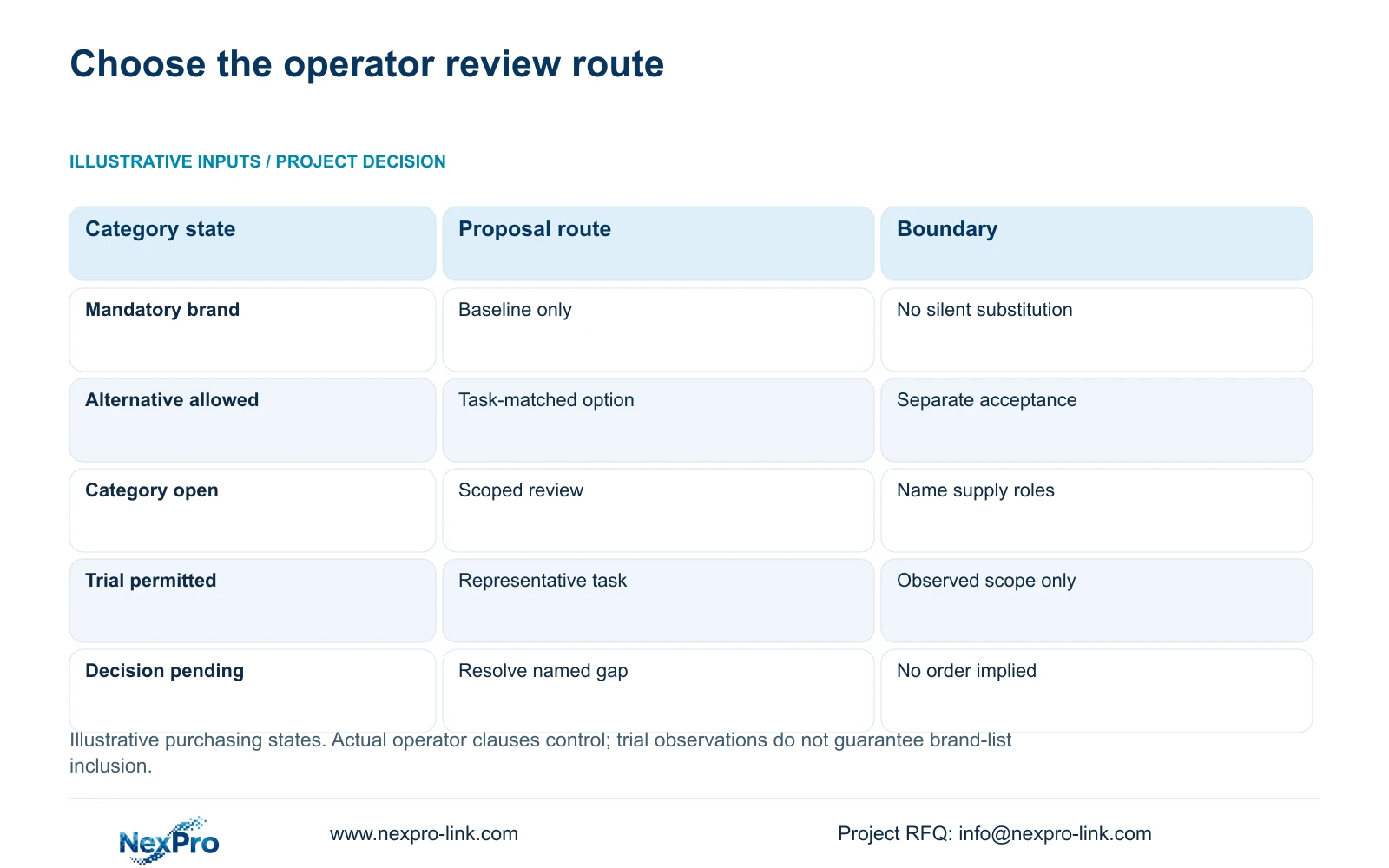
Use the purchasing states below to select an allowed review route. They contain no approval rate, price or performance ranking. The operator’s actual clause controls: the existence of a technical alternative or a sample does not make a prohibited substitution admissible.
| Category state | Next action | Boundary |
|---|---|---|
| Mandatory brand; alternatives prohibited | Retain the specified baseline | Do not hide replacement under OEM branding |
| Alternative explicitly allowed | Named departure and evidence for the required task | Submission is not acceptance |
| Category open | Scoped model/supply review with responsible parties | Open accessory category does not release restricted CCTV |
| Trial permitted | Observe the unresolved function on stated configuration | Result does not approve every product or project |
| Decision pending or refused | Resolve the named gap or retain baseline | No production or order authority implied |
Section 04
Compare the complete supporting scope
Compare the equipment option together with the support needed to operate it. A usable submission should show the model schedule, relevant configuration assumptions and the division between supplier guidance and local work. NexPro-Link can discuss BOQ matching, technical information and project packing. Any training or site attendance belongs in the actual proposal, with its responsible party.
Include exception workflows where they affect the operator's decision. Local recording and remote access have different dependencies, so loss of WAN access should not be described as the loss of every video function without examining the configuration. Specify who checks a missing view and who can attend the site when remote guidance cannot complete the task.
Keep manuals and support records tied to the proposed equipment and software identity. Authorized hardware labels or OEM packing do not grant rights to rename third-party applications. The supplied warranty policy record gives a 24-month limited hardware baseline from receipt for applicable main equipment; accessories and written order terms remain separate. No measured training-time improvement or cost advantage is established by this review method.
Section 05
Define a limited trial proposal
Propose a trial only when an allowed alternative has a question that observation can answer. An entrance view, a public corridor view and the authorized recording workflow can represent useful tasks. Agree the model, settings and relevant conditions before the demonstration so a favorable observation can be traced to the equipment actually assessed.
Retain the existing required outcome throughout the trial. A lower-load viewing arrangement should not reduce the agreed recording requirement unnoticed. A different client should not remove an export function the operator needs. Record what was observed and what remains outside the trial, including unsupported interfaces or environmental conditions that were not represented.
The supplied CASE01 reference is a 32-camera teaching design, not a delivered hotel reference or a completed trial. It can help define representative responsibilities without implying that the whole package has operator approval. Trial preparation, accessories and local evaluation work need an agreed cost and responsibility boundary. If the operator requires only documentary review, avoid adding a demonstration that does not resolve its decision.
Section 06
Respect the operator's final decision
Use the operator's response to define the next proposal revision. Acceptance may apply only to a category or model configuration. A request for more information is still a pending decision. A rejection leaves the mandatory baseline in place. Keep the scope of that response visible to procurement so a limited acceptance is not expanded into permission for unrelated items.
Recommend a task-matched NexPro-Link option when the alternative route is open and the required workflow can be demonstrated or documented adequately. Change the proposal if the operator requires a different platform, excludes the category or identifies a necessary function the option cannot support. Preserve the hotel team's ability to perform routine work with its authorized roles and defined escalation path.
Send the relevant brand-list clause, open equipment category and the specific task under discussion to info@nexpro-link.com. Add a short existing-system description and the project destination. The hotel project equipment support and BOQ support routes can help organize a scoped response. Guest footage and passwords are unnecessary for this initial inquiry.
| Situation | Required record | Decision boundary |
|---|---|---|
| Operator permits discussion | Named category and proposed deviation | Discuss without changing the mandatory order |
| Sample trial approved | Exact trial scope and configuration | Do not infer project substitution approval |
| Replacement approved in writing | Granted model/category and conditions | Carry only that scope into procurement |
Section 07
Buyer questions
Can NexPro-Link contribute if CCTV alternatives are prohibited? Potentially, within other categories the buyer permits or through relevant project information support. Confirm that scope explicitly. An open UPS or packing discussion must not be used to imply approval for a restricted CCTV substitution.
Does a trial result place a brand on the operator's list? No. A trial supplies observations for the operator's process. Ask the decision owner to state whether the result supports a model, a project-specific exception or further review. Keep the accepted scope attached to that response.
Which information is needed for an existing-platform option? Provide the platform identity and version when known, the exact operating functions required and the relevant alternative clause. Device discovery alone cannot answer whether recording search, events, audio or account behavior meets the operator's task.
Engineering references
These sources support the general planning principles. Always use the selected product's current datasheet and applicable project standards for final design.