A contractor's defects obligation and a supplier's hardware warranty can cover different work and start at different events. Map the agreements and restoration tasks before assigning a hotel security fault.
Section 01
Identify which agreements govern the fault
Treat the contractor's defects liability obligation and the equipment supplier's warranty as separate responsibilities. Map product supply, installation work and project service duties against their actual agreements. Use a coordinated service route where several parties contribute to restoration; change that route only when an explicit agreement or applicable local professional advice establishes a different allocation.
Start with the construction or installation agreement and the controlling equipment order. Read the relevant warranty policy alongside the quotation, pro forma invoice and accepted contract. Record which party promised each activity. A purchase of a coordinated hotel package does not automatically make the manufacturer responsible for local workmanship or every project defect.
The supplied NexPro-Link policy record, checked on 7 October 2026, describes a 24-month limited hardware baseline from customer receipt for eligible main equipment. It gives no universal contractor defects period. Legal allocation depends on the actual agreements and jurisdiction; the operational mapping here should support that review without presenting a global rule.
| Required task | Given information | Decision still needed |
|---|---|---|
| Assess hardware remedy | Equipment order and policy | Covered item and authorized remedy |
| Correct installation work | Installation or construction agreement | Relevant obligation and responsible party |
| Restore hotel operation | Service arrangements and handover records | Coordinator and local execution route |
Section 02
Separate installation work from product remedies
A hardware remedy addresses the covered equipment under its terms. Physical access, removal and refitting are separate tasks unless the agreement includes them. Reworking a termination, changing a mounting arrangement or restoring configuration also needs an assigned scope. The hotel's immediate restoration requirement may involve several activities even when only one component is defective.
Keep batteries and storage media identifiable within that mapping. Their terms do not automatically follow the main-equipment baseline. A contractor's obligation involving an installed system should not be translated into an identical manufacturer obligation for every component, and a supplier's accepted hardware claim does not establish payment for local labour.
Compare arrangements by the work they actually allocate. A supply-only order can be workable with a competent local contractor and clear escalation. A contract that assigns broader service to one coordinator needs an explicit description of that scope and its cost. Neither arrangement can be evaluated from the longest period in a brochure.
| Activity | Product route | Installation or service route | Hotel effect |
|---|---|---|---|
| Covered hardware defect | Authorized remedy under item terms | Local removal and fitting separately assigned | Replacement needs execution |
| Installation issue | Supplier diagnostics may assist | Applicable workmanship obligation assessed | Site correction may be needed |
| Configuration restoration | Supported guidance | Authorized local action and task check | Required function becomes usable |
Section 03
Map the symptom before assigning responsibility
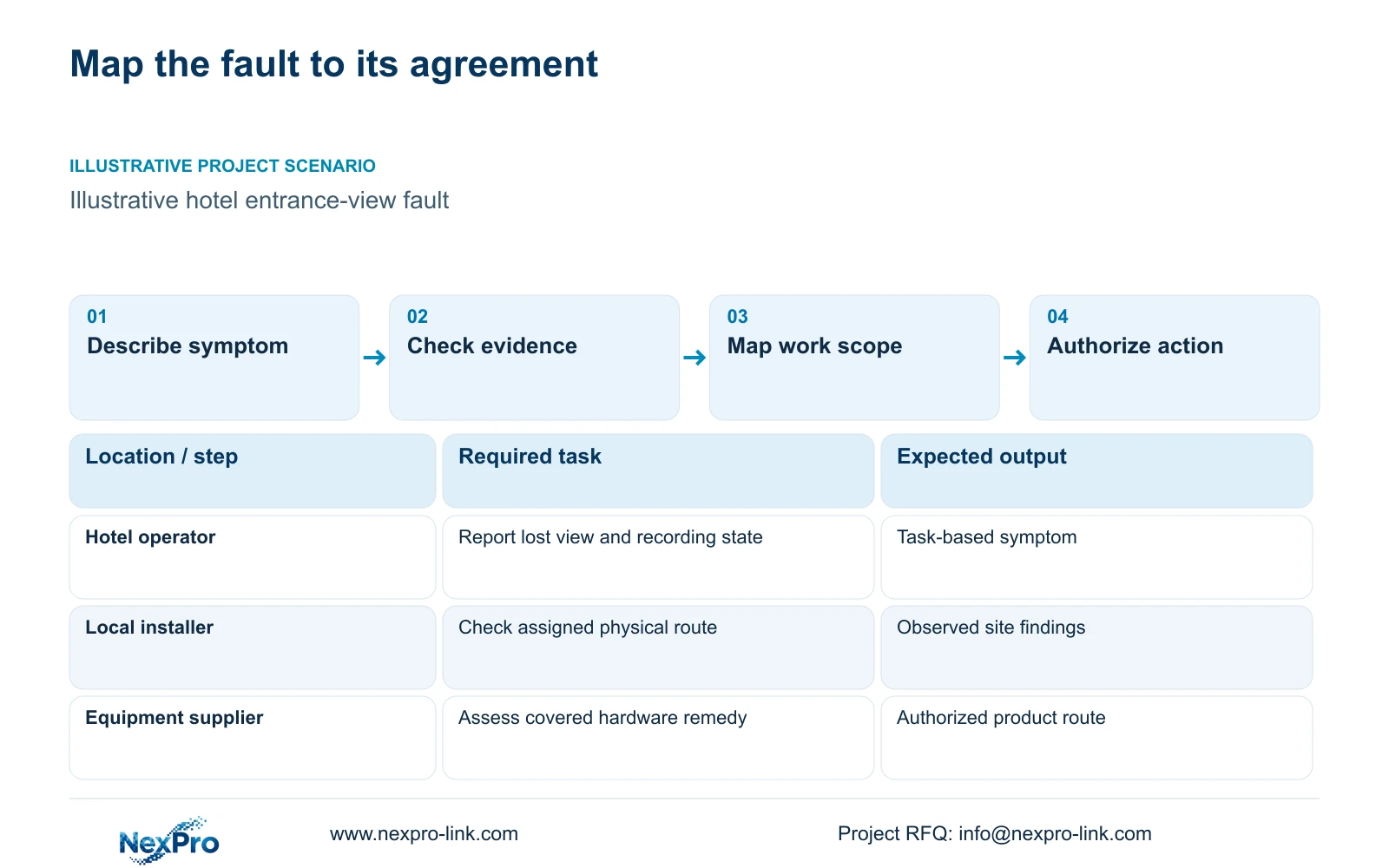
Describe the failed task before naming a liable party. For example, an illustrative entrance camera may have no live image, while a local operator can still retrieve earlier recordings. That observation narrows the investigation but does not prove a camera defect. Record the affected device, time and operating state, then identify the checks appropriate to its data and power path.
Use the actual equipment and port schedule when handing the issue to the installer or supplier. Record what was observed and what remains untested. A successful check at one node should not be reported as proof that the whole route works, and a remote configuration review cannot establish the condition of a physical termination.
Map findings to covered hardware, installation work or another assigned service only after the relevant evidence is available. Keep disputed allocation distinct from the authorized action needed to restore the hotel task. Where interim work is agreed, record who approves it and its cost basis without presenting that operational decision as a final legal conclusion.
Section 04
Compare the start events and remaining periods
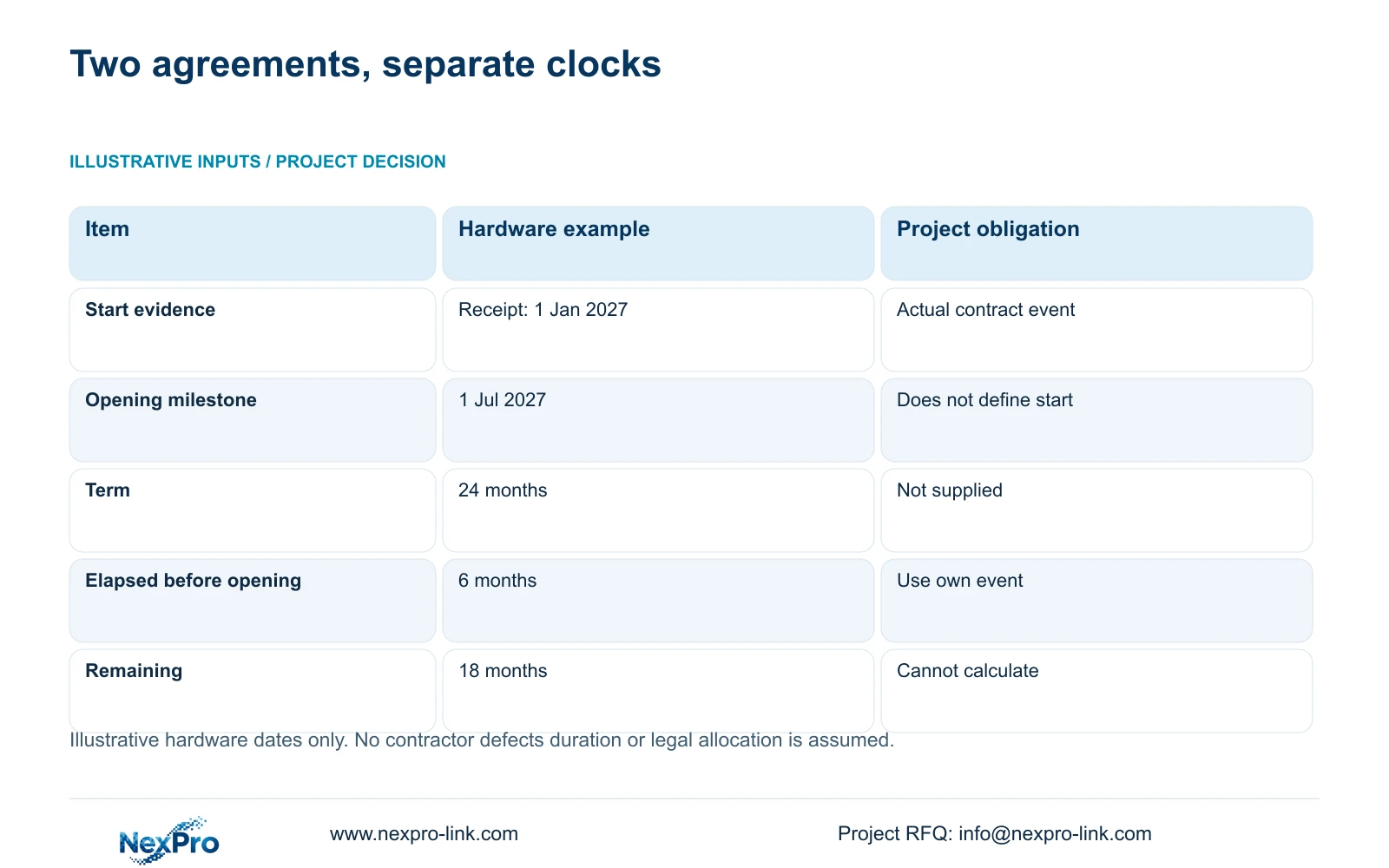
Product receipt and project completion can be different events. Keep each agreement's actual event visible instead of assigning one convenient start date to the entire system. The illustrative hardware timeline uses receipt on 1 January 2027 and hotel opening on 1 July 2027, with the supplied 24-month main-equipment baseline.
Remaining hardware coverage equals contractual months minus elapsed months since its start. Six months pass in this example, leaving 18 months at opening. The contractor's defects period is not supplied, so no contractor duration or expiry can be calculated. Opening itself does not establish that contractual event.
The comparison shows why a handover file needs both timelines. If the project's required service extends beyond the available product remedy, identify who carries the additional scope and seek written terms. Do not assume the manufacturer must extend coverage because another party has a later obligation, or that the contractor's obligation ends when a hardware term ends.
| Timeline field | Eligible main-hardware teaching example | Installation/project obligation |
|---|---|---|
| Controlling record | Equipment order and applicable policy | Actual signed installation or service agreement |
| Start event | Receipt on 1 January 2027 | Use the agreed event; opening alone proves nothing |
| Duration | 24-month example | Not supplied; do not invent |
| Opening milestone | 1 July 2027: six months elapsed, 18 remain | Record separately from the agreed start |
| Remaining service gap | Assess coverage and local restoration scope | Seek explicit allocation or appropriate local advice |
Section 05
Define how the parties escalate an unresolved fault
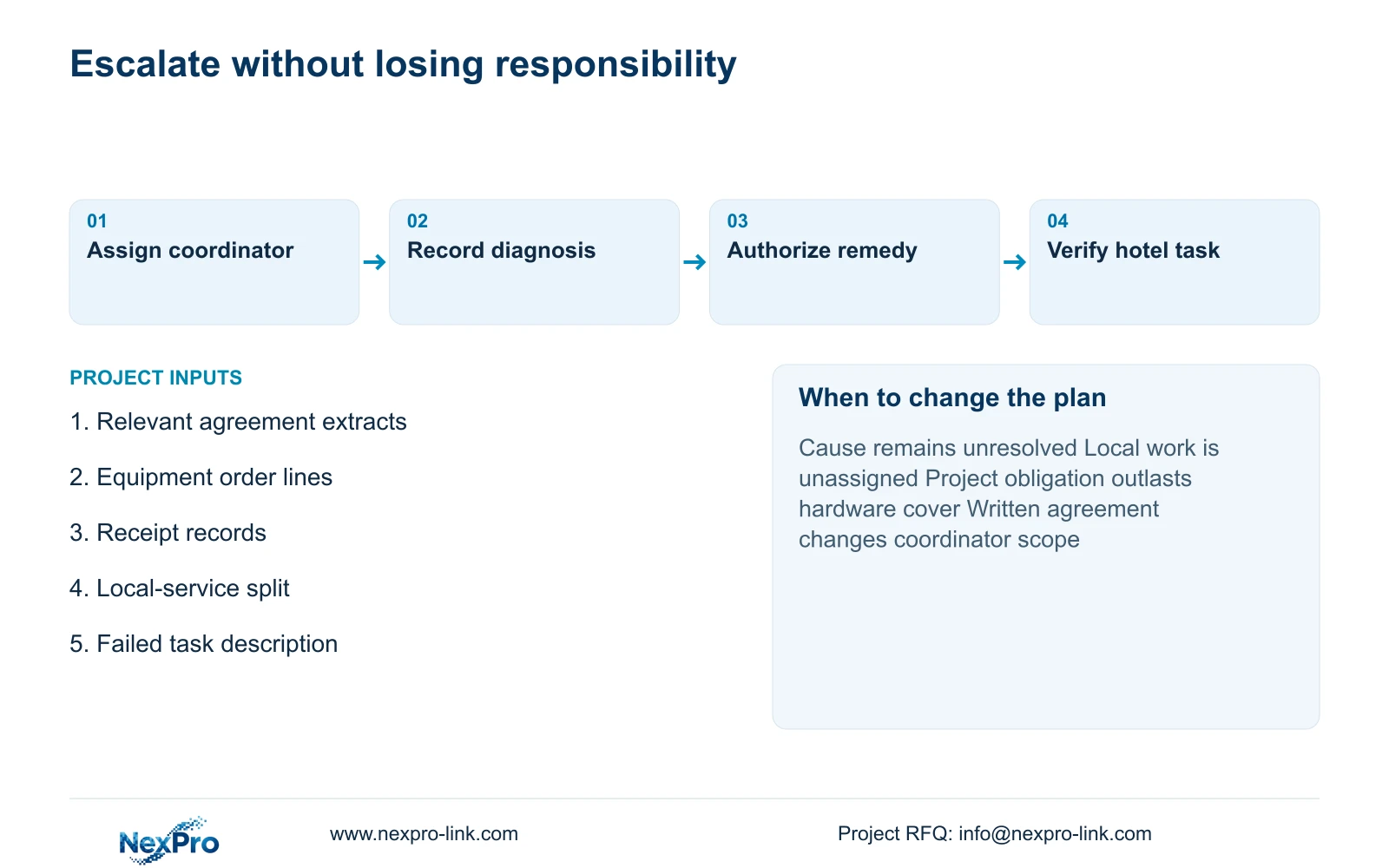
Give hotel staff a contact route tied to the failed task. The operator reports the symptom and impact; the agreed local team carries out appropriate physical checks; the supplier reviews supported equipment questions. The project coordinator keeps the records together. These roles may be held by different organizations, and their authority should be explicit.
Escalation should preserve the order reference and device identity while avoiding unnecessary disclosure of guest recordings or credentials. Before equipment is returned, obtain the approved RMA route. Allocate outward and replacement freight, customs responsibilities and any faster transport separately. Ongoing technical guidance does not promise unrestricted site attendance.
Buy additional coordination or local attendance when the existing arrangements leave the hotel unable to restore a required function. Retain the existing service split where it already has a competent owner for each activity. Any broader coordinator role should preserve the agreed operating outcome while stating which tasks and expenses it adds.
Section 06
Document the service route at project handover
The handover record should connect the equipment list to the responsible parties and applicable agreements. Include receipt evidence, installation records and the relevant start events. Keep the task-based operating instructions aligned with the delivered version so a new hotel team can identify the right view, retrieve footage and report a fault through the correct route.
For an actual case, record diagnosis, authorization and the work undertaken. Close the operational issue after checking the originally failed task under the relevant conditions. Preserve any unresolved contractual question separately. A replacement record must state its own coverage treatment without assuming that every replacement creates a new full term.
NexPro-Link's hotel and BOQ support can discuss equipment identity and supply boundaries. Send info@nexpro-link.com the relevant order lines, receipt dates, a short description of the installation-service split and the responsibility gap needing resolution. Share the necessary scope extracts rather than unrelated confidential contracts. Contract interpretation and local safety duties remain with the appropriate project professionals.
Section 07
Buyer questions
Does a hardware warranty automatically include installer travel? Travel and attendance require their own agreed scope. Identify the local provider and cost allocation even when the supplier accepts a covered hardware remedy.
Who should act when the fault's cause is disputed? Use the agreed coordinator and authorized investigation route. Document observations and any approved interim restoration work while keeping the unresolved contractual allocation separate.
What if the project requires service after the hardware term ends? Identify the additional period and tasks in the project agreement. Seek an explicit supplier variation or a separate service arrangement; do not assume either party automatically inherits the other's obligation.
Engineering references
These sources support the general planning principles. Always use the selected product's current datasheet and applicable project standards for final design.