Charging cable by metre and termination work by point can be valid. Define each line's included work and assign shared items once to prevent duplicate costs.
Section 01
Choose explicit measurement units
Use metres for defined cable quantities and a clearly described endpoint unit for termination work when those rows purchase different tasks. Charging both is acceptable if their inclusions do not overlap. If a per-point rate already includes cable and installation, separate metre-based charges need correction or an explicit exclusion before the BOQ can be compared.
Define what 'point' means in this project. It could represent one termination, both ends of one link, or a completed installed connection. Those meanings produce different quantities. State the unit in the item description and connect it to the endpoint schedule. A camera count alone cannot establish cable length or the number of shared panels.
Keep measured quantities distinguishable from provisional routes and allowances. RICS New Rules of Measurement provides a reference for different cost-planning and measurement purposes, but the example here is an editorial method, not a prescribed RICS contract form. Apply the project's agreed local measurement and contractual rules when issuing the actual BOQ.
| Required task | Given information | Decision still needed |
|---|---|---|
| Supply route cable | Endpoint route schedule | Installed metres or purchased reels |
| Complete terminations | Two physical ends per link | Per end or defined two-ended point |
| Accept links | Required test scope | Separate test row or included work |
Section 02
Describe included tasks
Write the cable row so a bidder can tell whether it covers material supply only or supply and pulling along the approved route. Identify the conductor and jacket requirements, and explain the treatment of termination allowances. Keep pathway construction outside that row unless its inclusion is deliberate and measurable.
Describe termination work with its endpoint materials and labour boundary. If a point includes both ends, say so. If modules are separately supplied, the termination rate should describe the installation work without silently supplying them again. Testing descriptions should identify the required object and records, with labeling responsibility assigned to one line.
An item can be commercially bundled while its technical inclusions remain explicit. A completed-point rate is useful when the route assumptions and completion requirements are stable. An itemized arrangement is easier to reconcile when route lengths remain provisional. Change the pricing structure when the measurement uncertainty changes, while preserving the same required operating connection.
Section 04
Compare bidder inclusions
Place competing bids against the same inclusion schedule. For each required task, record whether it is included, separately priced, excluded or unresolved. An unresolved amount should remain visible instead of being evaluated as zero. Compare quantities and specification changes separately so the buyer can understand what causes the total difference.
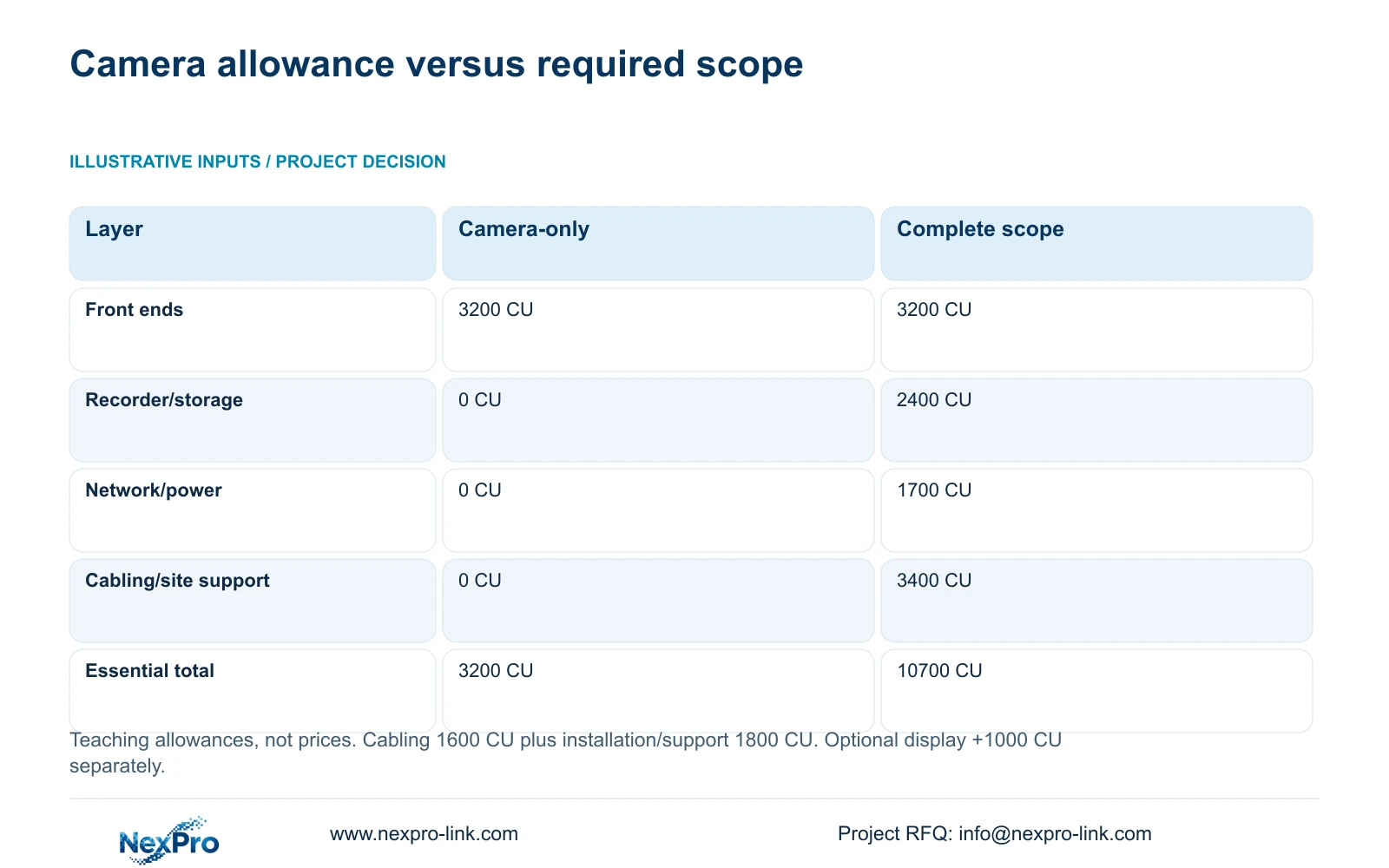
The supplied teaching example demonstrates why a camera-only allowance cannot represent a complete security package. Front ends are 3200 CU, recorder/storage 2400 CU, networking 800 CU, protected power 900 CU, cabling 1600 CU and installation/support 1800 CU. Adding required rows gives 10,700 CU. Optional display adds 1000 CU separately.
The zero entries in the camera-only column identify missing allowances, not free equipment or unnecessary work. This comparison illustrates scope completeness, not hotel budget proportions or supplier prices. For the cabling decision, its consequence is to retain all required connection work while ensuring that the 3400 CU cabling/site layer contains no duplicated activity.
| Metric / condition | Camera-only allowance | Complete allowance |
|---|---|---|
| Front ends (CU) | 3200 | 3200 |
| Recorder and storage (CU) | 0 | 2400 |
| Network and protected power (CU) | 0 | 1700 |
| Cabling and site/support work (CU) | 0 | 3400 |
| Essential total (CU) | 3200 | 10700 |
| Optional display | Not included | +1000 CU separately |
Section 05
Identify double counting
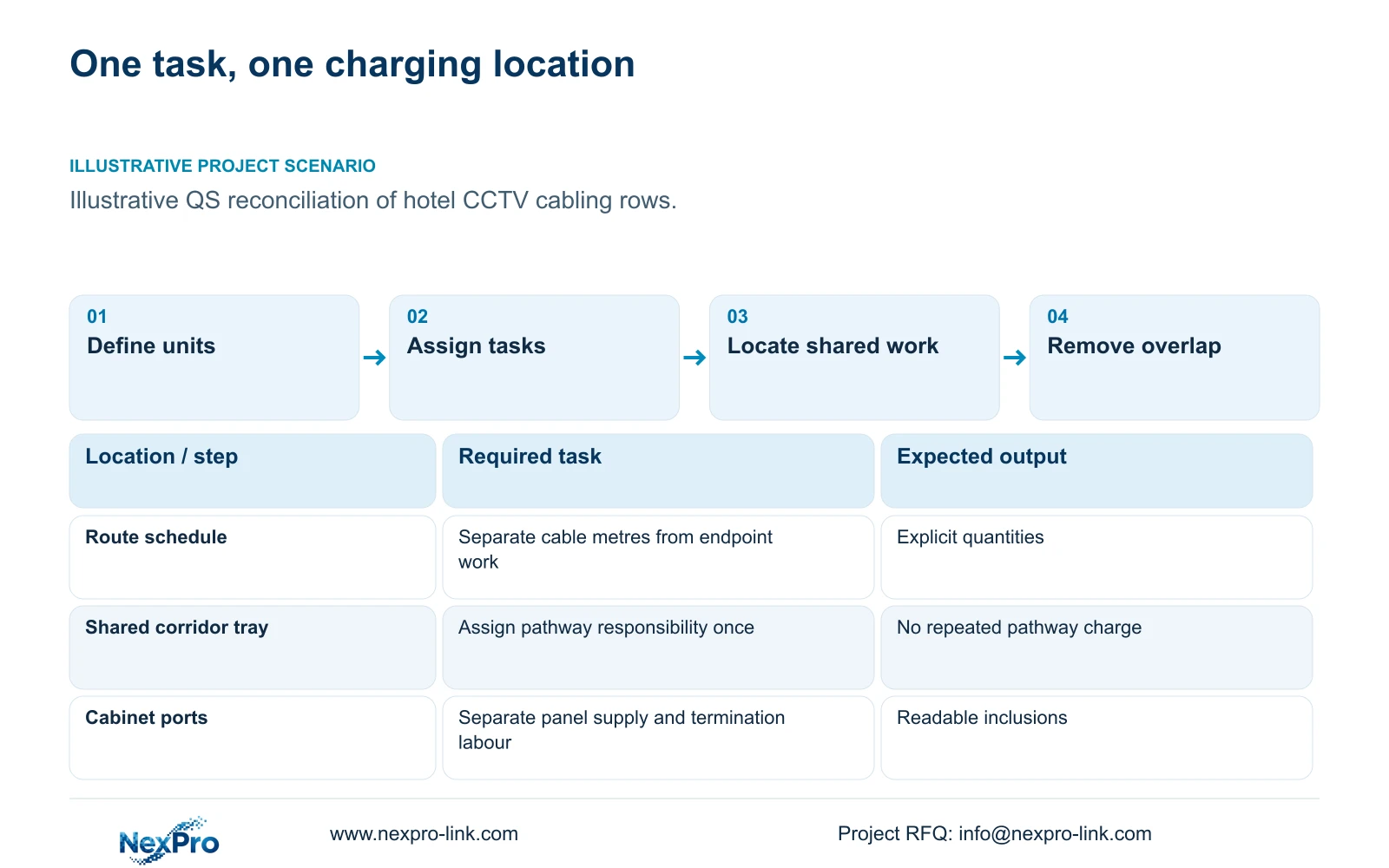
Check repeated work by tracing inclusions, not by looking for identical unit names. Cable pulling may appear inside an installed-metre rate and again inside a completed-point rate. Module supply may be listed individually while also included in a termination kit. Testing can be charged within a point and repeated as a system allowance.
Give each required task one charging location. If it appears elsewhere for coordination, mark that reference as included rather than adding another priced quantity. Keep physical equipment and the labour on that equipment distinguishable: buying a panel once and paying for port termination work are different tasks when the descriptions say so.
Remove only a genuine overlap. A common tray and a camera's dedicated final connection are different work, even if both appear under containment. Additional scope is worth buying when it closes a required pathway or acceptance gap. If another contractor already provides that same task, retain the interface responsibility and remove the repeated allowance according to the agreed commercial basis.
Section 06
Issue a clarified BOQ section
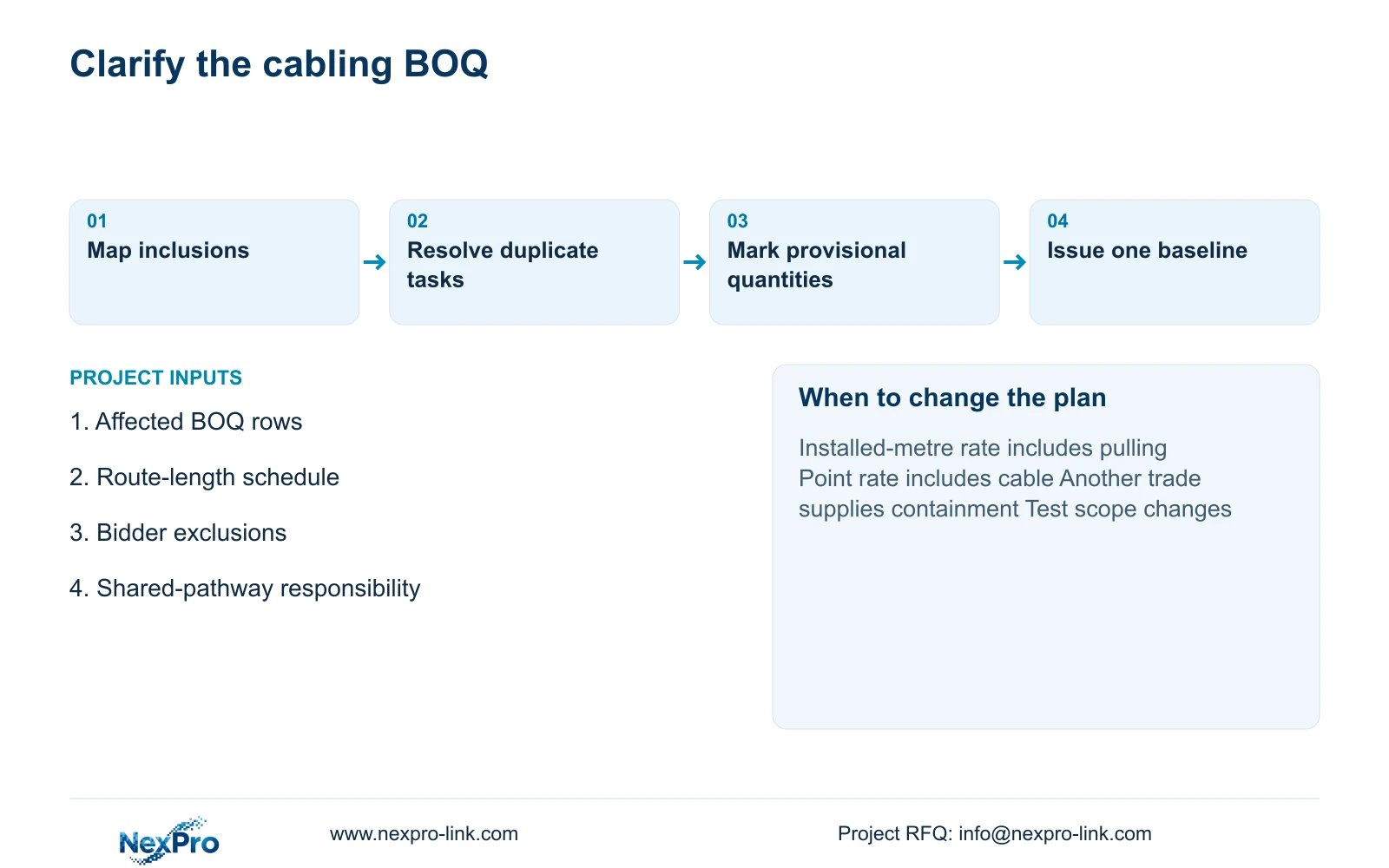
Issue a revision containing the route schedule, measurement units and inclusion descriptions together. Show which quantities are measured and which remain provisional. Identify the drawing or schedule version behind the changes so bidders do not price different baselines. A revised grand total without these records leaves the original ambiguity unresolved.
Recommend separate cable, laying, termination and testing definitions where lengths or responsibilities are still changing. A bundled completed-point item can be retained when its route basis and included work are explicit and the contract supports that measurement method. Revisit the arrangement when containment responsibility, endpoint materials or acceptance scope changes. Keep optional display and unrelated upgrades outside the cabling baseline.
Send info@nexpro-link.com the relevant BOQ rows, route-length schedule and bidder inclusion notes for a scoped equipment and quotation discussion. Include the reel format if material purchasing is part of the issue. NexPro-Link's BOQ support can assist with model matching and coordinated supply descriptions. Its CCTV manufacturing core and complementary supply coordination do not imply that local construction or every associated service is included.
Section 07
Buyer questions
Does using metres and points automatically duplicate charges? No. Metres can purchase cable while points purchase defined endpoint work. Duplication occurs when the same material or activity is included in both rates. Read the inclusion descriptions before removing either row.
Can we retain a single completed-point rate? Yes, if the endpoint definition, route basis, tests and shared-work exclusions are explicit. Where lengths remain provisional, separate rows can make later quantity revisions easier to explain.
Which documents are most useful for a BOQ clarification? Provide the affected rows and their inclusions, the matching route schedule and the current bidder exclusions. Identify the immediate overlap or missing task; a first review does not require unrelated confidential tender material.
Engineering references
These sources support the general planning principles. Always use the selected product's current datasheet and applicable project standards for final design.