Plan hospital CCTV backup power with practical guidance on define critical cctv services and use supported redundant arrangements. NexPro-Link project guide.
Section 01
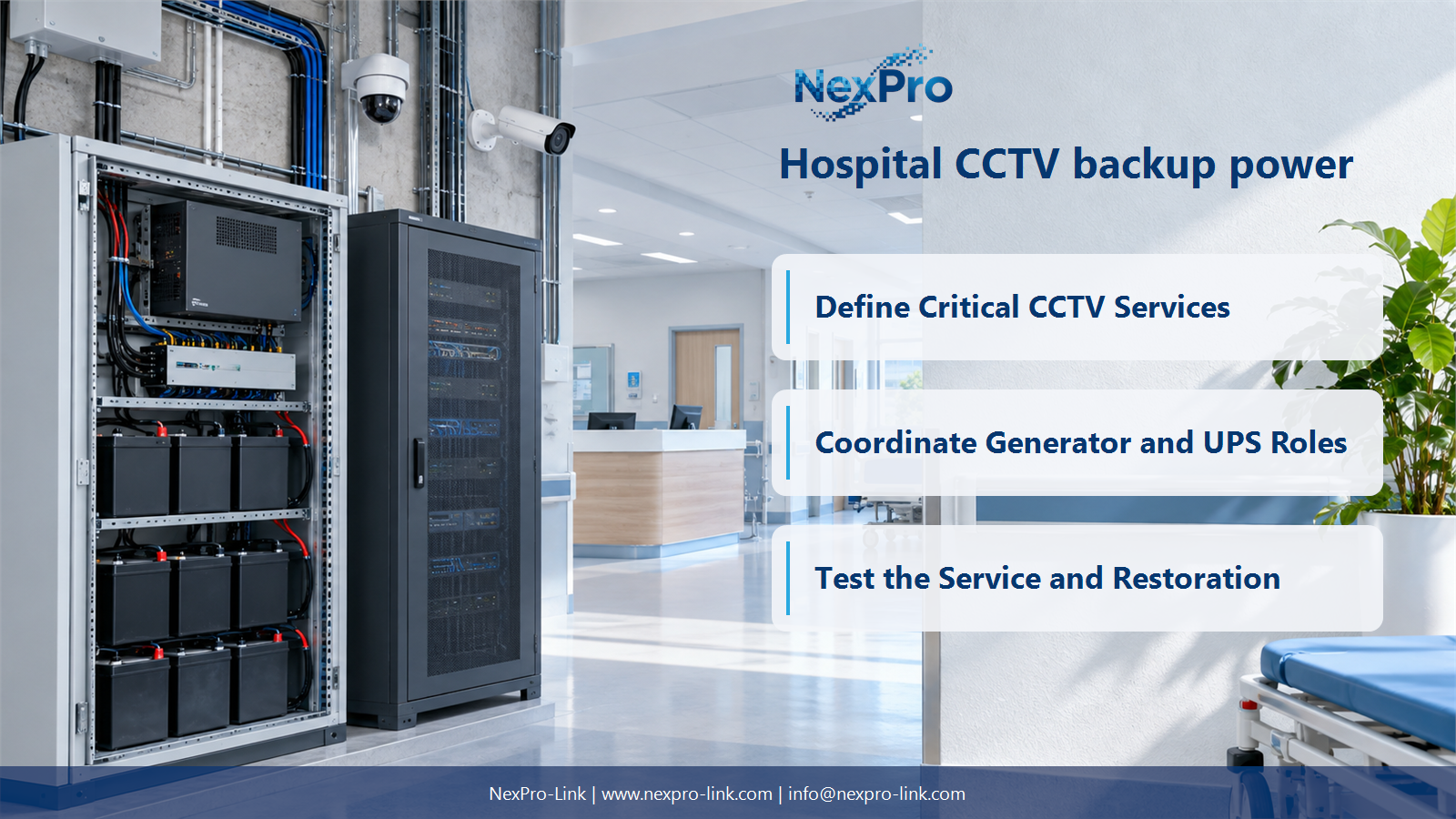
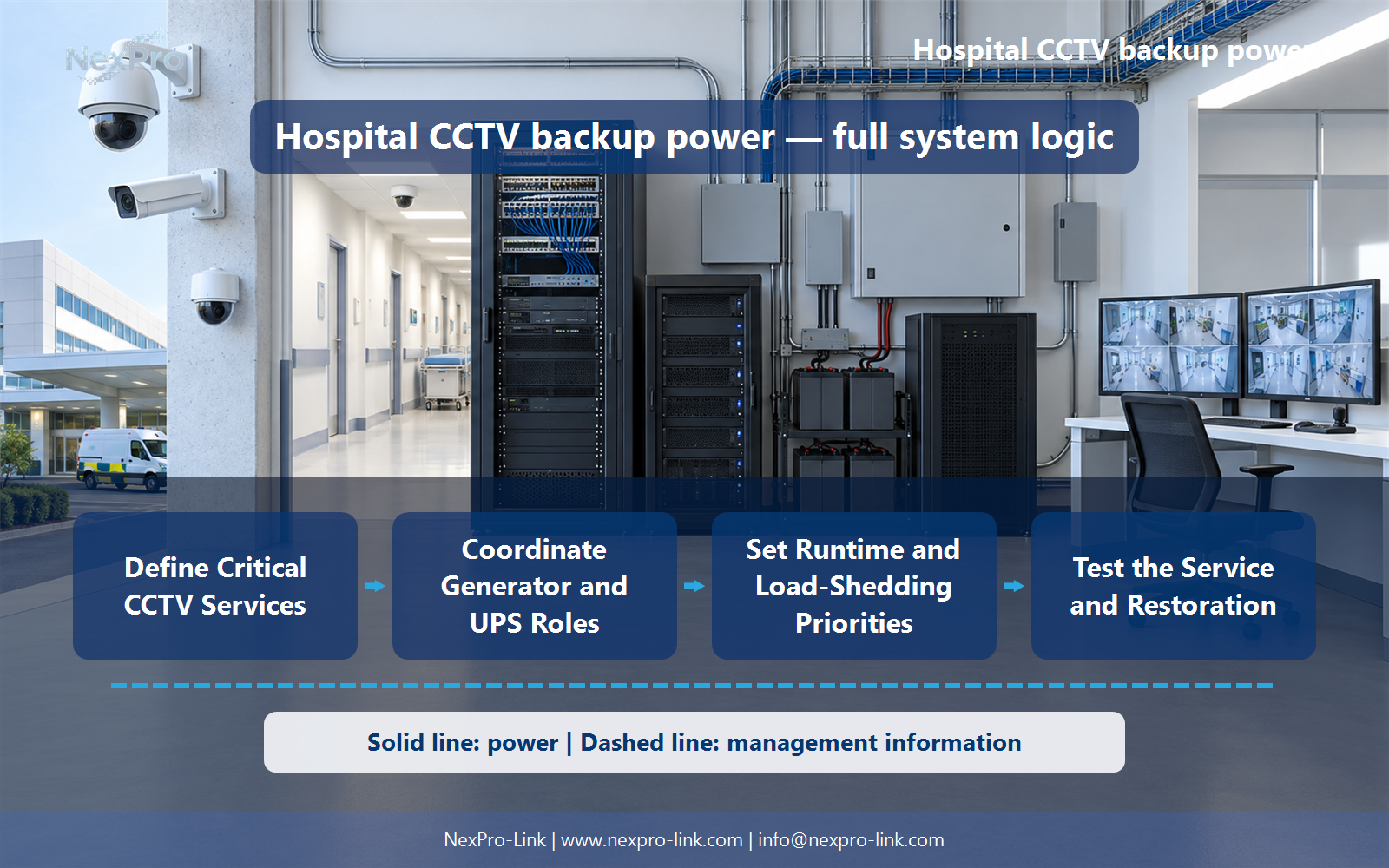
Define Critical CCTV Services
Identify the views and recording or response functions essential to the site's approved operating plan. Assign priorities rather than assuming every screen and camera has the same continuity requirement. Clinical life-safety systems and surveillance support have distinct responsibilities and should not be conflated.
Turn the answer into a working record using Service, Critical views, Required action, Priority.
| Decision area | Buyer question | Required output |
|---|---|---|
| Define Critical CCTV Services | Which hospital CCTV functions should survive an outage? | Identify the views and recording or response functions essential to the site's approved operating plan. |
| Trace Every Local Power Dependency | Why can cameras fail despite a backed-up control room? | Their local PoE switches, converters or intermediate network equipment may use an unprotected supply. |
| Coordinate Generator and UPS Roles | How should a UPS coordinate with hospital standby power? | Use the site's electrical design to define ride-through, transfer and recovery conditions. |
Section 02
Trace Every Local Power Dependency
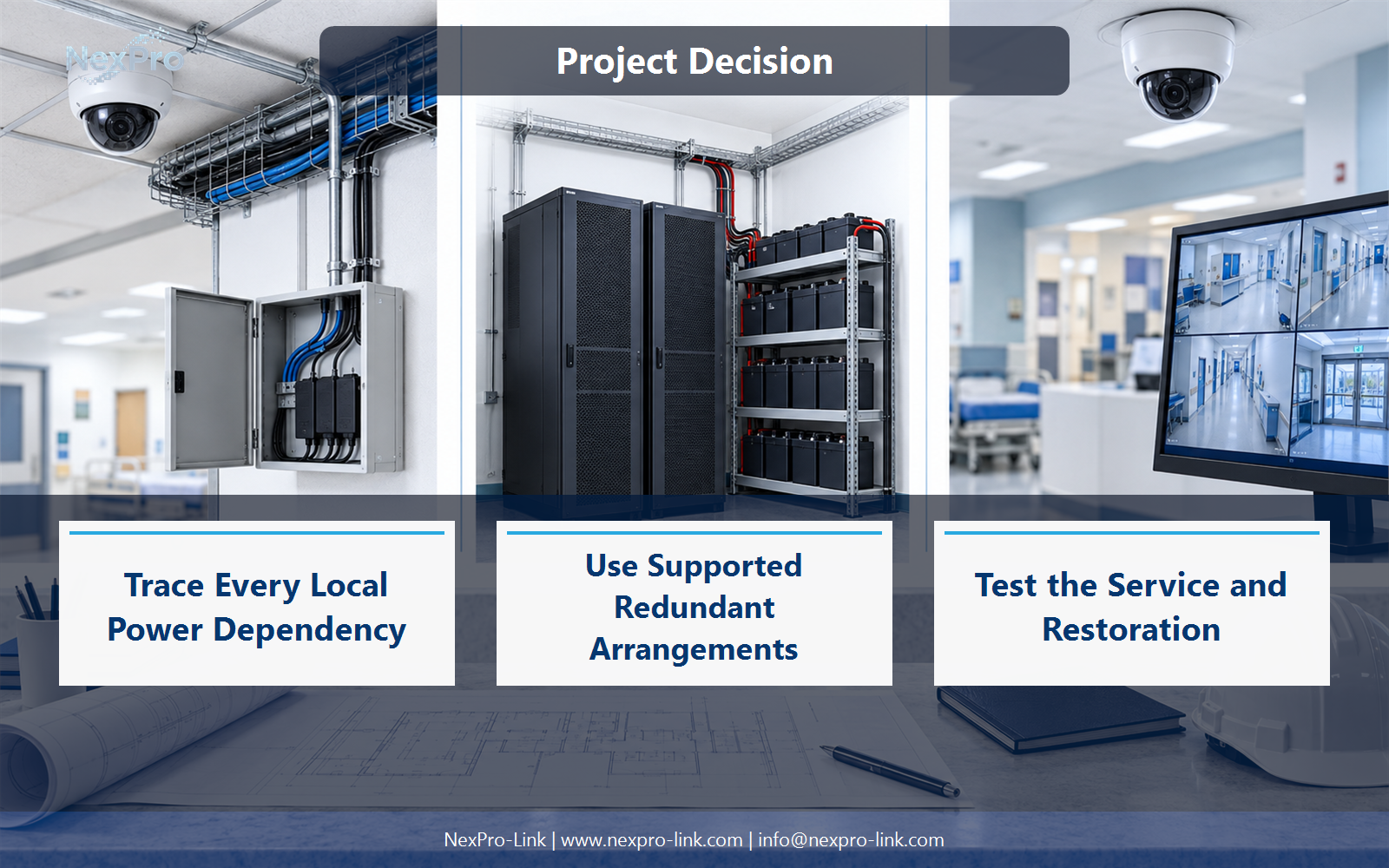
Their local PoE switches, converters or intermediate network equipment may use an unprotected supply. Trace power at every relevant location. A central UPS and generator connection cannot preserve a remote camera path when one field device loses its own input power.
Use Location, Device, Circuit, Backup, Service dependency to compare options on the same basis. Keep product capability, project assumption and operating responsibility in separate columns.
Section 03
Coordinate Generator and UPS Roles
Use the site's electrical design to define ride-through, transfer and recovery conditions. The UPS and generator must suit the actual load and operating arrangement. Avoid universal assumptions about start time or compatibility, and keep the responsible electrical team's interface requirements explicit.
The project output should make Source, Transition, UPS role, Load, Electrical owner traceable from input to acceptance.
- Confirm the answer to: How should a UPS coordinate with hospital standby power?
- Record the project fields: Source / Transition / UPS role / Load / Electrical owner.
- Keep product capability, project assumptions and site responsibility in separate records.
Section 04
Use Supported Redundant Arrangements
No. Their connection, transfer or dual-input arrangement must be supported and designed for the equipment. Shared circuits and single-input devices can remain common failure points. Never join independent UPS outputs as a generic redundancy shortcut.
Record Feed A, Feed B, Transfer, Common point, Supported load before selecting a product family. That makes later substitutions possible without silently changing the operational requirement.
Section 05
Set Runtime and Load-Shedding Priorities
Only when the approved workflow requires it. Recording and essential operator displays may take priority over a large wall. Define the protected load levels and duration, then select the battery configuration from applicable load-dependent information rather than UPS capacity alone.
Review Level, Active devices, Watts, Runtime, Operator action with the party that will operate or maintain the system.
Section 06
Test the Service and Restoration
Under an approved safe test plan, verify required camera visibility, recording, network connectivity and restoration after the power event. Record the actual load and configuration. Keeping the UPS illuminated is not enough to prove the surveillance service remains available.
Use Test stage, Required CCTV function, Observation, Restoration as the handoff between design and procurement.
Engineering references
These sources support the general planning principles. Always use the selected product's current datasheet and applicable project standards for final design.