For each conditional response, identify the missing evidence, decision owner and consequence for order release. Retain the original clause and later clarification together.
Section 01
Split each clause into requirements a reviewer can check
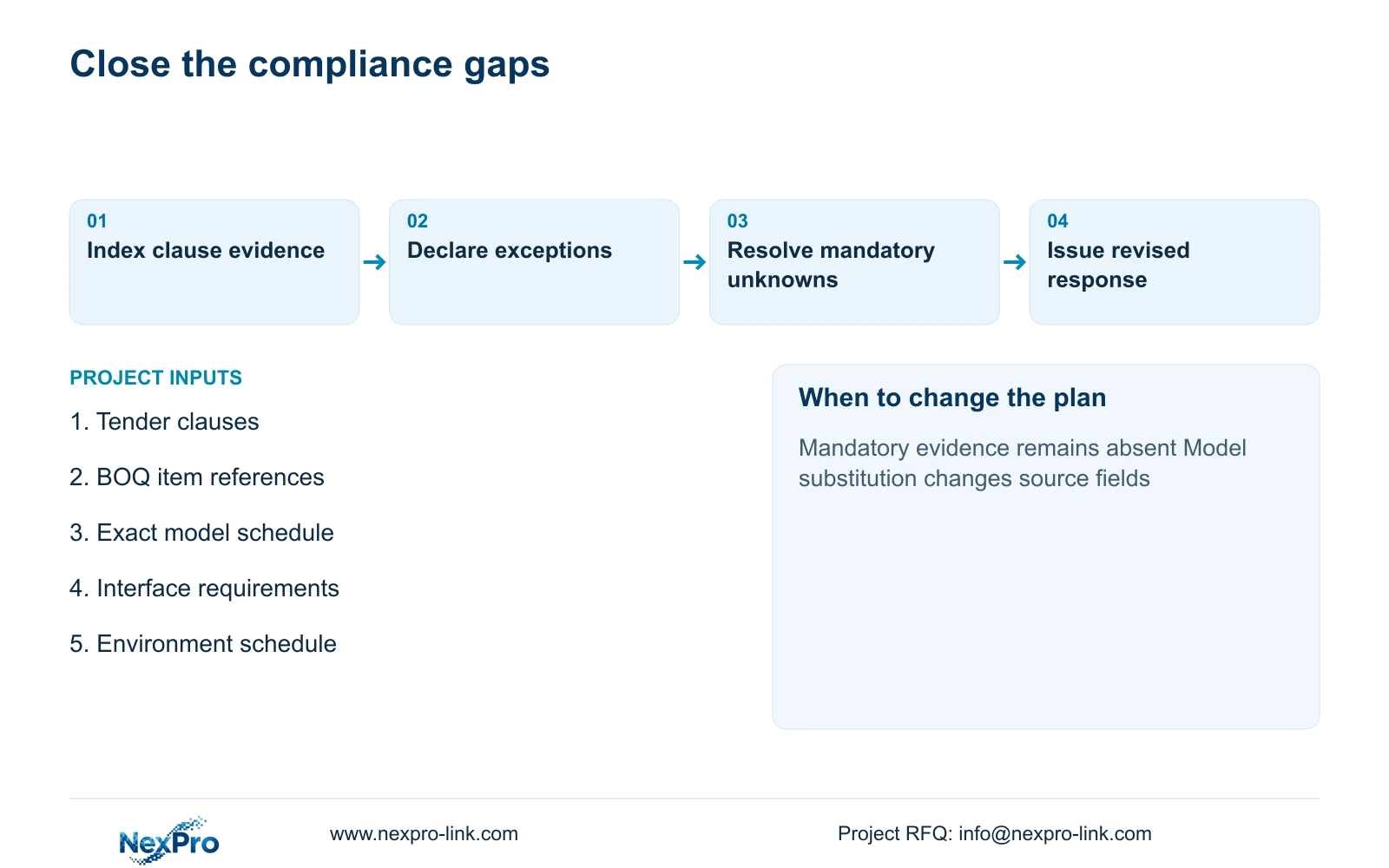
For each conditional response, identify the missing evidence, decision owner and consequence for order release. Retain the original clause and later clarification together. Close the condition only against that specific requirement; a broad approval email should not erase unrelated unresolved interfaces or silently change the issued model identity.
A factory tender compliance matrix should retain each source clause and answer its individual requirements with exact model or system evidence. State exceptions openly. A low price cannot compensate for an unsupported mandatory function, and one general compliance tick should not cover retention, interfaces, environmental conditions and installation responsibilities together.
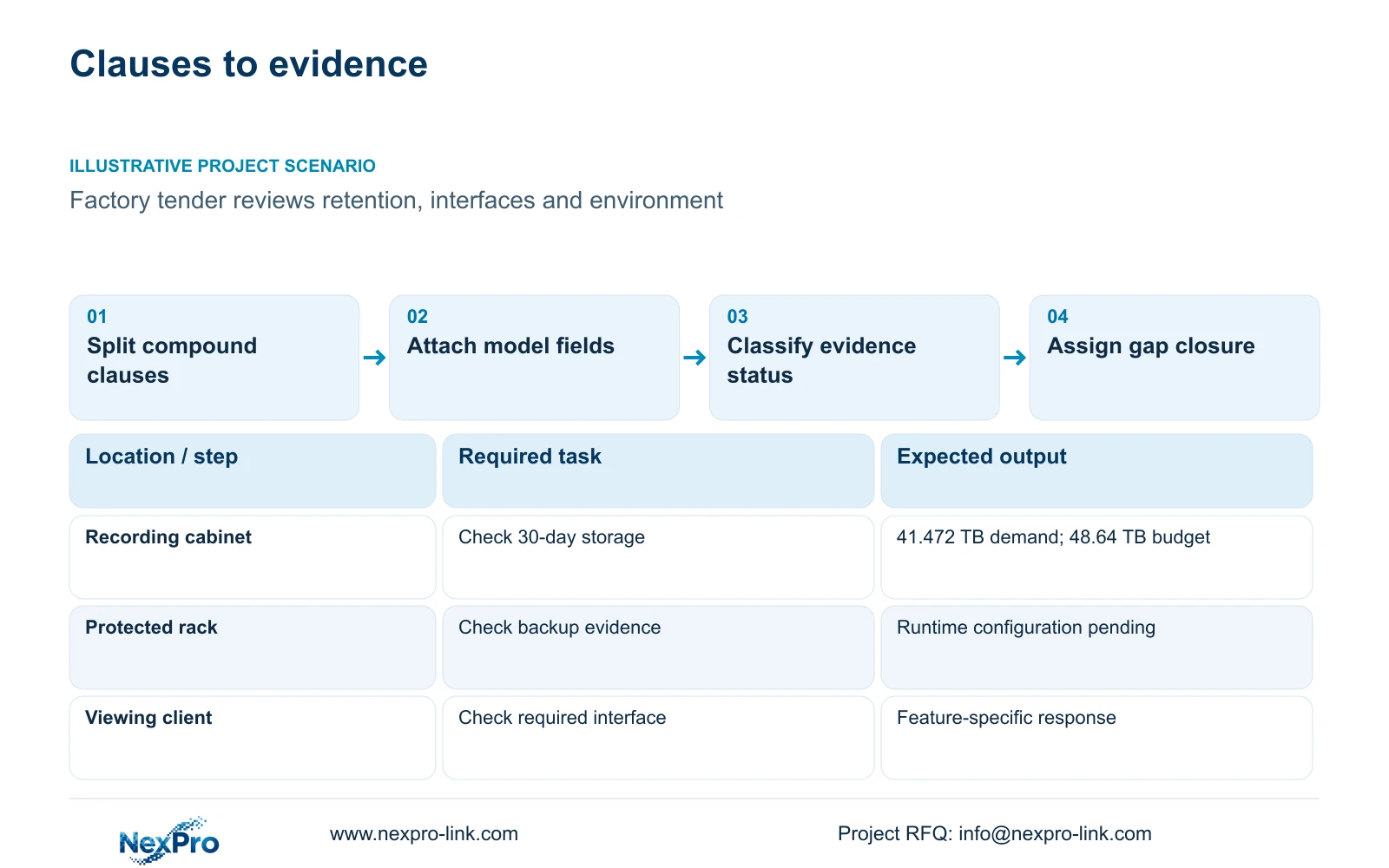
Illustrative project scenario: A tender specifies retention, interfaces and environmental conditions across several factory zones. Use the supplied 32-camera CNC reference for the ordinary recording scope, while treating any further tender conditions as planning requirements awaiting actual documents. The case assumes 30 days of continuous recording; it is not a customer acceptance result or proof that every proposed tender clause is met.
Give compound clauses child references. A recording clause might separate camera quantity, accepted stream mode, average bitrate, retention and export task. Preserve the parent wording and unit. The engineer can then evaluate a storage calculation without accidentally approving unrelated decoding or failover requirements. Procurement can see which mandatory items remain open before comparing prices.
Section 02
Attach the source field that answers the requirement
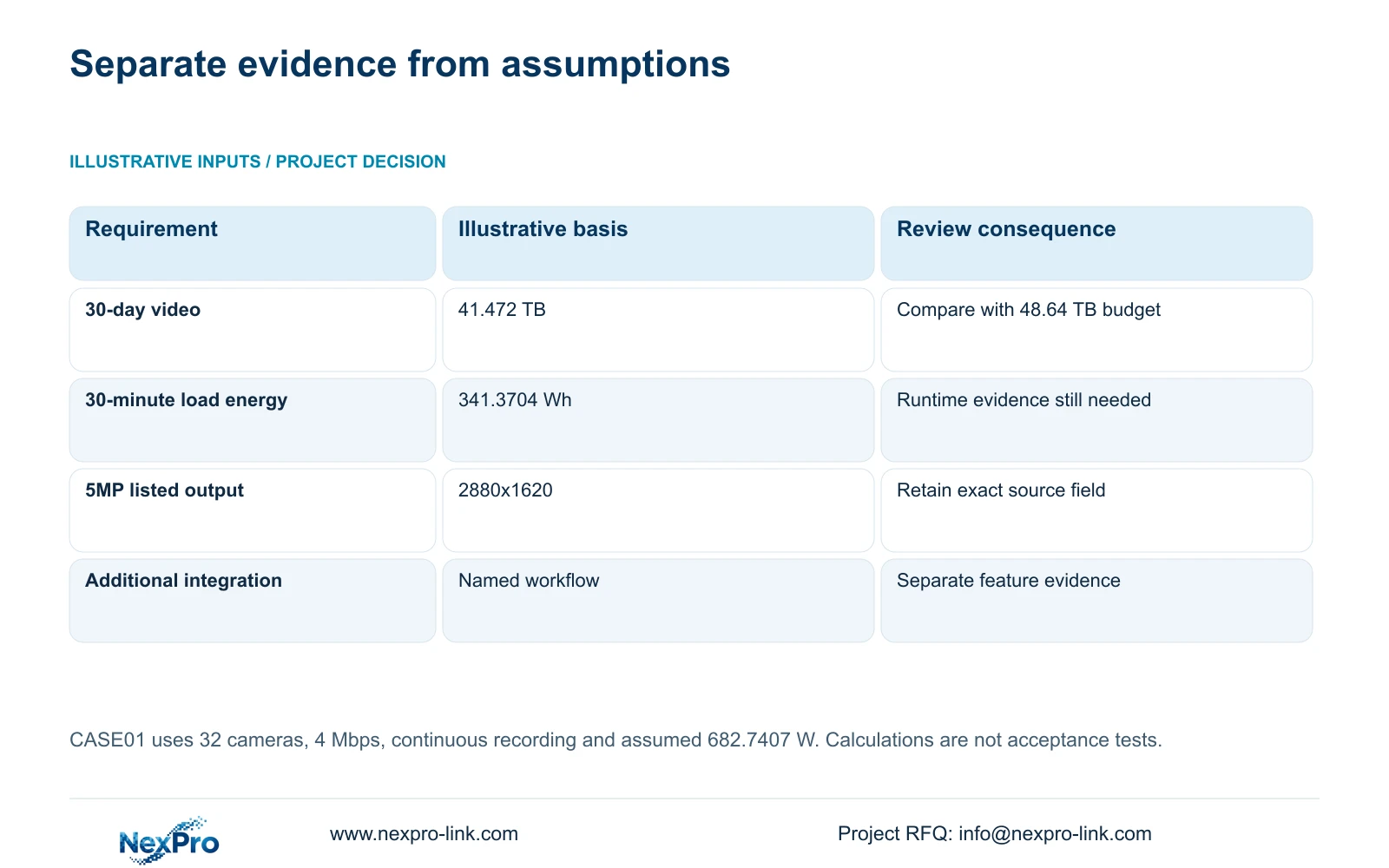
For a proposed model, record its full identity, document title or revision and the relevant field. Avoid relying on a family heading when the tender requires a particular output. The supplied BL2812M 5MP specification lists 2880x1620 and 25 fps. Retain that listed output in the response rather than silently changing it to another familiar 5MP resolution.
The NexPro-NVR4449-4K reference lists 49 channels, 320 Mbps input and four SATA bays up to 18 TB per drive. Its summary distinguishes 49×5MP and 9×4K modes. Those fields can support specific hardware responses, but a 49-channel label does not answer a clause asking for simultaneous high-resolution decoding or RAID. Such requirements need their own supported configuration evidence.
Environmental responses should be just as narrow. A published camera temperature or IP field applies to that model under its stated scope. It does not establish washdown suitability, chemical resistance, explosion protection or the assembled installation's acceptance. Where the tender asks for specialist scope, keep that row separate and seek the applicable qualified evidence.
Section 03
Use different statuses for missing evidence and known deviations
Use a small, defined status vocabulary: supported by cited evidence, verification pending, declared deviation, excluded scope and not applicable where justified. An absent camera peak-power field belongs under verification pending if the requirement could still be met. An offered specification that demonstrably differs from a mandatory clause belongs under declared deviation. Do not turn either into a compliant response to keep the matrix visually tidy.
For a 30-minute backup requirement, the case's recording-first load is an illustrative 682.7407 W. Load-side energy = 682.7407 × 0.5 = 341.3704 Wh. That calculation does not establish UPS runtime. The selected battery configuration and runtime evidence remain needed even if a capacity candidate satisfies the W and VA checks.
Give every unresolved row an evidence owner, requested action and affected BOQ reference. Assign local cable installation and testing to the agreed installer, while equipment documentation remains with the supplier. Distinguishing supplied, retained, installer-provided and optional scope shows who must close the issue without confusing an exclusion with a product failure.
Section 04
Review the complete recording chain before adding interfaces
Apply the supplied package matrix to the tender's actual functions. The base package needs evidence for its cameras, recording, network, protected-power boundary and authorised retrieval. An expanded package retains those requirements and adds evidence for the requested integration. The comparison below shows the scope distinction; neither column represents an already approved system.
For the CASE01 storage row, video_TB = 32 × 4 × 10^6 × 86400 × 30 / 8 / 10^12 = 41.472 TB. The illustrative four 16 TB drives give a video budget of 64 × 0.95 × 0.80 = 48.64 TB. Compare 41.472 TB with that budget directly. The 20% reserve is already included, and the assumed bitrate must be replaced by the accepted stream basis.
The decisive difference is whether the tender requires an additional workflow. If it does, the expanded interface becomes mandatory scope with its own equipment, software and test response. ONVIF profile applicability can inform that review, but live video alone does not establish event handling, search or audio. Keep the required feature response visible instead of hiding it beneath general compatibility language.
| Requirement group | Core recording response | Expanded interface response |
|---|---|---|
| Recording outcome | 32 views; 30-day calculation | Same recording outcome retained |
| Hardware identity | Exact camera, recorder and disk models | Same plus named interface equipment |
| Network and power | Local resources and load assumptions | Added processing dependencies included |
| Software and access | Authorised retrieval and export evidence | Additional required workflow evidence |
| Procurement boundary | Complete core supply and site split | Added scope and responsible integrator |
Section 05
Resolve mandatory gaps before recommending the offer
Present a recommendation in two parts: technical eligibility under the tender requirements and commercial comparison on equivalent scope. A supported storage arrangement cannot offset an unresolved mandatory platform function. The quantity surveyor should carry the cost of required additions only after the engineer has defined what those additions must accomplish.
When a deviation can be considered, describe the offered condition, operational consequence and proposed mitigation. For example, a changed display arrangement may preserve retrieval while altering simultaneous viewing. Ask the authorised reviewer whether that difference is acceptable. If the tender does not permit the change, retain the specified requirement rather than implying that a competitive price creates permission.
Supplier registration, brand acceptance and project equipment approval should appear as separate status records. NexPro-Link's BOQ & Tender Support scope can assist with model matching and declared deviations, but the buyer makes the acceptance decision. Competitor proposals should receive the same evidence standard, with no assumptions drawn from brand reputation alone.
Section 06
Issue a readable matrix with a short evidence index
Keep the main matrix concise enough to review alongside the BOQ. Include clause reference, requirement, offered response, status, evidence reference, exception and action owner. Place full datasheets and calculations in an indexed attachment. A reviewer should be able to move directly from a requirement to the relevant source field without searching an unstructured catalogue.
After clarification, update the affected row and retain the earlier response in the revision record. If a camera model changes, check the stream, lens, environment and power inputs that depend on it. If a display or server is added, update the protected load list. An approval statement attached to an obsolete configuration should not be carried forward unchanged.
The final issue should distinguish documented model ratings, illustrative design assumptions and results requiring demonstration. That separation allows the engineer to approve supported elements while naming the remaining conditions. It also gives procurement a defensible basis for requesting a corrected offer rather than accepting a blanket promise of compliance.
Section 07
Buyer questions
Can one datasheet support several matrix rows? Yes. Cite the relevant field or section separately for each requirement. Reusing a document is sensible; reusing one broad statement for unrelated functions is not.
How should an ambiguous tender requirement be answered? Quote the wording, state the interpretation used for the offer and request clarification. Keep the response conditional where another interpretation would change equipment or scope.
Should a pending test be marked noncompliant? Mark it as verification pending unless existing evidence establishes a deviation. The reviewer can then decide whether that unresolved condition prevents evaluation or order release.
Section 08
Build a clause-linked compliance response
Send the tender clauses, BOQ references, proposed model schedule and mandatory interface or environment requirements to info@nexpro-link.com for a scoped technical response with explicit exceptions.
Engineering references
These sources support the general planning principles. Always use the selected product's current datasheet and applicable project standards for final design.