Keep forecast volumes, approved equipment roles and authorized purchase releases in separate records. Use the forecast for discussion, then confirm actual site inputs and commercial terms at each release.
Section 01
Start with one project the contractor can evaluate
Keep forecast volumes, approved equipment roles and authorized purchase releases in separate records. Use the forecast for discussion, then confirm actual site inputs and commercial terms at each release. Record which prior evidence is reused and which needs renewal. Neither a roadmap nor a successful pilot obliges an unapproved future order.
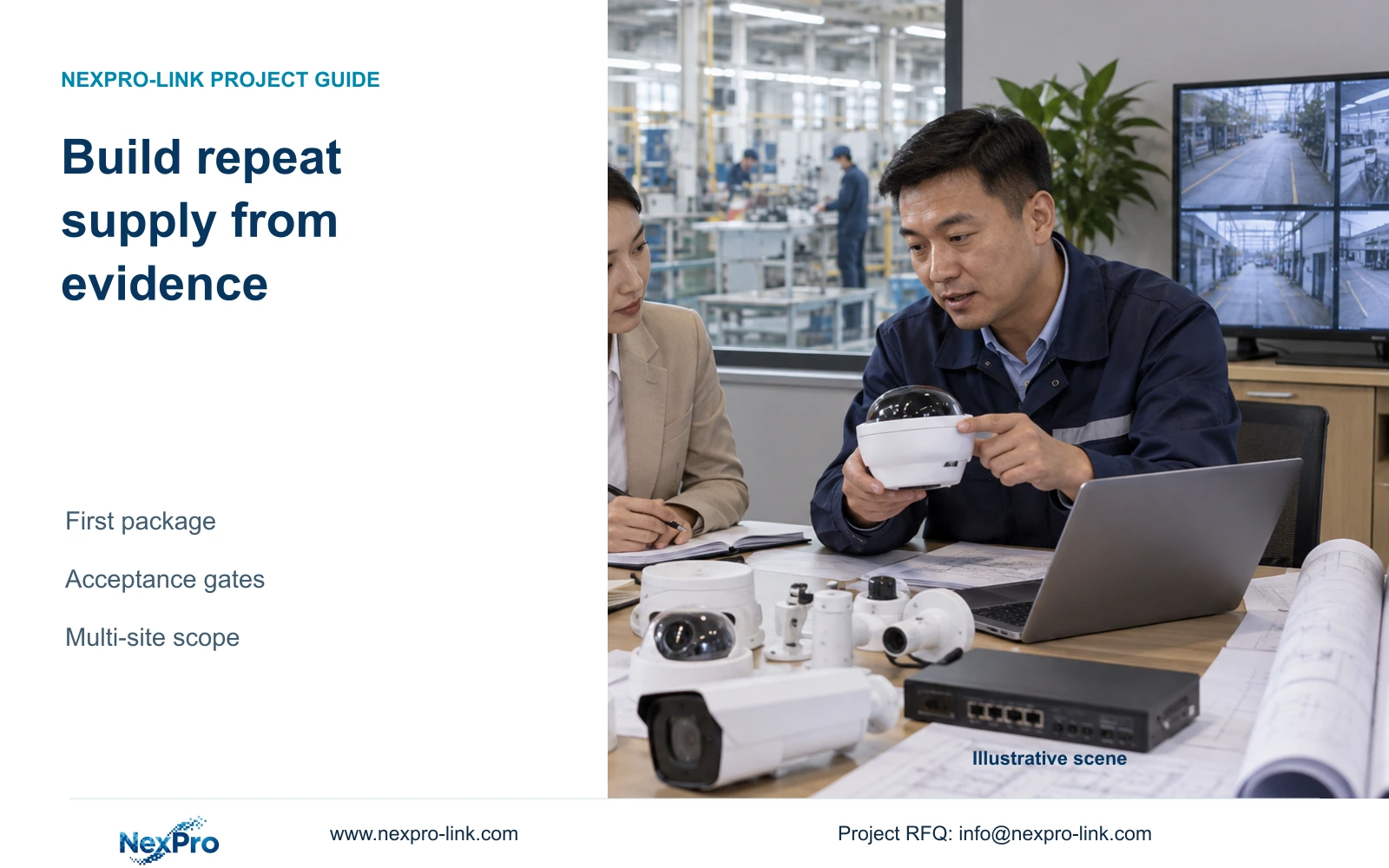
Build a factory security partnership around one measurable project scope, evaluate the delivered equipment and support experience, then expand the parts worth repeating. The first RFQ should identify a bounded operating task and supplier category. This gives the contractor an evidence-based decision about further cooperation without promising future orders or treating supplier approval as approval for every site.
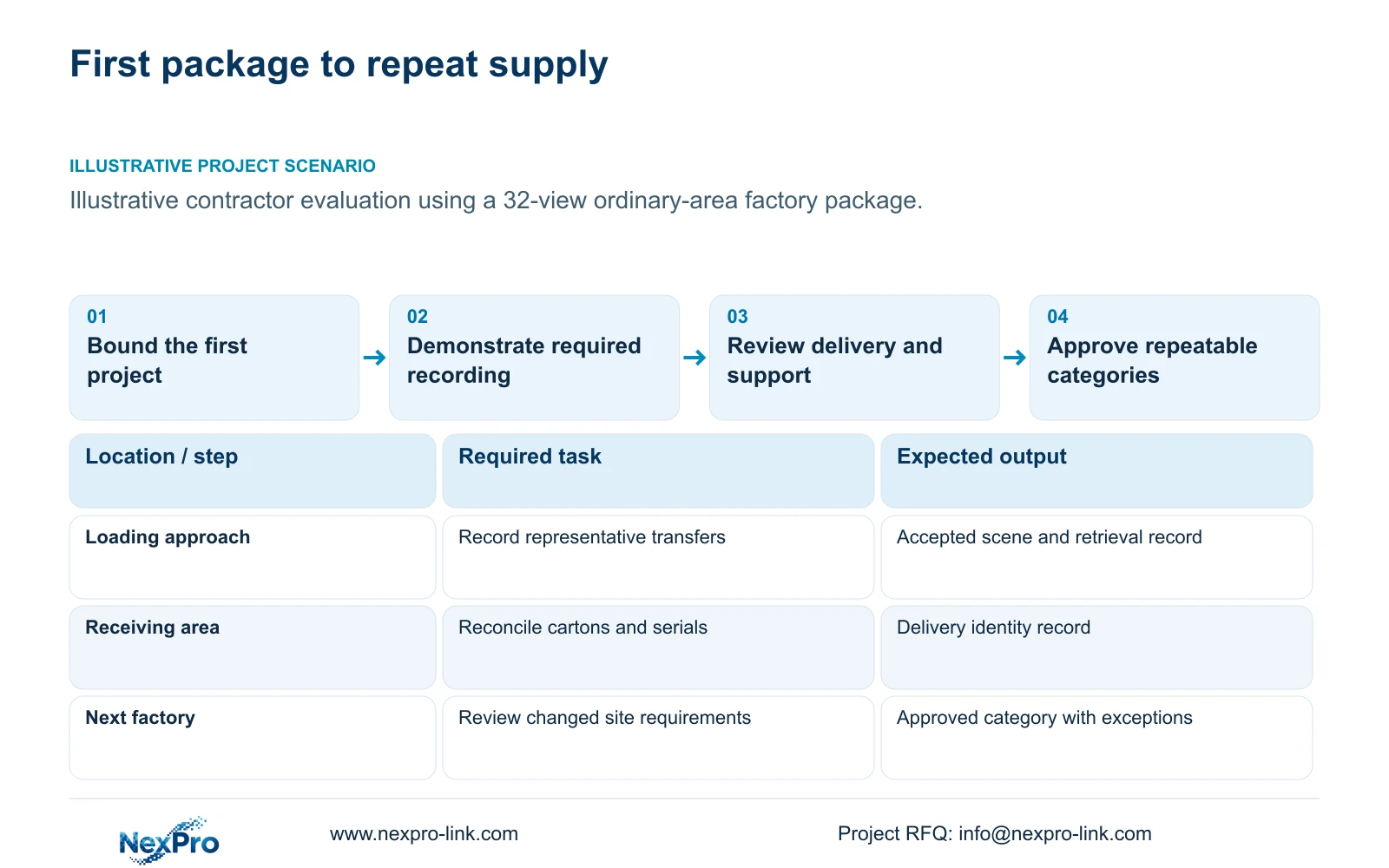
Illustrative project scenario: A contractor wants a long-term overseas supply partner rather than a one-off equipment seller. Assume it uses the CASE01 32-camera CNC factory reference as a possible first package, limited to ordinary security recording of access and material transfers. The quantities and operating targets are planning assumptions; no customer delivery, acceptance or supplier performance result is claimed.
Set the first boundary around complete recording and authorized retrieval, with cabling, installation and electrical work assigned explicitly. Record who approves the equipment and who verifies it after installation. If the immediate opportunity is only a camera supply category, define that narrower trial honestly and identify the retained recorder and network dependencies. Its outcome can support that category decision without proving the entire factory system.
Section 02
Make the first package a controlled delivery exercise
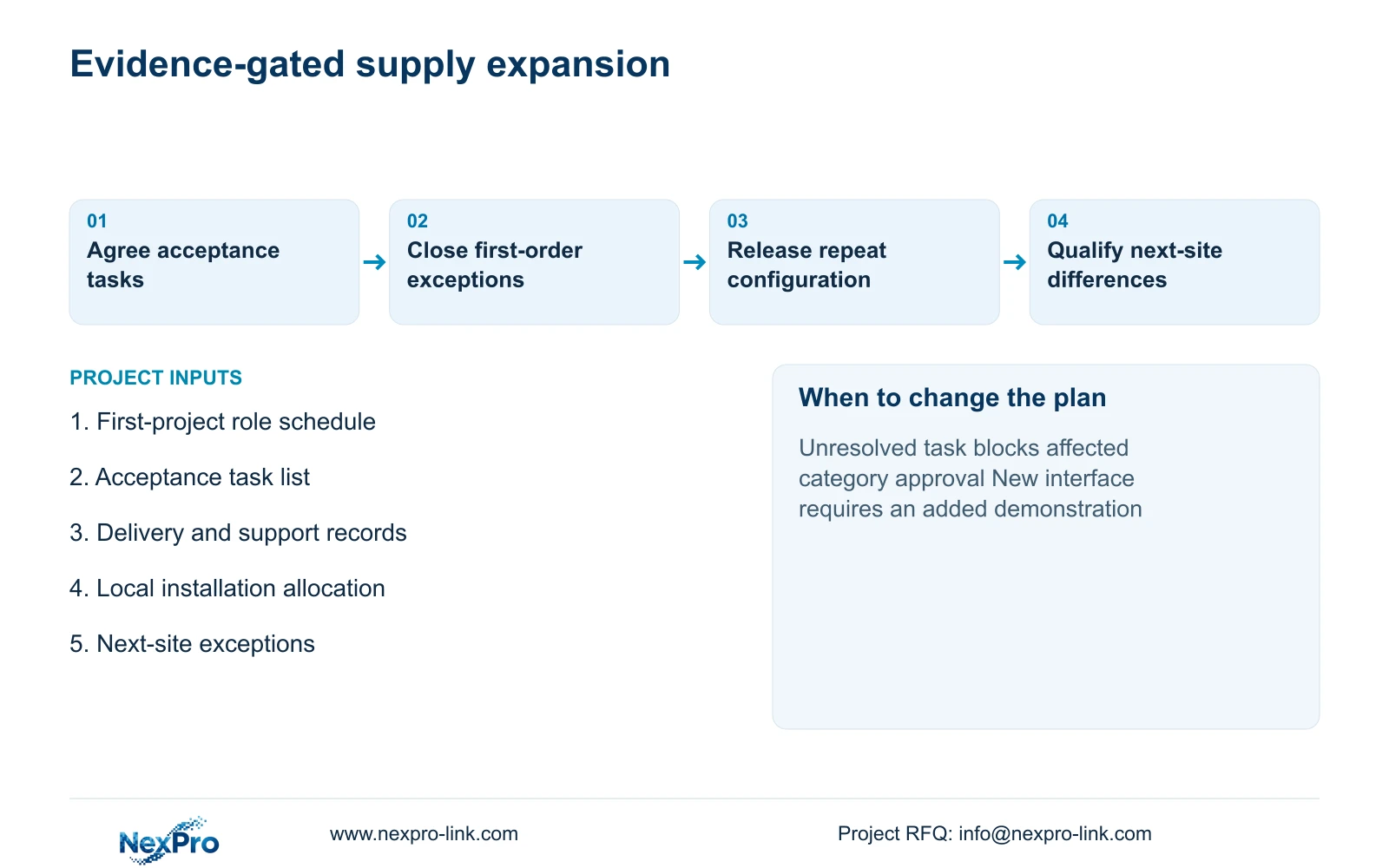
Before ordering, agree the tasks that will demonstrate acceptance. For the illustrative project, those could include matching delivered models to the schedule, recording representative transfers, retrieving an event by time and exporting footage for authorized review. Select scenes that expose the expected difficulty, such as a loading approach during movement. A static bench picture would answer fewer questions about the required security task.
Use preparation records to keep the tested configuration identifiable. Record model, firmware, stream settings and accessories, then check that the supplied batch matches the approved basis. If a 5MP camera from the supplied BL or DM series is selected, retain the listed 2880×1620 output field in the submittal. Do not silently replace that dimension with a different interpretation of the family label.
Evaluate the supply process alongside image and recording checks. At receipt, reconcile cartons, serials and accessories against the packing list. During installation, record whether document gaps or configuration differences prevent a required task. Log the question, information supplied, response and eventual resolution without assigning invented performance scores. This lets the contractor distinguish a correctable preparation issue from an equipment limitation before expanding the relationship.
Section 03
Choose a complete core before testing extra integration
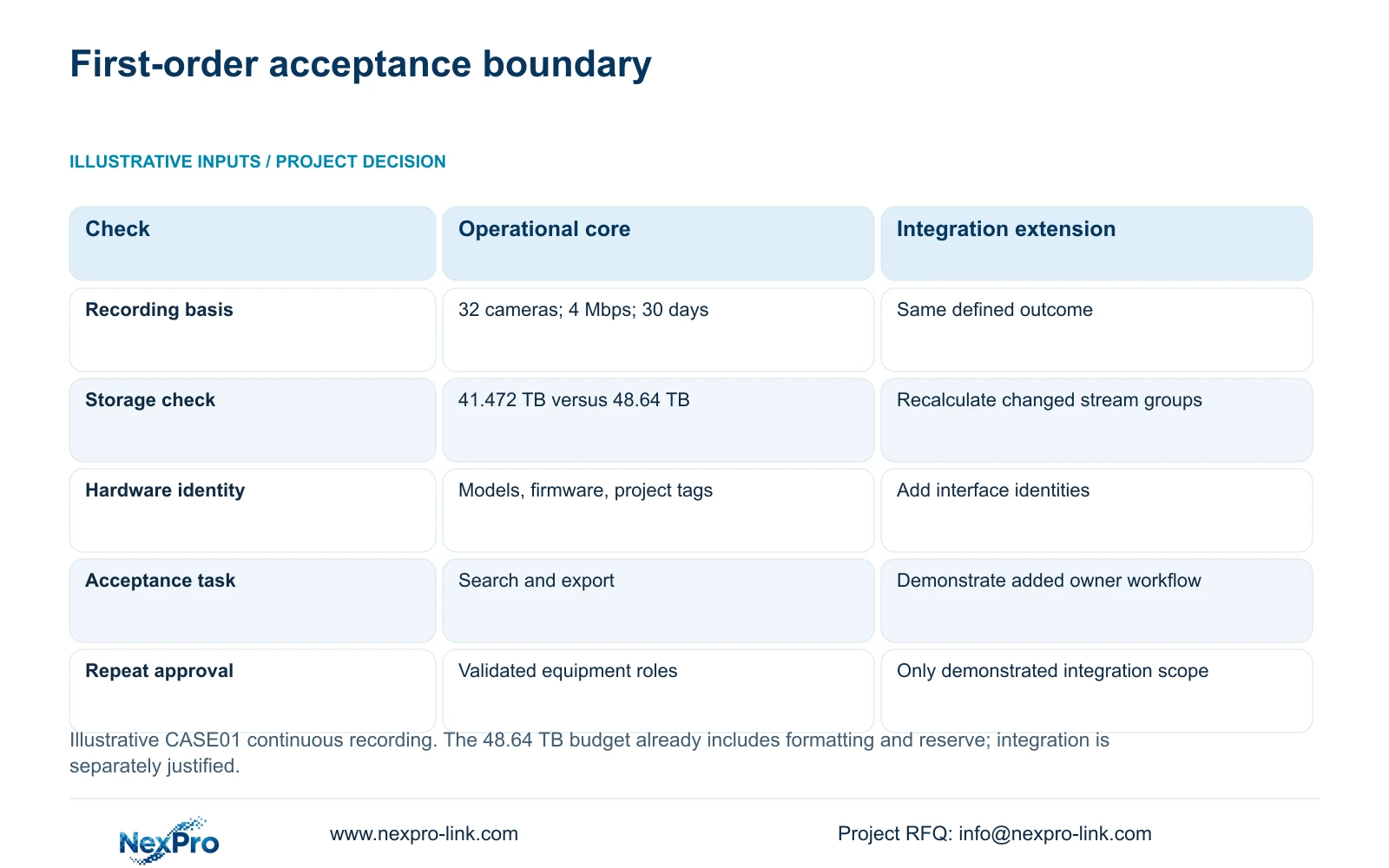
For a first package, Option A should cover the required camera-to-recording chain and the operator's retrieval task. Option B keeps that outcome and adds a justified management or integration workflow. Apply the same ownership method to both: classify every item as supplied, retained, installer-provided or optional, and name the party responsible for each interface. The comparison below establishes a usable first-order boundary.
The decisive choice is whether the added workflow is required for acceptance. If the owner needs centralized permissions or a specified platform connection, include that interface and its demonstration in the first package. If it is merely a possible future feature, keep it separately priced and qualified. Otherwise, the contractor may judge the supplier on an undefined integration while the core recording task remains unresolved.
NexPro-Link's factory project-supply and BOQ-support pages describe equipment coordination, model matching and technical submission support. That scope can help assemble the first package, but it does not establish native compatibility among all devices or include local construction automatically. An empty responsibility or software field should trigger clarification before order release, not an assumption that another party will supply it.
| Decision | Option A: operational core | Option B: integration included |
|---|---|---|
| Recording outcome | Agreed 32 views and retrieval tasks | Same recording outcome |
| Equipment identity | Model, firmware and project tag | Same records plus approved interfaces |
| Network and power | Required nodes and dependencies allocated | Added server and interface loads allocated |
| Software acceptance | Authorized search and export | Additional owner workflow demonstrated |
| Purchase boundary | Complete core BOM/BOQ and local-work allocation | Added scope, deliverables and interface owner |
Section 04
Use acceptance and service records to decide the next order
At first-project review, separate supplier preparation, site installation and unresolved design assumptions. A missing accessory concerns the delivery file; an obstructed view may concern final mounting or changed production layout. Assign the cause and corrective owner before deciding whether the package should repeat. Keep rejected or conditional items out of the approved baseline until their required function has been demonstrated.
CASE01 provides a useful calculation check for this review. Its illustrative storage formula is video_TB = cameras × average_Mbps × 10^6 × 86400 × days / 8 / 10^12. With 32 cameras, 4 Mbps average, continuous recording and 30 days, the result is 41.472 TB. The 64 TB raw disk arrangement gives a planning video budget of 64 × 0.95 × 0.80 = 48.64 TB. Retain the input record so a later stream change is investigated instead of blamed automatically on the recorder.
Agree a workable service route before equipment leaves the first project. Identify the fault-report contact, return authorization process, replacement decision, local labour and freight allocation. The supplied policy states a 24-month receipt-based baseline for eligible main equipment, while the rack UPS source also states 1–2 years. Confirm applicable order terms and separate batteries, disks and consumables. Review actual support experience when available; a simulated support exercise can clarify the process but cannot prove resolution performance.
Section 05
Expand validated roles while recalculating each factory
Promote the useful results into a repeat-order configuration: accepted equipment roles, document revisions, packing conventions and service responsibilities. Keep a separate site-exception schedule for each new factory. The project manager controls the release, the engineer checks technical applicability, and procurement reconciles the quantities and commercial terms. This permits consistent supply without forcing different buildings into the first site's design.
Capacity references show why the site schedule remains essential. CASE01 assumes a recording-first AC load of 682.7407 W and a load of 1,262.7407 W when optional LCD panels and decoding are added. SP1KR(S) is quoted at 1 kVA/900 W and SP2KR(S) at 2 kVA/1800 W. These are capacity references, not runtime evidence. A later project needs its own protected-load list, electrical-node allocation and battery/runtime confirmation even if the supplier family remains familiar.
Expand categories only when their interface and service scope are understood. Repeat camera supply might lead to recorder coordination or OEM packing; it does not automatically qualify specialist cameras, enterprise software or local installation. Preserve mandatory brand and platform requirements at sites where they apply. When comparing another supplier, hold observation tasks, retention, backup objectives and local services constant, using current matching quotations rather than assuming partnership status establishes a cost advantage.
Section 06
Document repeat supply without promising volume
The next agreement should state how a site order becomes releasable. Require an approved role schedule, resolved deviations, current configuration and accepted packing instructions. Define how the supplier proposes substitutions and how the contractor approves them. Forecasts can support planning, but distinguish anticipated projects from committed quantities so neither party mistakes a discussion about growth for an authorized purchase.
For overseas supply, identify the delivery destination and the division between equipment preparation and local installation. NexPro-Link can discuss coordinated equipment lists, relevant technical documents and project/OEM packing. The contractor should retain the local partner's installation and acceptance duties in the site order. If a new destination changes document or delivery requirements, resolve those before treating the next shipment as a simple copy.
Keep the partnership review tied to observable outputs: correct delivery identity, completion of agreed tasks, useful support records and closure of exceptions. Use those results to retain, narrow or expand the approved category. A multi-site arrangement becomes practical when each order can trace its equipment and responsibilities back to a controlled baseline, while changes remain visible enough to review before they reach the next factory.
Section 07
Buyer questions
Must the first evaluation include a full 32-camera system? No. Use the smallest scope that can demonstrate the category under review. A camera-only evaluation needs a defined recorder and network context; it cannot establish acceptance of a complete package. The 32-camera reference provides a planning example, not a minimum order.
Can supplier prequalification replace site acceptance? No. Prequalification assesses suitability to enter a purchasing category. Site acceptance checks the installed equipment against that project's required tasks and conditions. Keep the two decisions and their approving parties separate.
What if the first delivery has a correctable documentation problem? Record its effect, agree a correction and verify the revised document against the equipment. The next-order decision can remain conditional until closure. Do not hide the issue or treat every documentation fault as grounds for wholesale equipment replacement.
Section 08
Define a first package worth evaluating
Send your first-project equipment roles, proposed acceptance tasks, service/interruption requirements and delivery destination with local-installer allocation to info@nexpro-link.com to discuss a bounded initial supply package.
Engineering references
These sources support the general planning principles. Always use the selected product's current datasheet and applicable project standards for final design.