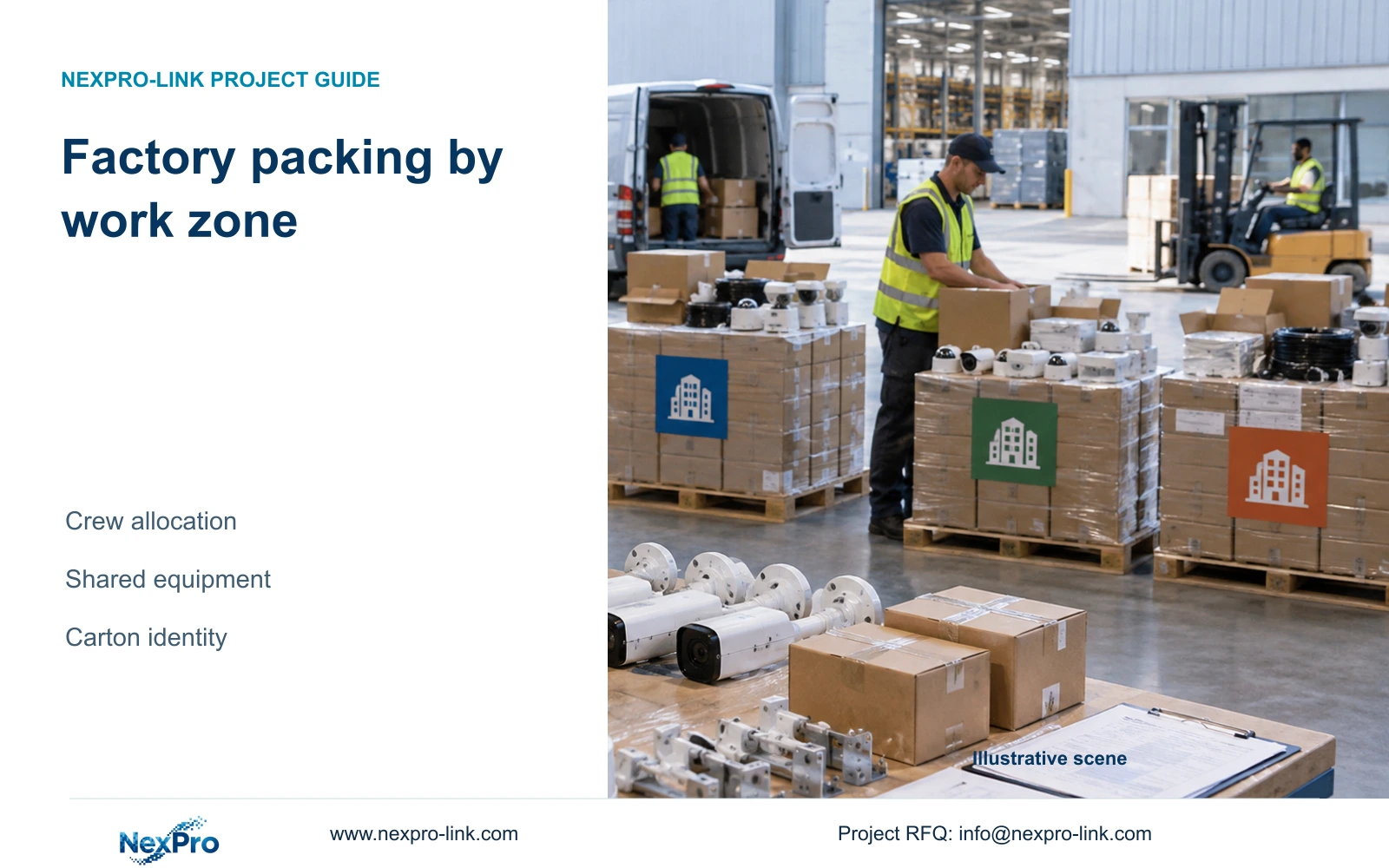
If destinations change after packing, revise the carton-to-work-package map before site issue. Preserve contents identity while correcting allocation, and identify shared items that must not be issued twice.
Section 01
Assign equipment to approved installation work groups
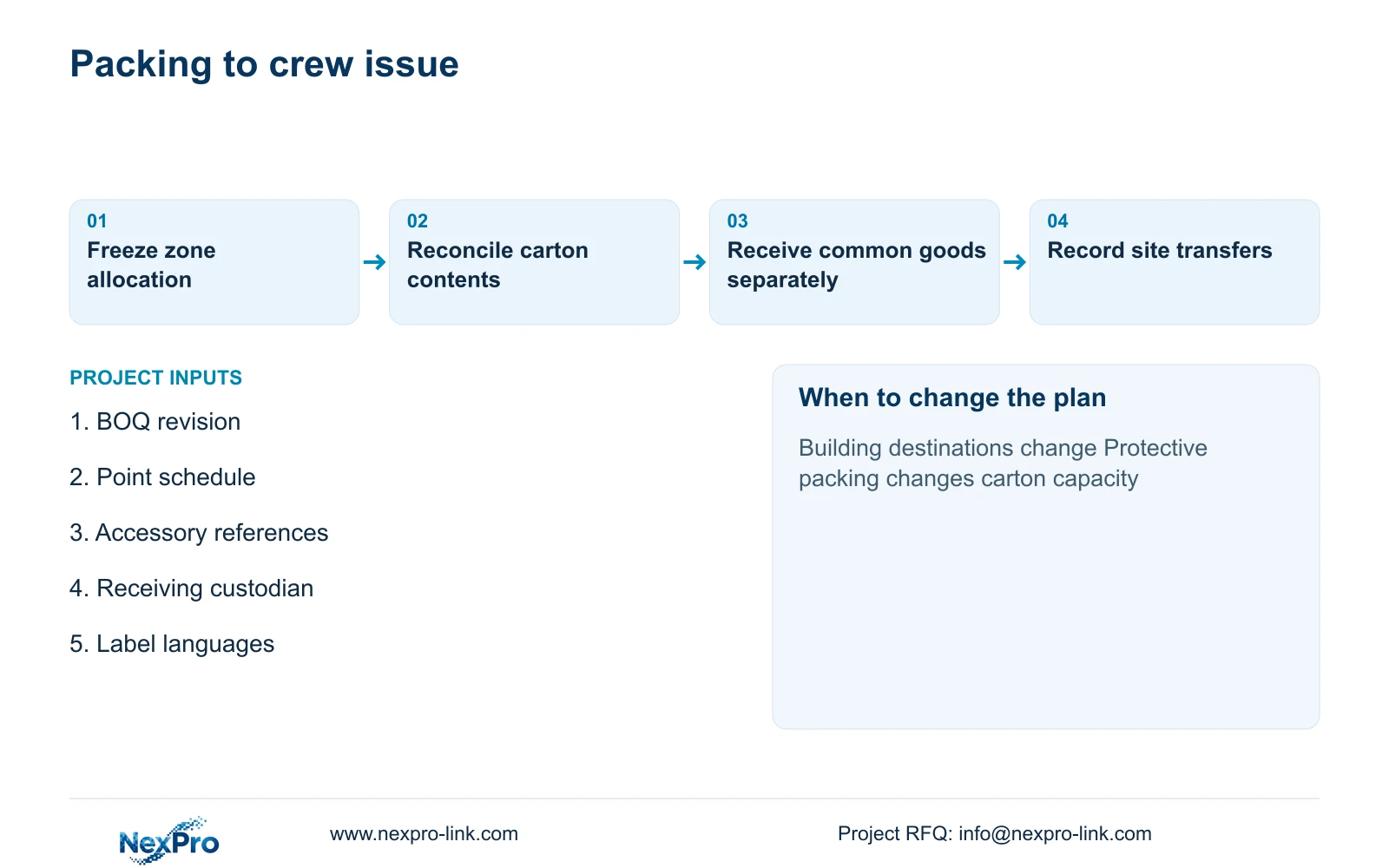
If destinations change after packing, revise the carton-to-work-package map before site issue. Preserve contents identity while correcting allocation, and identify shared items that must not be issued twice. Record who authorizes the new destination. A revised zone label does not itself revise the equipment's environmental or installation approval.
Factory security packaging by building and production zone should follow the approved installation schedule. Assign each device line to a building, zone and work package, then connect that allocation to carton contents. Keep shared equipment under a separate register. The aim is to let the receiving team issue the correct equipment without reconstructing the design from product-only boxes.
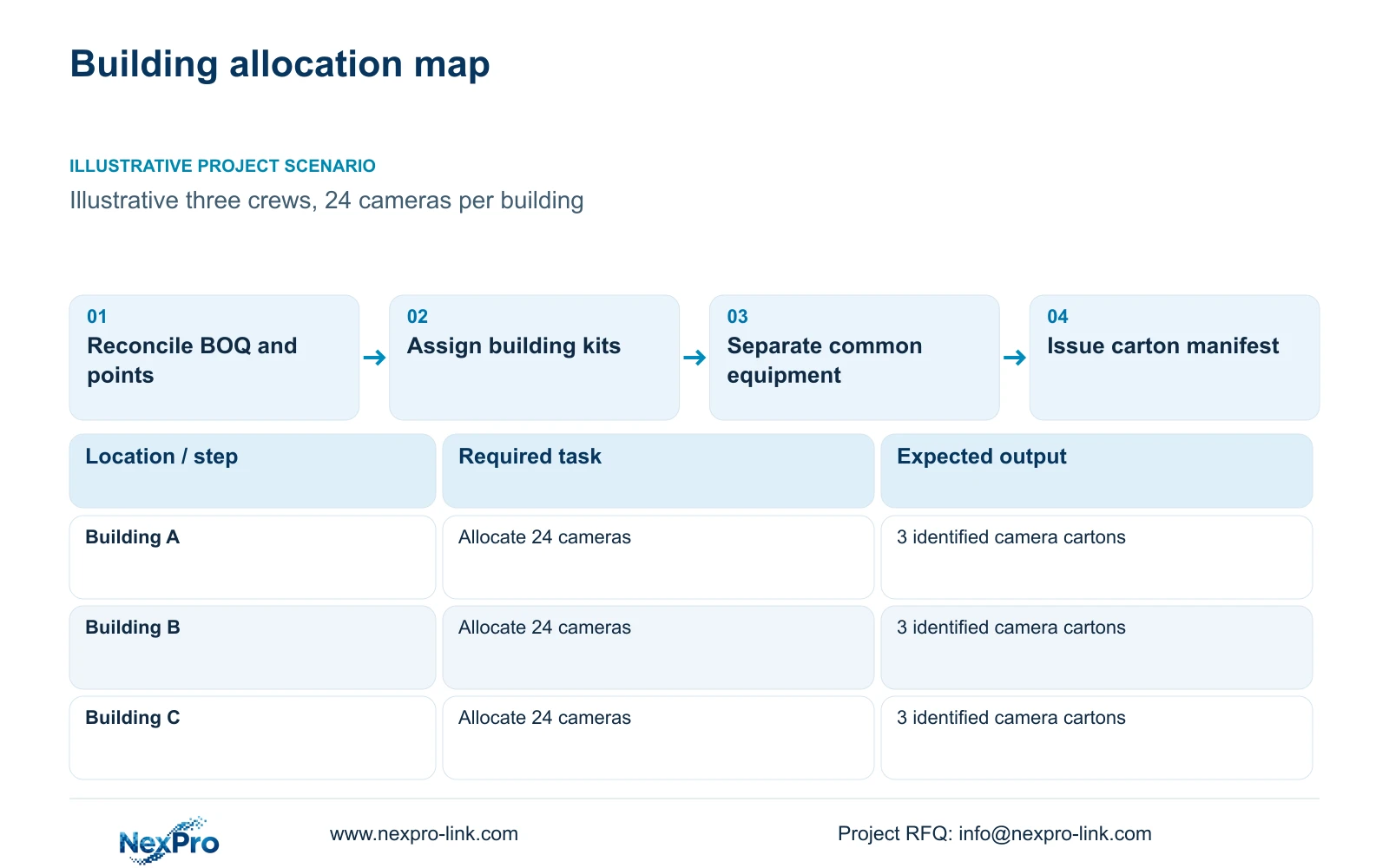
Illustrative project scenario: Three installation crews receive equipment for separate factory buildings. The supplied packing example assumes 24 cameras per building, giving 72 cameras altogether. Assume each crew has an approved point schedule and a designated receiving contact. These are planning arrangements, with no claim that this shipment or its installation has occurred.
Before requesting zone packing, reconcile the BOQ with the camera schedule. A BOQ gives purchasing quantities; the point schedule gives destinations and installation roles. Resolve discrepancies before assigning cartons. Otherwise a clean building label can send an incorrect model to the right building, leaving the crew with a precise label but an unusable installation kit.
Section 03
Make the carton manifest recoverable after unpacking
Give each outer carton a unique identifier and record its building, work package, models, quantities and included accessories. Keep an electronic manifest and place an appropriate contents record with the shipment. Serial mapping can connect units to cartons and later to installed locations. The site should be able to recover that mapping after the box has been discarded.
Specify packaging language and label hierarchy. The building code should be easy to find, but it must not replace the actual model description or obscure required product identity. Customer artwork is optional presentation scope; carton allocation is an installation-control task. Laser logos, box printing and third-party software branding remain separate decisions.
Record transfers when the site reallocates a unit between crews. Update the receiving register and point schedule using its serial or controlled asset tag. Do not alter the equipment's technical label to match a changed destination. This retains the original supply record while allowing the site allocation to evolve under a documented revision.
Section 04
Compare destination clarity at the same carton count
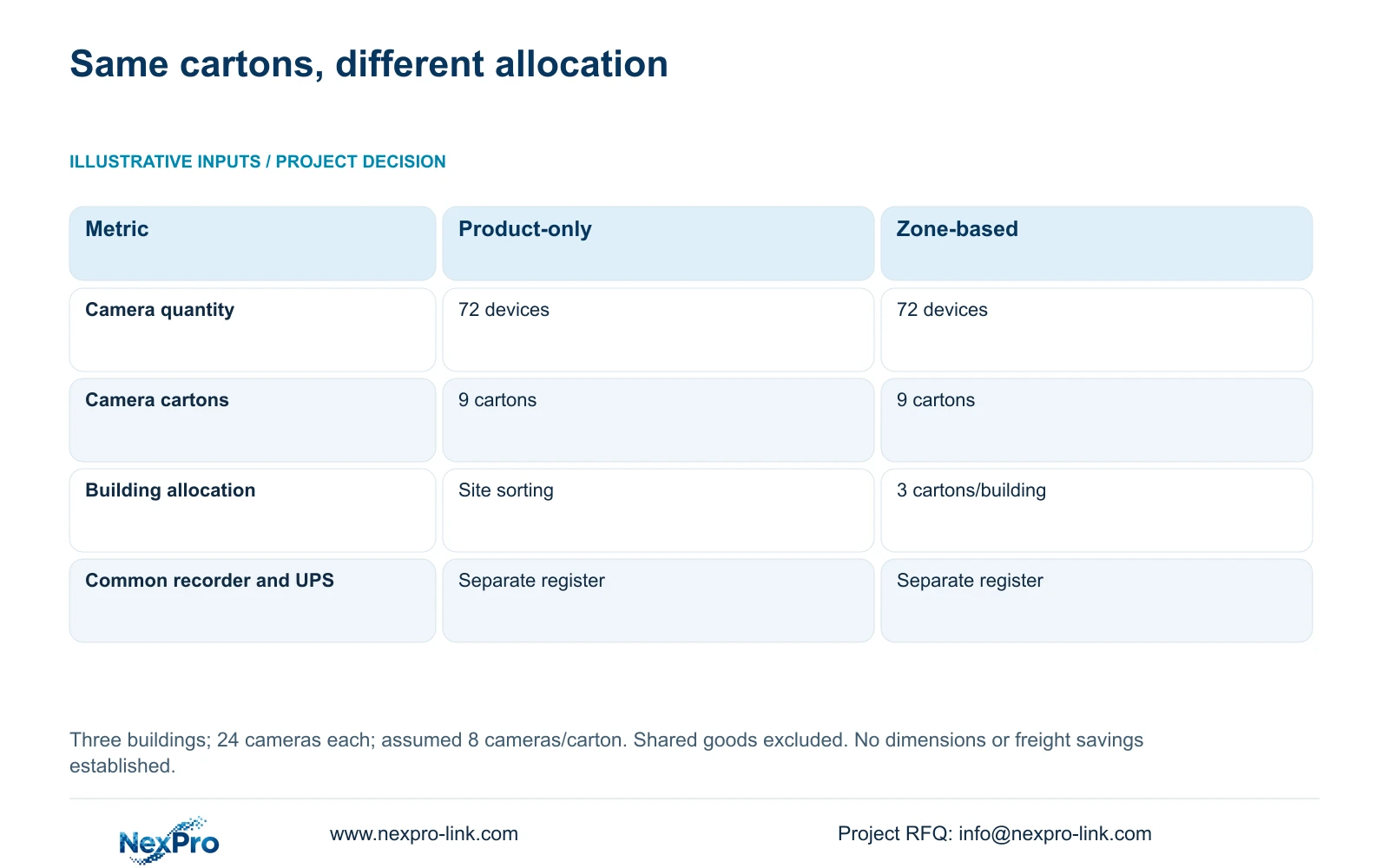
The supplied illustration assumes three buildings with 24 cameras each and eight cameras per carton. Total camera cartons = 72 / 8 = 9 cartons. Building allocation = 24 / 8 = 3 cartons per building. Both options contain the same 72 cameras and the same nine camera cartons; dimensions, packing construction and freight charges have not been established.
The decisive difference is where destination sorting occurs. Product-only packing leaves the site to allocate units from mixed destinations. Zone-based packing carries that allocation in the carton marks and manifest. It can make issuing equipment clearer, but the example does not prove fewer cartons, lower freight or reduced labour. Those conclusions need actual packing and work records.
Shared recorder and UPS equipment remain on a separate register in both options. They are not included in the nine-camera-carton total. Likewise, accessories that do not fit the assumed camera packing need their own identified packages. Treat eight cameras per carton as an illustrative input until the supplier confirms the actual models and protective packing.
| Decision | Product-only packing | Zone-based packing |
|---|---|---|
| Cameras | 72 devices | 72 devices |
| Camera cartons | 9 cartons | 9 cartons |
| Destination grouping | Mixed building destinations | 3 identified cartons/building |
| Shared recorder and UPS | Separate shared-scope register | Separate shared-scope register |
| Site issue method | Sort against point schedule | Issue against assigned zone manifest |
Section 05
Use zone packing when destinations are stable
For the three-crew scenario, choose identified cartons by building when the point schedules and crew allocations are approved. Give the site a release list for each building and retain common equipment separately. This preserves the camera specification while changing the preparation and receiving process. NexPro-Link's project and OEM packing scope can support discussion of that arrangement.
Use product-based packing with a controlled site allocation register when buildings are still changing, the owner has a central stores process or protective packing makes mixed work packages impractical. A hybrid can keep manufacturer product boxes inside identified outer cartons. Request confirmation of the actual arrangement instead of assuming every local kit must be physically mixed.
Compare supplier offers on manifest detail, accessory allocation, serial mapping and receiving responsibility. A larger preparation charge may include work otherwise left to site staff, but there is no supported saving figure here. Keep sample preparation, special labels and any repacking effort visible in the quotation so the project manager can decide who should perform each task.
Section 06
Connect factory release to site receiving
Release packing against a dated BOQ and allocation revision. State who approves the content list, who applies labels and who signs the site receiving register. NexPro-Link's BOQ support can help reconcile selected models with the list; the contractor must confirm that the building allocation reflects the approved installation sequence.
At dispatch, compare the carton manifest with order quantities and record common equipment separately. At receipt, count cartons, inspect visible condition and check discrepancies before issuing goods to crews. These are proposed control steps, not a claim that transport damage or labour savings have been measured. Any missing accessory should be assigned to an accountable supply line.
If building readiness changes after packing, revise the issue plan rather than silently relabelling the shipment. Keep the original packing identity and add the approved destination change to the receiving record. The final asset schedule should identify installed location independently of original carton destination, allowing commissioning changes without losing the procurement trail.
Section 07
Buyer questions
Can zone-based packing use neutral product boxes? Yes. Neutral individual boxes can sit within project-labelled outer cartons, provided the supplier confirms the protective arrangement and the manifest identifies the actual models and accessories. Custom colour printing is a separate choice.
What happens when one crew needs another building's camera? Make a controlled transfer in the receiving and point registers. Record the unit identity, original allocation and new destination so the packing list remains useful without pretending the initial allocation never changed.
Should spare devices be assigned to a building? Assign them according to the owner's spare-storage plan. If they are common project stock, mark them as shared spares with a custodian rather than including them in an installation quantity that a crew expects to mount.
Section 08
Prepare a building-based packing plan
Send the approved BOQ, building and zone allocation, accessory schedule, and receiving destination with label languages to info@nexpro-link.com to discuss camera kits and separately controlled shared equipment.
Engineering references
These sources support the general planning principles. Always use the selected product's current datasheet and applicable project standards for final design.