Delivered CCTV and UPS equipment needs a delay plan even when it remains unopened. Record custody, obtain model-specific battery instructions, and distinguish technical readiness from the written warranty clock.
Section 01
Manage the delay through separate custody and operating dates
When a factory opening slips after equipment delivery, manage storage care, commissioning readiness and warranty timing separately. Assign custody immediately, obtain exact model storage instructions and keep the applicable order terms with the asset record. Delayed operation does not by itself establish a new warranty start date or prove that stored batteries remain ready.
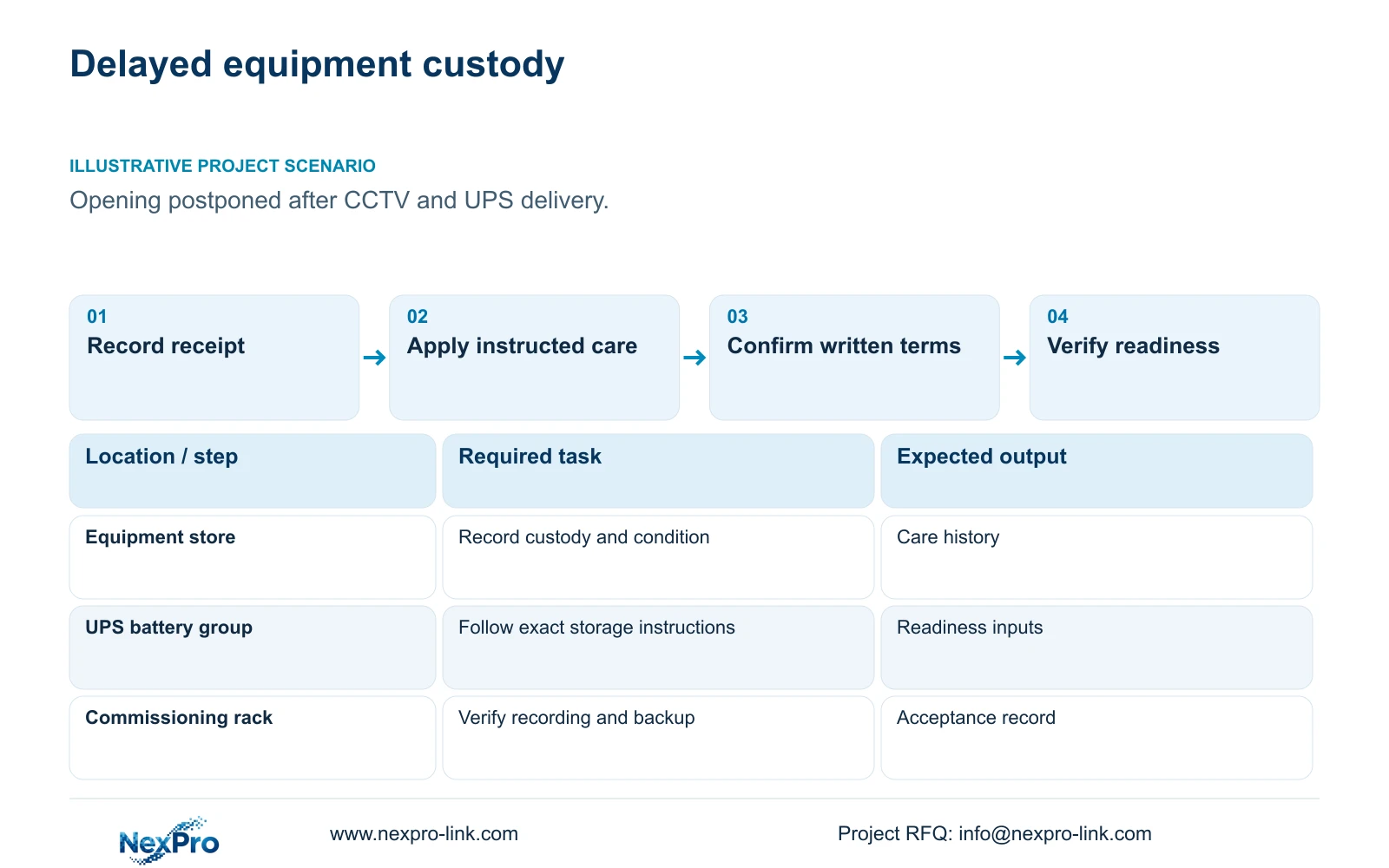
Illustrative project scenario: The building opening is delayed after CCTV and UPS equipment has been delivered. Assume cartons remain in an approved store while equipment-room completion is postponed. The teaching timeline records receipt at month 0 and commissioning at month 3. This relative timeline is an example, not a dated customer incident.
Record shipment, receipt, inspection, preparation and commissioning as distinct milestones. The project manager should identify which items are unopened, bench-prepared or already energized. In an operating-factory extension, also record which retained equipment must continue working while new stock waits. A revised opening date should trigger a care review without overwriting the original receipt evidence.
Section 02
Keep model-specific storage instructions with each equipment group
Create a storage register by model and serial group, naming the custodian, location and applicable instructions. The register should distinguish cameras, recorders, drives and UPS/battery assemblies because their handling and maintenance tasks differ. Record carton damage or environmental concerns promptly, and isolate suspect equipment from the installation-ready batch until its condition is resolved.
Obtain the selected UPS and battery configuration's storage, inspection and recharge instructions from the supplier. No universal interval, charge level or storage temperature is supplied for this article. Do not substitute an operating-temperature field from a camera datasheet for storage guidance, or assume that unopened packaging removes the battery maintenance task.
Where equipment was bench-prepared, retain its configuration and preparation records alongside custody history. Schedule permitted inspections without exposing devices to unfinished construction unnecessarily. If the approved store becomes unavailable, agree a replacement location and handling arrangement before moving stock. The delay plan should identify who performs and records care, not merely who owns the cartons.
Section 03
Record warranty scope by item instead of choosing the longest headline
The supplied NexPro-Link warranty policy gives an eligible-main-equipment baseline of 24 months from receipt. The rack UPS page separately uses a 1–2-year product term. Preserve both statements and obtain the controlling quotation or order terms for the exact supplied items. Batteries, storage, accessories and local service should have their own scope entries.
Record the applicable trigger, duration, covered item and support route with the model and receipt evidence. Ask the supplier to resolve any conflict in writing before assuming one public statement controls every product. Retain a different project-specific term only where the applicable written order establishes it; do not generalize that term to other orders.
Separate equipment warranty from installer support and commissioning obligations. The cost manager should request the treatment of labor, transport and replacement handling rather than infer that these are included in the equipment period. If an opening-based arrangement is requested, record it as a proposed commercial change until written acceptance establishes its terms.
Section 04
Show how a delayed start changes the remaining period
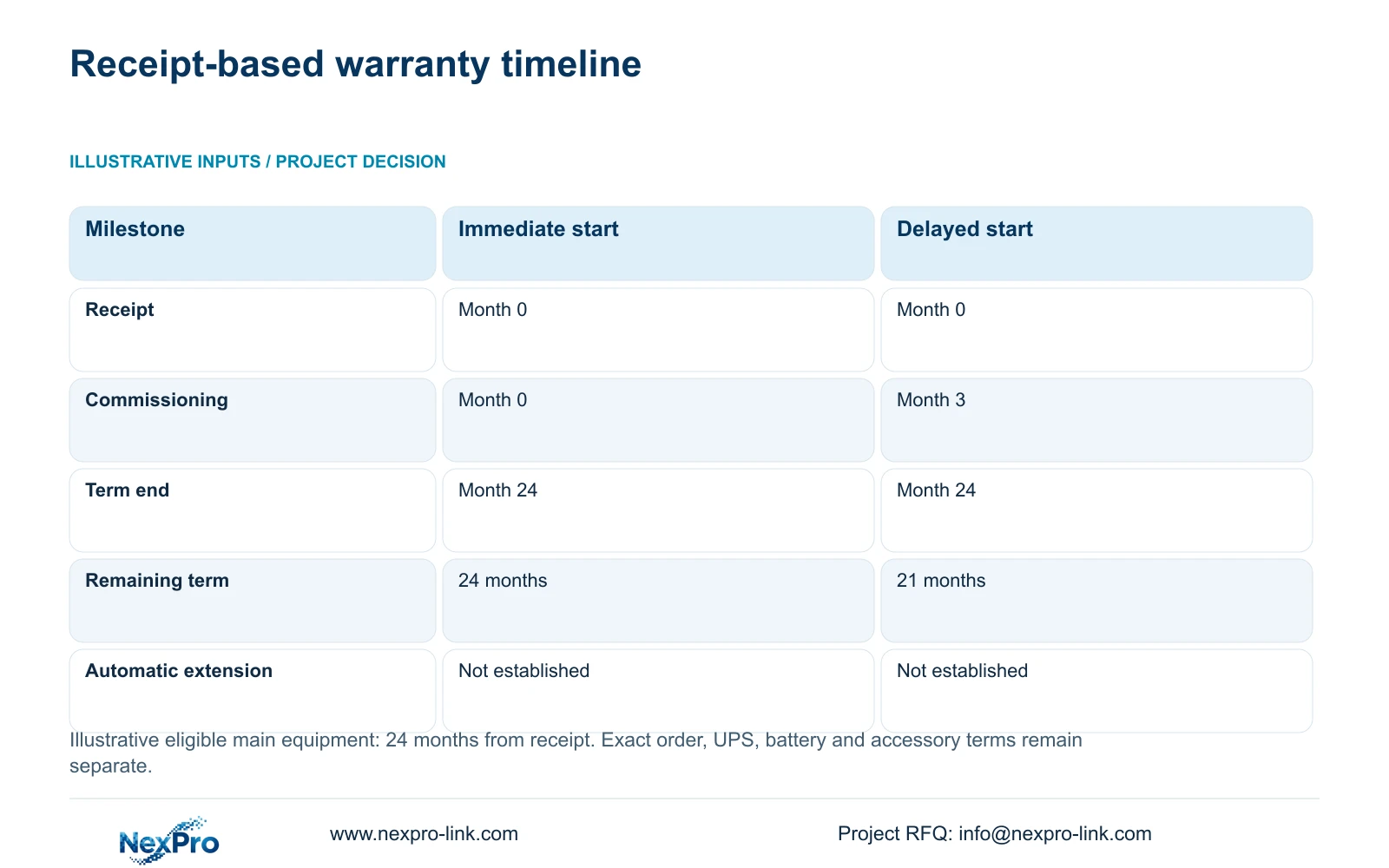
The illustrative receipt-based timeline assumes eligible main equipment has a 24-month term beginning at month 0. Immediate commissioning at month 0 leaves 24 months. Commissioning at month 3 leaves 24 - 3 = 21 months, while the illustrative end remains month 24. The opening delay has not established an automatic extension.
The decisive difference is the amount of the original period remaining when operations start. This arithmetic does not assign the same term to UPS batteries, drives or local installation. Nor does it establish how a particular commercial disagreement must be resolved. Use the exact order dates and agreed scope for the buyer's item-level record.
Keeping this timeline beside the storage register makes the choices visible. The owner can request a revised shipment strategy for undelivered batches, a written term arrangement or separate post-storage readiness work. None of those actions should be described as accepted until the relevant supplier and project parties confirm them.
| Milestone | Immediate commissioning | Delayed commissioning |
|---|---|---|
| Receipt | Month 0 | Month 0 |
| Commissioning | Month 0 | Month 3 |
| Original term end | Month 24 | Month 24 |
| Remaining at commissioning | 24 months | 21 months |
| Automatic extension | Not established | Not established |
Section 05
Recheck operating readiness before connecting delayed equipment
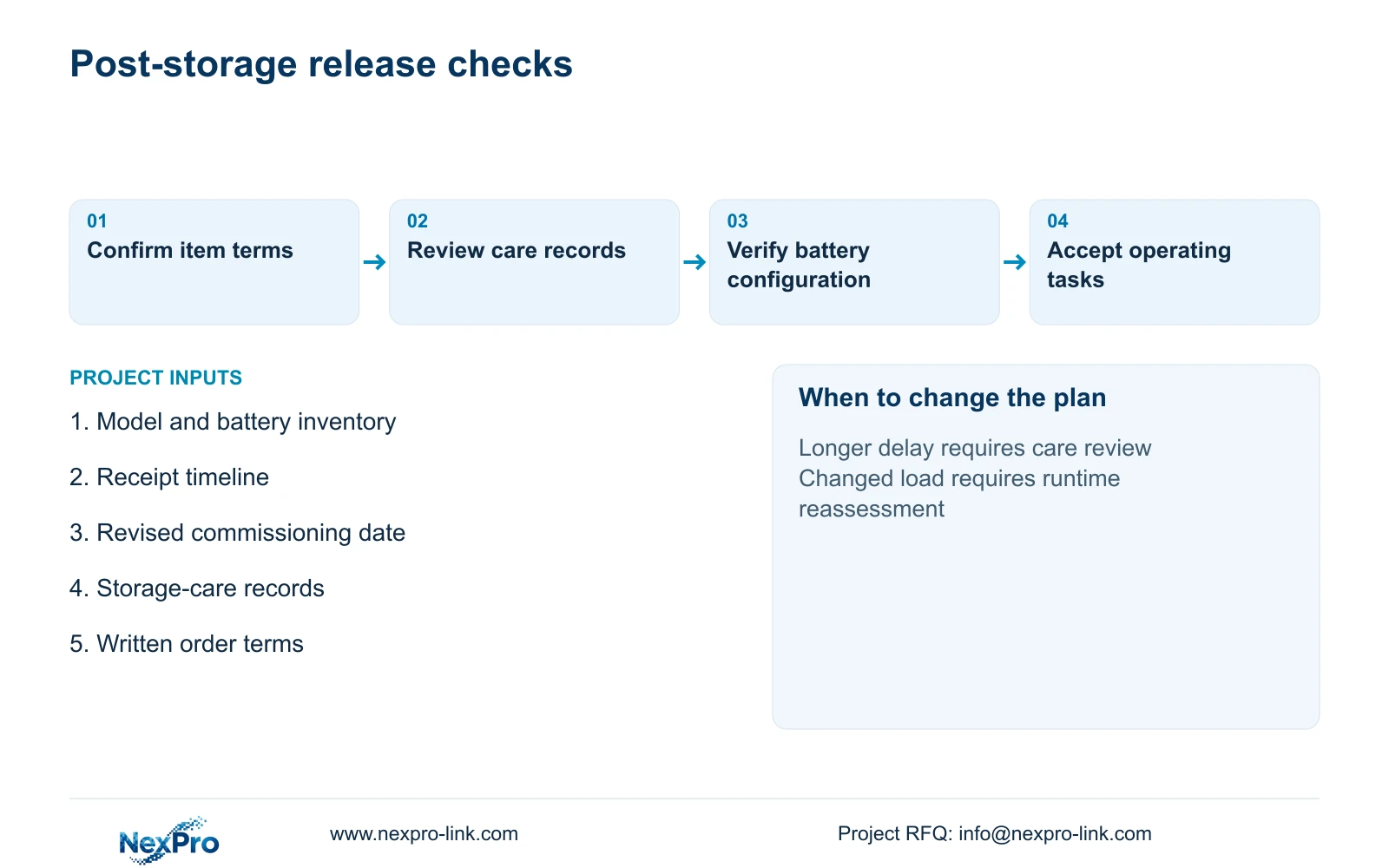
Prefer a controlled care and recommissioning plan for equipment already delivered, while staging undelivered items against realistic zone dates where commercially practical. Before energization, the local team should confirm the equipment room, electrical interfaces and installation condition. Then verify recorder disks, actual streams, operator retrieval and the selected backup configuration.
CASE09's full recording-priority reference assumes a 682.7407 W load and 341.3704 Wh of load-side energy for a 30-minute objective. Its SP1KR(S) reference is rated 1kVA/900W. The energy calculation is not demonstrated runtime, especially after storage. Confirm the exact battery configuration, state and relevant runtime evidence before accepting the outage task.
NexPro-NVR4449-4K's four bays and published input capacity also do not prove post-storage disk condition or the required recording workflow. Check those tasks on the supplied system. If the delayed factory layout changes camera positions or network nodes, update the affected design inputs before testing against an obsolete commissioning schedule.
Section 06
Release delayed stock with a documented care and acceptance record
Prepare a delayed-stock release list showing custody history, completed instructed care, outstanding condition questions and the receiving installation zone. Assign the supplier to clarify product instructions and terms, the custodian to record storage actions, and the local installer to verify site interfaces. The owner should accept the operational tasks separately from the commercial warranty record.
NexPro-Link's project supply scope can support revised equipment coordination, packing and delivery arrangements for remaining batches. Request item-level clarification where UPS product terms differ from the general main-equipment policy. Model substitution should not be used to erase an unresolved storage issue; any replacement needs its own approved technical and commercial basis.
At commissioning, retain the actual start date, tested configuration and acceptance results without changing the original receipt date. If the project contains retained operating equipment, book any shared-path changes within permitted windows and preserve a restoration plan. A complete delay handoff explains what was stored, how it was cared for and what was verified before use.
Section 07
Buyer questions
Does unopened packaging establish that a stored UPS is ready? No. Readiness depends on the exact battery configuration, instructed care and commissioning checks. Obtain the applicable storage instructions rather than applying a generic recharge interval.
Should all items share one warranty date in the asset register? Only where their written terms establish the same trigger and scope. Keep model-specific equipment, batteries, drives and local service distinguishable so a general date does not hide exceptions.
Can warranty timing be renegotiated after delivery? It can be requested, but a revised arrangement must be confirmed in writing. Until then, retain the documented original basis and do not present the later opening as an agreed extension.
Section 08
Resolve the delayed-stock release basis
Send the model and battery inventory, receipt/commissioning timeline, storage-care records and relevant quotation or order terms to info@nexpro-link.com to discuss readiness inputs and item-specific supply clarification.
Engineering references
These sources support the general planning principles. Always use the selected product's current datasheet and applicable project standards for final design.