For a retained Dahua component, demonstrate the intended recording and retrieval task with the exact proposed combination before approving reuse. Record unsupported features and their accepted treatment.
Section 01
Define the recording service before selecting a platform
For a retained Dahua component, demonstrate the intended recording and retrieval task with the exact proposed combination before approving reuse. Record unsupported features and their accepted treatment. Keep an independently working recording package distinct from integration into the retained platform; one successful live stream does not qualify both offers as equivalent.
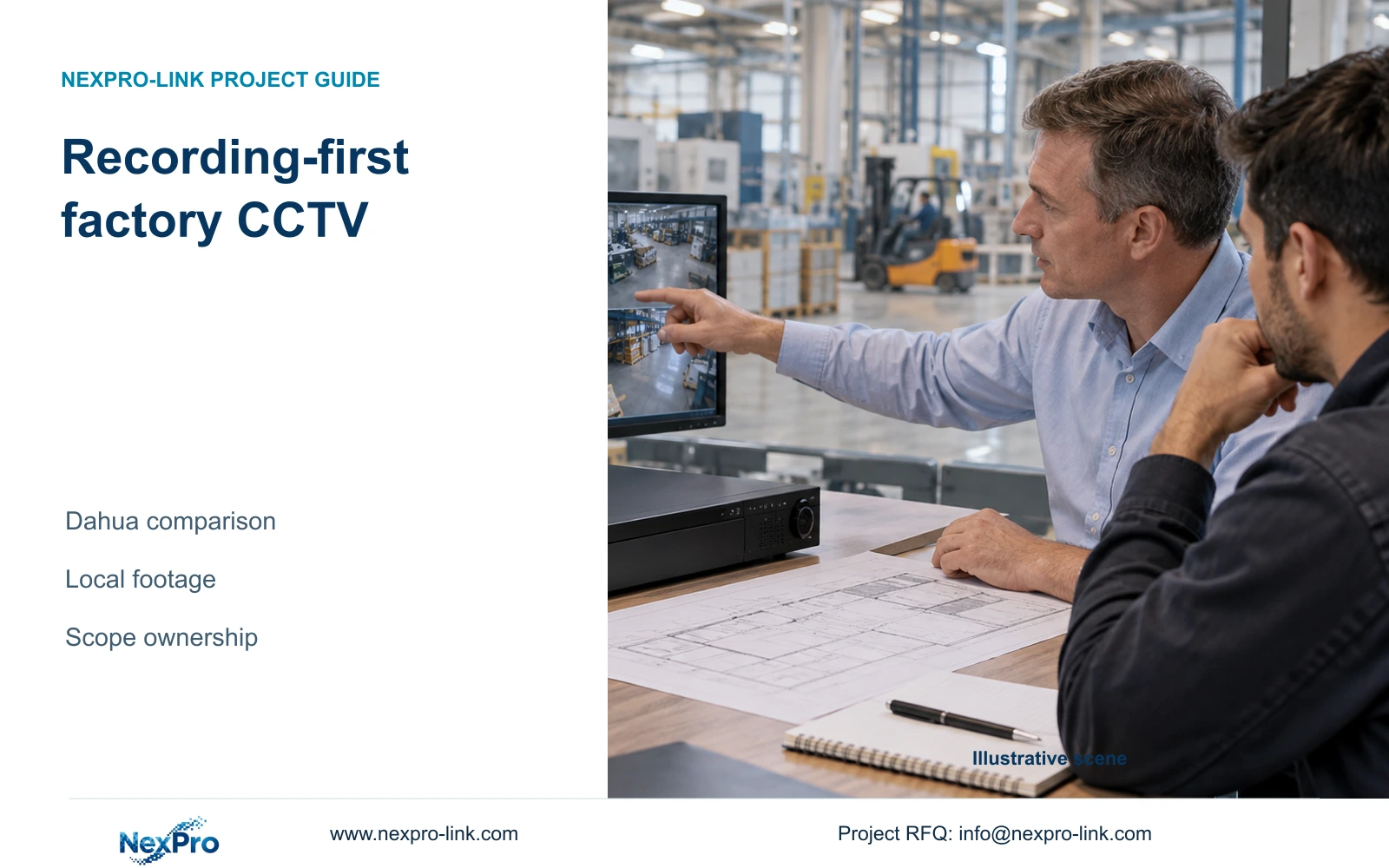
For a recording-first factory, compare NexPro-Link and Dahua packages by usable local footage, reliable retrieval and the remote-access tasks the owner actually needs. Preserve any required Dahua-specific integration as a separate qualification item. Comparing a basic recording package only against a flagship management system produces a misleading technical and commercial baseline.
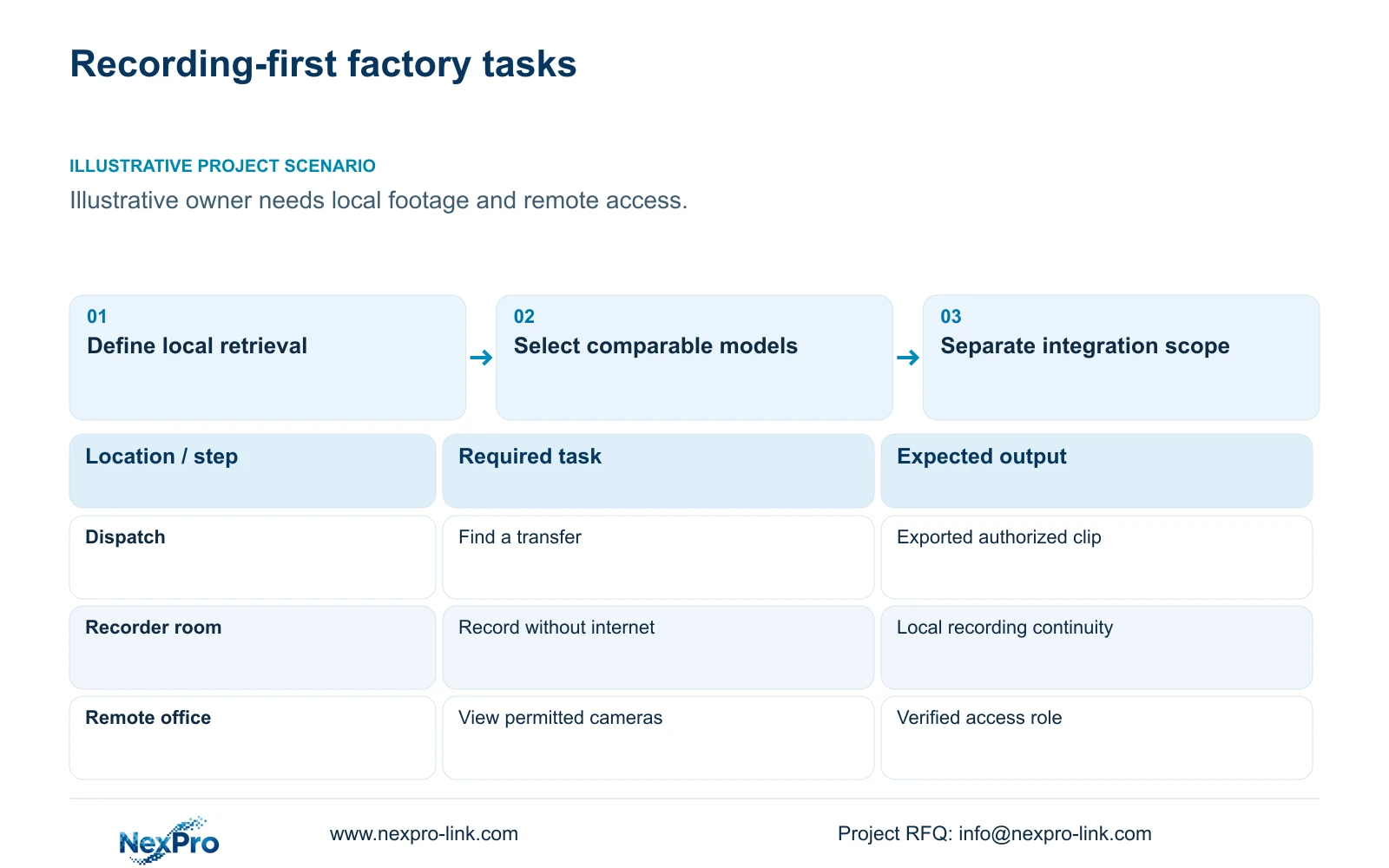
Illustrative project scenario: The owner's primary requirement is usable local footage and practical remote access. Assume the CASE01 factory has 32 ordinary-area views and an operator who searches by camera location and approximate event time. The owner is considering a Dahua proposal alongside a NexPro-Link alternative, without an established requirement for centralized enterprise administration.
Translate practical access into explicit actions: view selected cameras, locate a recorded transfer and export a clip for an authorized reviewer. Identify who performs each action and whether it must remain possible without internet access. Local recording and remote access have different dependencies, so acceptance should test them separately.
Section 02
Choose competitor models that fit the same service
Ask the Dahua bidder to identify camera models, recorder modes, regional firmware and included software. Its manufacturing-solutions material provides industry architecture context, but does not establish the performance or price of an unspecified camera. A suitable budget or midrange configuration belongs in the comparison if it can meet the accepted task.
The NexPro-BL2812M55-5MP-DIC-AI is an ordinary-area reference with listed 2880×1620 main output, 25fps at 5MP and a 2.8–12mm motorized lens. Use these fields to plan a trial view rather than treating the 5MP label as a guaranteed advantage over another resolution. Confirm the mounting position, target width and moving-object detail in recorded footage.
For recording, NexPro-NVR4449-4K lists 320Mbps input, four SATA bays and up to 18TB per drive. Its published summary separates 49×5MP and 9×4K modes. The Dahua offer should provide equivalent mode evidence for its selected streams, plus playback and export requirements. Neither a generic channel count nor a shared 4K label proves the complete workflow.
Section 03
Carry retention and access into the complete package
CASE01 assumes 32 cameras averaging 4Mbps, recording continuously for 30 days. The illustrative formula is video_TB = cameras × average_Mbps × 10^6 × 86400 × days / 8 / 10^12. Substitution gives 41.472TB of video and 128Mbps aggregate input. Both bidders should price the same accepted recording quality and period, then replace the assumed bitrate with project evidence.
Four 16TB disks give 64TB raw capacity. With the case's 95% usable-space factor and 20% reserve, recording_budget = 64 × 0.95 × 0.80 = 48.64TB. Compare 41.472TB directly with that budget; adding the reserve again would distort the result. These are planning assumptions, and no RAID arrangement is claimed.
Treat remote access as an end-to-end service. Assign the owner responsibility for accounts and approved connectivity, the installer responsibility for network configuration, and the equipment supplier responsibility for the quoted device and client scope. Test the exact camera-recorder-client combination where mixed equipment is proposed. ONVIF applicability alone cannot settle every search, event or audio requirement.
| Item | Required task | Scope status | Responsible party |
|---|---|---|---|
| Recorder and four disks | Retain the agreed recording period | Supplied and compatibility-qualified | Equipment supplier |
| Camera access network | Deliver all accepted streams | Supplied or approved retained network | Network installer |
| Remote accounts | Allow authorized selected-camera access | Owner-managed | Factory security administrator |
| Dahua platform interface | Preserve any mandatory existing workflow | Retained or separately qualified | Platform integrator |
Section 04
Price the usable service rather than the goods list
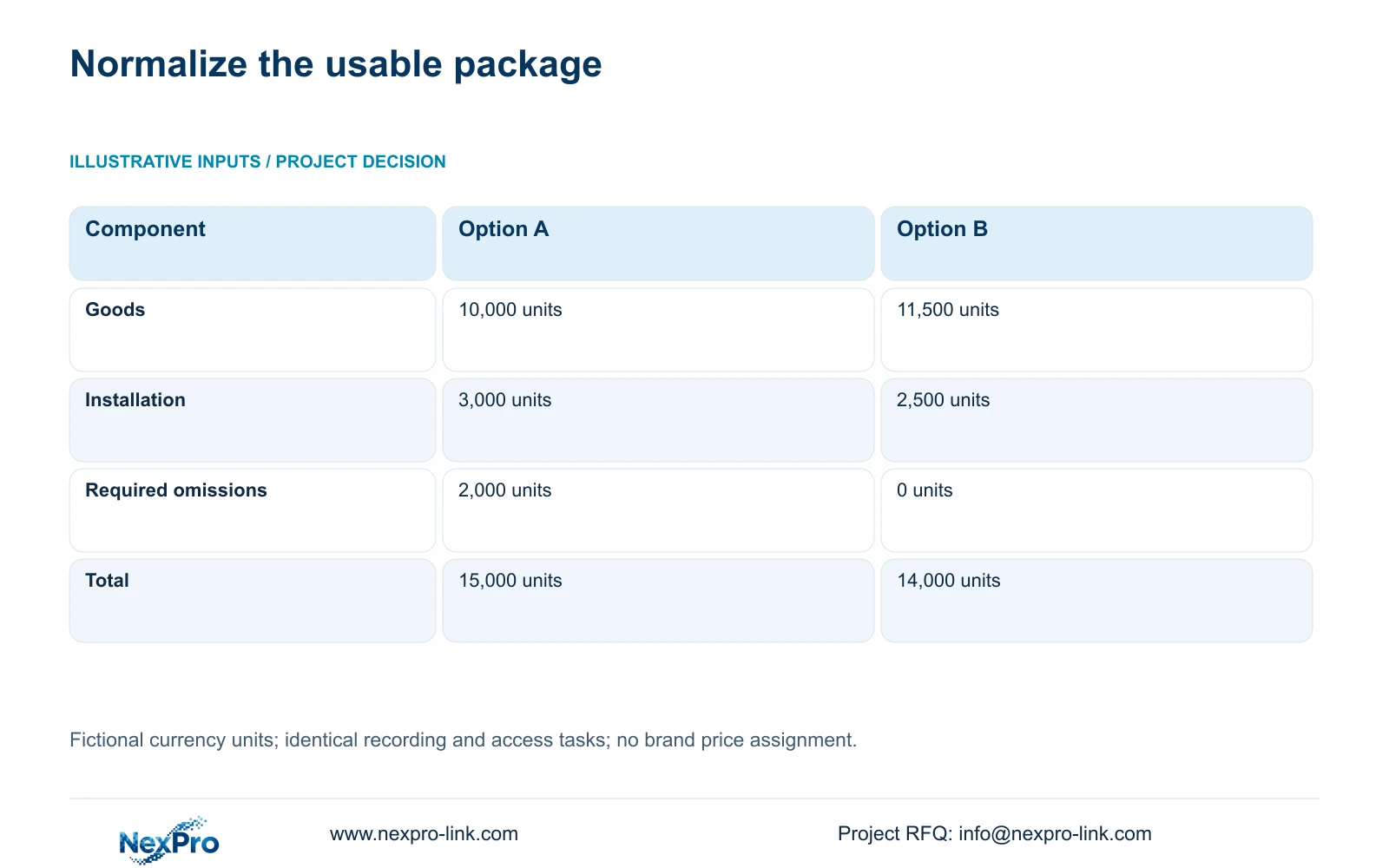
Use a common commercial schedule after the recording and access requirements have passed technical review. In the fictional example below, normalized_total = goods + installation + required_omitted_items. A totals 10,000 + 3,000 + 2,000 = 15,000 currency units; B totals 11,500 + 2,500 + 0 = 14,000 units. A_total minus B_total equals 1,000 units.
The lower goods quotation becomes the more expensive completed package because required omissions outweigh its initial advantage. In a real recording-first review, an omission might concern disks, an access configuration task or installation, but the supplied 2,000-unit figure is not a price for any particular item. Neither option represents NexPro-Link or Dahua.
Keep optional integrated management outside the required-service total until the owner defines its use. If it is required, include its licenses, hosting and implementation in both offers. Normalize quotation dates, quantities, currency and delivery scope before claiming a saving. An unpriced dependency remains unresolved rather than becoming a zero-cost assumption.
| Component | Option A | Option B |
|---|---|---|
| Goods | 10,000 units | 11,500 units |
| Installation | 3,000 units | 2,500 units |
| Required omitted scope | 2,000 units | 0 units |
| Normalized total | 15,000 units | 14,000 units |
Section 05
Keep the recording-first option unless management has a defined job
For the stated scenario, recommend evaluating a complete local recording package first. Demonstrate retrieval and export on the actual proposed hardware, then test authorized remote access under the owner's network policy. This gives the owner a usable decision without purchasing enterprise functions solely because expansion might happen someday.
Change that recommendation when the plant requires a defined Dahua-specific event workflow, centralized permissions or integration with an existing platform. Ask the integrator to demonstrate the requirement using the offered versions. If a NexPro-Link alternative cannot provide that function within an accepted arrangement, retain the relevant Dahua scope and compare only the remaining substitutable equipment.
CASE01's recording-priority design also retains a modest operator display. Its optional four-panel LCD wall is a separate operating choice, not part of the retention calculation. Protect recording equipment and necessary network devices according to their actual electrical circuits; adding a central UPS does not protect an independently powered remote switch.
Section 06
Make the sample workflow the procurement acceptance record
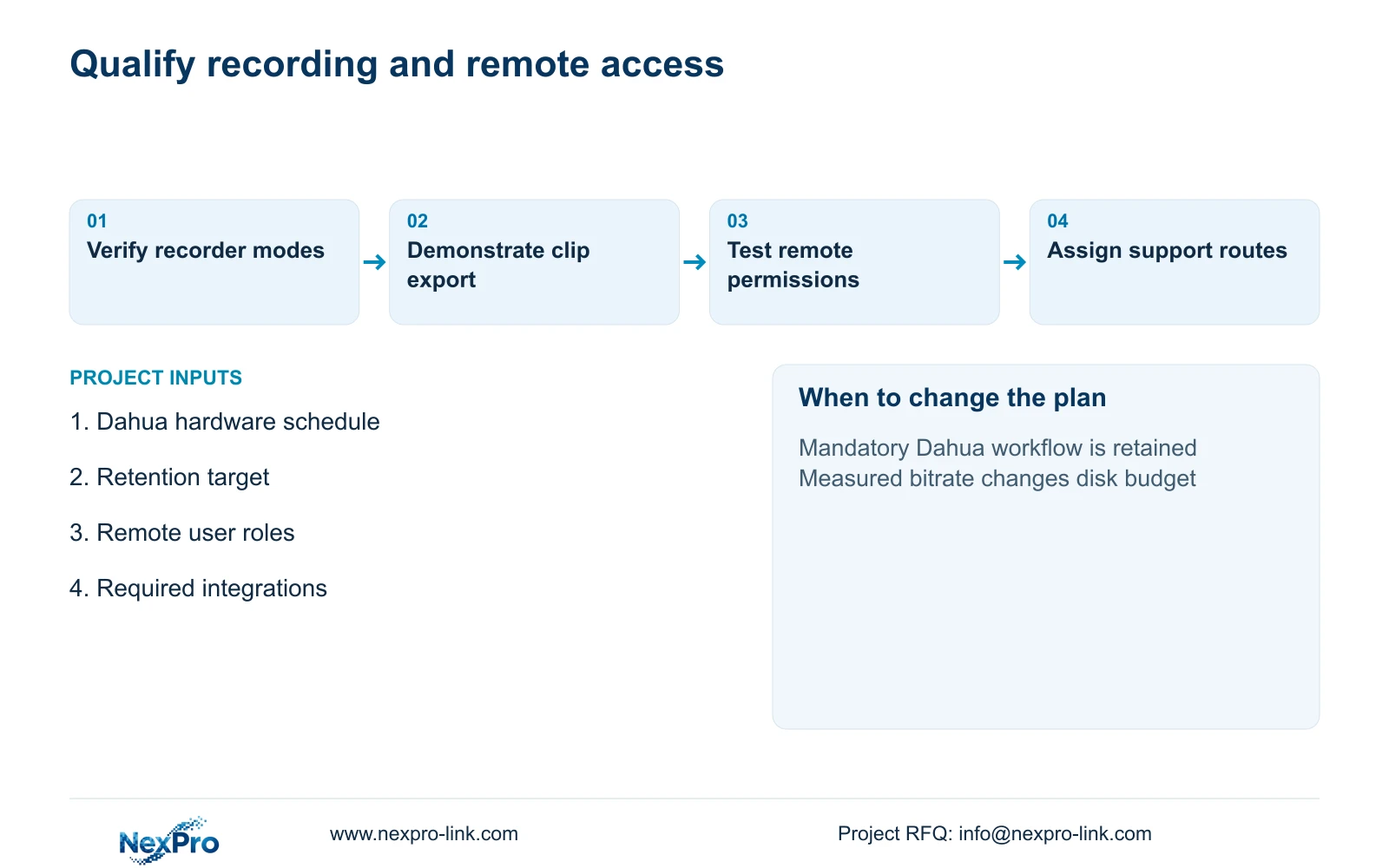
Document the demonstrated camera, recorder and client versions with the approved retrieval sequence. The installer should be able to reproduce that sequence after shipment and at handover. Record any feature available only through a particular client or integration, so the owner does not mistake a demonstration setup for a capability included everywhere.
A procurement-ready delta table should identify supplied recording equipment, retained infrastructure, optional management and local installation. NexPro-Link can discuss model matching, technical submittals and coordinated equipment preparation through its BOQ support scope. Include project tags and packing references where they help the installer connect the delivered equipment to the accepted schedule.
Define escalation separately for lost remote access and lost local recording. Their consequences differ, and the responsible party may differ too. Agree the equipment support route, local service scope and configuration records before the order. This turns a recording-first comparison into a manageable operating package rather than a collection of loosely matched products.
Section 07
Buyer questions
Is internet access required for the illustrative retention target? The target is based on local recording. Remote access needs its own connectivity, but the proposed recorder should demonstrate continued recording during an approved internet-disconnection test.
Can an existing Dahua recorder remain in the alternative? Potentially, if its exact model, firmware, input modes, storage and required feature paths are qualified with the proposed cameras. Treat reuse as a tested retained component, not automatic mixed-brand compatibility.
Should the owner remove enterprise software from every bid? No. Remove it only when its functions are unnecessary and the procurement rules permit that change. Keep software that supports a mandatory operating or integration task.
Section 08
Define your recording-first comparison
Email the Dahua model and firmware schedule, retention and export requirements, remote-access user roles, and complete quotation scope to info@nexpro-link.com to discuss a matched NexPro-Link recording package.
Engineering references
These sources support the general planning principles. Always use the selected product's current datasheet and applicable project standards for final design.