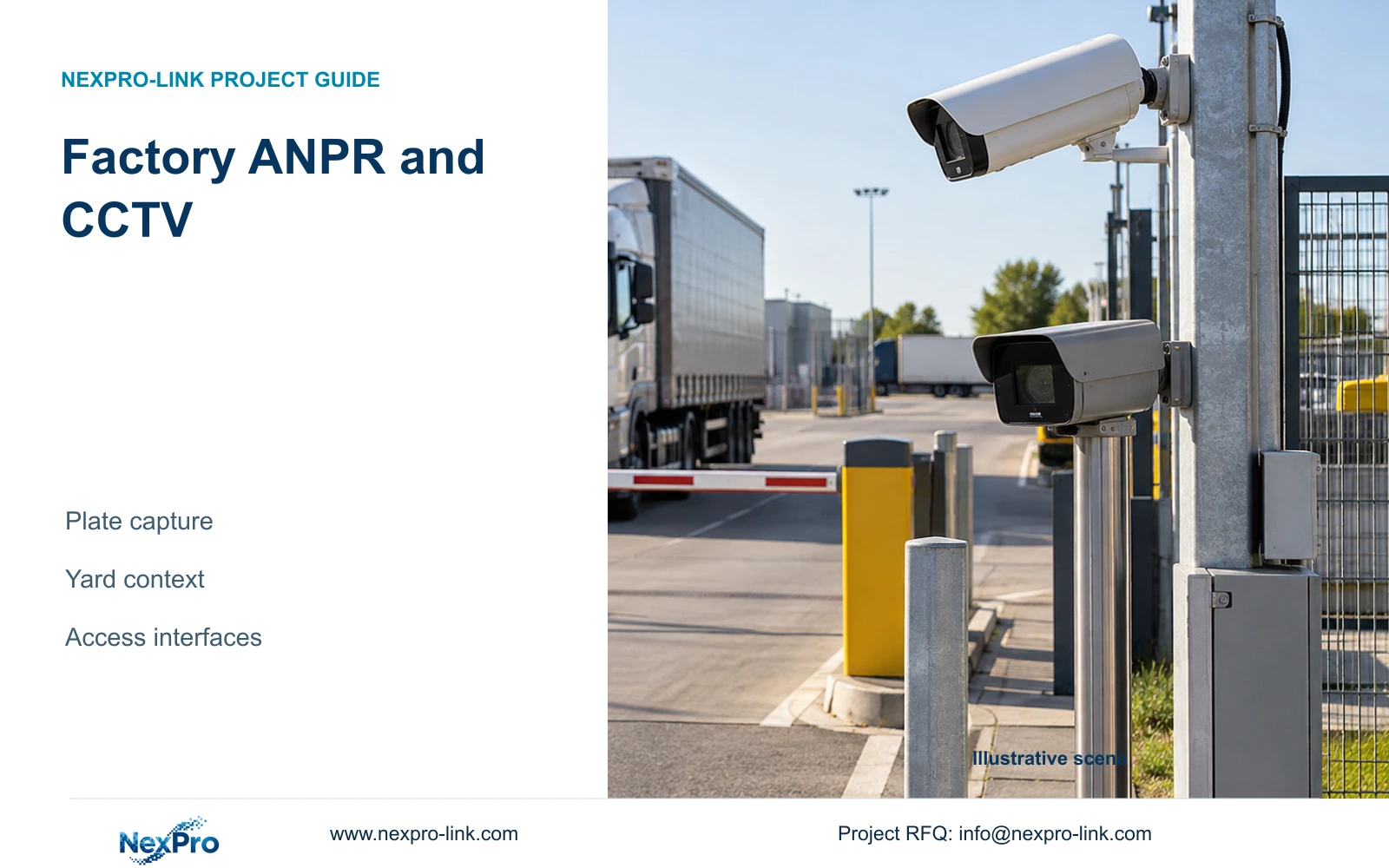
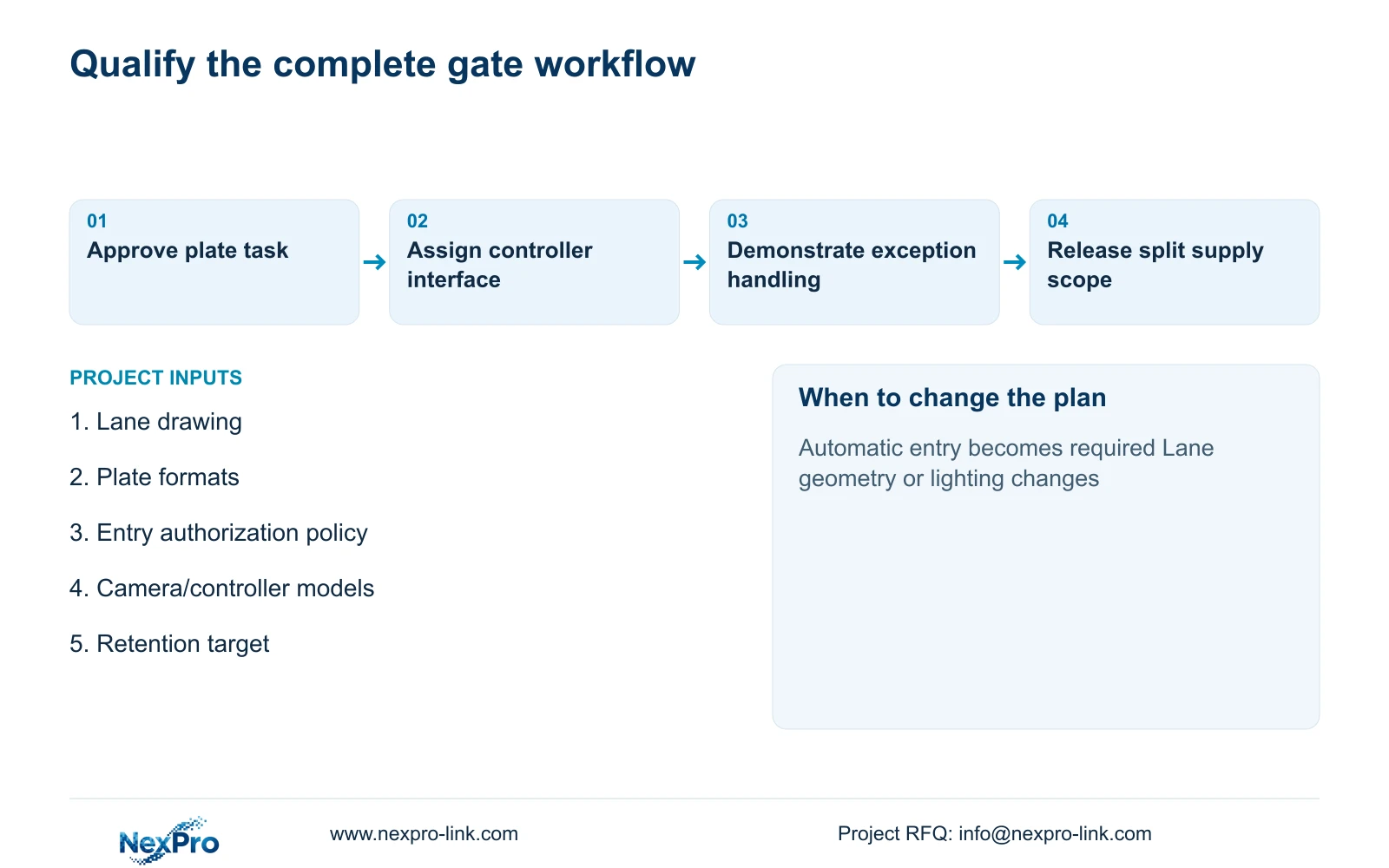
Ask each qualifying lane proposal to demonstrate the owner's handling of an unread or ambiguous plate. Record what video, plate result and authorization record remain available, without assuming automatic barrier action.
Section 01
Decide whether the gate needs plate records or vehicle alerts
Ask each qualifying lane proposal to demonstrate the owner's handling of an unread or ambiguous plate. Record what video, plate result and authorization record remain available, without assuming automatic barrier action. An alternative that omits this agreed exception workflow cannot be called equivalent solely because it recognizes a favorable sample plate.
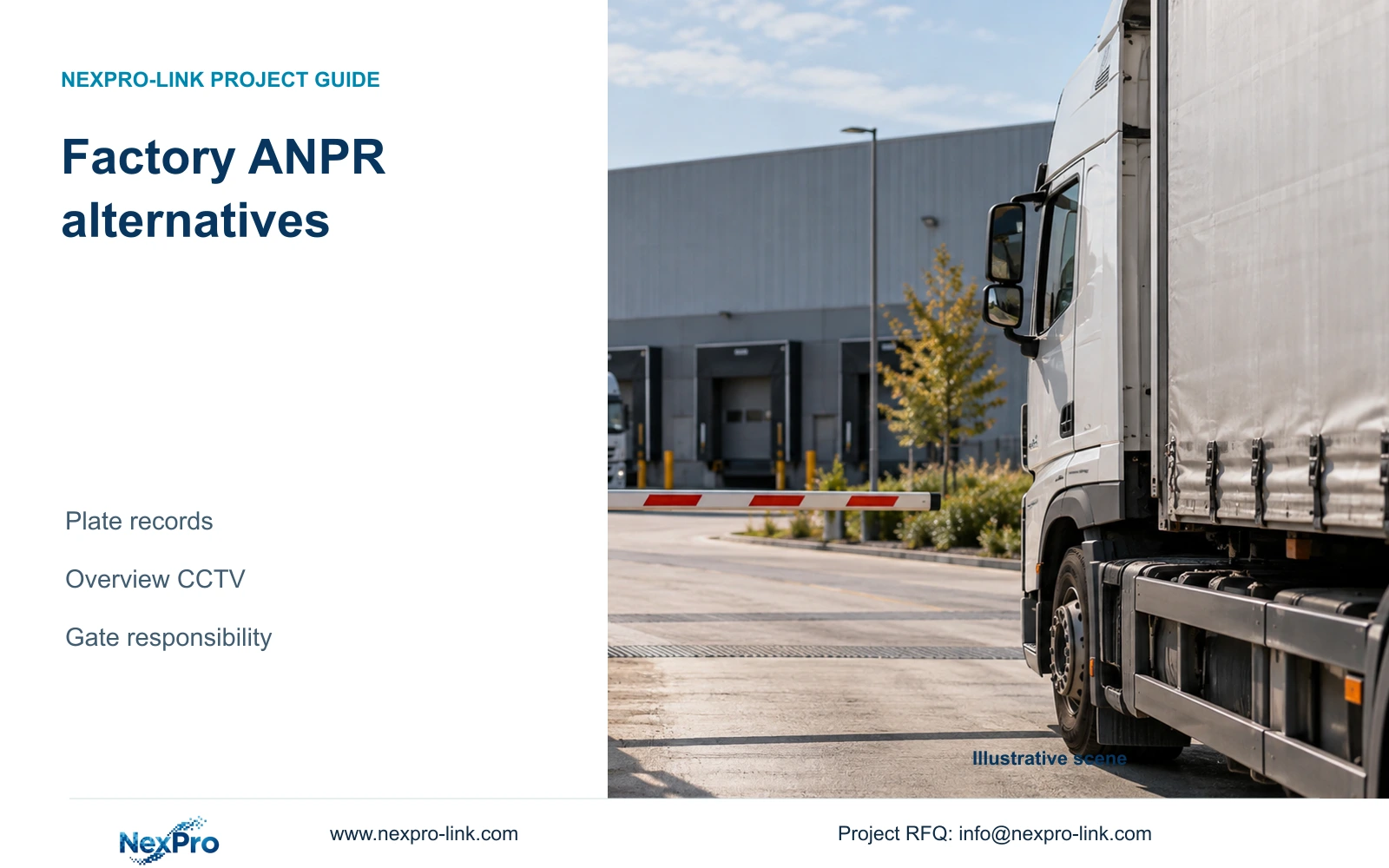
Compare factory ANPR alternatives at the function level. A general camera that classifies a vehicle does not thereby read its plate, create a searchable plate record or authorize entry. If plate reading is required, retain a dedicated, qualified plate solution in every compliant offer and compare the ordinary overview cameras separately.
Illustrative project scenario: One proposal includes ANPR devices while another only lists vehicle detection on general cameras. Assume the factory wants to review deliveries at its gate and is deciding whether plate-based lookup or automatic entry is necessary. Use CASE01's four gate-overview views as ordinary security context, without assigning them a plate-reading capability.
Ask the owner to choose the required result: an alert that a vehicle entered a view, a readable plate image for manual review, a searchable plate text record, or a qualified authorization workflow. These results have different equipment and interface requirements. A proposal should state which it delivers and which remain outside its scope.
Section 02
Compare the complete event from approach to retrieval
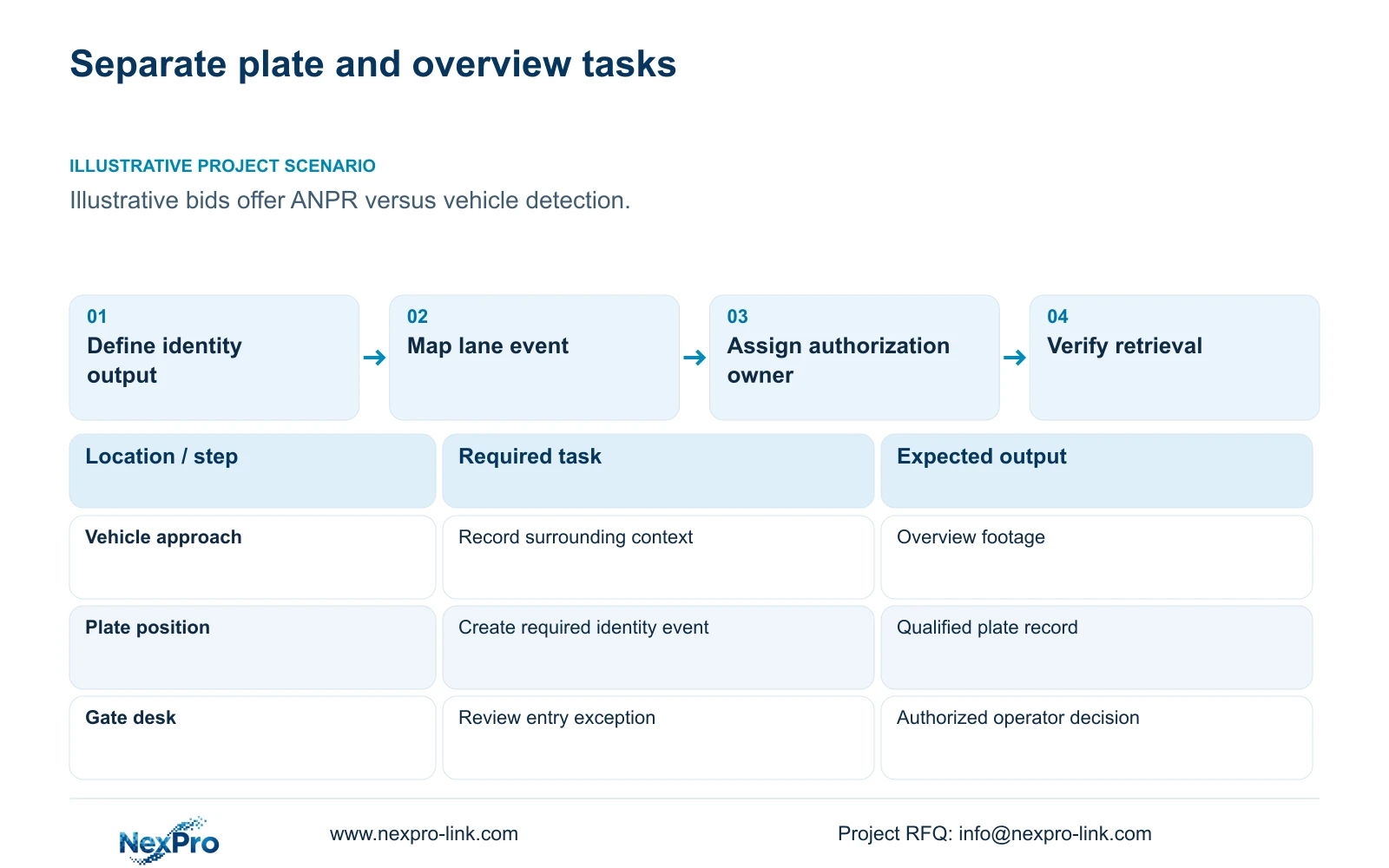
Map the lane event before selecting equipment. Record vehicle approach, the intended capture position, the plate event, the review or authorization step, and the associated overview footage. The design brief should include lane geometry, vehicle movement, plate formats and expected lighting so each supplier qualifies the same task.
Separate plate capture from the wider view of the driver, vehicle and load. A dedicated plate view may support an identity event while an ordinary camera provides surrounding context. The buyer should be able to retrieve the related records by an agreed reference such as lane, timestamp and delivery event, without assuming a custom integration already exists.
For the dedicated route, require exact models, regional plate scope, firmware and evidence of the offered search workflow. For the general-camera route, demonstrate the promised vehicle alert and footage retrieval. A readable plate in one sample does not establish automated recognition, and a successful recognition demonstration does not establish every gate-controller interface.
Section 03
Assign authorization and barrier behavior to named owners
Keep the authorization decision separate from the camera's observation. The factory owner defines who may enter and how exceptions are handled; the gate-system integrator qualifies the controller interface; the local installation team implements the accepted equipment arrangement. Ordinary surveillance should not acquire an unstated responsibility for safe barrier movement.
The project manager should obtain an agreed response to unreadable plates, unregistered vehicles and a lost communication path. A manual review process may be suitable for the owner's task, but it needs an operator role and a usable record. If automatic entry is required, include the approved controller and exception workflow in the same scope review.
Verify applicable local requirements with the responsible gate and electrical specialists. This article provides procurement boundaries, not barrier safety design instructions. Neither a vehicle-classification feature nor a successful plate lookup proves the protective behavior of the complete lane.
| Item | Required task | Scope status | Responsible party |
|---|---|---|---|
| Overview camera | Record vehicle and handover context | Supplied ordinary CCTV | CCTV supplier and installer |
| Plate-reading equipment | Create required plate event | Specialist scope if required | ANPR supplier/integrator |
| Authorized vehicle list | Define permitted entry | Owner-managed | Factory security owner |
| Barrier/controller interface | Execute approved gate workflow | Retained or installer-provided | Gate-system integrator |
| Exception review | Handle unresolved entry events | Required operating procedure | Factory gate operator |
Section 04
Keep the recording core while adding only required lane functions
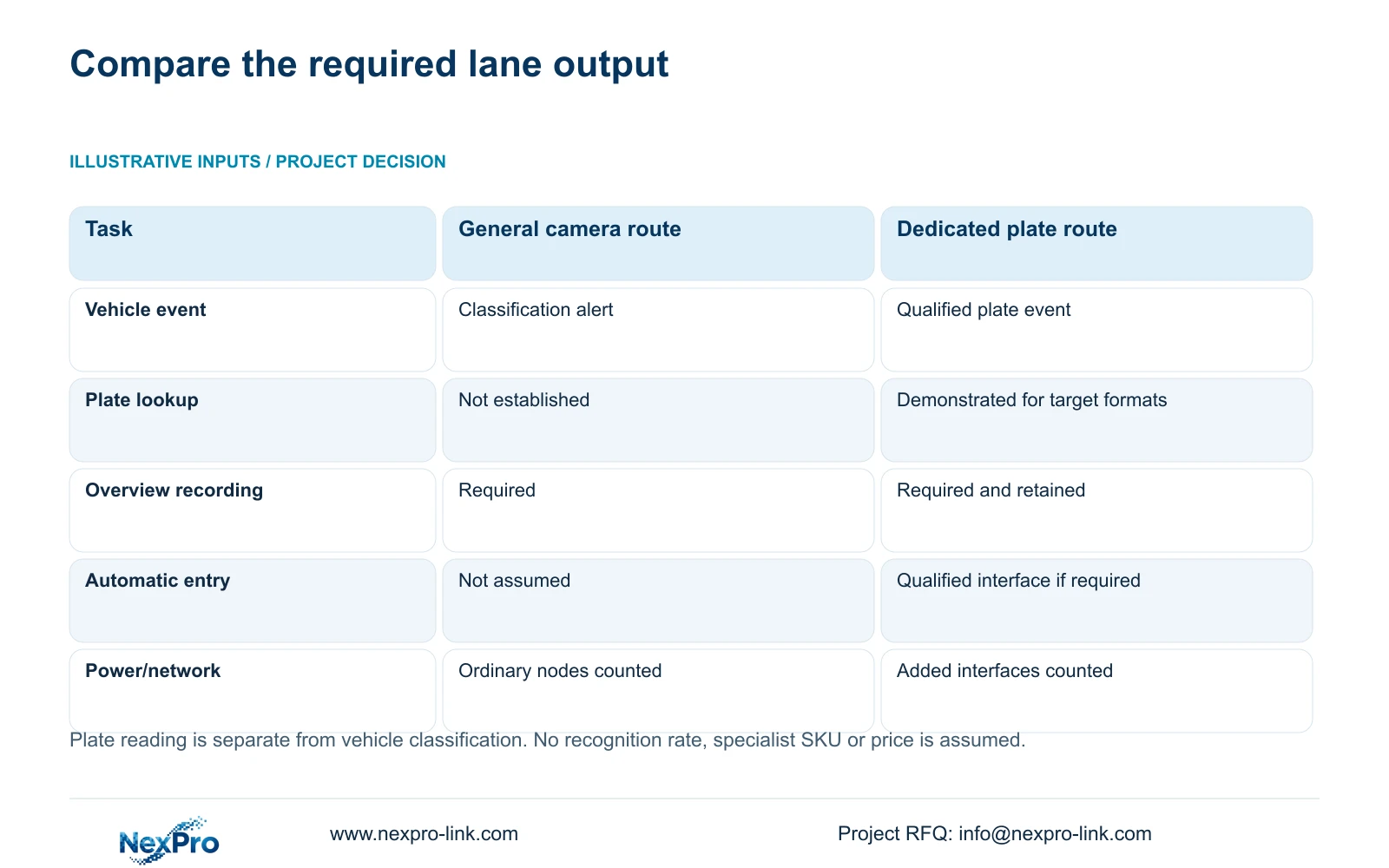
The supplied scope method assigns each item to supplied, retained, installer-provided or optional, with one named owner per interface. Apply it to the lane comparison below. Both routes retain usable overview recording, network connectivity and necessary power; only the dedicated route is proposed for a qualified plate-record task.
The decisive difference is the required output. If the owner requires searchable plate text, the overview-only route is incomplete regardless of its vehicle analytics. If the owner needs general access evidence and staffed review, a complete overview package may satisfy the narrower task. Neither result follows from an arbitrary score or an invented price.
CASE01's 32-camera recording core assumes 4Mbps per stream and 30-day continuous recording, producing 128Mbps input and 41.472TB of video. Any added plate streams, event records or server resources need their own capacity review. Do not absorb specialist equipment into the original channel and storage assumptions without checking its recording mode and data path.
| Decision | Overview with vehicle analytics | Qualified dedicated plate package |
|---|---|---|
| Recording outcome | Vehicle and handover context | Same context plus required plate event |
| Identity output | Vehicle classification only | Plate records demonstrated for target formats |
| Network and power | Camera and recorder nodes counted | Added plate devices/interfaces counted |
| Software and access | Authorized footage retrieval | Qualified plate lookup and event linkage |
| Gate interface | No automatic authorization assumed | Approved interface only if required |
Section 05
Recommend the lane package that matches the approved identity task
Where plate search or plate-based entry is part of the brief, recommend keeping a dedicated qualified ANPR scope and using ordinary CCTV for context. The competing offer must meet the same plate formats, operating conditions and retrieval workflow. Do not accept removal of that function as a like-for-like cost reduction.
Where the owner only needs general delivery evidence, recommend evaluating the complete ordinary recording route with a clear manual-review procedure. NexPro-BL2812M55-5MP-DIC-AI is a possible ordinary-area reference with listed 2880×1620 output and a 2.8–12mm motorized lens. Its human/vehicle classification is not evidence of plate identification.
Change the selection when lane geometry, lighting, vehicle movement or the authorization requirement changes. Preserve the ordinary recording task while requalifying the affected plate and controller scope. A brand mandate or required existing gate interface may also constrain the alternative even when its overview cameras are suitable.
Section 06
Procure a demonstrable lane workflow with explicit exclusions
Prepare a model/scope delta table showing the proposed plate equipment separately from overview cameras and recording infrastructure. Identify the exact controller connection, required event reference and supporting software. NexPro-Link's factory project scope and BOQ support can help organize equipment and submittal requirements without declaring an unqualified ordinary model to be an ANPR product.
Agree a demonstration that follows an event through capture, review, retrieval and any approved authorization step. Record the offered versions and the circumstances requiring manual intervention. If the interface uses mixed devices, qualify the specific workflow; ONVIF live-video connectivity does not establish plate metadata exchange or barrier control.
Include lane-specific mounts, network terminals, cabinet power and local installation in the commercial schedule. Distinguish supplied equipment from retained gate assets and optional automation. The procurement decision should preserve the required function and make the remaining responsibilities visible to the owner, gate integrator and CCTV contractor.
Section 07
Buyer questions
Can a guard manually read a plate from ordinary footage? Possibly, if the installed scene and recording provide readable detail. Qualify that manual task explicitly; it does not establish automated recognition or searchable plate metadata.
Must ANPR automatically open the barrier? No. Plate events can support operator review without automatic authorization. The owner should specify the entry process, and the gate integrator should qualify any control interface separately.
Can existing gate cameras be included in the comparison? Yes, as retained assets after their models, recorded views and required workflows are verified. Do not infer ANPR capability from the fact that they already observe the lane.
Section 08
Define the factory gate comparison
Send the lane drawing and plate formats, required plate-search or entry workflow, proposed camera/controller models, and recording-retention requirement to info@nexpro-link.com to discuss separate ANPR and ordinary CCTV supply scopes.
Engineering references
These sources support the general planning principles. Always use the selected product's current datasheet and applicable project standards for final design.