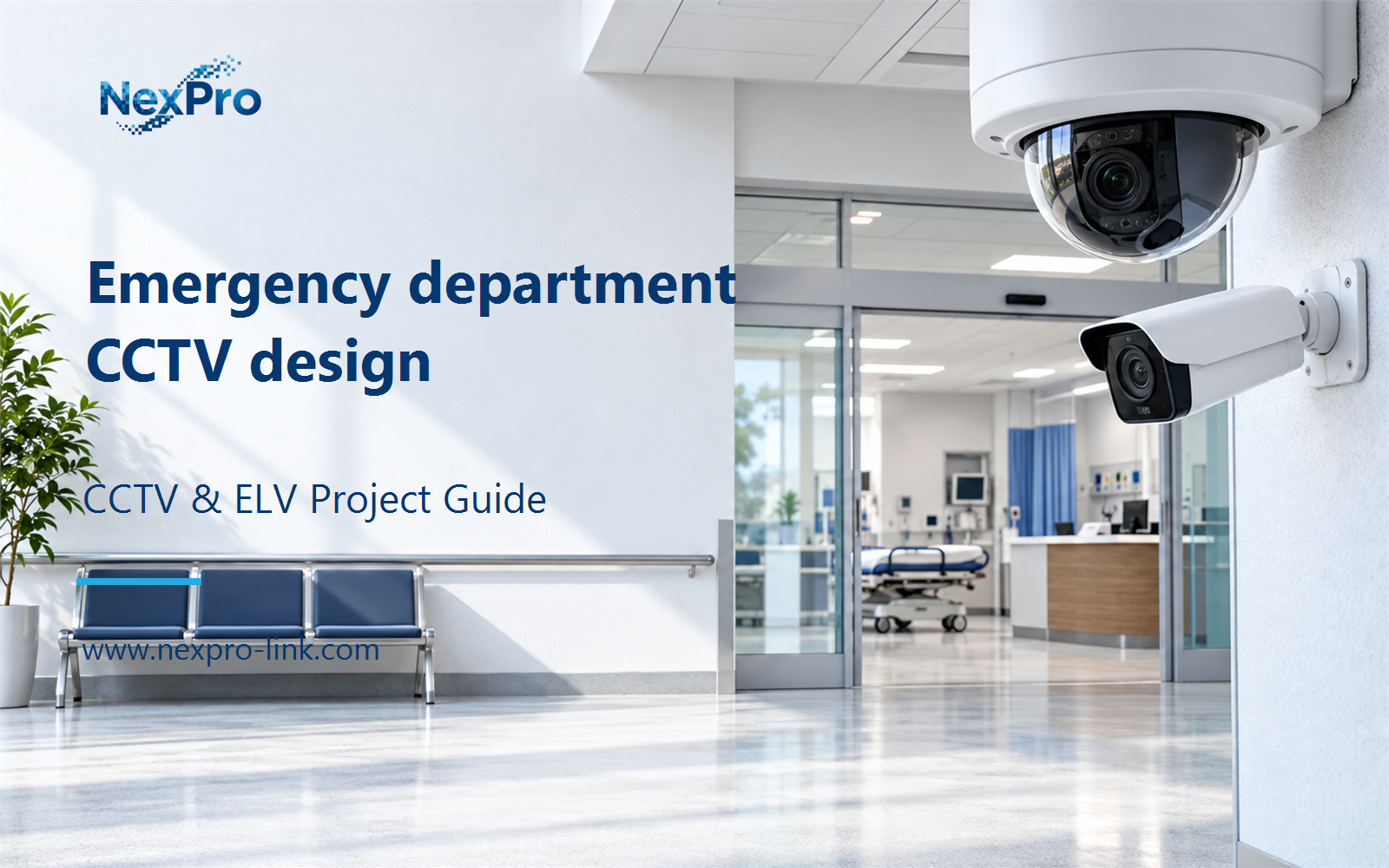
Plan emergency department CCTV design with practical guidance on map the response journey and design rapid authorized retrieval. NexPro-Link project guide.
Section 01
Map the Response Journey
It should help authorized staff locate an incident, understand relevant context and coordinate the agreed response. Map entrances, public waiting and controlled boundaries to those tasks. Do not assume that observing a clinical interaction is necessary simply because it occurs in an emergency department.
Turn the answer into a working record using Incident type, Location, Required view, Response owner.
| Decision area | Buyer question | Required output |
|---|---|---|
| Map the Response Journey | What should emergency-department CCTV help operators do? | It should help authorized staff locate an incident, understand relevant context and coordinate the agreed response. |
| Choose Fixed Views and PTZ Support | Should a PTZ provide the only emergency entrance coverage? | Not when continuous evidence of that entrance is required. |
| Distinguish Event Marking from Recording | Is event-triggered recording enough for an emergency area? | That depends on the accepted risk of missed triggers and the context required. |
Section 02
Choose Fixed Views and PTZ Support
Not when continuous evidence of that entrance is required. A PTZ can support inspection but may point elsewhere when an event occurs. Use fixed views for essential coverage and define how any PTZ is controlled without intruding into unrelated sensitive areas.
Use Critical entrance, Fixed view, PTZ role, Privacy boundary to compare options on the same basis. Keep product capability, project assumption and operating responsibility in separate columns.
Section 03
Distinguish Event Marking from Recording
That depends on the accepted risk of missed triggers and the context required. Continuous recording with event marking may serve a different purpose from recording only after a trigger. Compare those behaviors explicitly rather than assuming an analytic alarm captures every important interaction.
The project output should make Mode, Trigger dependency, Context, Missed-event consequence traceable from input to acceptance.
- Confirm the answer to: Is event-triggered recording enough for an emergency area?
- Record the project fields: Mode / Trigger dependency / Context / Missed-event consequence.
- Keep product capability, project assumptions and site responsibility in separate records.
Section 04
Design Rapid Authorized Retrieval
Use clear camera labels, consistent time information and role-appropriate playback and export access. Define which workstation or operator can retrieve the event. A large display wall does not by itself provide a usable search workflow or authorization boundary.
Record Event, Camera group, Search method, Authorized role before selecting a product family. That makes later substitutions possible without silently changing the operational requirement.
Section 05
Protect the Essential Service Path
Identify the cameras, local switches, backbone, recorders and essential operator display needed for the agreed response service. Coordinate with the site's electrical design and avoid assuming that the hospital's generator protects every local network cabinet. Test the defined service under controlled conditions.
Review Critical views, Network nodes, Recording, Display, Backup with the party that will operate or maintain the system.
Section 06
Prepare a Response-Oriented Package
Include camera roles, mounting and privacy requirements, recording and network allocation, storage, operator display and local backup power. Specify cabling and installation interfaces with clinical operations. Keep the supplier's equipment support distinct from clinical-policy approval and emergency-response authority.
Use Area, View role, Infrastructure, Operational interface as the handoff between design and procurement.
Engineering references
These sources support the general planning principles. Always use the selected product's current datasheet and applicable project standards for final design.