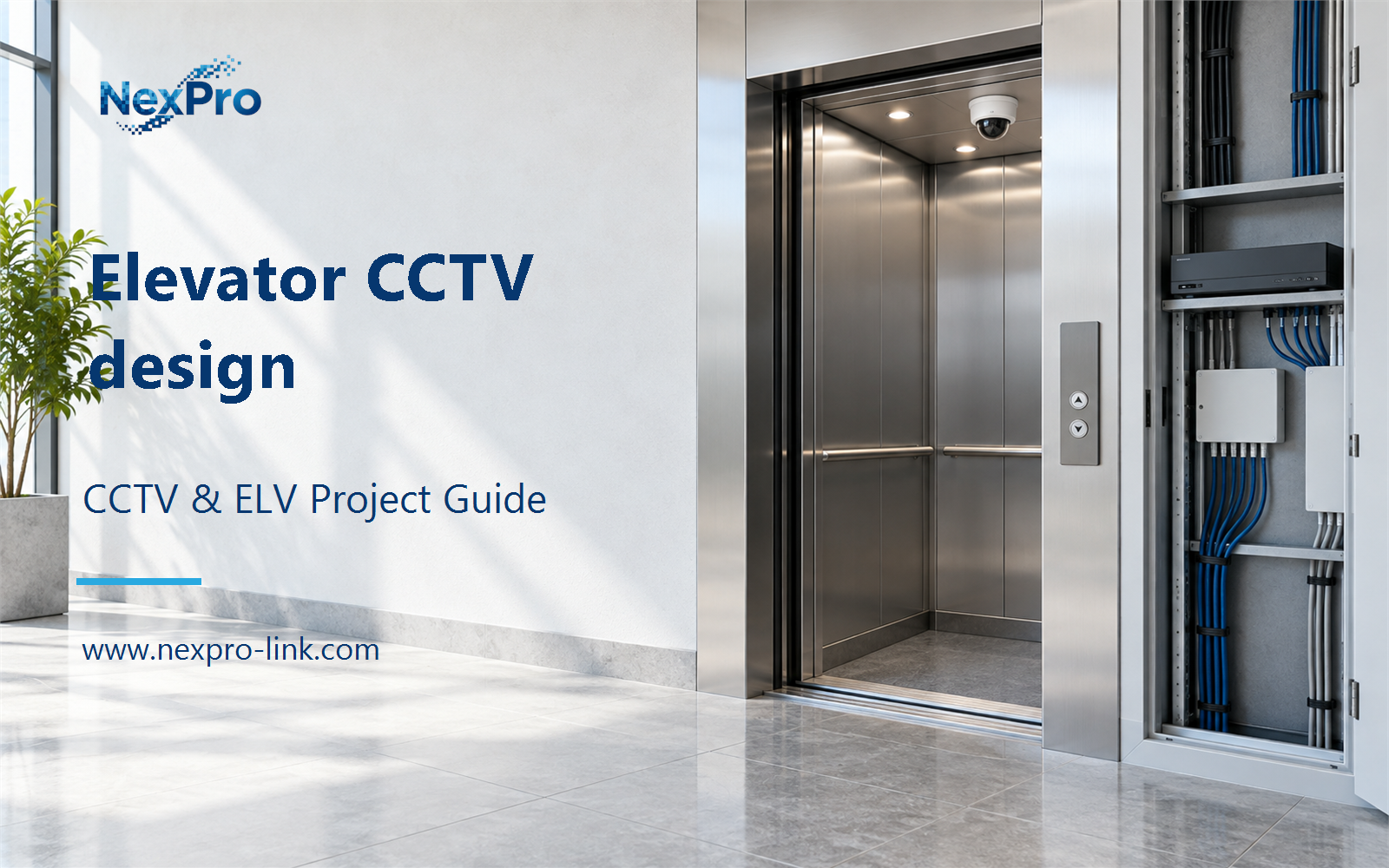
Plan elevator CCTV design with practical guidance on coordinate with the elevator design and locate fixed network and recording equipment. NexPro-Link project guide.
Section 01
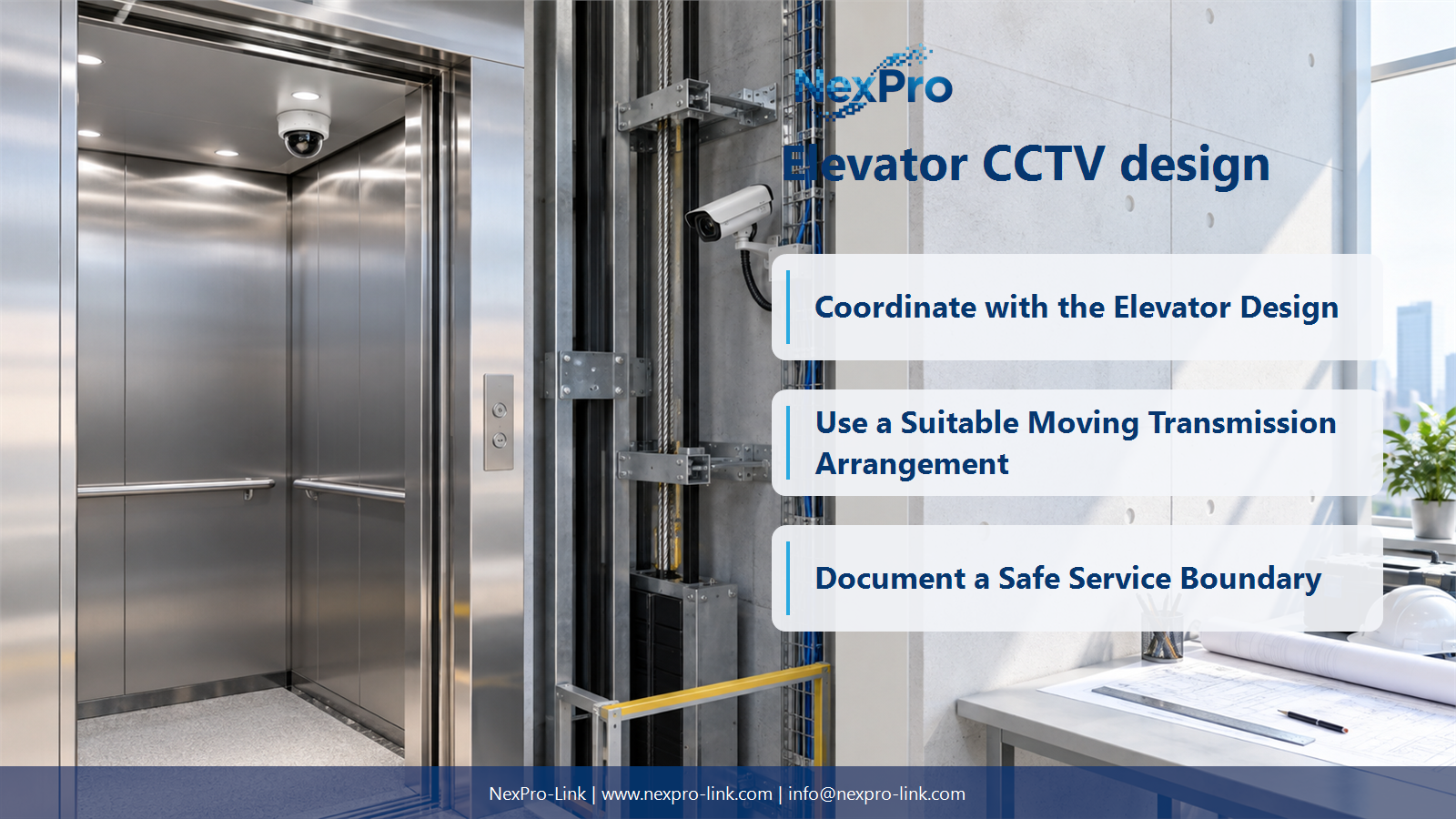
Coordinate with the Elevator Design
The responsible elevator and building teams should coordinate mounting, power, moving cables and maintenance access. CCTV additions must not interfere with the lift's safety or operation. A general surveillance installer should not treat the shaft as an ordinary cable pathway.
Turn the answer into a working record using Interface, Lift contractor, CCTV team, Building owner.
| Decision area | Buyer question | Required output |
|---|---|---|
| Coordinate with the Elevator Design | Who should approve CCTV installation interfaces in a lift? | The responsible elevator and building teams should coordinate mounting, power, moving cables and maintenance access. |
| Frame the Cabin View Appropriately | What should an elevator camera show? | Define the authorized cabin-monitoring purpose and choose a view that supports it without unnecessary intrusion. |
| Use a Suitable Moving Transmission Arrangement | Can ordinary fixed CAT6 be used as a travelling cable? | Do not assume so. |
Section 02
Frame the Cabin View Appropriately
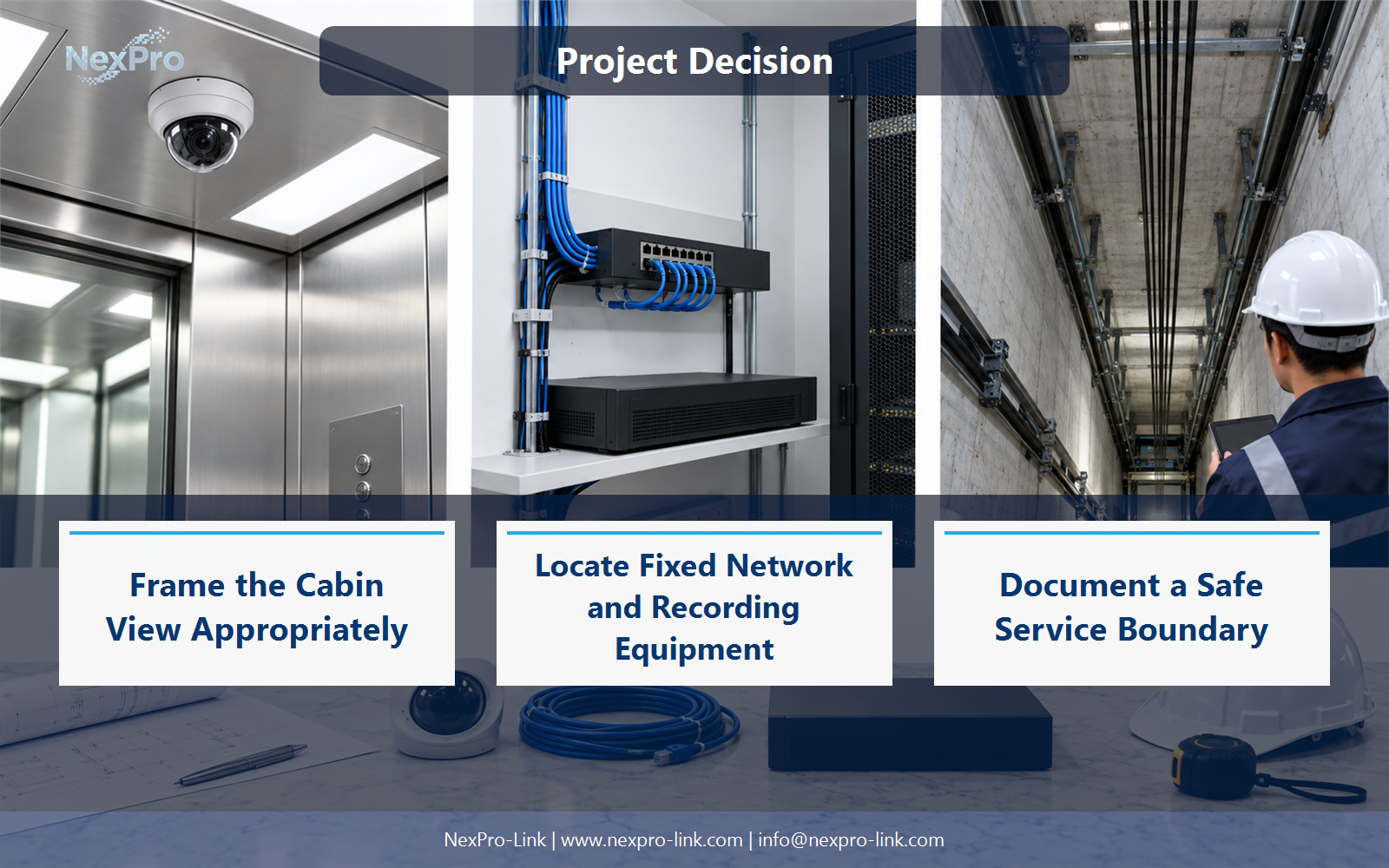
Define the authorized cabin-monitoring purpose and choose a view that supports it without unnecessary intrusion. Account for mirrors, lighting and obstruction. Camera housing and mounting must fit the installation conditions; a standard dome label alone does not establish elevator suitability.
Use Cabin, Purpose, View, Reflection, Mounting to compare options on the same basis. Keep product capability, project assumption and operating responsibility in separate columns.
Section 03
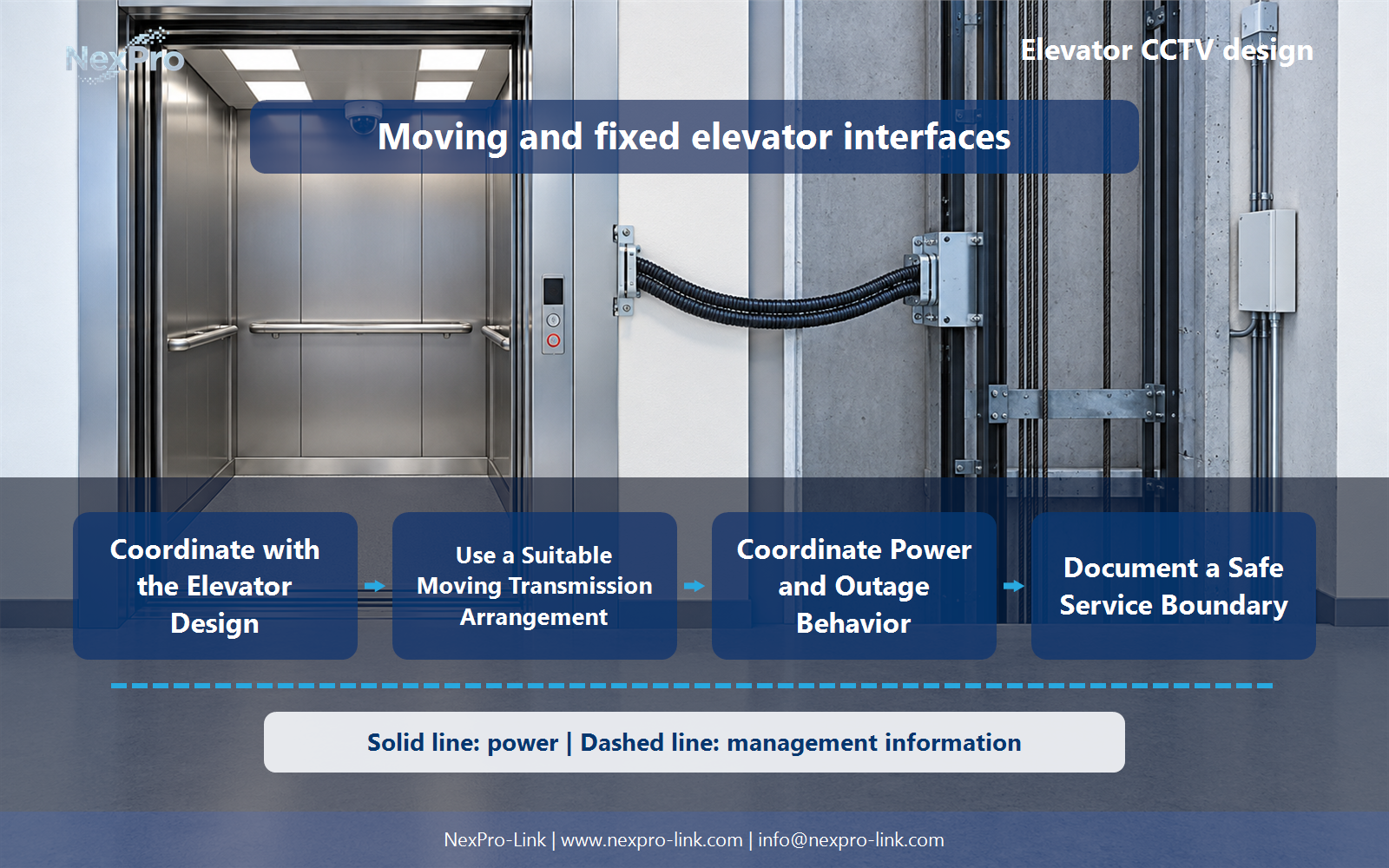
Use a Suitable Moving Transmission Arrangement
Do not assume so. Moving applications need a supported cable or transmission arrangement suitable for repeated motion and the lift installation. Use the elevator project's approved interface rather than improvising a hanging fixed-cable link based only on Ethernet category.
The project output should make Moving segment, Supported medium, Motion condition, Interface traceable from input to acceptance.
- Confirm the answer to: Can ordinary fixed CAT6 be used as a travelling cable?
- Record the project fields: Moving segment / Supported medium / Motion condition / Interface.
- Keep product capability, project assumptions and site responsibility in separate records.
Section 04
Locate Fixed Network and Recording Equipment
Use the supported fixed endpoint and network arrangement defined with the lift contractor, then map it to recording and operator access. The moving link and building backbone are different segments. Label their ownership and maintenance responsibilities separately.
Record Cabin link, Fixed endpoint, Switch, Recorder, Owner before selecting a product family. That makes later substitutions possible without silently changing the operational requirement.
Section 05
Coordinate Power and Outage Behavior
Not necessarily. The camera may use a power arrangement tied to the lift or a separate supported supply. Define what remains available during power events and coordinate it with the responsible electrical and elevator teams. Do not assume a generic PoE extension solves every moving-power requirement.
Review Camera supply, Lift power, Network backup, Recording behavior with the party that will operate or maintain the system.
Section 06
Document a Safe Service Boundary
Include the authorized view, equipment and transmission roles, power arrangement, identifiers and service contacts. Keep passwords controlled and specify who may access restricted lift areas. The package should support maintenance without encouraging unqualified modifications to the elevator installation.
Use Asset, Interface, Cable owner, Power owner, Service contact as the handoff between design and procurement.
Engineering references
These sources support the general planning principles. Always use the selected product's current datasheet and applicable project standards for final design.