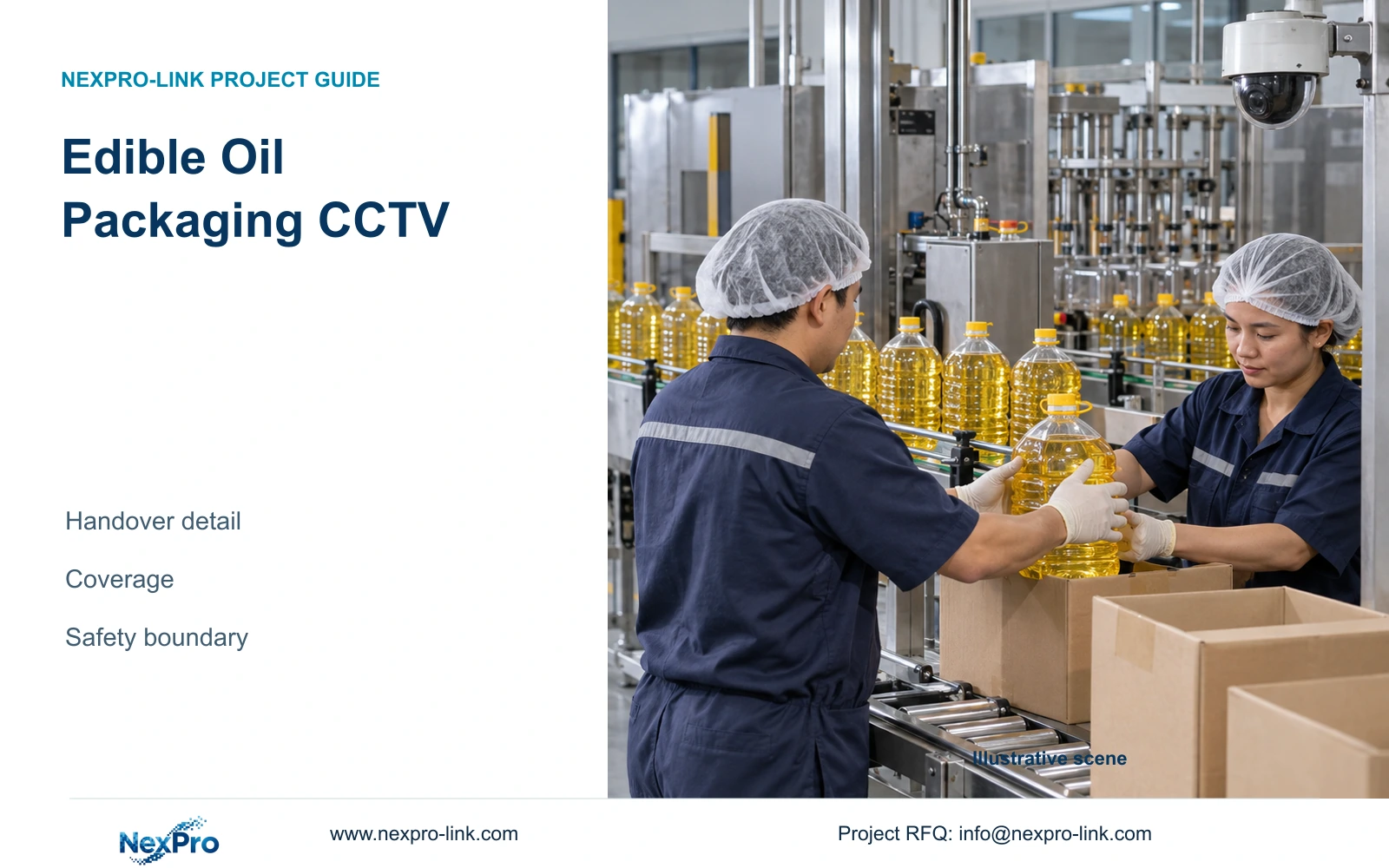
Edible-oil packaging CCTV should document container handovers without inheriting process-safety duties. A worked field-width comparison shows where detail improves and why wider movement context may still need another view.
Section 01
Identify container handovers that need recorded evidence
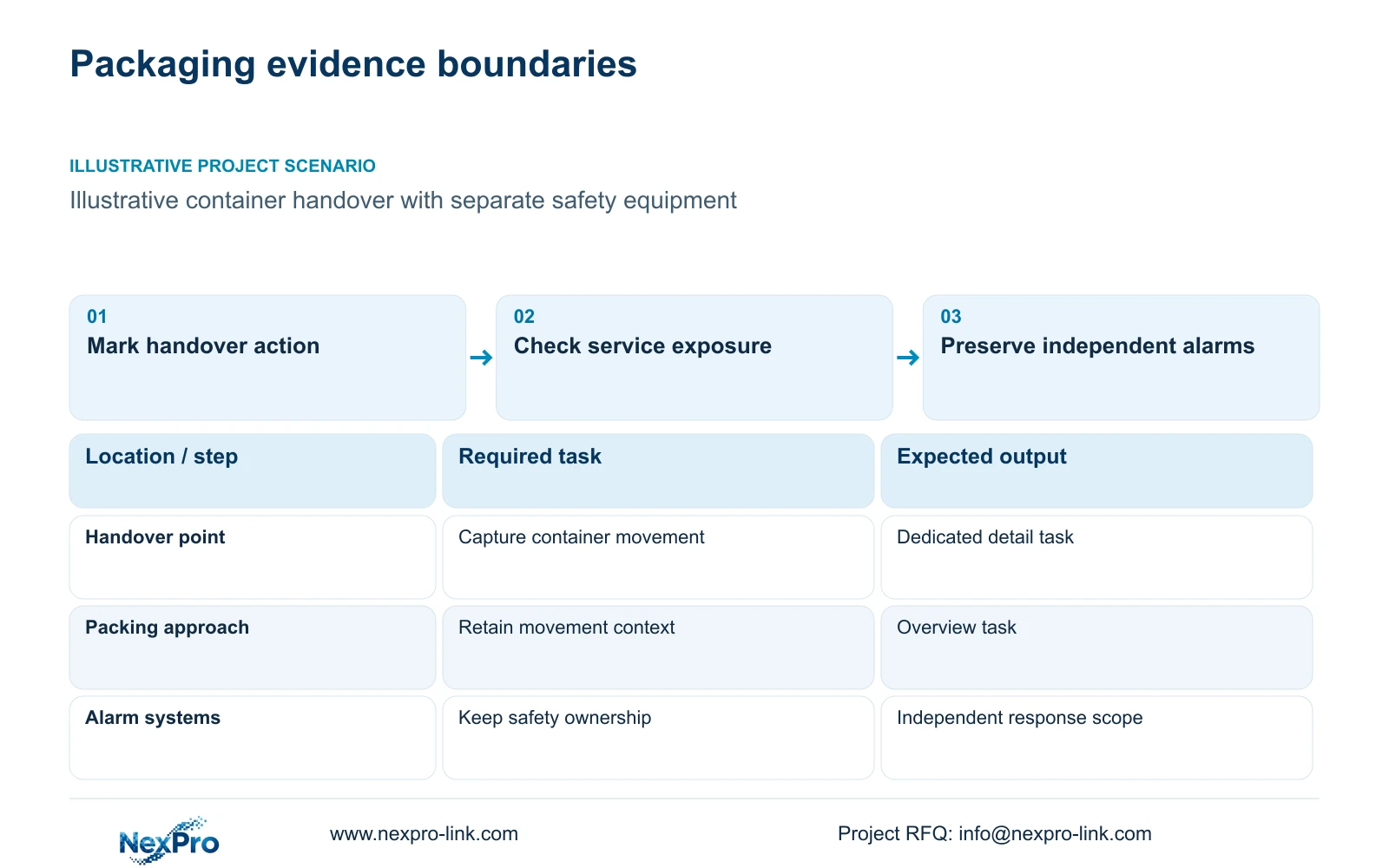
Edible oil packaging CCTV should be defined as an observation and investigation layer. Select views around container handover, packing access and dispatch movement, while preserving independent spill control, fire detection and process-safety functions. Ordinary camera analytics cannot be assumed to perform those duties.
Illustrative project scenario: The packing hall wants footage of container handover while process safety equipment is supplied separately. Assume the owner needs to see when containers move from packing responsibility to loading responsibility and enough context to investigate a disputed movement. No automated fill inspection or safety response is included in this security task.
Mark the handover action and target plane on the layout before selecting a lens setting. Separate general-area mounts from cleaning-sensitive positions and identify permitted observation areas. The camera schedule should explain what each view must show, who reviews it and which production or alarm duties remain outside the CCTV package.
Section 02
Assess contamination exposure and practical service access
Obtain the facility's cleaning method and restrictions for the proposed camera, support and connections. Consider where deposits or incidental splash could affect the optical surface and where a technician can work without disrupting the handover route. A mount that improves target detail may be unsuitable if it cannot be cleaned or serviced through the approved access method.
Start with a qualified normal-area position away from direct exposure. If that position loses the required action behind equipment or loads, compare a revised angle with a separately qualified exposed assembly. Show the changed mount and route in the quotation; relocation is not a cost-free assumption.
The ordinary BL2812M and DM2812M 5MP references list IP66 and -20 to +60°C. Those ratings do not establish every chemical or hygienic cleaning condition. Keep specialist assemblies separately scoped and let the responsible facility and local designers determine the relevant installation restrictions.
Section 03
Keep independent alarm duties explicit in the interface schedule
Write an interface schedule that assigns CCTV recording and playback to the security package and spill, fire and process responses to their responsible systems. If operators use footage after an alarm, define the relevant camera location and event reference. Do not make the availability of a general video client a prerequisite for the independent alarm's operation.
NIST SP 800-82 Rev.3 provides published context for considering operational constraints and system separation. For this project, any proposed data connection to production equipment needs an agreed owner and permitted information flow. A request to view an event does not automatically authorise control-network access or establish a supported integration.
The illustrative supply arrangement can keep cameras on local access switches and recording at suitable service nodes, with authorised clients as viewing branches. UPS protection follows actual power circuits. Its inclusion in a security rack does not establish backup protection for separately supplied safety equipment.
Section 04
Compare overview width with dedicated handover detail
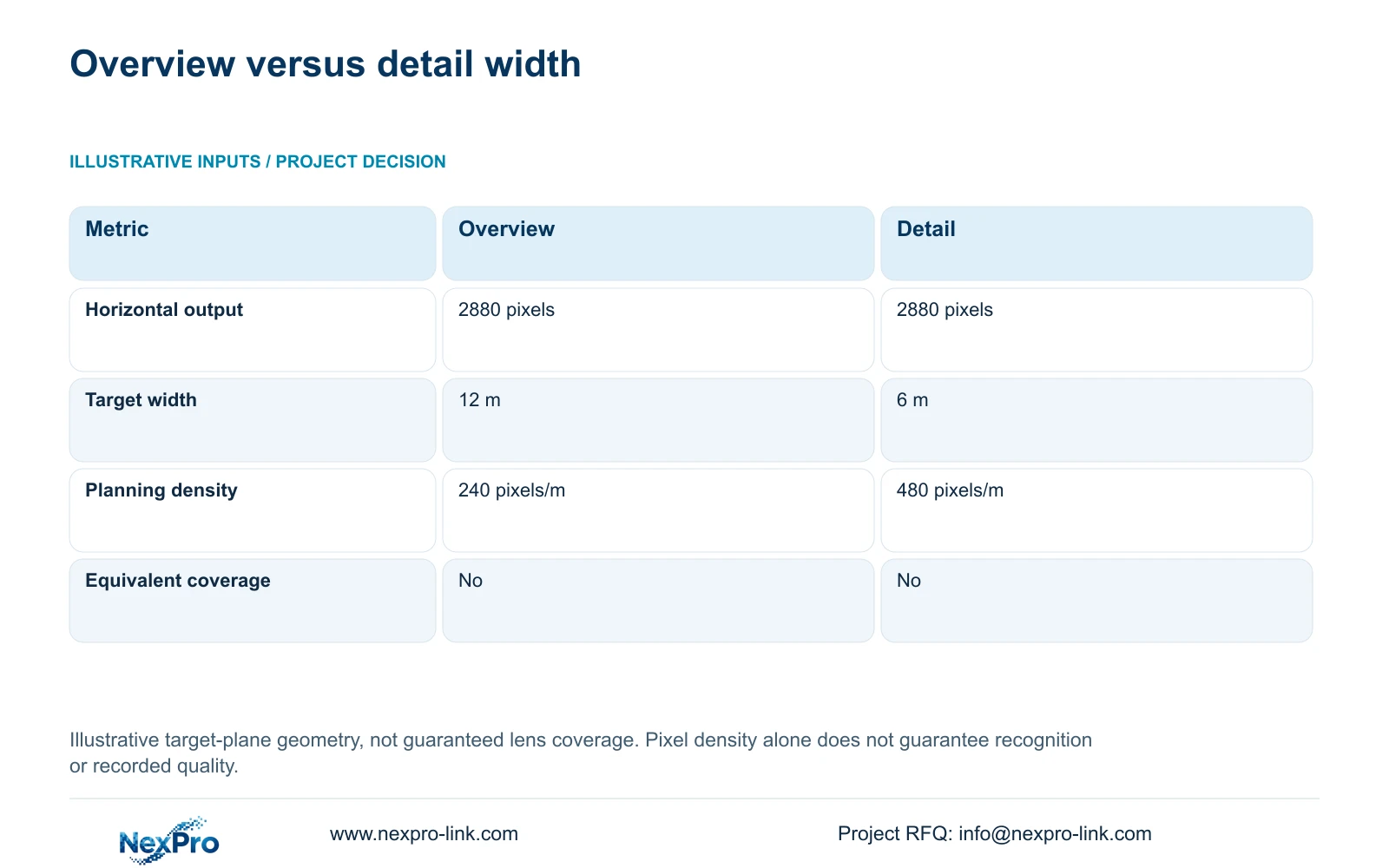
Use an illustrative horizontal output of 2880 pixels and compare widths at the same target plane. Option A covers 12 m; option B covers 6 m. The formula is planning_pixels_per_metre = horizontal_output_pixels / target_width_m. Therefore 2880 / 12 = 240 pixels/m and 2880 / 6 = 480 pixels/m.
The narrower example doubles planning density while removing half the horizontal coverage. It is not area-equivalent to the overview. If the owner needs both close handover detail and the approach or departure route, preserve an overview or another suitable context view rather than treating the tighter image as a camera-count reduction.
The 2880-pixel input is consistent with the listed 2880×1620 source field for the ordinary 5MP references. The 12 m and 6 m widths are assumed geometry, not guaranteed fields of view at particular lens settings. Pixel density alone does not guarantee recognition: motion, light, compression, angle and obstruction still require a recorded trial.
| Metric | Overview option | Detail option |
|---|---|---|
| Horizontal output | 2880 pixels | 2880 pixels |
| Target width | 12 m | 6 m |
| Planning density | 240 pixels/m | 480 pixels/m |
| Equivalent coverage | No | No |
| Primary task | Movement context | Dedicated handover detail |
Section 05
Add detail only where the investigation task needs it
Recommend a task-adjusted detail view at the critical container handover, retaining wider movement context where it is part of acceptance. Use ordinary equipment at qualified normal positions and a separately approved assembly where exposure demands it. Keep process-safety functions independent regardless of how many security views are added.
CASE03 provides a wider food-factory planning reference with 48 cameras, two 24-camera recording nodes and eight specialist positions. Adding a detail camera to an actual package changes its channel count, bitrate, PoE and route requirements. The case's quantities cannot absorb that change without revision, and its assumed camera demand is not a published peak-power rating.
Compare supplier offers on the same overview and detail tasks, supported recording modes and installation scope. Preserve mandatory platforms or specialist requirements. Ask the cost team to separate an additional camera and route from any proposed safety-system integration, so neither is hidden inside an apparently comparable CCTV line.
Section 06
Release a package with measurable views and exclusions
The BOQ should identify each target width, camera location, mounting environment and accepted action. Include supplied equipment, local mounting and cable work, specialist exceptions and retained alarm systems. Keep the overview and detail location names consistent with operator search references.
NexPro-Link can discuss model matching, technical deviations and project preparation through its BOQ & Tender Support scope. Zone-labelled packing helps keep the ordinary equipment and specialist interfaces identifiable at delivery. The local project team approves site installation and the independent alarm responsibilities.
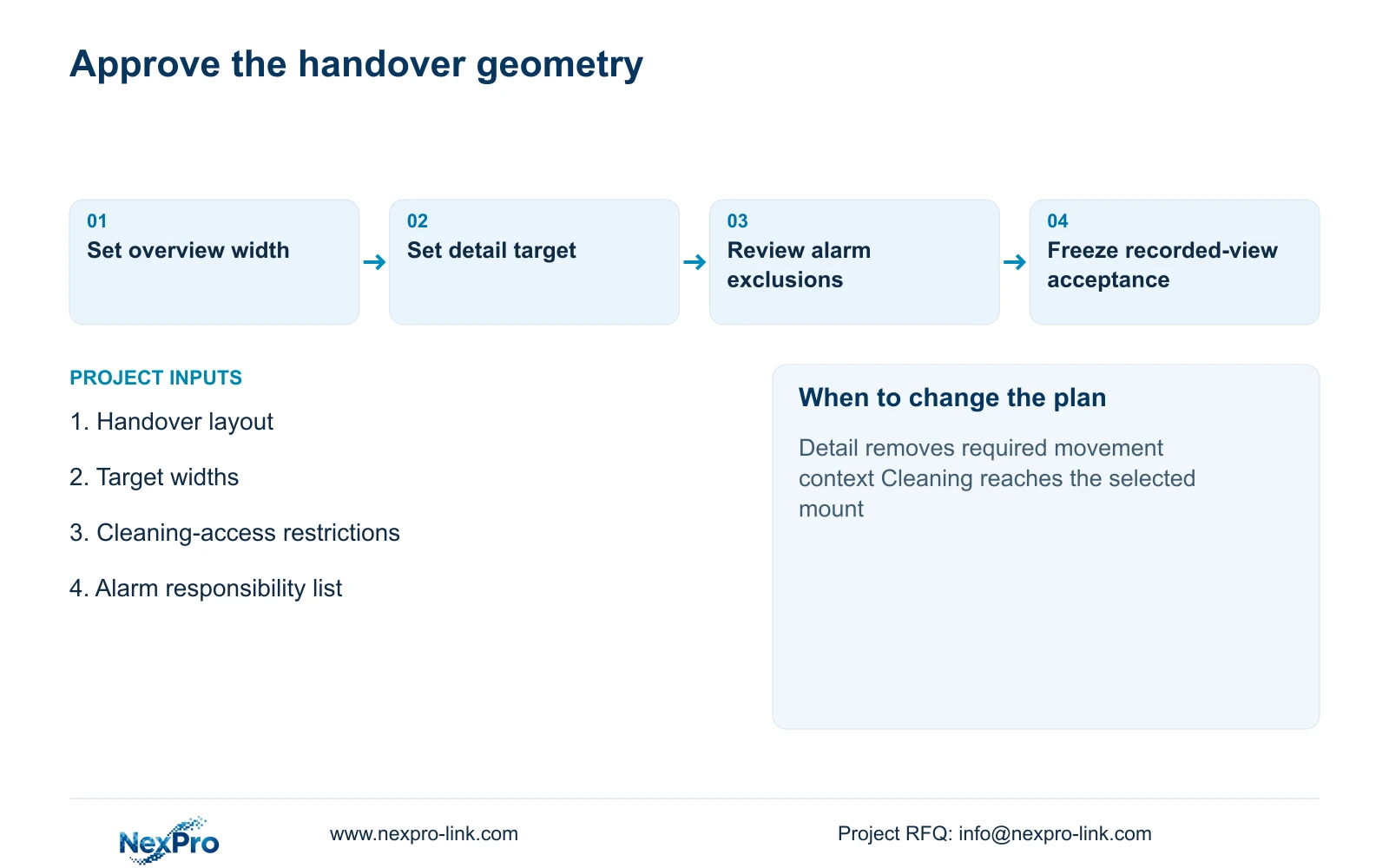
Demonstrate container handover in recorded playback at the proposed geometry and operating light. Check that the overview still explains movement after the detail view is added. Freeze the approved configuration with the camera schedule; changes to target width, packaging equipment or cleaning reach should reopen the affected selection and system-resource inputs.
Section 07
Buyer questions
Does 480 pixels/m guarantee container-label recognition? No recognition threshold is assigned here. The figure is a planning density from assumed geometry. Label size, angle, movement, illumination and recorded compression must be assessed in a representative trial.
Can CCTV still help after a spill alarm? Yes, footage may provide authorised movement context around the event. The spill response and alarm function remain with their responsible systems; usefulness for review does not establish a safety-control capability.
Can the motorized lens replace a dedicated overview? Only if the accepted task tolerates losing the wider scene when the view is tightened. A motorized varifocal setting changes the selected field; it does not establish simultaneous overview and detail capture or PTZ motion.
Section 08
Define the packaging evidence views
Send the container-handover layout, required overview and detail widths, cleaning-access restrictions and independent alarm responsibility list to info@nexpro-link.com. NexPro-Link can discuss a camera package with clear observation and safety boundaries.
Engineering references
These sources support the general planning principles. Always use the selected product's current datasheet and applicable project standards for final design.