Limit the discussion to general administrative and facility IT power and stay out of weapon, tactical and mission systems.
Section 01
Define the Non-Weapon Scope
Limit the discussion to general administrative and facility IT power and stay out of weapon, tactical and mission systems.
A defense facility label covers a wide range of equipment, only some of which belongs in a conventional UPS scope. Start by separating administrative IT from operational systems. The administrative side includes office computers, file and print services, ordinary LAN switching and non-weapon facility information systems such as building management or maintenance logging. These loads have power inputs, dependencies and continuity objectives that a standard facility team can specify without special clearance.
The operational side includes weapons, targeting, tactical communication and other mission systems. It stays out of this package and should not be inferred from the site's name or industry category. If a reader only knows that the building is a defense facility, that fact alone does not tell them which systems are administrative.
The table gives the reader a place to write each load down. The last row matters as much as the first three. A UPS proposal that quietly absorbs an operational system carries the wrong boundary and will be returned or signed with an error baked in.
| Decision area | Project question | Required output |
|---|---|---|
| Define the Non-Weapon Scope | Which administrative and facility loads are in the general IT scope? | Scope table: administrative IT / facilities / ordinary network / exclusions |
| Use Stated Requirements | How should sector-specific requirements be handled? | Requirement table: installation / property / applicable scope / owner |
| Map Ordinary Service Dependencies | What should the protected service include? | Service map: application / storage / network / management |
Section 02
Use Stated Requirements
Sector-specific requirements arrive as written statements from the site. Treat them as procurement inputs for that installation. A facility label does not establish a universal military qualification or ruggedness level, and a general equipment description should not be converted into an unsupported certification or performance claim.
For a controlled facility the requirement may read as a restricted-access server room, a single-phase input and a stated temperature range. None of that is exotic. It is ordinary electrical and environmental specification, and it should be quoted back in those terms.
Every entry here is illustrative. A real project replaces it with the site's own stated values. The point of the table is to keep each requirement tied to an owner and a scope, so a vague phrase such as "military grade" cannot slide into the specification without a source.
Section 03
Map Ordinary Service Dependencies
Once the scope and requirements are agreed, trace the ordinary service dependencies. The reader wants to know what must keep running so the administrative service survives a short outage. Keep sensitive system details out of public examples. A hypothetical conventional office rack can show the method without revealing real infrastructure.
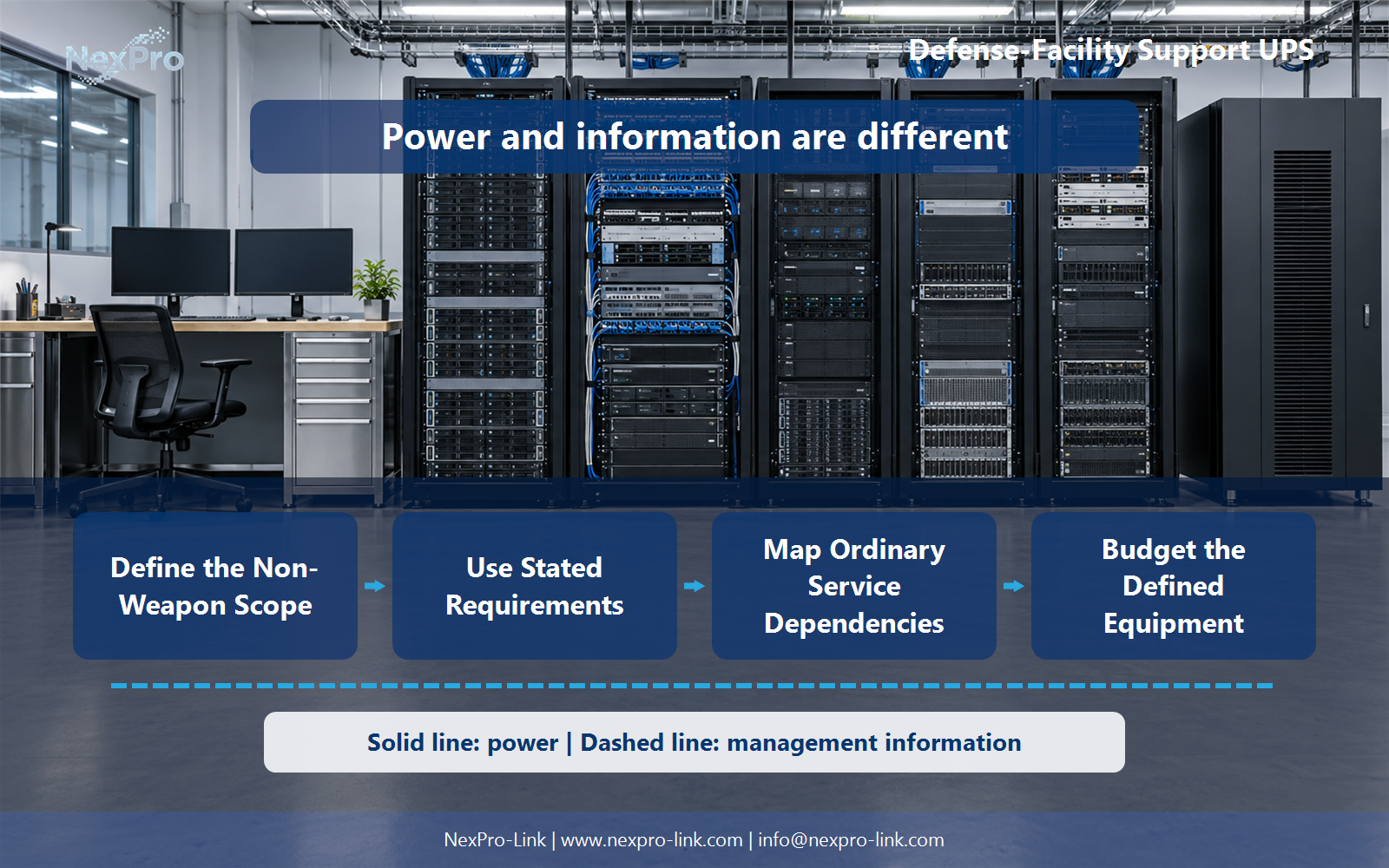
The map separates power from management information. The UPS feeds the power path. The management agent uses a different path to read UPS status and start a shutdown. Keeping the two apart prevents the design from implying a software integration that may not exist yet.
- Confirm the answer to: What should the protected service include?
- Draw electrical power as a solid path and management information as a separate dashed path.
- Keep external services and specialist approvals outside the UPS equipment claim.
Section 04
Budget the Defined Equipment
Capacity comes from the specified configuration, demand states and physical constraints. Growth assumptions are added separately. The result is a transparent support-load budget, not a generalized claim about defense-system resilience.
The table below lists teaching inputs for the hypothetical admin room. All loads, power factors, times and margins are illustrative and are not measured values or runtime guarantees.
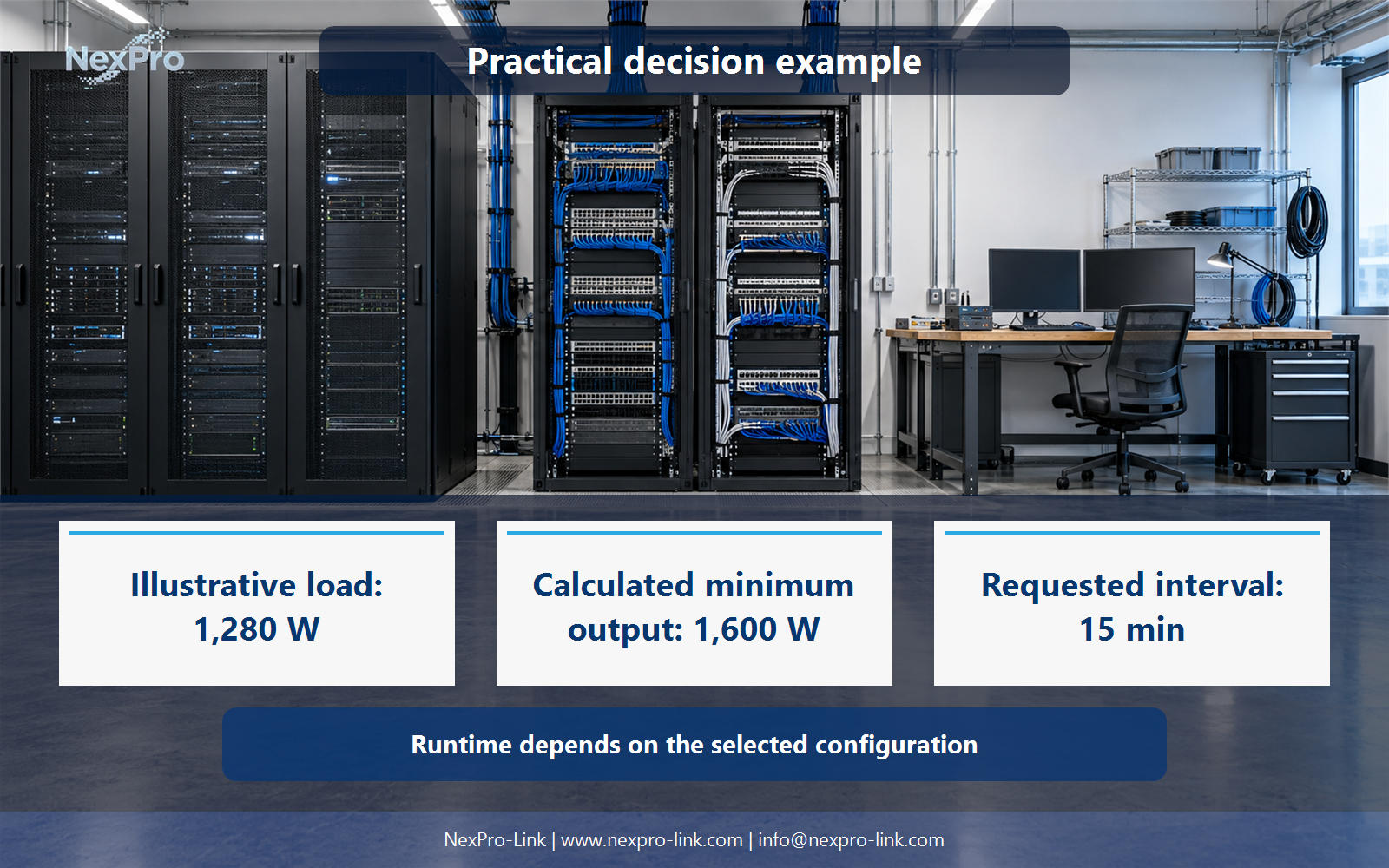
The protected AC input totals 1,280 W. From there the calculation follows the shared formulas in this content pack.
The W and VA limits are checked separately because a load can clear one and fail the other. The 320 Wh figure is load-side energy, not a battery nominal rating. It excludes conversion losses, discharge rate, temperature and aging, so it cannot select a battery set on its own. A candidate such as the NX-UP-RM-001 configuration C2KR(S), rated 2,000 VA and 1,800 W with internal VRLA batteries, clears both illustrative minimums, but the runtime objective and the site's battery configuration still decide the fitting.
Section 05
Plan Service and Access
Restricted facilities add one constraint the ordinary office does not: access. State permitted access, replacement arrangements and maintenance objectives without exposing sensitive procedures. Keep the discussion at equipment-support level and do not promise unlimited onsite support unless the actual arrangement provides it.
The schedule is deliberately ordinary. It names who coordinates and what can be replaced, and it leaves the site free to set its own clearance rules. Nothing here promises zero downtime.
Section 06
Prepare a Conventional Supply Brief
The last step is to hand NexPro-Link a brief it can quote. Provide only the authorized support-load requirements and the necessary installation constraints. Do not imply military certification, mission-system integration or weapons support from the general product offering.
NexPro-Link can discuss conventional UPS supply within that scope. The brief keeps the request factual, so the supplier responds to equipment, interfaces and supply terms rather than to an undefined "defense UPS."
Engineering references
These sources support the general planning principles. Always use the selected product's current datasheet and applicable project standards for final design.