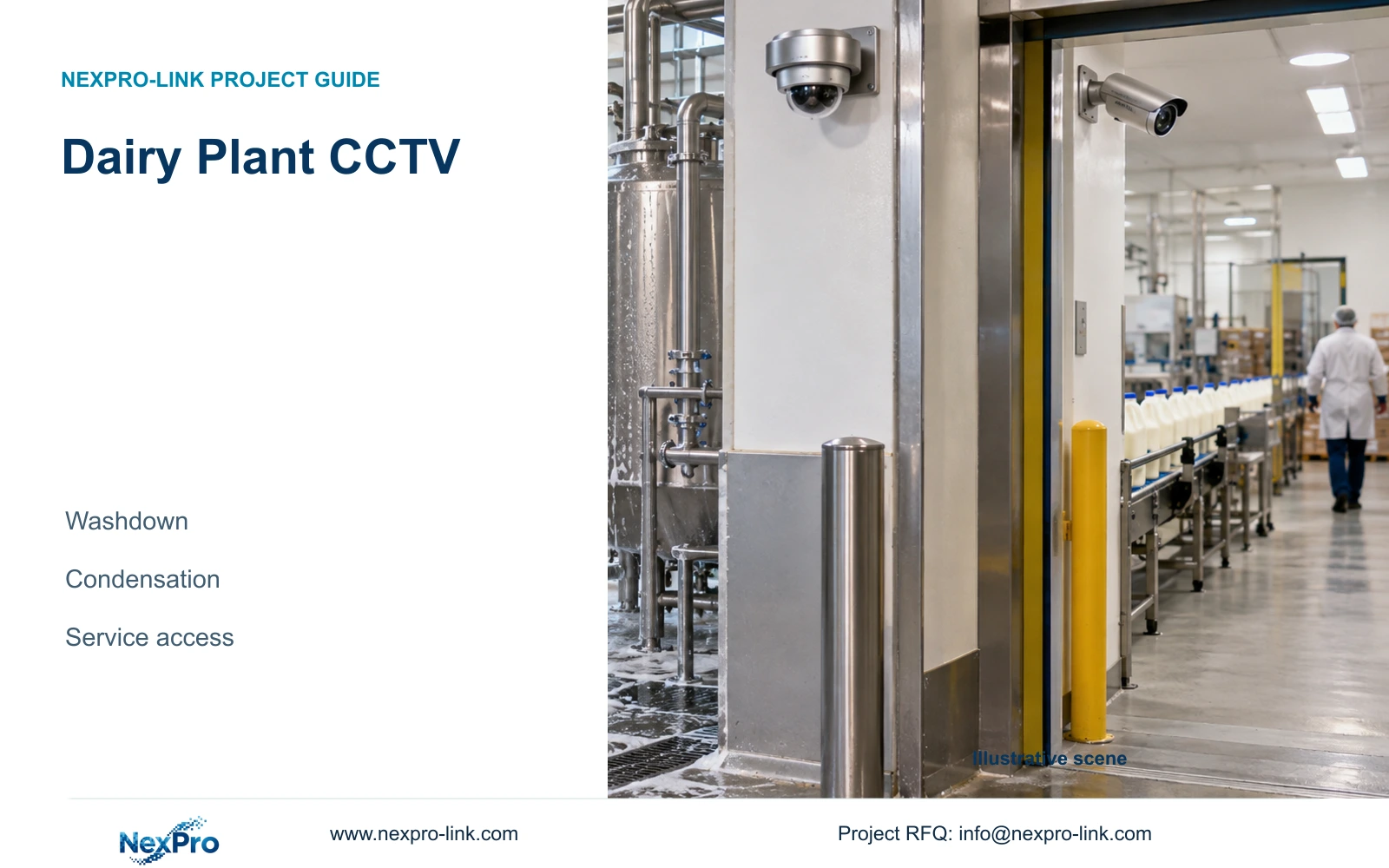
Dairy CCTV selection needs separate answers for washdown, condensation and maintenance access. Qualify the complete exposed assembly while retaining ordinary equipment where the actual conditions permit it.
Section 01
Map cleaning exposure at each proposed mounting point
Dairy plant CCTV should use specialist equipment where the actual cleaning and environmental exposure requires it, while retaining ordinary cameras at suitable normal-area positions. IP66 alone does not establish resistance to every washdown method, cleaning chemical or hygienic requirement. Select against the complete operating and cleaning cycle.
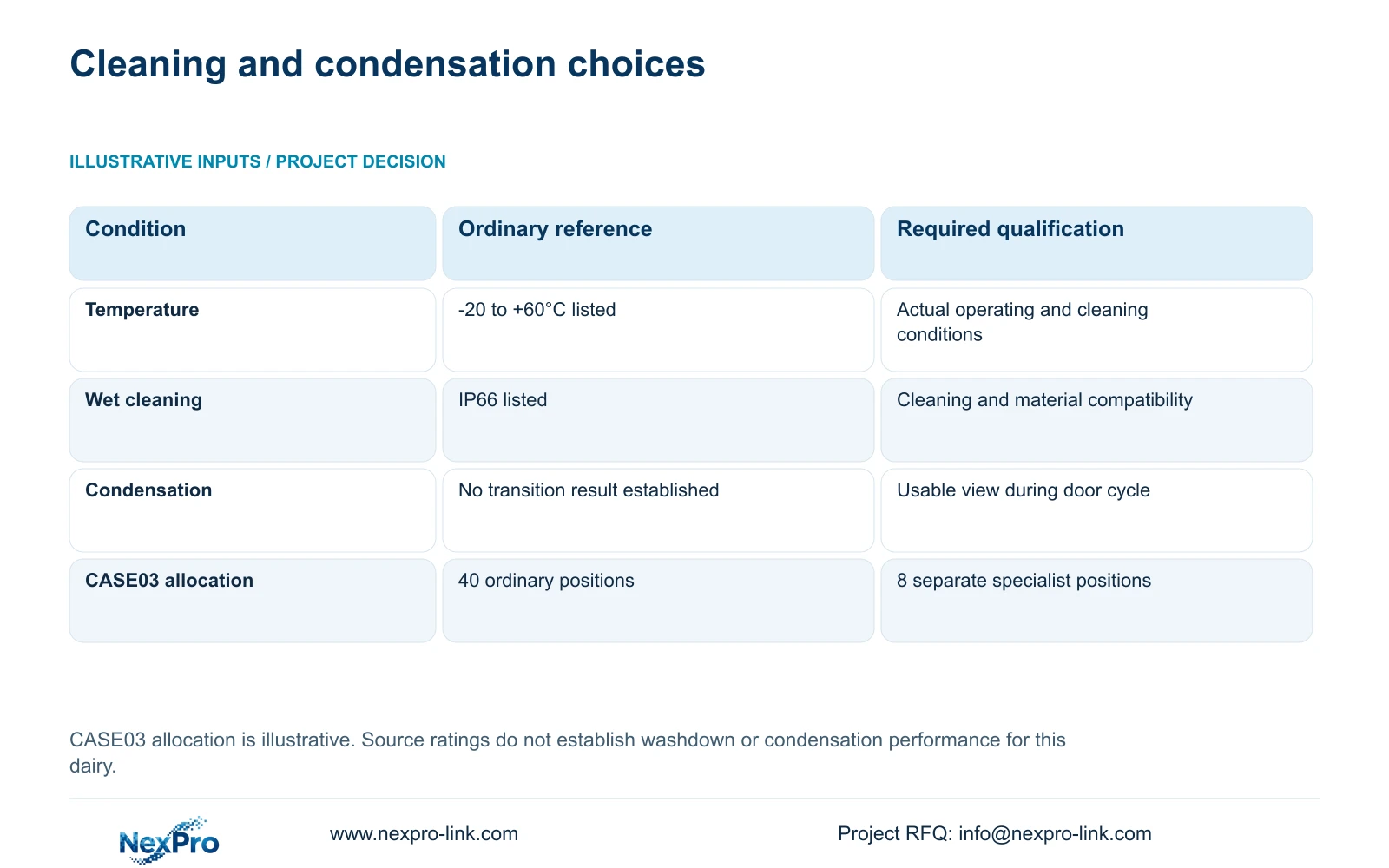
Illustrative project scenario: A dairy facility has wet-cleaned production boundaries and dry packing corridors. Assume the project needs security views of permitted material transfers and corridor access. The supplied CASE03 allocation of 40 ordinary positions and eight specialist positions is a reference for separating scope, not evidence that this dairy has those exact quantities or approved locations.
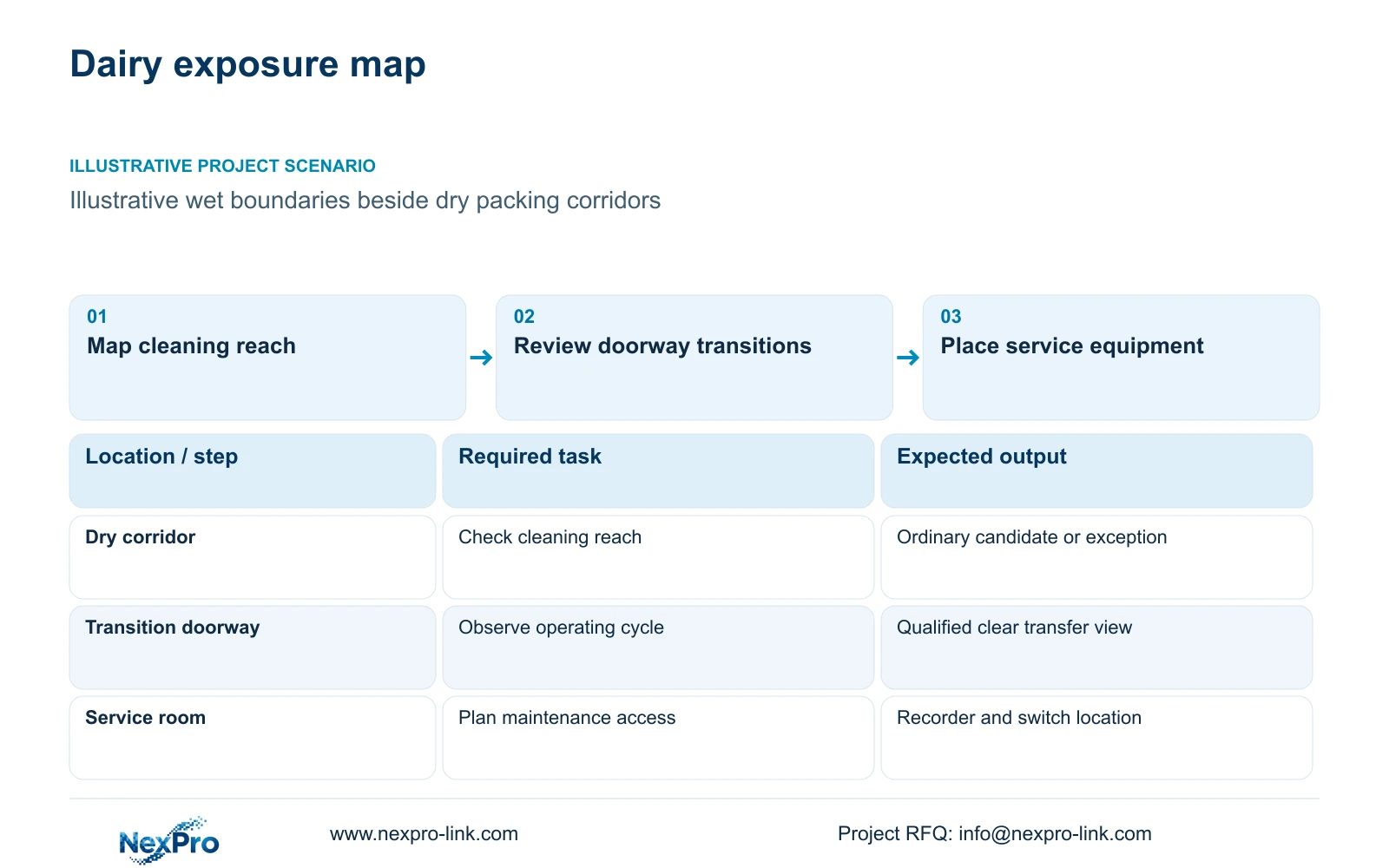
For each mount, obtain the cleaning method, direction of exposure, chemicals used and relevant temperature conditions from the facility. Mark the camera body, connection and support on the same drawing. A dry corridor label is insufficient if cleaning reaches a doorway mount or technicians must enter the wet zone to service it.
Section 02
Evaluate condensation through the doorway operating cycle
A transition position needs its own review even when neither adjoining room appears unsuitable in isolation. Record when doors open, what movement must remain visible and whether the optical surface or connection is affected during those periods. The security requirement may fail through an obscured view before an equipment fault appears.
Start by considering a fixed position on the suitable dry side that sees the permitted transfer. Check the open door, pallet height and viewing angle. If the doorway blocks the action, a second qualified view may be preferable to moving an ordinary camera into a more exposed position. Any proposed enclosure or condensation-management feature needs documented suitability for the complete installation.
Acceptance should cover the operating sequence that produces the concern, including door movement and the facility's relevant cleaning or transition conditions. A clear image taken while the door remains closed does not resolve the transfer task. Record observed limitations and agree whether repositioning, specialist equipment or an additional view is required.
Section 03
Put service equipment where maintenance is practical
Place switches, recorders and batteries in suitable accessible service locations wherever the route design permits. The facilities team should approve the cabinet location and access arrangements; the local installer should define routes and penetrations; the supplier should identify equipment and connection requirements. This prevents a camera change from becoming an unassigned cabinet or cabling variation.
CASE03 illustrates two independent recording nodes with 24 cameras each. Local recording and protected power are assigned per node. In a dairy adaptation, the node positions should follow suitable room conditions and routes rather than hygiene-zone camera totals alone. A remote AC-powered cabinet is not protected merely because the central recorder has a UPS.
Check every proposed copper route after choosing the service rooms. CASE03 assumes individual continuous lengths of 41 to 76 m, including a declared 6 m allowance. Those example lengths cannot be copied onto a revised dairy layout. Moving a rack can change route length, termination access and the need for a different backbone arrangement.
Section 04
Qualify the whole assembly against the exposure matrix
Use the decision rule location conditions AND complete product scope AND approved installation requirements. The BL2812M and DM2812M ordinary 5MP references list IP66, -20 to +60°C, a 2.8–12mm motorized lens and the listed 2880×1620 output at 25fps. These source fields are relevant to suitable normal-area views; they are not dairy washdown approvals.
The comparison separates the dry corridor from two distinct exceptions: direct cleaning exposure and a condensation-prone transition. The decisive difference is whether the complete assembly has support for the actual condition. A temperature range does not resolve chemical compatibility, and ingress protection does not ensure a clear optical surface during a transfer.
If specialist scope is required, qualify the camera, mounts, connections and service method together. Do not assemble unrelated accessories and describe the result as an approved hygienic system. Any classified-area condition remains a separate specialist design question, with applicable local requirements verified by the responsible project team.
| Condition | Ordinary-area basis | Required change or evidence |
|---|---|---|
| Dry packing corridor | Check IP66 and -20 to +60°C fields | Approve materials and actual cleaning reach |
| Direct wet cleaning | Ordinary PDF does not establish suitability | Qualify cleaning method and full assembly |
| Doorway condensation | Temperature field alone is insufficient | Demonstrate usable view through transition |
| Exposed connections | Camera rating cannot settle installation | Specify compatible protected connections |
| Service equipment | Suitable accessible room | Revise routes after cabinet relocation |
Section 05
Retain normal-area value without weakening exposed positions
Recommend ordinary equipment for confirmed dry, suitable locations and an exception schedule for wet-cleaned and condensation-sensitive positions. This keeps the buyer's normal-area package coherent while preserving the performance the exposed views need. Reclassify an ordinary position when cleaning reaches it or its required transfer view cannot be maintained from the approved location.
Separate hardware and installation effects in the cost comparison. A relocated camera may need a longer route or another support. A specialist assembly may need different power or additional maintenance access. Compare those actual requirements across proposals rather than assuming a plant-wide specialist upgrade or a uniform ordinary package is automatically more economical.
The recording task remains the same whichever environmental option is chosen. Confirm exact specialist stream modes and required playback functions with the selected recorder. A 49-channel catalogue description does not establish every mixed-camera workflow, full-resolution decode arrangement or disk redundancy feature. Keep unresolved compatibility items visible before the purchase order.
Section 06
Prepare an exposure-led equipment and handover schedule
The schedule should give each camera a location name, transfer task, cleaning status and maintenance owner. List normal-area cameras as supplied candidates, specialist assemblies as separately qualified scope and site penetrations as local installation work. Show retained equipment and optional items explicitly so a supplier can price the requested boundary.
NexPro-Link's project and BOQ support can coordinate normal-area model matching and relevant technical documents around that schedule. Project packing can use the approved room and point names. The facility's hygiene team and local specialists retain approval of installation materials and exposed assemblies; equipment coordination does not transfer those responsibilities.
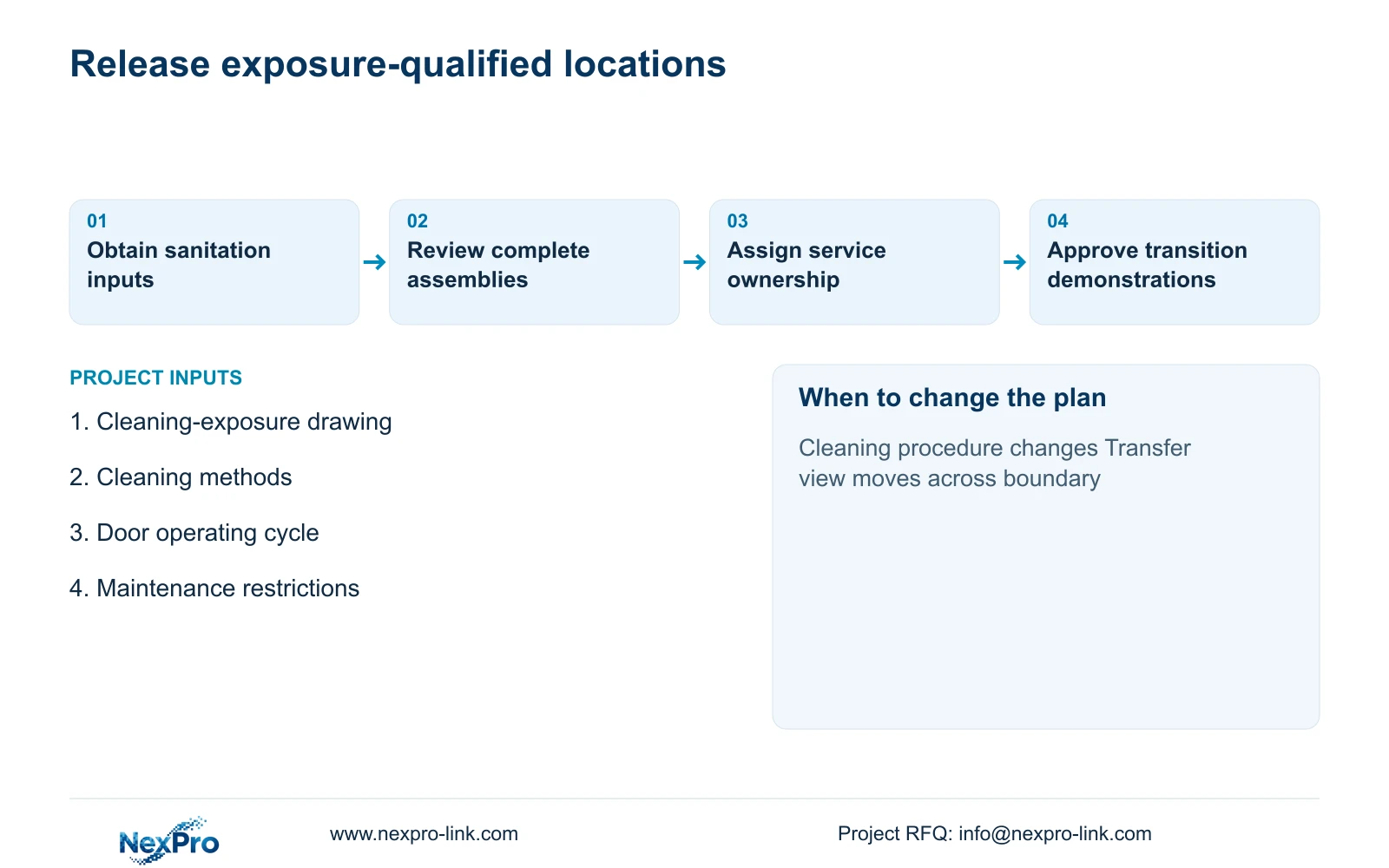
At handover, demonstrate the dry corridor view and each transition exception under representative conditions. Provide configuration records and a location map that operators can use for search and export. A cleaning-procedure revision should identify the affected camera rows and trigger reassessment before the revised procedure is treated as compatible with the installed equipment.
Section 07
Buyer questions
Can a camera on the dry side of a doorway still need specialist qualification? Yes. Cleaning spray, humid air movement or service access may cross the drawn room boundary. Review exposure at the actual mount and connection rather than relying on the room's name.
Should we purchase an enclosure before resolving the camera position? Resolve the required view and exposure first. An enclosure changes the complete assembly and may affect servicing or the optical path. Its suitability must be assessed with the selected camera and installation method.
What should a supplier state when washdown evidence is unavailable? The offer should identify the unsupported condition and keep that position provisional or separately scoped. An ordinary IP66 specification should not be presented as evidence of compatibility with the facility's cleaning procedure.
Section 08
Map the dairy's exposed camera positions
Send your cleaning-exposure drawing, cleaning-method details, doorway transition conditions and maintenance-access restrictions to info@nexpro-link.com. NexPro-Link can discuss the normal-area package and clearly separated specialist interfaces.
Engineering references
These sources support the general planning principles. Always use the selected product's current datasheet and applicable project standards for final design.