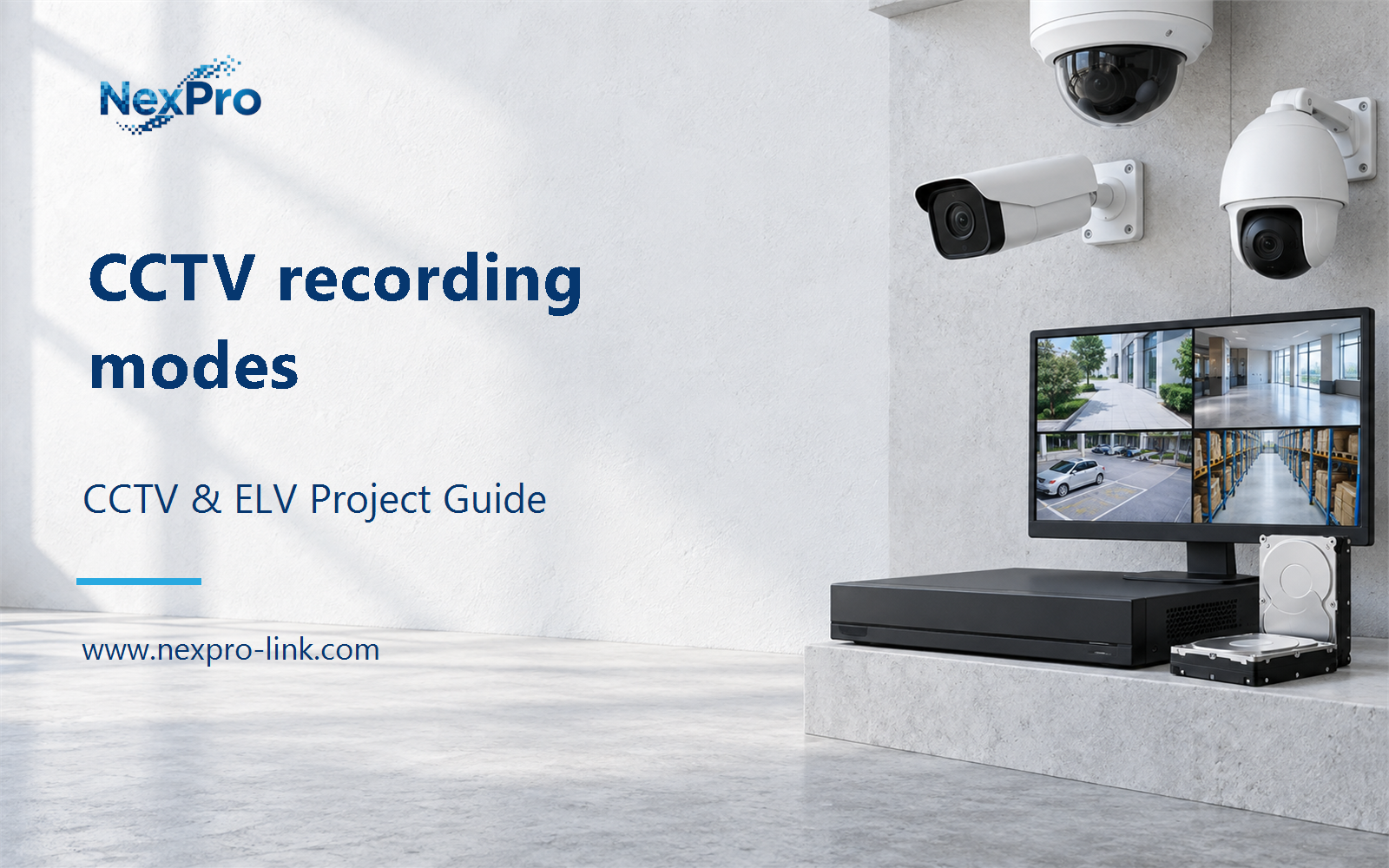
Plan CCTV recording modes with practical guidance on define what must remain recorded and pre-event and post-event context. NexPro-Link project guide.
Section 01
Define What Must Remain Recorded
Start with the events and context that must remain available, including periods when no alarm is generated. Continuous, event-driven and reduced-frame-rate recording leave different evidence. Select the mode from the operational requirement before estimating the storage saving.
Turn the answer into a working record using Camera group, Required context, Recording mode, Risk.
| Decision area | Buyer question | Required output |
|---|---|---|
| Define What Must Remain Recorded | How should a recording mode be selected? | Start with the events and context that must remain available, including periods when no alarm is generated. |
| Continuous Recording and Predictability | Why choose continuous CCTV recording? | It preserves an ongoing record without depending on an event trigger for capture. |
| Motion and Event Triggers | Is motion recording the same as analytic event recording? | Not necessarily. |
Section 02
Continuous Recording and Predictability
It preserves an ongoing record without depending on an event trigger for capture. Capacity still varies with bitrate and scene conditions, but the recording schedule is clearer. Continuous recording does not guarantee every frame is usable; image quality, system load and recording health remain important.
Use Hours per day, Stream setting, Average rate, Retention to compare options on the same basis. Keep product capability, project assumption and operating responsibility in separate columns.
Section 03
Motion and Event Triggers
Not necessarily. Motion detection may react to image changes, while an analytic rule may classify or qualify an event. Their missed-event and false-trigger behavior differs. Specify the trigger and fallback behavior rather than using event recording as a single interchangeable feature.
The project output should make Trigger, Required event, Unwanted activation, Fallback traceable from input to acceptance.
- Confirm the answer to: Is motion recording the same as analytic event recording?
- Record the project fields: Trigger / Required event / Unwanted activation / Fallback.
- Keep product capability, project assumptions and site responsibility in separate records.
Section 04
Pre-Event and Post-Event Context
They extend each recorded event beyond the trigger period, and overlapping events can make the effective recording time much longer than the alarm duration. Include those intervals when estimating capacity. Also verify whether the chosen device and mode support the required buffering and context.
Record Trigger duration, Pre-time, Post-time, Overlap, Recorded time before selecting a product family. That makes later substitutions possible without silently changing the operational requirement.
Section 05
Reduced Frame Rate and Time-Lapse Modes
It can omit the temporal detail needed to follow quick actions, vehicles or exchanges. A lower frame rate may suit some overview tasks but should be evaluated against the event to reconstruct. It does not have a universally proportional effect on compressed storage.
Review Event speed, Needed sequence, FPS option, Detail loss with the party that will operate or maintain the system.
Section 06
Estimate and Revisit the Retention Outcome
No. Activity level, trigger behavior, pre- and post-recording, and codec settings determine the result. Use labelled scenarios and compare them with observed recording rates after commissioning. Treat retention as a requirement to verify, not a percentage inferred from the recording mode's name.
Use Scenario, Active time, Recorded hours, Estimated TB, Observation as the handoff between design and procurement.
Engineering references
These sources support the general planning principles. Always use the selected product's current datasheet and applicable project standards for final design.