Design carton-factory views with working stacks in place, keep dispatch coverage independent, and connect shift-based recording decisions to a transparent storage budget.
Section 01
Approve coverage with the working stacks in place
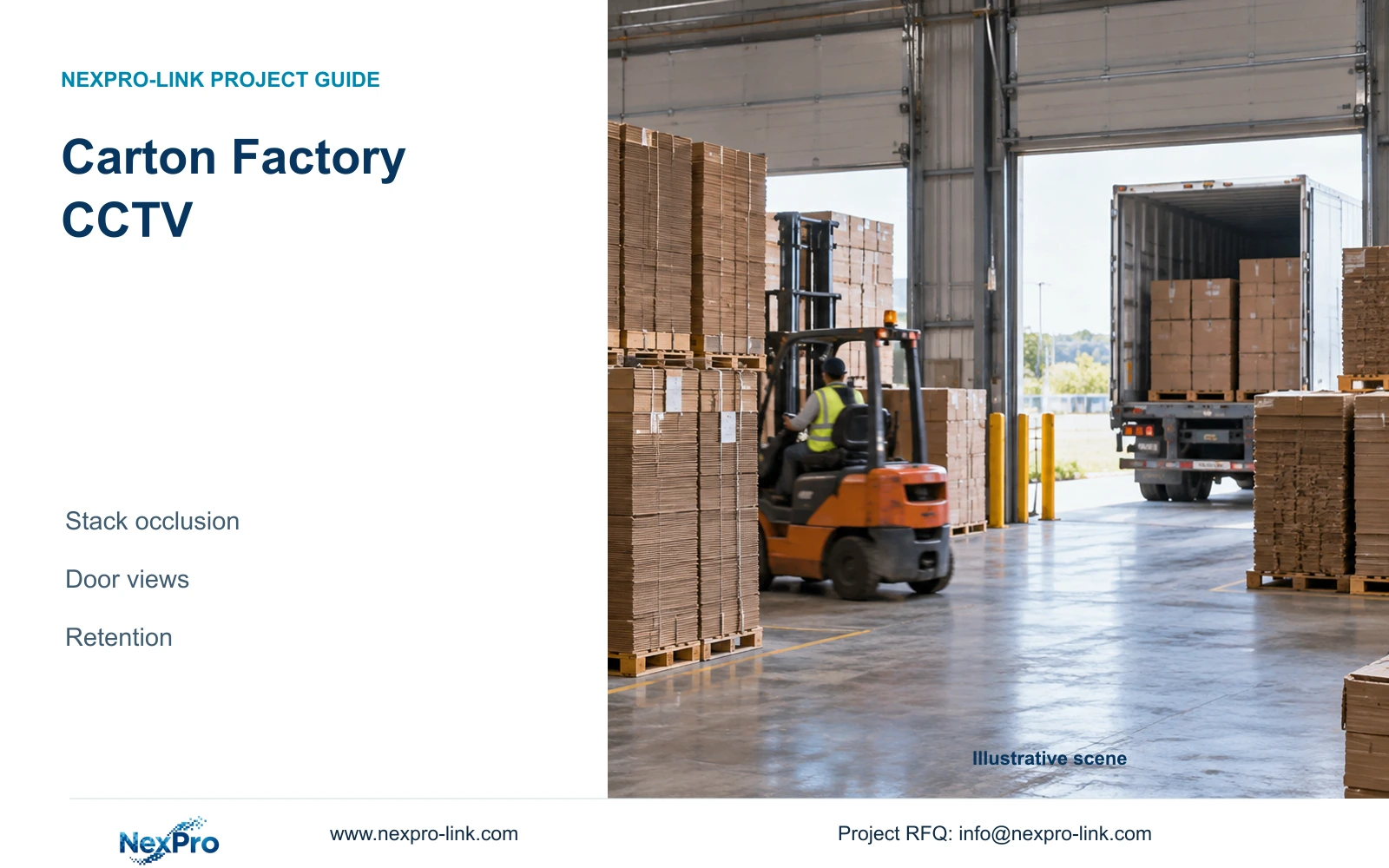
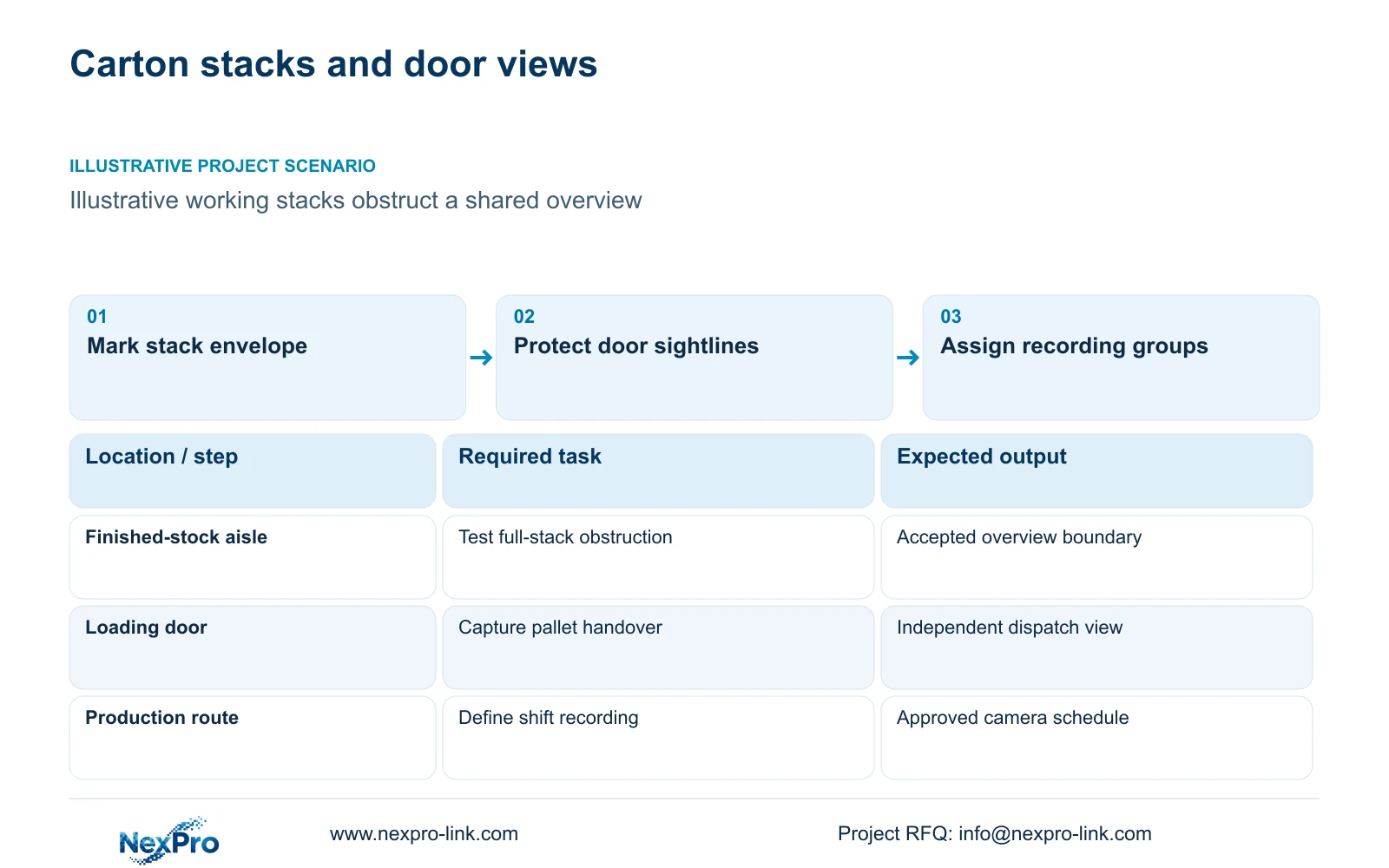
Carton factory CCTV should preserve fixed loading-door and transfer views at full working stack height. Establish those sightlines before selecting recording schedules or storage. An empty-floor overview does not demonstrate coverage once finished cartons occupy the permitted staging areas. Ask the owner to define the maximum working stack envelope and the movements that must remain visible, then evaluate camera positions against that condition.
Illustrative project scenario: Finished cartons block a view that looked satisfactory before production started. Assume the disputed view crosses a temporary staging area toward a loading door. The engineer places the expected stack envelope on the drawing and checks whether the transfer plane remains visible during normal loading. A dedicated door view may be needed even if the overview still shows the aisle. This is a hypothetical planning exercise; no stack height, final camera quantity or successful field result is supplied.
Section 02
Give dispatch a view independent of storage aisles
Treat each loading-door handover as its own observation task. Include the outgoing pallet or bundle, the receiving vehicle position and enough movement context to follow departure. A camera looking through an aisle can lose that task whenever cartons are staged between it and the door. Compare a dedicated door-facing position with the proposed shared overview using working stacks, open doors and normal handling equipment.
Check changing daylight at the opening, label orientation and transfer speed on recorded footage. Raising the mount may clear a stack while making the required pallet reference harder to see, so height alone is not an acceptance criterion. The NexPro-BL2812M55-5MP-DIC-AI provides a relevant ordinary-area reference with listed 2880×1620 output and a 2.8–12mm motorized lens, but those fields do not establish a guaranteed view from an unspecified position. Record the approved target width and obstruction conditions. Do not treat security recording as carton print inspection or machine guarding.
Section 03
Separate recording groups by actual activity
Use the owner's operating schedule to distinguish continuously needed views from views that may follow a defined shift schedule. Dispatch can continue outside a production shift, and stock movement may occur while machinery is idle. Therefore, a stopped line does not automatically justify stopping its nearby security recording. For each camera group, state operating hours, permitted recording mode, required retention and who approves exceptions.
If the owner considers event recording for an idle area, demonstrate the trigger and the required event context before reducing the storage allowance. Keep dispatch views on the approved policy independently of adjacent production groups. The supplied 32-camera calculation below remains a continuous 24-hour baseline; it assumes no savings from idle periods. A shift-based alternative needs actual hours and representative bitrate for each group. Record the schedules in the handover pack so operators can distinguish an intentional non-recording period from a fault.
Section 04
Price the chosen retention with usable capacity
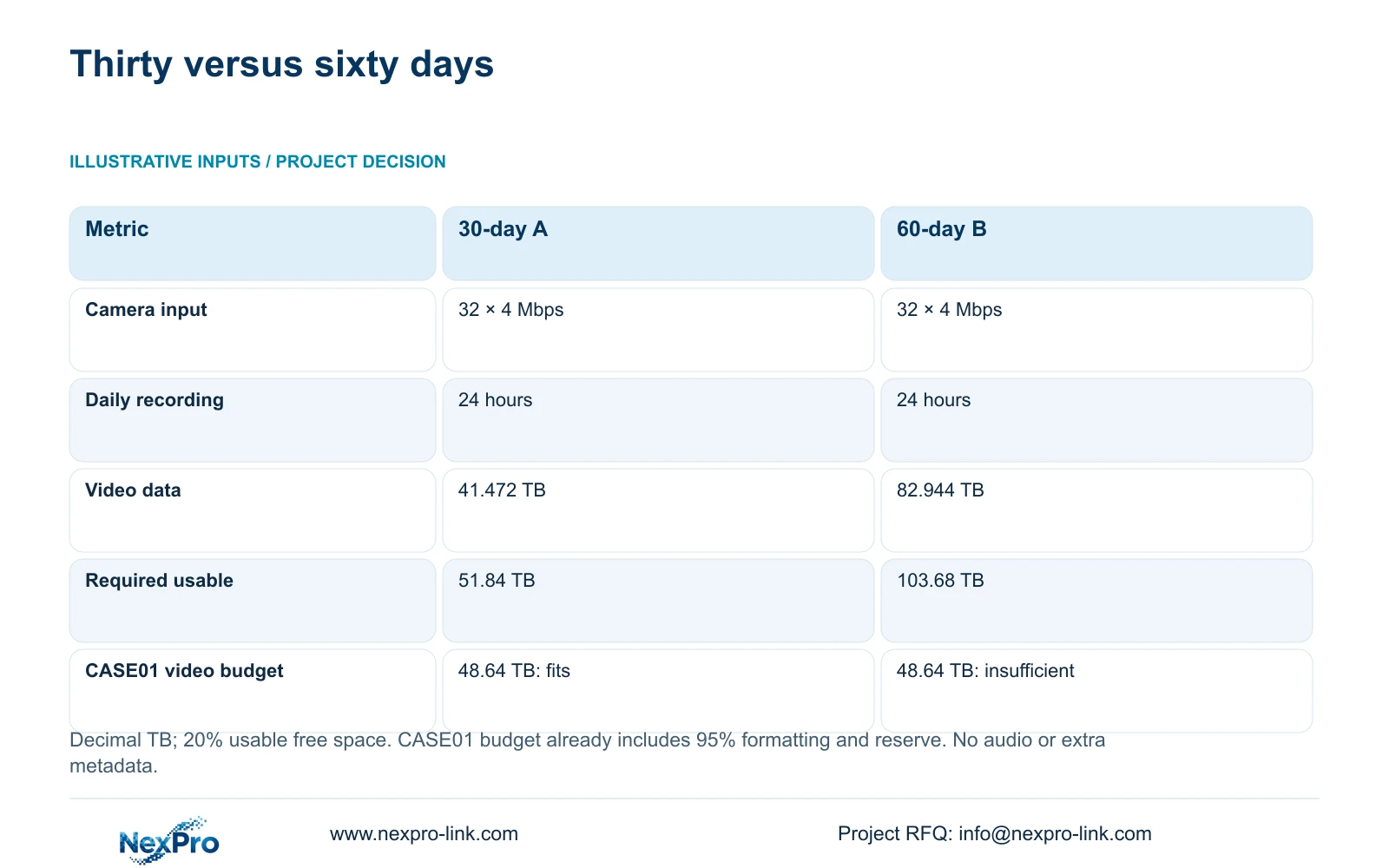
The illustrative inputs are 32 cameras, an average 4 Mbps each, 24 hours/day and either 30 or 60 days. Use video_TB = n × Mbps × 10^6 × 86400 × days / 8 / 10^12. This gives 41.472 TB for 30 days and 82.944 TB for 60 days, in decimal TB. With 20% of usable space kept free, required_usable_TB = video_TB / 0.8, giving 51.84 TB and 103.68 TB respectively.
The decisive change is the doubled retention requirement at unchanged assumed recording quality. It does not establish a brand-specific compression advantage. Raw disks, filesystem overhead and any supported redundancy arrangement remain separate from these usable targets. Audio and additional metadata are excluded. Replace 4 Mbps with representative measured averages before making a binding capacity commitment, and retain the chosen quality during that measurement. If groups record different hours, calculate their quantities separately and sum them before applying the stated free-space policy.
| Metric | Option A | Option B |
|---|---|---|
| Cameras | 32 | 32 |
| Average camera bitrate | 4 Mbps | 4 Mbps |
| Daily recording | 24 hours | 24 hours |
| Retention | 30 days | 60 days |
| Video quantity | 41.472 TB | 82.944 TB |
| Required usable capacity | 51.84 TB | 103.68 TB |
Section 05
Keep dispatch coverage while changing storage scope
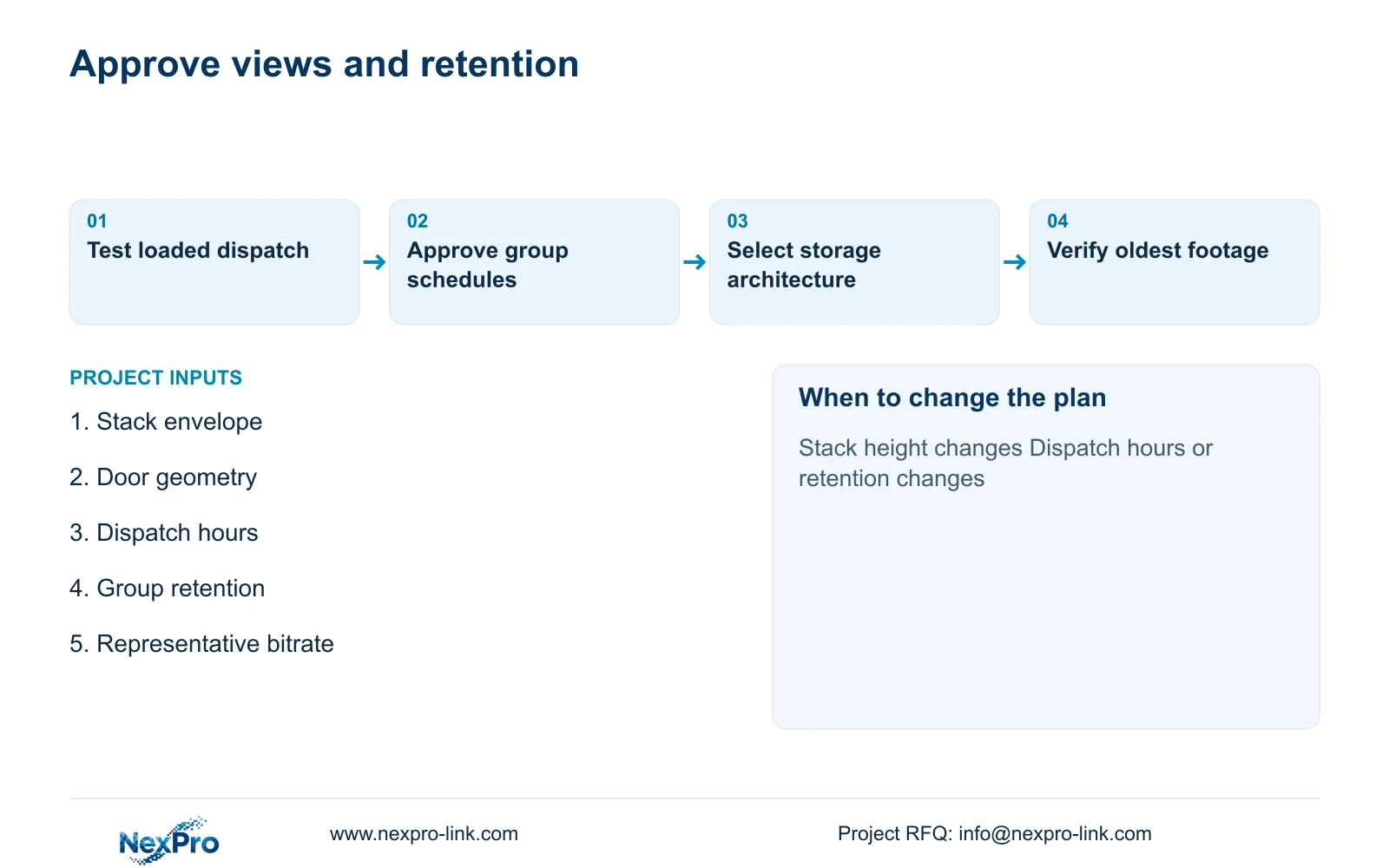
Recommend fixed dispatch views that pass the full-stack test, then choose retention from the owner's incident-review needs. If the budget cannot support the longer period, compare an explicitly approved group-specific policy rather than removing a critical door view without explaining the consequence. Reopen the design when stack limits, dispatch hours, average bitrate or retention changes. Camera geometry and recording duration solve different problems and should remain separate approval decisions.
CASE01 provides a useful 30-day illustrative baseline: four 16 TB disks give 64 TB raw capacity, 60.8 TB after the assumed 95% factor and a 48.64 TB video budget after the 20% free-space reserve. Its 41.472 TB video requirement fits; the 82.944 TB 60-day requirement does not. The NexPro-NVR4449-4K has four SATA bays listed up to 18 TB each, so a longer policy needs a revised supported storage architecture. The NexPro-NVR8864-4K offers eight listed bays, but that alone does not establish RAID, decode capacity or the final disk arrangement.
Section 06
Handover the stack map and recording schedule together
Procurement should issue the approved stack envelope, door-view schedule and recording policy as one quotation basis. Mark supplied cameras, retained views, optional capacity and installer-provided supports separately. NexPro-Link's BOQ support can coordinate model matching and the associated recorder and storage list. Keep actual cable routes, PoE demand and protected switch and recorder loads attached to the same location IDs so a moved camera does not create an unpriced dependency.
At commissioning, demonstrate a loaded dispatch sequence, retrieve a known shift event and check the oldest available footage against the agreed policy. Confirm the recording schedule after configuration changes or replacement hardware. Operators should know who may export incidents and who may alter retention. A retrieval monitor can remain sufficient unless the daily supervision task needs more displays. Any specialist exposure near printing or solvent-related operations stays separately assessed; it should not be inferred from the ordinary loading-door camera specification.
Section 07
Buyer questions
Does a 60-day policy mean every camera needs 60 days? Only if the owner requires that common period. Group-specific retention can be considered, but confirm the selected recorder's implementation and document the shorter periods explicitly.
Can idle shifts be counted as zero storage? Only where the approved policy actually stops recording. Lower activity alone does not establish zero bitrate or reliable event-only coverage.
Should adding bigger disks replace an occlusion review? No. Storage preserves the images received; it cannot recover a loading event hidden behind cartons. Approve the full-stack sightline before capacity selection.
Section 08
Price carton views and retention together
Send the maximum working stack envelope, loading-door transfer plan, shift and dispatch schedule, and camera-group retention requirements to info@nexpro-link.com for a comparable equipment and storage scope.
Engineering references
These sources support the general planning principles. Always use the selected product's current datasheet and applicable project standards for final design.