A remote depot can keep recording when WAN access fails, provided its local network and power chain remain available. This example sizes sixteen views and separates UPS capacity from one-hour runtime.
Section 01
Keep the recording path entirely within the depot
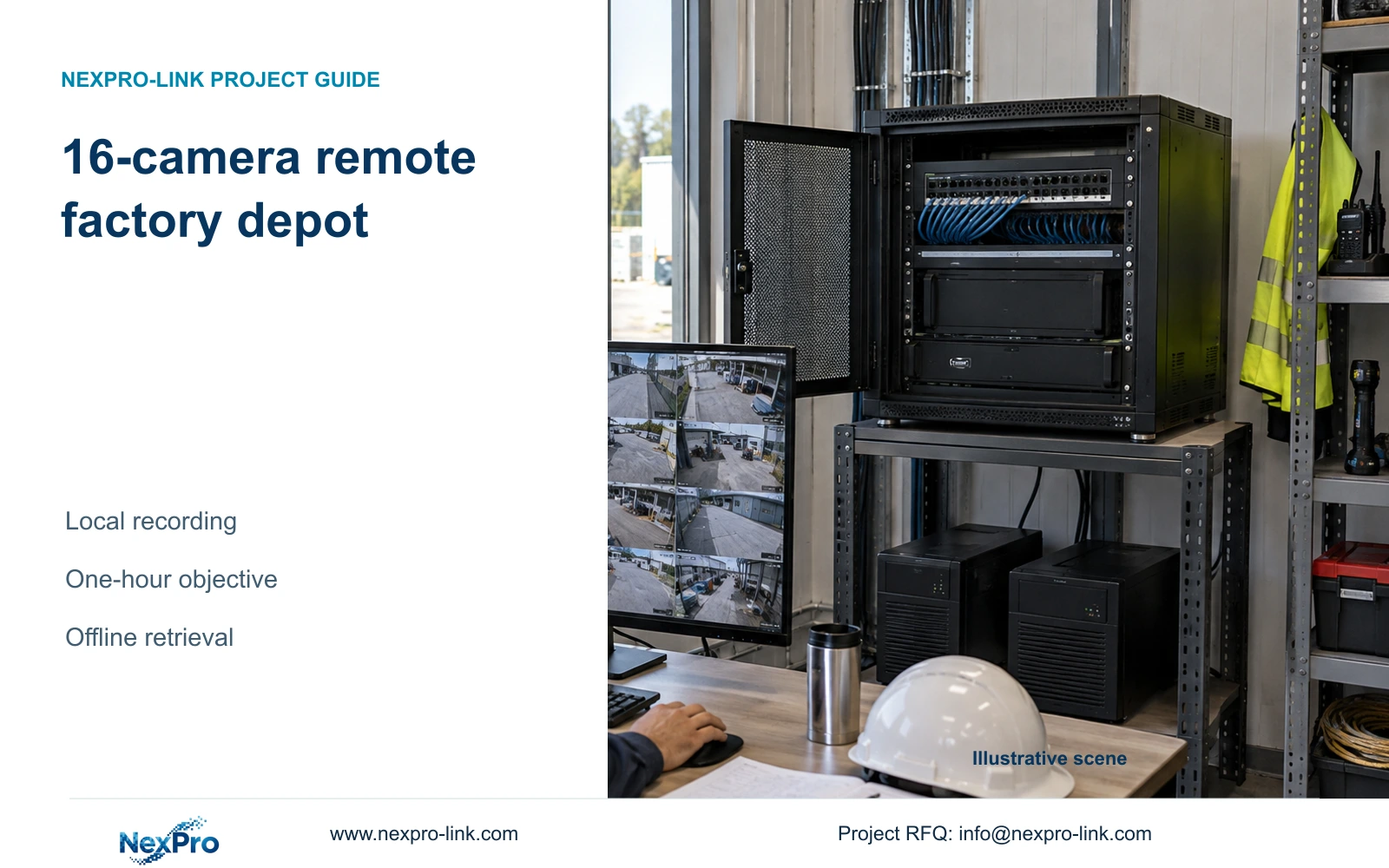
For a sixteen-camera remote depot, use local recording with a documented retrieval screen and protect every device needed between cameras and disks. WAN access should serve authorized remote viewing rather than carry the only recording path. A permanent video wall is unnecessary for the reference task. Select battery configuration against the one-hour operating objective separately from the UPS's output rating.
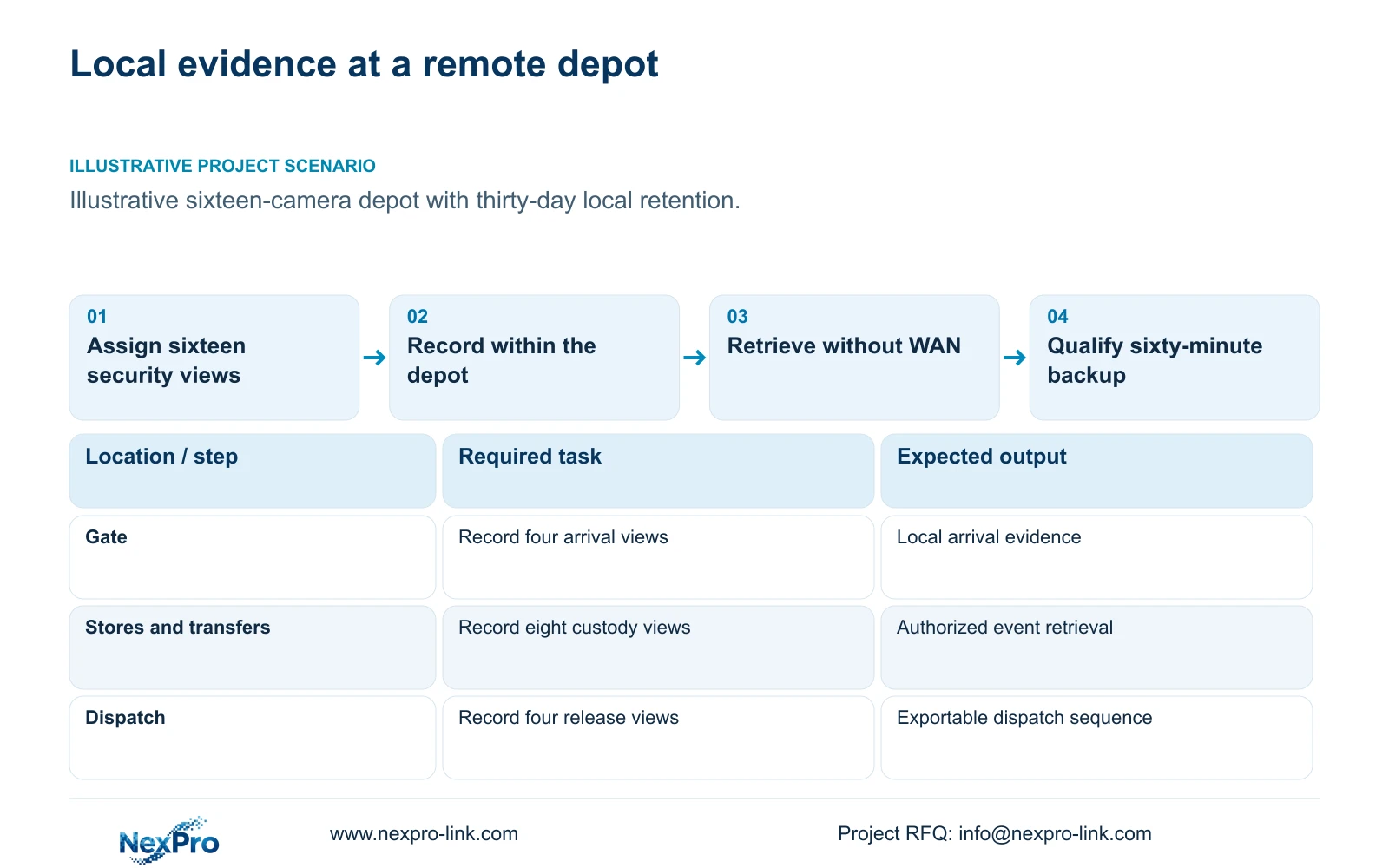
Illustrative project scenario: A remote factory depot needs sixteen ordinary security cameras, thirty-day retention and a sixty-minute backup objective. CASE10 assigns four cameras to the gate, four to stores, four to permitted transfers and four to dispatch. One local node handles recording and retrieval. These are assumed observation tasks, not camera quantities inferred from floor area or evidence from a completed installation.
For each zone, specify what an operator must retrieve: an arrival, a store-access event, a transfer or a dispatch sequence. Mark view width, lighting and mounting conditions on the plan. The NexPro-BL2812M55-5MP-DIC-AI and NexPro-DM2812M55-5MP-DIC-AI ordinary-area references list 2880×1620 output and 2.8–12mm motorized lenses. Evaluate the selected view on recorded footage; the 5MP family label alone does not establish usable detail. Any newly identified specialist environment requires separate qualification.
Section 02
Build thirty-day retention from the actual stream schedule
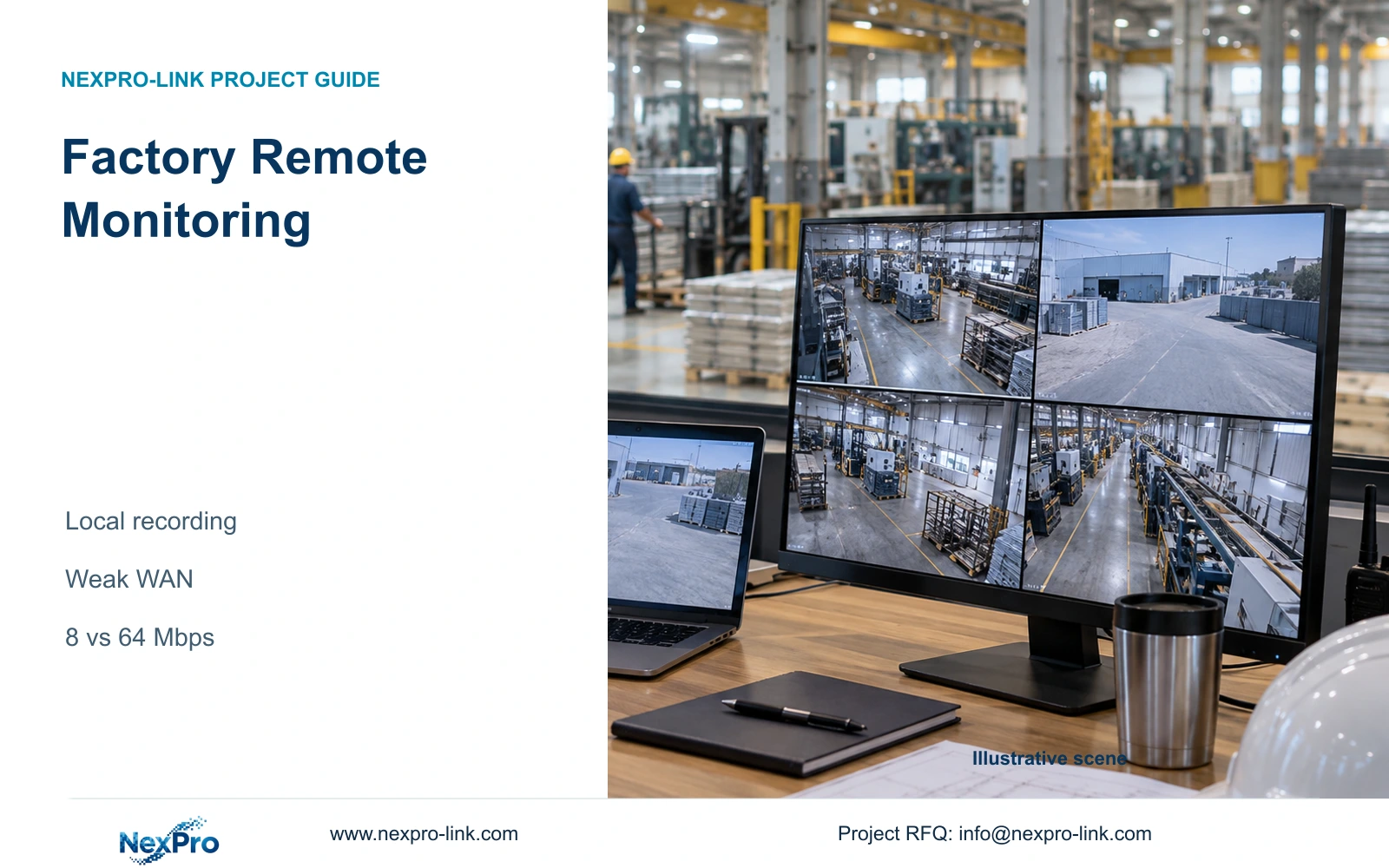
The example assumes sixteen supported 5MP-class streams at an average 4 Mbps each, recorded continuously for 30 days. Aggregate input is 16 × 4 = 64 Mbps. The decimal-capacity formula is video_TB = cameras × average_Mbps × 10^6 × 86400 × days / 8 / 10^12. Substituting the inputs gives 20.736 TB. Preserve recording hours and bitrate in the calculation sheet so later changes remain visible.
Allowing 20% of usable space to remain free requires 20.736 / 0.80 = 25.92 TB usable capacity. Four 8 TB drives give 32 TB raw; the illustrative 95% formatted-capacity factor gives 30.4 TB usable. Available video budget is 32 × 0.95 × 0.80 = 24.32 TB, exceeding 20.736 TB. Compare these figures directly because the budget already includes reserve. Additional audio or metadata needs its own allowance.
NexPro-NVR4449-4K provides a reference with 320 Mbps input and four SATA bays, up to 18 TB per drive. Confirm the exact drive model, firmware and required stream combination, then test playback and export under recording load. The published summary distinguishes 49×5MP from 9×4K; it does not establish unrestricted 4K recording or simultaneous decoding. Four occupied bays also leave no free bay in this arrangement, and no RAID protection is assumed.
Section 03
Protect local switching even when remote access is optional
Arrange two eight-camera access groups, N1-SW1 and N1-SW2, feeding the local recorder. A WAN outage should leave those paths intact. Draw the core, router and retrieval connection explicitly, identifying any routing, addressing or other local dependency that could fail when external connectivity disappears. Keep equipment in an environment suitable for its operation, charging, ventilation and service.
Each group assumes eight ordinary cameras at 12 W device-side demand, totaling 96 W. With 90% cable delivery, PSE_output_W = 96 / 0.90 = 106.6667 W. At an 80% budget-utilization target, required PSE budget is 106.6667 / 0.80 = 133.3333 W. With assumed 15 W switch self-consumption and 90% AC conversion, complete switch_AC_W = (106.6667 + 15) / 0.90 = 135.1852 W. Obtain actual maximum camera demand and switch ratings before final selection.
Match individual port requirements as well as the total power budget, including uplink capacity beyond the eight powered devices. Essential switching stays on backup even if the owner excludes optional displays. Record authorized remote-access roles and a local retrieval method that remains usable offline. NIST SP 800-82 Rev.3 provides context for respecting factory operational-network constraints; agree permitted connections and support access with the network owner. Verify both eight-device groups under the selected switch's actual PoE admission policy: negotiated allocations may exceed the calculated draw-based budget even when individual ports appear suitable.
Section 04
Request one-hour runtime for a defined protected load
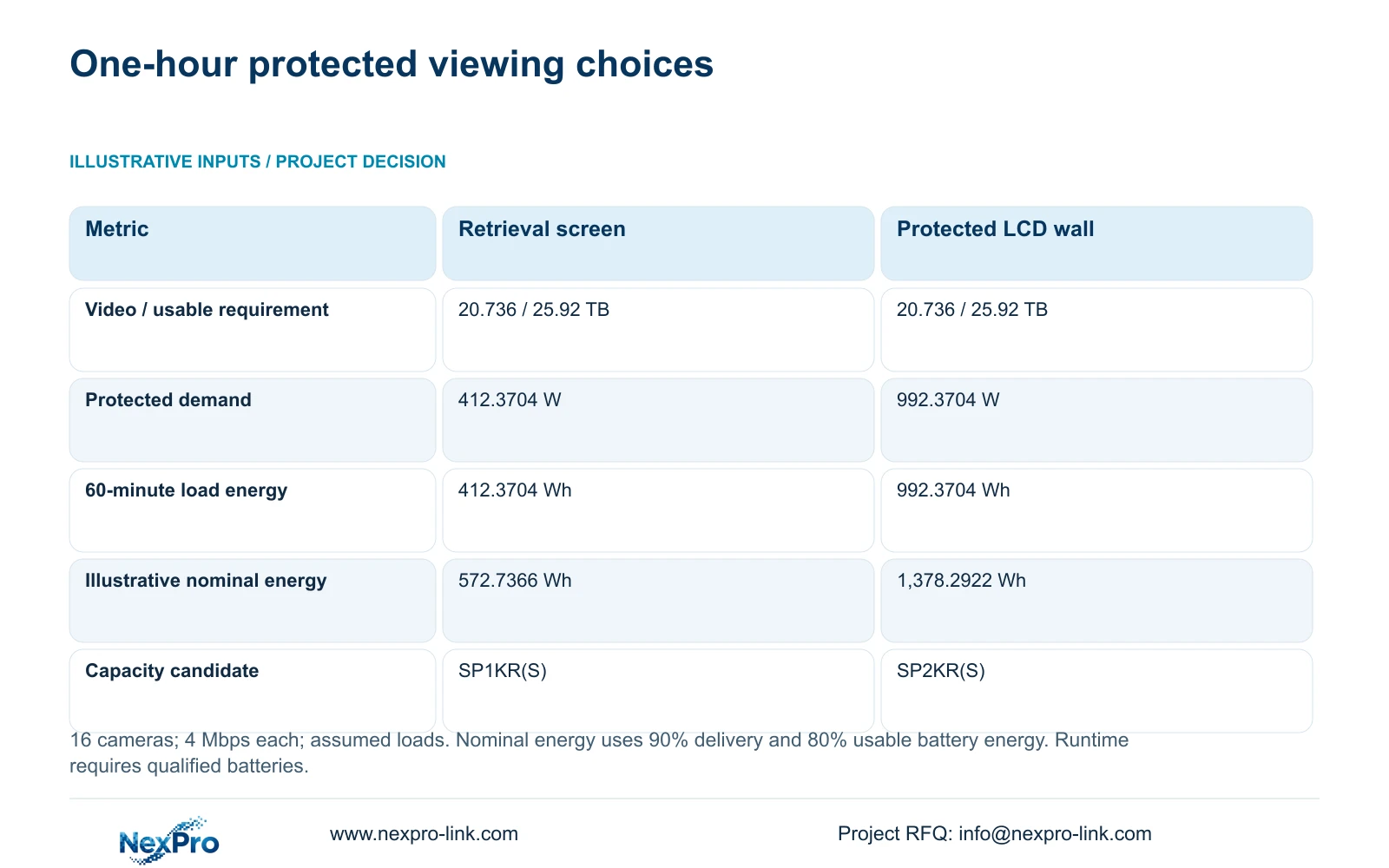
Option A includes two complete switch AC loads, an assumed 30 W recorder, four drives at 8 W each, a 25 W core, a 15 W router and a 40 W retrieval screen. Total protected demand is 412.3704 W. Option B keeps the screen and adds four assumed 120 W LCD panels plus a 100 W decoder, reaching 992.3704 W. Do not add camera watts again after counting the complete switch inputs.
Both options retain 20.736 TB of video; B changes viewing and backup demand. Choose A for the stated local retrieval task. Add B only for a defined concurrent viewing requirement, and qualify decoder performance separately. NX-VP-5535 is a 55-inch 1920×1080 LCD reference. Its assumed 120 W load here is not a published power measurement, and NX-VD-4K16's name does not prove sixteen simultaneous 4K decodes.
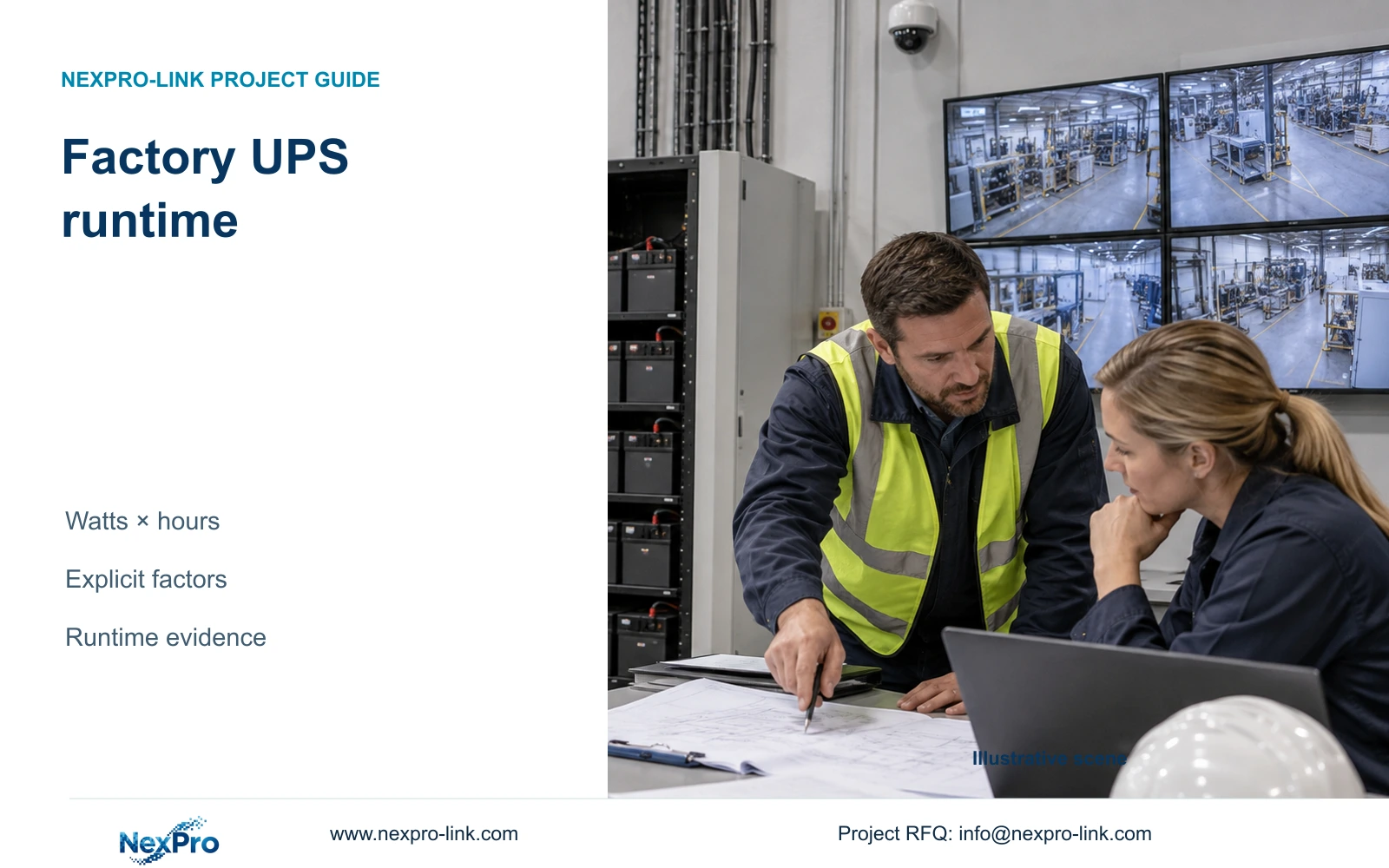
Under assumed PF 0.9 and 80% rated utilization, require rated_W ≥ load_W / 0.80 and rated_VA ≥ load_W / (0.90 × 0.80). SP1KR(S), rated 1kVA/900W, is A's capacity candidate; SP2KR(S), rated 2kVA/1800W, is B's. Load_Wh = load_W × 60 / 60 gives the table's energy values. Further illustrative factors of 90% battery-to-load delivery and 80% usable battery energy yield 572.7366 Wh and 1,378.2922 Wh nominal requests. Manufacturer-supported batteries and runtime curves must establish the actual hour.
| Metric | A: retrieval screen | B: protected LCD wall |
|---|---|---|
| Required video | 20.736 TB | 20.736 TB |
| Required usable capacity | 25.92 TB | 25.92 TB |
| Protected AC demand | 412.3704 W | 992.3704 W |
| 60-minute load energy | 412.3704 Wh | 992.3704 Wh |
| Illustrative nominal battery energy | 572.7366 Wh | 1,378.2922 Wh |
| UPS capacity candidate | SP1KR(S) | SP2KR(S) |
Section 05
Allocate complete cable runs before shipping materials
All sixteen links are new purchases in CASE10. Assumed base routes run from 35 to 70 m, with 6 m per link for service and termination, producing continuous cuts of 41–76 m and 936 m total. The lower bound is ceil(936 / 305) = four reels. The supplied feasible allocation uses 294 m, 305 m, 296 m and 41 m on those reels, preserving complete runs.
The fourth reel has 264 m remaining, but that material cannot replace a continuous run already assigned elsewhere without revising the cut plan. Label each cut by camera identity and verify routes before dispatch. The allocation includes no additional blanket waste percentage; any project spare reel needs separate approval. Final route changes may affect cable quantity, termination location and the access-node arrangement together.
The assumed module-ended design needs 32 termination modules and 16 cabinet ports. DT968MX and the SP5648 48-port panel are relevant references; confirm compatible cable and patch cords. A direct-plug/MPTL design changes material counts and testing. Fluke Networks guidance distinguishes typical 90 m permanent links and 100 m channels. Specify route-suitable cable construction, containment and building entries, with fibre and powered endpoints listed separately if actual crossings require them.
Section 06
Accept the depot package through offline and outage tests
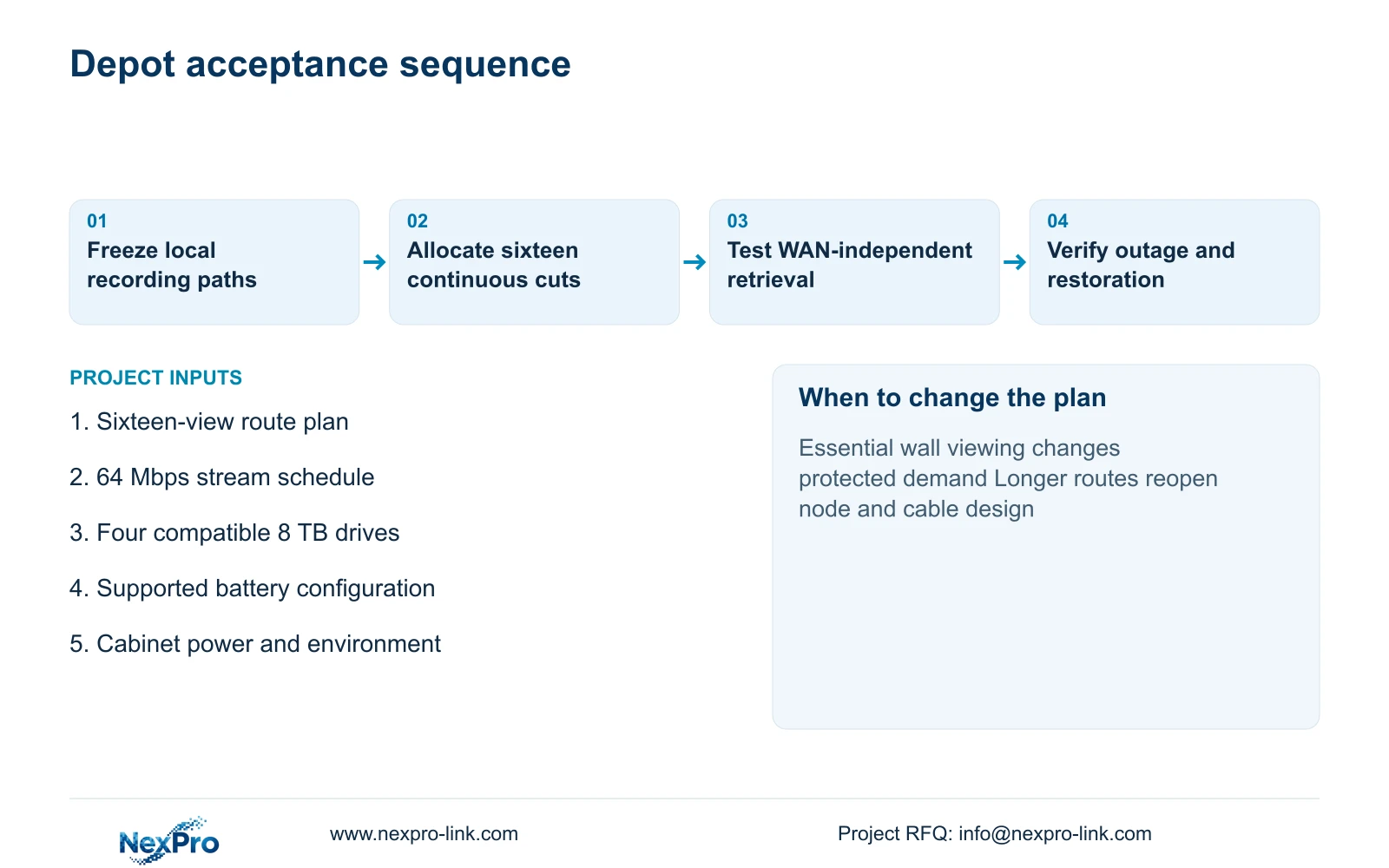
Release a base equipment schedule for sixteen ordinary cameras, one qualified recorder, four compatible 8 TB drives, two matched access switches, one UPS with its supported battery configuration, one retrieval screen and four cable reels. Include rack, PDU, mounting, terminations and approved electrical work as explicit lines. The optional wall has a separate supply and power scope so it cannot silently consume the battery allowance reserved for recording.
Acceptance should first demonstrate recording and local retrieval with WAN access disconnected. Export a selected event and verify usable playback outside the recorder. Then run an approved power test against the agreed load, initial charge and battery conditions. Record continuity, alarms and recovery when mains returns. Follow-up checks should establish readiness for another outage after recharge; a first discharge alone does not answer that operating question.
NexPro-Link can coordinate model matching, technical submittals and project packing through its published supply scope. For a remote site, agree replacement-item identity and local troubleshooting responsibilities before comparing quotations. An alternative brand package should provide the same sixteen accepted views, retention and qualified backup duration. Reopen the design for higher bitrates, additional cameras, longer routes, changed battery conditions or an essential display requirement. Local construction and electrical acceptance remain assigned to the project's appointed team.
Section 07
Buyer questions
Can the retrieval screen be left outside battery backup? It can if the owner permits recording without local viewing during outages. Option A includes its assumed 40 W load, so excluding it requires a revised protected-load schedule and operating procedure. Retain every network device needed for recording.
Does restoring internet access automatically copy missing video to headquarters? No automatic synchronization is established here. This design retains footage locally. Specify and test any headquarters archive or transfer workflow separately, including permissions, upload capacity and ownership of failed transfers.
What evidence should support the one-hour battery quotation? Request the exact UPS and battery configuration, a runtime curve for the specified load, and stated operating conditions. Agree how site acceptance addresses initial charge, temperature and battery condition. Nominal Wh alone is insufficient.
Section 08
Define the depot's protected package
Email your sixteen-view route plan, stream and retention schedule, one-hour protected-load list, and cabinet power and environmental details to info@nexpro-link.com for a NexPro-Link equipment and battery-configuration proposal.
Engineering references
These sources support the general planning principles. Always use the selected product's current datasheet and applicable project standards for final design.
- User BL2812M series product specification
- User DM2812M series product specification
- NexPro-NVR4449-4K
- NexPro-Link rack online UPS
- NexPro-Link Structured Cabling
- NexPro-Link BOQ & Tender Support
- NexPro-Link Project Supply
- Fluke Networks cable-testing guidance
- APC/Schneider UPS buying guide
- NIST SP 800-82 Rev.3 final
- NexPro-Link NX-VP-5535 LCD video wall panel
- NexPro-Link NX-VD-4K16 network video decoder
- Microchip: Next-Generation PoE IEEE 802.3bt White Paper