A phased campus project must work at each handover, not only after the final building is finished. Compare Seetong-compatible, Hikvision and Dahua proposals against the same approved monitoring scope, phase boundaries and access requirements. Separate installed equipment from future allowances so an economical first phase does not conceal an expensive or incompatible expansion path.
Section 01
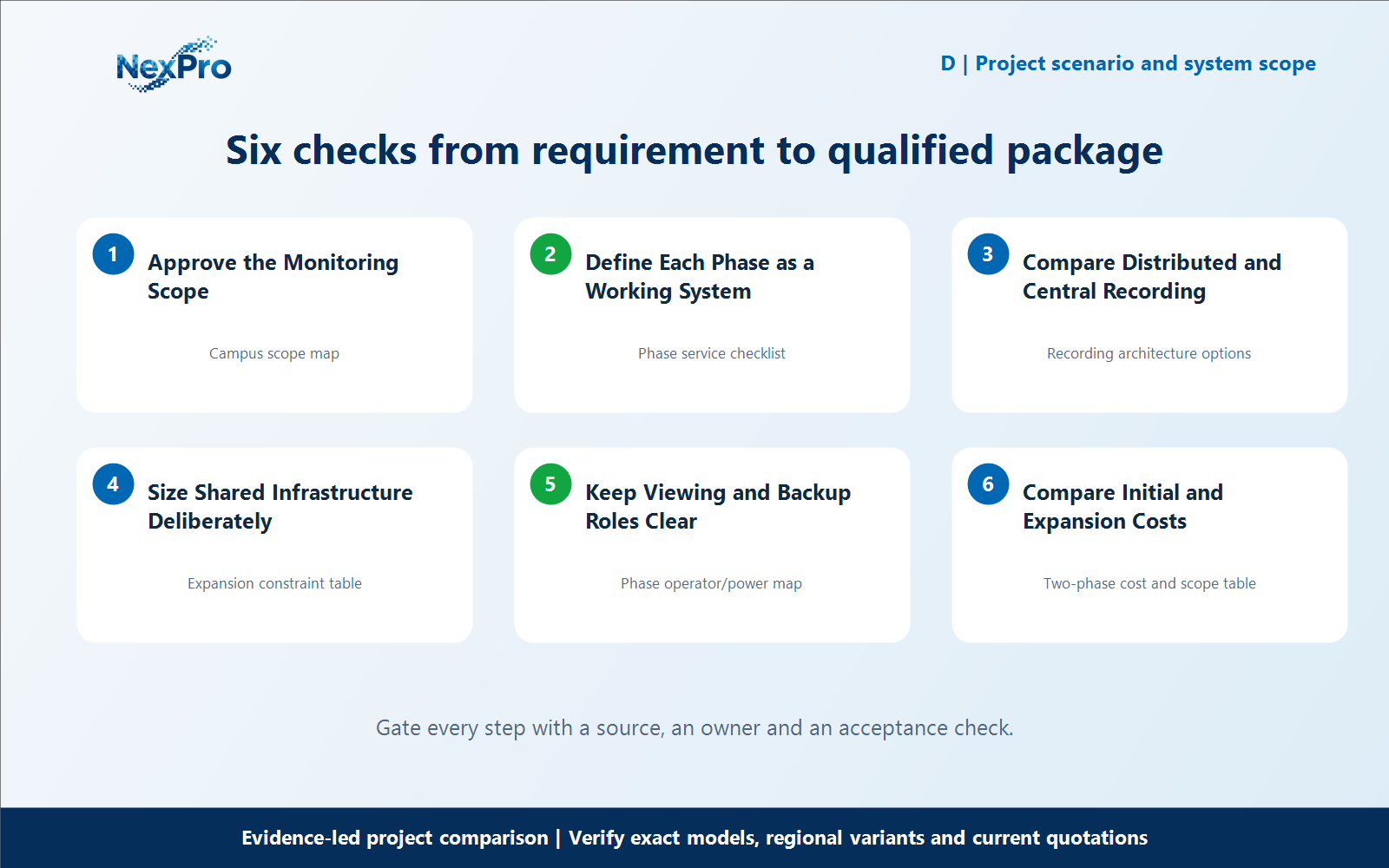
Approve the Monitoring Scope
A phased campus project must work at each handover, not only after the final building is finished. Compare Seetong-compatible, Hikvision and Dahua proposals against the same approved monitoring scope, phase boundaries and access requirements. Separate installed equipment from future allowances so an economical first phase does not conceal an expensive or incompatible expansion path. What should be agreed before campus equipment selection? Agree the areas and safety tasks that the institution has approved for monitoring, together with access and retention requirements. Keep sensitive or excluded spaces outside the proposal. Camera and platform choices should follow that scope, not introduce unnecessary identification or monitoring capabilities as default features.
For approve the monitoring scope, build a working record around Campus scope map. For Seetong Hikvision Dahua campus CCTV, record the current project condition, candidate response, evidence source and unresolved boundary before comparing offers.
Review Campus scope map separately from the downstream workflow. This prevents one attractive specification from deciding the complete Seetong Hikvision Dahua campus CCTV question without considering recording, installation, operation and support consequences.
Carry the Campus scope map record into the RFQ, BOQ review or pilot checklist. For Seetong Hikvision Dahua campus CCTV, keep product capability, project assumptions and supplier responsibility beside the approve the monitoring scope decision; site measurements, network policy, installation safety and acceptance remain project inputs unless the signed scope says otherwise.
- Record campus scope map with a named source, owner or acceptance check; do not leave it as an unqualified brochure phrase.
Section 02
Define Each Phase as a Working System
What must a first-phase design deliver? It must provide its agreed recording, viewing and power functions independently of equipment that will arrive later. Identify temporary arrangements and future dependencies. This prevents an inexpensive first-phase quote from omitting essential components on the assumption that the final phase will eventually provide them.
For define each phase as a working system, build a working record around Phase service checklist. For Seetong Hikvision Dahua campus CCTV, record the current project condition, candidate response, evidence source and unresolved boundary before comparing offers.
Review Phase service checklist separately from the downstream workflow. This prevents one attractive specification from deciding the complete Seetong Hikvision Dahua campus CCTV question without considering recording, installation, operation and support consequences.
Carry the Phase service checklist record into the RFQ, BOQ review or pilot checklist. For Seetong Hikvision Dahua campus CCTV, keep product capability, project assumptions and supplier responsibility beside the define each phase as a working system decision; site measurements, network policy, installation safety and acceptance remain project inputs unless the signed scope says otherwise.
- Record phase service checklist with a named source, owner or acceptance check; do not leave it as an unqualified brochure phrase.
Section 03
Compare Distributed and Central Recording
Which recording arrangement is automatically better? Neither is universally better. Compare building links, local operation, management requirements and failure effects. Verify the exact recorders or platform in the proposed arrangement. A distributed Seetong-compatible scope may fit some needs, but centralized requirements should not be removed merely to simplify the comparison.
For compare distributed and central recording, build a working record around Recording architecture options. For Seetong Hikvision Dahua campus CCTV, record the current project condition, candidate response, evidence source and unresolved boundary before comparing offers.
Review Recording architecture options separately from the downstream workflow. This prevents one attractive specification from deciding the complete Seetong Hikvision Dahua campus CCTV question without considering recording, installation, operation and support consequences.
Carry the Recording architecture options record into the RFQ, BOQ review or pilot checklist. For Seetong Hikvision Dahua campus CCTV, keep product capability, project assumptions and supplier responsibility beside the compare distributed and central recording decision; site measurements, network policy, installation safety and acceptance remain project inputs unless the signed scope says otherwise.
- Record recording architecture options with a named source, owner or acceptance check; do not leave it as an unqualified brochure phrase.
| Comparison factor | Object or condition | Evidence-led action | Do not infer |
|---|---|---|---|
| Phase 1 | Independent required service | Include all essential equipment | Not an incomplete starter kit |
| Phase 2 | Defined additional scope | Check shared constraints | No unlimited expansion |
| Infrastructure | Installed vs reserved | Ports/power/bandwidth distinct | No spare-port-only claim |
| Value | Initial plus expansion scope | Use coherent versions | Avoid hidden second-phase cost |
Section 05
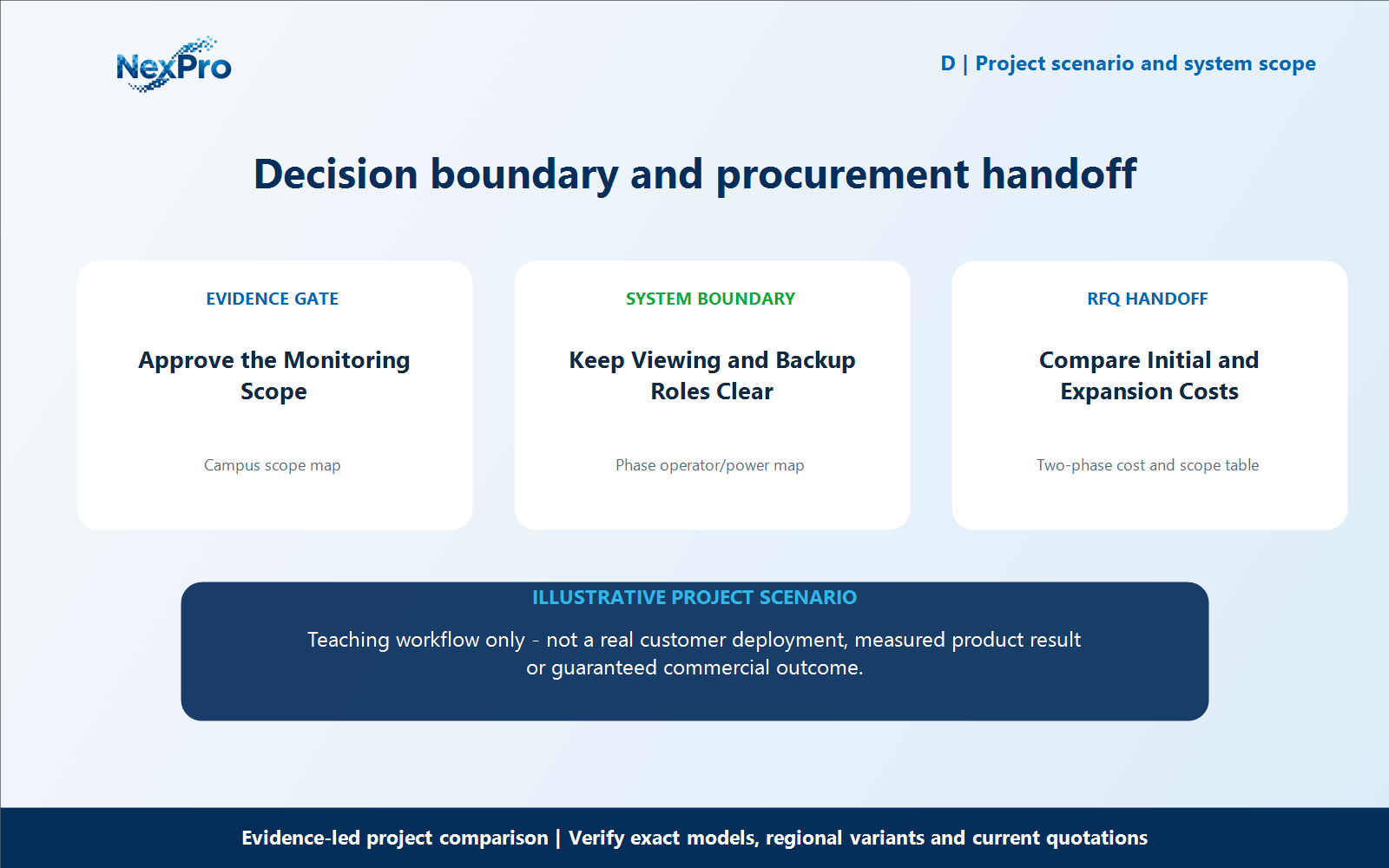
Keep Viewing and Backup Roles Clear
How should operations be handed over by phase? Define who views which buildings and which services must remain available during an outage. Include the switches and links required by those services. Select ordinary displays or a larger monitoring arrangement from the actual staff workflow, not from the size of the campus name.
For keep viewing and backup roles clear, build a working record around Phase operator, power map. For Seetong Hikvision Dahua campus CCTV, record the current project condition, candidate response, evidence source and unresolved boundary before comparing offers.
Review Phase operator and power map separately from the downstream workflow. This prevents one attractive specification from deciding the complete Seetong Hikvision Dahua campus CCTV question without considering recording, installation, operation and support consequences.
Carry the Phase operator/power map record into the RFQ, BOQ review or pilot checklist. For Seetong Hikvision Dahua campus CCTV, keep product capability, project assumptions and supplier responsibility beside the keep viewing and backup roles clear decision; site measurements, network policy, installation safety and acceptance remain project inputs unless the signed scope says otherwise.
- Record phase operator with a named source, owner or acceptance check; do not leave it as an unqualified brochure phrase.
- Verify power map with a named source, owner or acceptance check; do not leave it as an unqualified brochure phrase.
Section 06
Compare Initial and Expansion Costs
How can NexPro-Link show value across phases? Provide a standard equipment schedule with current quantities, future options and version-change rules. Compare both the first phase and the planned expansion with equivalent alternatives. A lower starting price is useful only when the next phase remains technically and commercially coherent.
For compare initial and expansion costs, build a working record around Two-phase cost and scope table. For Seetong Hikvision Dahua campus CCTV, record the current project condition, candidate response, evidence source and unresolved boundary before comparing offers.
Review Two-phase cost and scope table separately from the downstream workflow. This prevents one attractive specification from deciding the complete Seetong Hikvision Dahua campus CCTV question without considering recording, installation, operation and support consequences.
Carry the Two-phase cost and scope table record into the RFQ, BOQ review or pilot checklist. For Seetong Hikvision Dahua campus CCTV, keep product capability, project assumptions and supplier responsibility beside the compare initial and expansion costs decision; site measurements, network policy, installation safety and acceptance remain project inputs unless the signed scope says otherwise.
What should the buyer include in an RFQ for Seetong Hikvision Dahua campus CCTV? Provide the camera schedule, required workflows, candidate equipment lists, mandatory brand or integration constraints, and the evidence still needed for compare initial and expansion costs. Keep access credentials out of the inquiry. For Seetong Hikvision Dahua campus CCTV, this defines the next comparison; it does not promise identical performance, fixed savings or automatic approval.
- Record two-phase cost and scope table with a named source, owner or acceptance check; do not leave it as an unqualified brochure phrase.
Engineering references
These sources support the general planning principles. Always use the selected product's current datasheet and applicable project standards for final design.