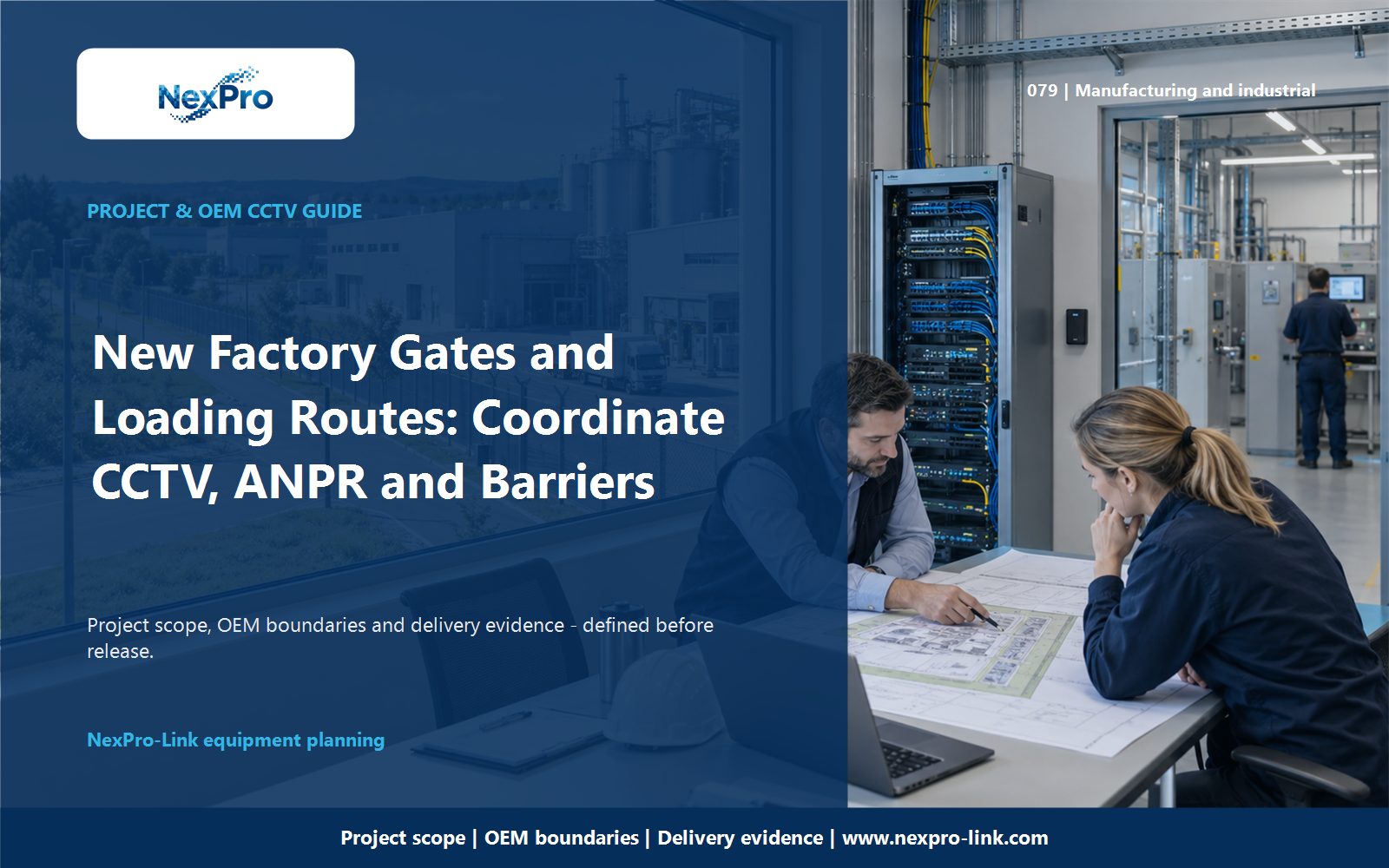
A new factory separates visitor cars, supplier trucks and dispatch vehicles at its entrances. Describe whether each lane needs automatic identification, an operator decision or recording only.
Section 01
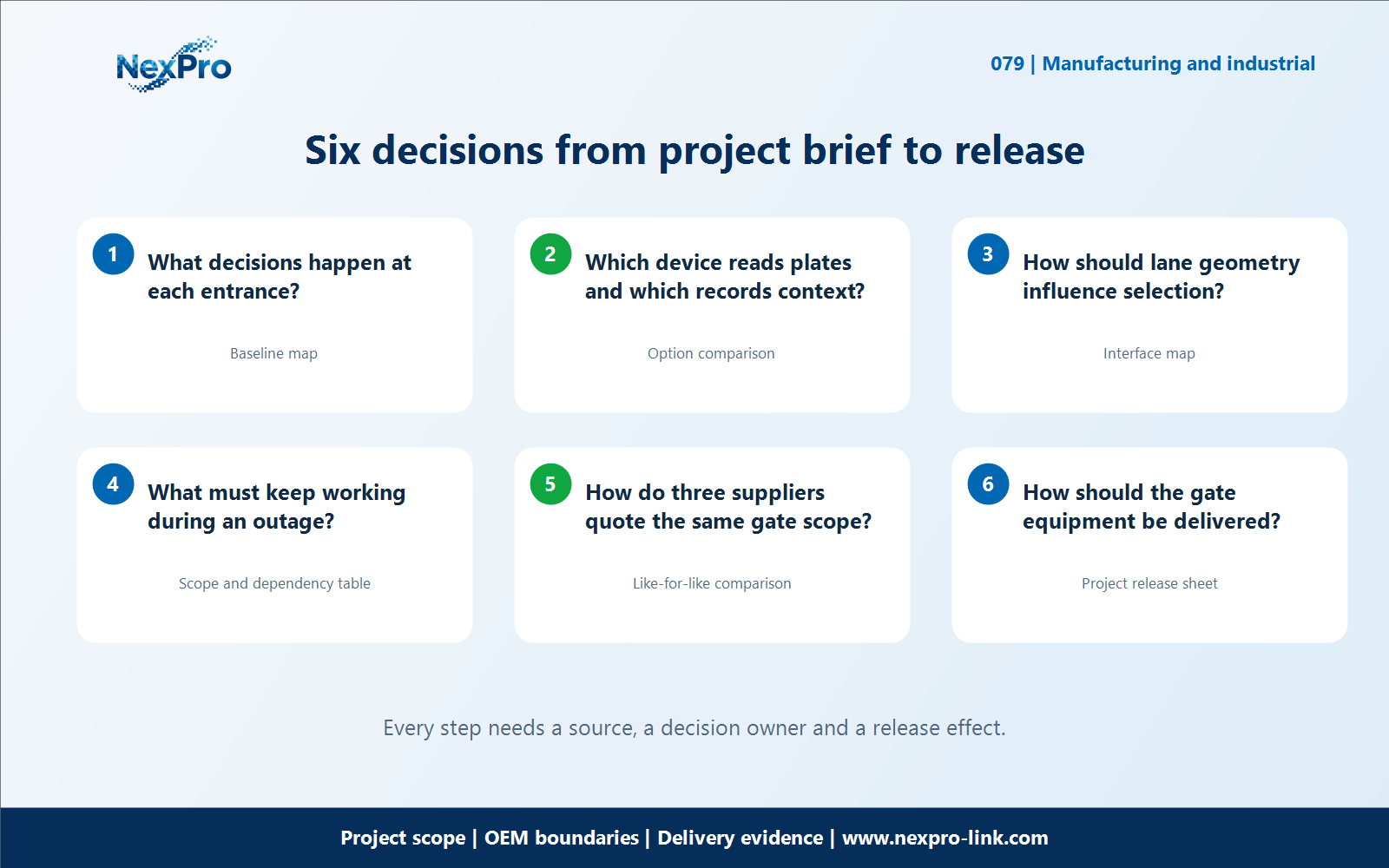
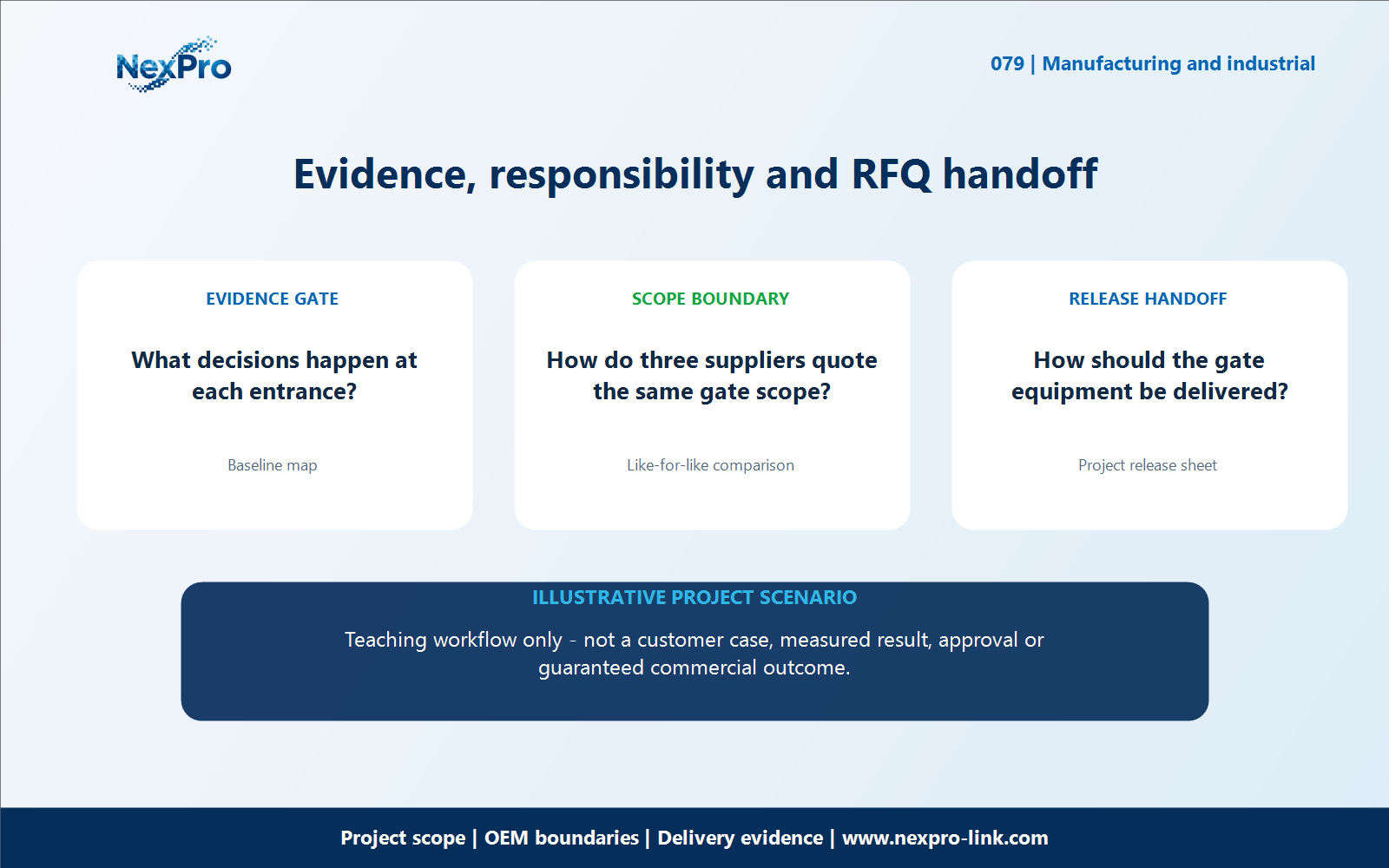
What decisions happen at each entrance?
A new factory separates visitor cars, supplier trucks and dispatch vehicles at its entrances. Describe whether each lane needs automatic identification, an operator decision or recording only. Different vehicle groups can require different workflows. Do not specify a plate-recognition device at every position simply because the project includes a barrier.
For the "What decisions happen at each entrance" decision, use the baseline map fields Area or item, Required task, Current assumption, Decision owner. Apply it to new factory gate loading CCTV so the buyer, supplier and local integrator can see which input is confirmed, who owns it and which evidence remains open.
Evaluate what decisions happen at each entrance against the stated site task and the surrounding equipment, documentation, packing and handover dependencies for new factory gate loading CCTV. For what decisions happen at each entrance in new factory gate loading CCTV, record the confirmed condition, chosen option and remaining evidence separately; an open value is not a price, test, approval or customer-result claim.
Carry the what decisions happen at each entrance decision into the RFQ, BOQ, configuration or release record for new factory gate loading CCTV. For what decisions happen at each entrance in new factory gate loading CCTV, name the equipment, artwork, network, installation and acceptance owner; site-specific work remains with the buyer or integrator unless the signed scope says otherwise.
Section 02
Which device reads plates and which records context?
Which device reads plates and which records context? Separate the recognition view from the context view. A recorder can preserve video without being the system that authorizes a barrier movement. Name the component and interface responsible for each decision in the project schedule. For New Factory Gates and Loading Routes: Coordinate CCTV, ANPR and Barriers, keep this decision tied to the same project brief rather than opening a separate generic specification exercise.
For the "Which device reads plates and which records context" decision, use the option comparison fields Position or option, Suitable condition, Trade-off, Next choice. Apply it to new factory gate loading CCTV so the buyer, supplier and local integrator can see which input is confirmed, who owns it and which evidence remains open.
Evaluate which device reads plates and which records context against the stated site task and the surrounding equipment, documentation, packing and handover dependencies for new factory gate loading CCTV. For which device reads plates and which records context in new factory gate loading CCTV, record the confirmed condition, chosen option and remaining evidence separately; an open value is not a price, test, approval or customer-result claim.
Carry the which device reads plates and which records context decision into the RFQ, BOQ, configuration or release record for new factory gate loading CCTV. For which device reads plates and which records context in new factory gate loading CCTV, name the equipment, artwork, network, installation and acceptance owner; site-specific work remains with the buyer or integrator unless the signed scope says otherwise.
Section 03
How should lane geometry influence selection?
How should lane geometry influence selection? Use the actual lane geometry, expected motion and lighting to select the capture arrangement. Installation dimensions should follow the applicable device guidance and site design. A generic camera height does not establish reliable recognition for every entrance. For New Factory Gates and Loading Routes: Coordinate CCTV, ANPR and Barriers, keep this decision tied to the same project brief rather than opening a separate generic specification exercise.
For the "How should lane geometry influence selection" decision, use the interface map fields Device or record, Input, Output, Responsible party. Apply it to new factory gate loading CCTV so the buyer, supplier and local integrator can see which input is confirmed, who owns it and which evidence remains open.
Evaluate how should lane geometry influence selection against the stated site task and the surrounding equipment, documentation, packing and handover dependencies for new factory gate loading CCTV. For how should lane geometry influence selection in new factory gate loading CCTV, record the confirmed condition, chosen option and remaining evidence separately; an open value is not a price, test, approval or customer-result claim.
Carry the how should lane geometry influence selection decision into the RFQ, BOQ, configuration or release record for new factory gate loading CCTV. For how should lane geometry influence selection in new factory gate loading CCTV, name the equipment, artwork, network, installation and acceptance owner; site-specific work remains with the buyer or integrator unless the signed scope says otherwise.
| Project question | Project-oriented treatment | Keep equal when comparing offers |
|---|---|---|
| What decisions happen at each entrance? | Describe whether each lane needs automatic identification, an operator decision or recording only. | Factory zone and environmental requirement |
| Which device reads plates and which records context? | Separate the recognition view from the context view. | Required event-review task |
| How should lane geometry influence selection? | Use the actual lane geometry, expected motion and lighting to select the capture arrangement. | Network and operational boundary |
| What must keep working during an outage? | Define the required behavior of recording and access systems during a power loss separately. | Complete supply and local-work scope |
Section 04
What must keep working during an outage?
What must keep working during an outage? Define the required behavior of recording and access systems during a power loss separately. Barrier safety and manual operation belong to the responsible control design. Backup video power alone does not establish safe or continuous vehicle access. For New Factory Gates and Loading Routes: Coordinate CCTV, ANPR and Barriers, keep this decision tied to the same project brief rather than opening a separate generic specification exercise.
For the "What must keep working during an outage" decision, use the scope and dependency table fields Item, Included, Dependency, Separate option. Apply it to new factory gate loading CCTV so the buyer, supplier and local integrator can see which input is confirmed, who owns it and which evidence remains open.
Evaluate what must keep working during an outage against the stated site task and the surrounding equipment, documentation, packing and handover dependencies for new factory gate loading CCTV. For what must keep working during an outage in new factory gate loading CCTV, record the confirmed condition, chosen option and remaining evidence separately; an open value is not a price, test, approval or customer-result claim.
Carry the what must keep working during an outage decision into the RFQ, BOQ, configuration or release record for new factory gate loading CCTV. For what must keep working during an outage in new factory gate loading CCTV, name the equipment, artwork, network, installation and acceptance owner; site-specific work remains with the buyer or integrator unless the signed scope says otherwise.
Section 05
How do three suppliers quote the same gate scope?
How do three suppliers quote the same gate scope? Issue a common lane and task schedule to all suppliers. Separate recognition, ordinary cameras, control interfaces and installation work. This reveals whether a price difference reflects real value or simply a missing gate function. For New Factory Gates and Loading Routes: Coordinate CCTV, ANPR and Barriers, keep this decision tied to the same project brief rather than opening a separate generic specification exercise.
For the "How do three suppliers quote the same gate scope" decision, use the like-for-like comparison fields Requirement, Baseline, Proposed treatment, Remaining difference. Apply it to new factory gate loading CCTV so the buyer, supplier and local integrator can see which input is confirmed, who owns it and which evidence remains open.
Evaluate how do three suppliers quote the same gate scope against the stated site task and the surrounding equipment, documentation, packing and handover dependencies for new factory gate loading CCTV. For how do three suppliers quote the same gate scope in new factory gate loading CCTV, record the confirmed condition, chosen option and remaining evidence separately; an open value is not a price, test, approval or customer-result claim.
Carry the how do three suppliers quote the same gate scope decision into the RFQ, BOQ, configuration or release record for new factory gate loading CCTV. For how do three suppliers quote the same gate scope in new factory gate loading CCTV, name the equipment, artwork, network, installation and acceptance owner; site-specific work remains with the buyer or integrator unless the signed scope says otherwise.
Section 06
How should the gate equipment be delivered?
How should the gate equipment be delivered? Pack by entrance and lane with the relevant interface and accessory references. Preserve each component's technical identity even when the overall project uses buyer branding. This helps the local team assemble the intended workflow rather than a visually uniform but incomplete kit. For New Factory Gates and Loading Routes: Coordinate CCTV, ANPR and Barriers, keep this decision tied to the same project brief rather than opening a separate generic specification exercise.
For the "How should the gate equipment be delivered" decision, use the project release sheet fields Configuration, Artwork, Quantity, Location, Release stage. Apply it to new factory gate loading CCTV so the buyer, supplier and local integrator can see which input is confirmed, who owns it and which evidence remains open.
Evaluate how should the gate equipment be delivered against the stated site task and the surrounding equipment, documentation, packing and handover dependencies for new factory gate loading CCTV. For how should the gate equipment be delivered in new factory gate loading CCTV, record the confirmed condition, chosen option and remaining evidence separately; an open value is not a price, test, approval or customer-result claim.
Carry the how should the gate equipment be delivered decision into the RFQ, BOQ, configuration or release record for new factory gate loading CCTV. For how should the gate equipment be delivered in new factory gate loading CCTV, name the equipment, artwork, network, installation and acceptance owner; site-specific work remains with the buyer or integrator unless the signed scope says otherwise.
Engineering references
These sources support the general planning principles. Always use the selected product's current datasheet and applicable project standards for final design.