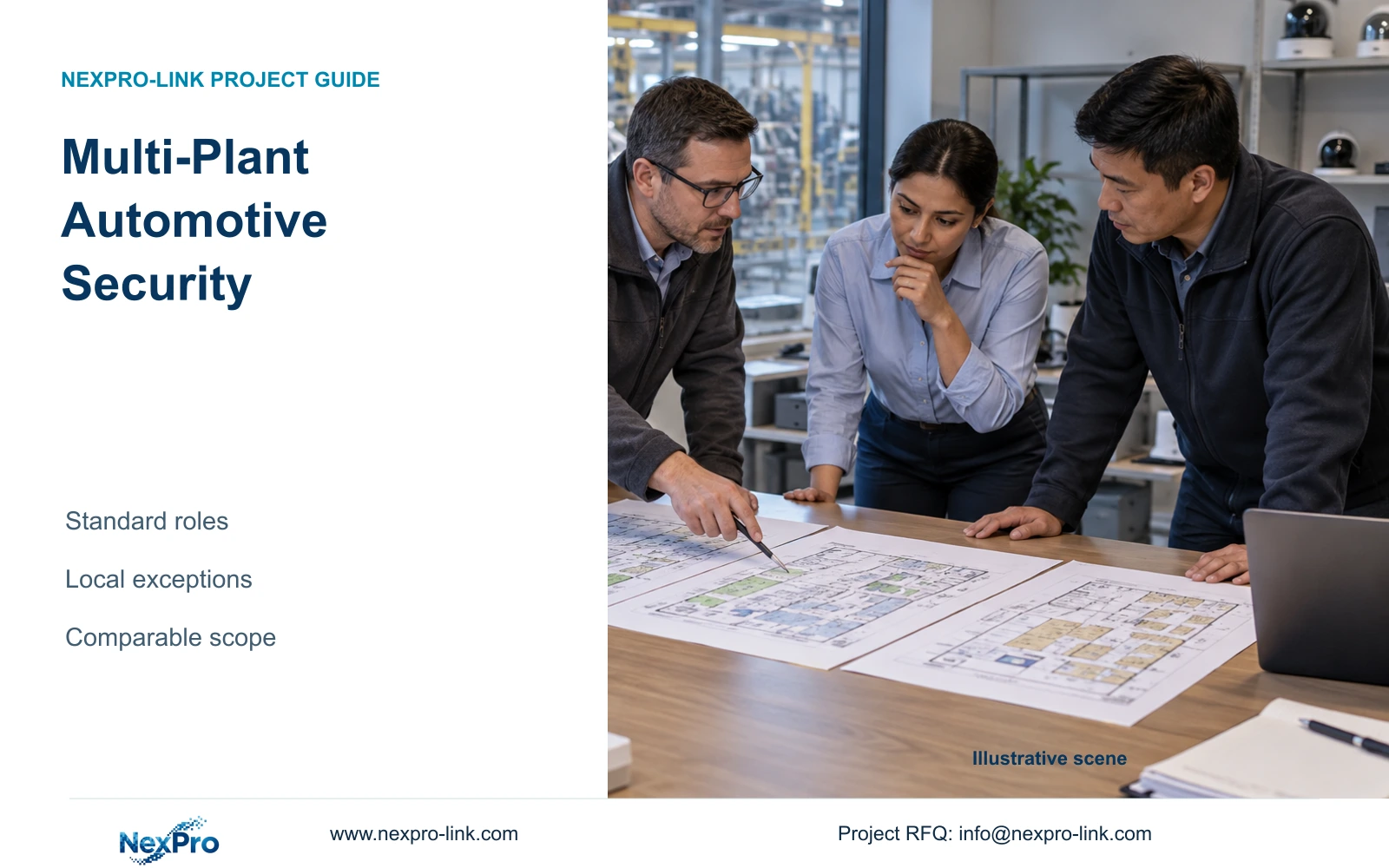
A common automotive CCTV equipment family can simplify repeat procurement while each plant keeps its own routes, retention and specialist requirements. Compare the shared core and local exceptions before judging quoted savings.
Section 01
Standardise device roles and keep quantities local
Multi-plant automotive security should use a controlled equipment family and a common documentation structure, with plant-specific schedules for links, special environments and retention. Standardise what an approved device role must accomplish, then select quantities from each layout. A receiving overview, material handover view and dispatch exit view can share acceptance criteria without sharing an identical lens setting, mounting position or cable allowance.
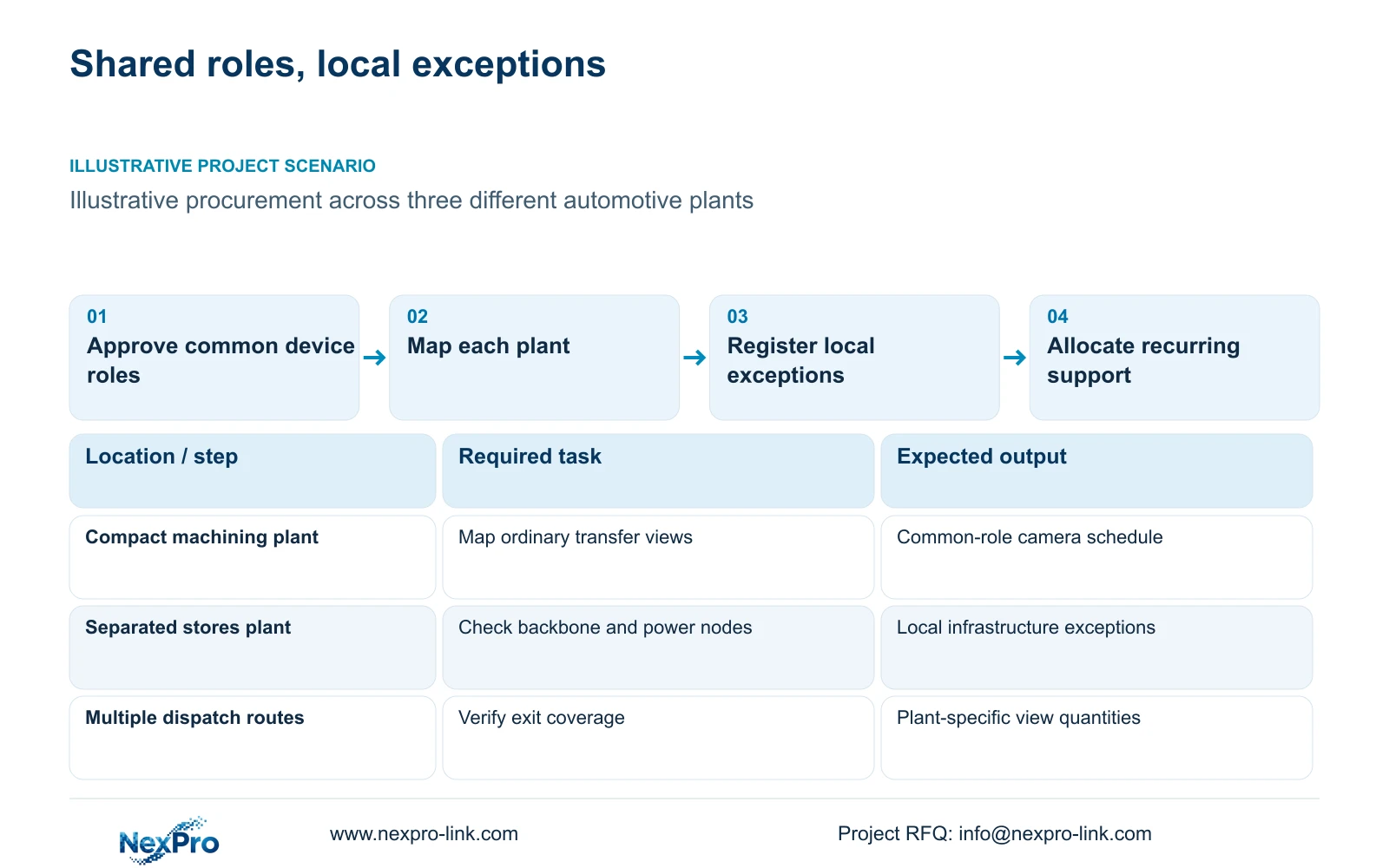
Illustrative project scenario: An automotive supplier plans the same procurement workflow for three plants with different layouts. Assume one plant is a compact machining site, another has separated stores, and the third uses several dispatch routes. These planning assumptions explain why the buyer needs a common purchasing structure with local exceptions. They do not establish actual sites, quantities or a completed rollout.
Create a role register before negotiating a repeated kit. For each role, record the event to be observed, expected lighting and movement, approved model reference and acceptance scene. The design engineer maps those roles onto each plant; the quantity surveyor prices the resulting schedule. Keep the revision identifier on both documents so a later camera substitution cannot be mistaken for an unchanged standard.
Section 02
Price exceptions where the site changes the requirement
Build a plant exception register around conditions that change equipment or installation. Useful entries include a longer backbone, an independently powered remote cabinet, a restricted control-network interface and a location outside the ordinary camera's environmental scope. Each entry should identify the affected role, reason for departure, approving party and quotation line. Avoid a single miscellaneous allowance that hides which plant needs the additional work.
For suitable ordinary areas, NexPro-BL2812M55-5MP-DIC-AI offers a 2.8–12mm motorized lens; its supplied 5MP specification lists 2880×1620 output and 25fps. That makes it a candidate within the common family, subject to the actual view. The same reference does not establish component inspection, special chemical resistance or hazardous-location suitability. Retain a specialist requirement wherever the plant's assessed conditions demand it.
Treat the production-control boundary as another site exception. A plant asking for manual time-reference searches has a different interface scope from one requiring software-linked events. NIST SP 800-82 Rev.3 provides an OT-security reference for considering operational constraints and separation. Have the responsible plant team approve the proposed connection; a repeat CCTV kit should not introduce an unreviewed route into the control network.
Section 03
Compare the support work that repeats after delivery
Separate common preparation from recurring plant support. The shared scope can include a controlled model list, configuration record, location-label format and handover-document template. Local support may include alignment, cable testing, operator training and a visit to replace a failed device. Price and allocate those activities explicitly. A supplier's equipment warranty does not automatically include local labour or the travel needed to reach each plant.
The public NexPro-Link warranty baseline for eligible main equipment is 24 months from receipt, subject to controlling quotation and order terms. The rack UPS product page separately uses a 1–2-year term. Preserve that distinction in a multi-plant schedule rather than applying the longest headline to every item. Record battery and storage scope, return arrangements and who handles removal and reinstatement for the specific order.
For handover, keep approved views alongside a separate process-interface list. The local integrator owns installation evidence and alignment records; the owner's quality or production team owns its operational records; the supplier documents the delivered configuration. Test a replacement workflow as well as first installation: identify the role, select an approved replacement, restore relevant settings and verify the view. This makes support comparable across plants.
Section 04
Normalise the complete scope before ranking quotations
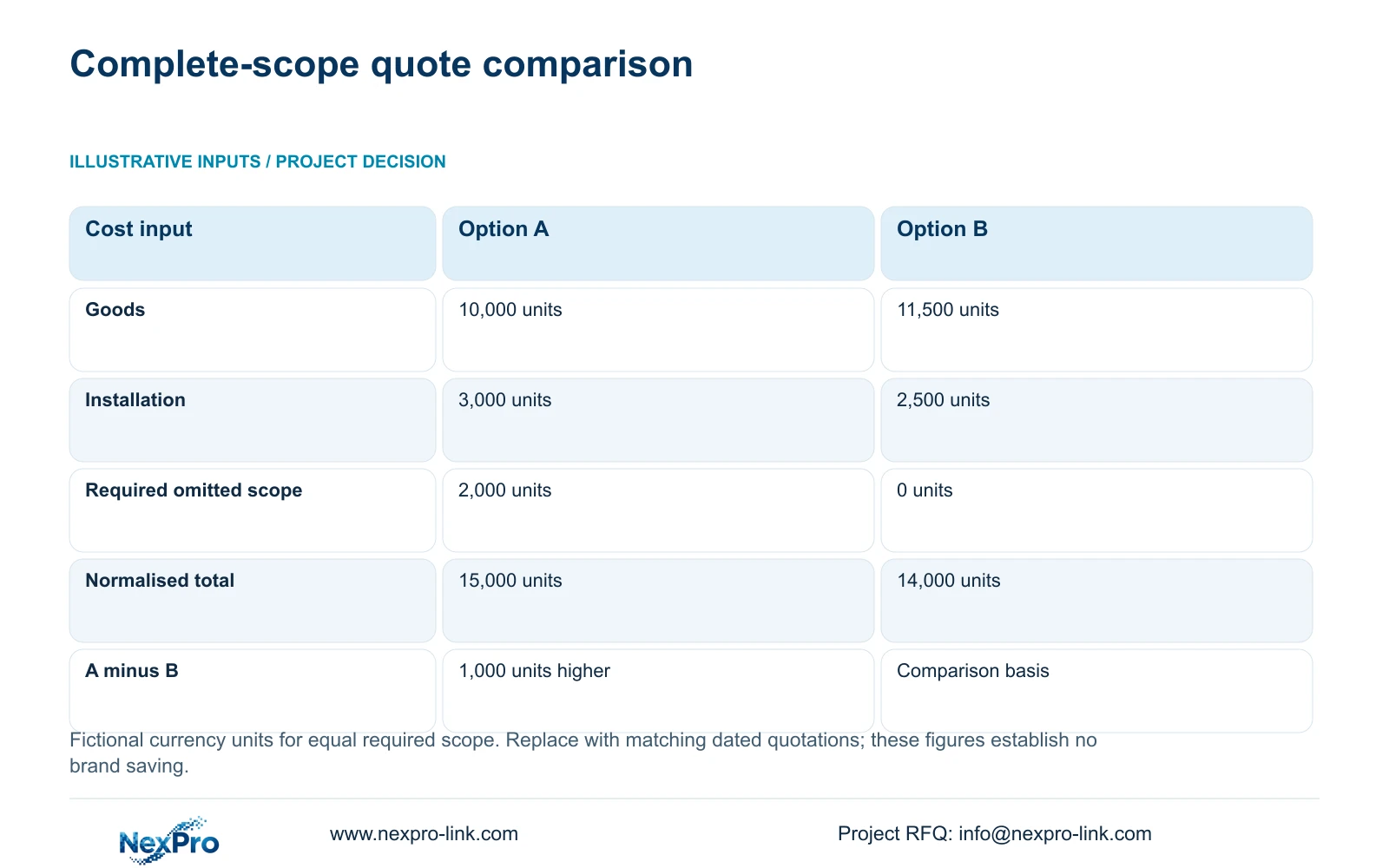
Use the following purely fictional currency-unit example to compare two offers for the same defined package. Option A quotes goods at 10,000 units, installation at 3,000 units and omits 2,000 units of required scope. Option B quotes goods at 11,500 units, installation at 2,500 units and has zero required omitted scope in this example. These are teaching inputs, not NexPro-Link or competitor prices.
The formula is normalized_total = goods + installation + required_omitted_items. Option A therefore totals 10,000 + 3,000 + 2,000 = 15,000 units. Option B totals 11,500 + 2,500 + 0 = 14,000 units. Using difference = A_total − B_total, the difference is 1,000 units. A's lower goods price reverses at the complete-scope level because installation and missing requirements change the comparison.
For an actual three-plant tender, first normalise each plant separately, then aggregate only the accepted scopes. Replace every monetary input with same-date, same-quantity, same-currency and same-delivery-scope quotations. An unpriced specialist item remains unresolved, not zero. Keep recurring support in a separate comparison over the buyer's stated period, and list any tax, freight or other exclusions that still prevent an equal comparison.
| Cost component | Option A | Option B |
|---|---|---|
| Quoted goods | 10,000 units | 11,500 units |
| Installation | 3,000 units | 2,500 units |
| Required omitted scope | 2,000 units | 0 units |
| Normalised total | 15,000 units | 14,000 units |
Section 05
Reuse the calculation method without copying the result
CASE01 illustrates why a standard recorder role still needs a plant-specific capacity check. Its 32 ordinary-area cameras at an assumed average 4Mbps generate 128Mbps input. For 30 days of continuous recording, video_TB = 32 × 4 × 10^6 × 86400 × 30 / 8 / 10^12 = 41.472TB. Four 16TB drives give 64TB raw, with an illustrative recording budget of 64 × 0.95 × 0.80 = 48.64TB. That budget already includes formatting allowance and reserve.
The NexPro-NVR4449-4K reference provides four SATA bays and 320Mbps input, while its summary distinguishes 49×5MP and 9×4K modes. A second plant cannot inherit the same selection merely because its camera count is similar. Different streams, retention, simultaneous viewing or a disk-failure requirement can change the architecture. Recording capacity does not establish RAID or decoding performance.
Power and cable schedules also remain local. CASE01's recording-priority load is an illustrative 682.7407W, making SP1KR(S), rated 1kVA/900W, a capacity candidate under the case assumptions. Its 341.3704Wh load-side requirement for 30 minutes is not proven UPS runtime. The case's 1,872m and seven 305m reels likewise belong to its declared routes. Reuse the worksheet, but replace route lengths, device demand and battery configuration for each plant.
Section 06
Release a common core with signed plant deviations
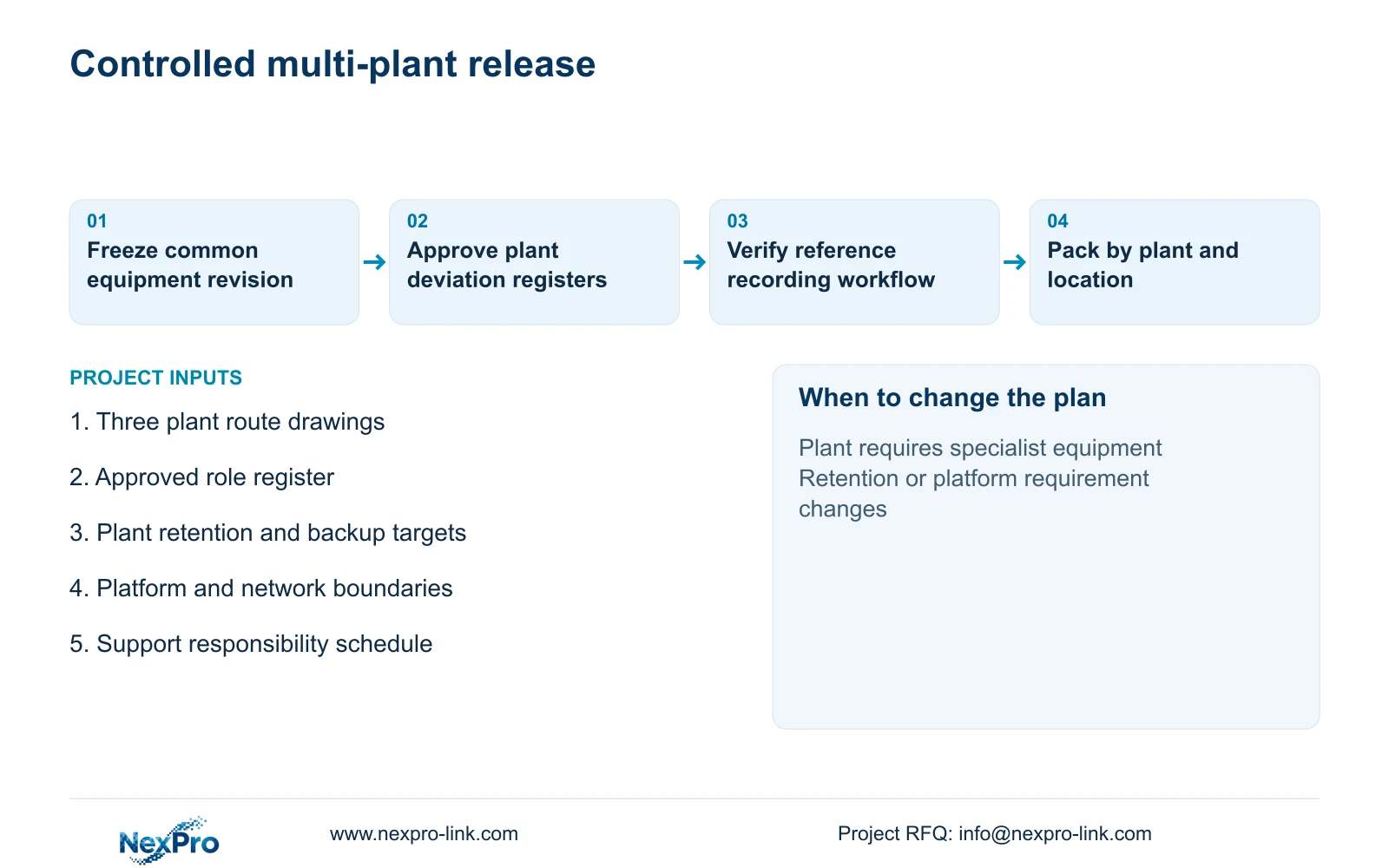
The preferred procurement structure is a common approved core plus separately priced plant deviations. It preserves repeatable model matching and document preparation while allowing the engineer to solve real local constraints. Change that structure when a mandatory platform, specialist environment or materially different operating workflow makes the common family unsuitable. Record the exception rather than weakening the requirement to preserve purchasing uniformity.
Before volume release, demonstrate the relevant recording, playback and export tasks on the proposed configuration. A common sample can establish the reference workflow, but each plant still needs its own view and installation acceptance. Mark supplied, retained, optional and locally provided items in the schedule. Optional displays should remain separate from recording; adding an LCD wall also changes power, mounting and room-service scope.
NexPro-Link's BOQ and project-supply services can support model matching, technical deviations, configuration preparation and project packing. Use plant and location identifiers on cartons and configuration records, with approved OEM artwork where requested. Local installers retain their agreed construction responsibilities. Freeze the equipment revision and exception register together before shipment, so a common purchasing programme delivers the correct package to each plant.
Section 07
Buyer questions
Should all three plants buy the same spare camera? A shared spare is useful only for the roles and configurations it can actually replace. Separate specialist spares and record acceptable substitutions. Check lens setting, mounting accessories, firmware and recording workflow before treating two units as interchangeable.
Does central viewing require one central recorder? No. Local recording with authorised central viewing is a possible architecture. Check the selected client, network paths, access controls and concurrent viewing requirements separately. Keeping recording local can preserve that task during loss of the inter-plant connection, provided local dependencies remain available.
How should a discontinued model enter the standard kit? Treat its replacement as a controlled change. Compare the role requirements, document deviations and repeat the affected workflow checks before approval. Update the common equipment register and plant schedules without assuming the new model preserves every prior function.
Section 08
Build a comparable three-plant equipment schedule
Send the plant layouts and transfer routes, your approved device or platform requirements, each plant's retention and backup objectives, and the quotation and recurring-support scope to info@nexpro-link.com. NexPro-Link can discuss a shared equipment core with separately identified plant exceptions.
Engineering references
These sources support the general planning principles. Always use the selected product's current datasheet and applicable project standards for final design.