A library refurbishes its public floor with taller shelving and relocated service counters while retaining part of the existing camera system. Compare the old views with the new shelving and counter layout.
Section 01
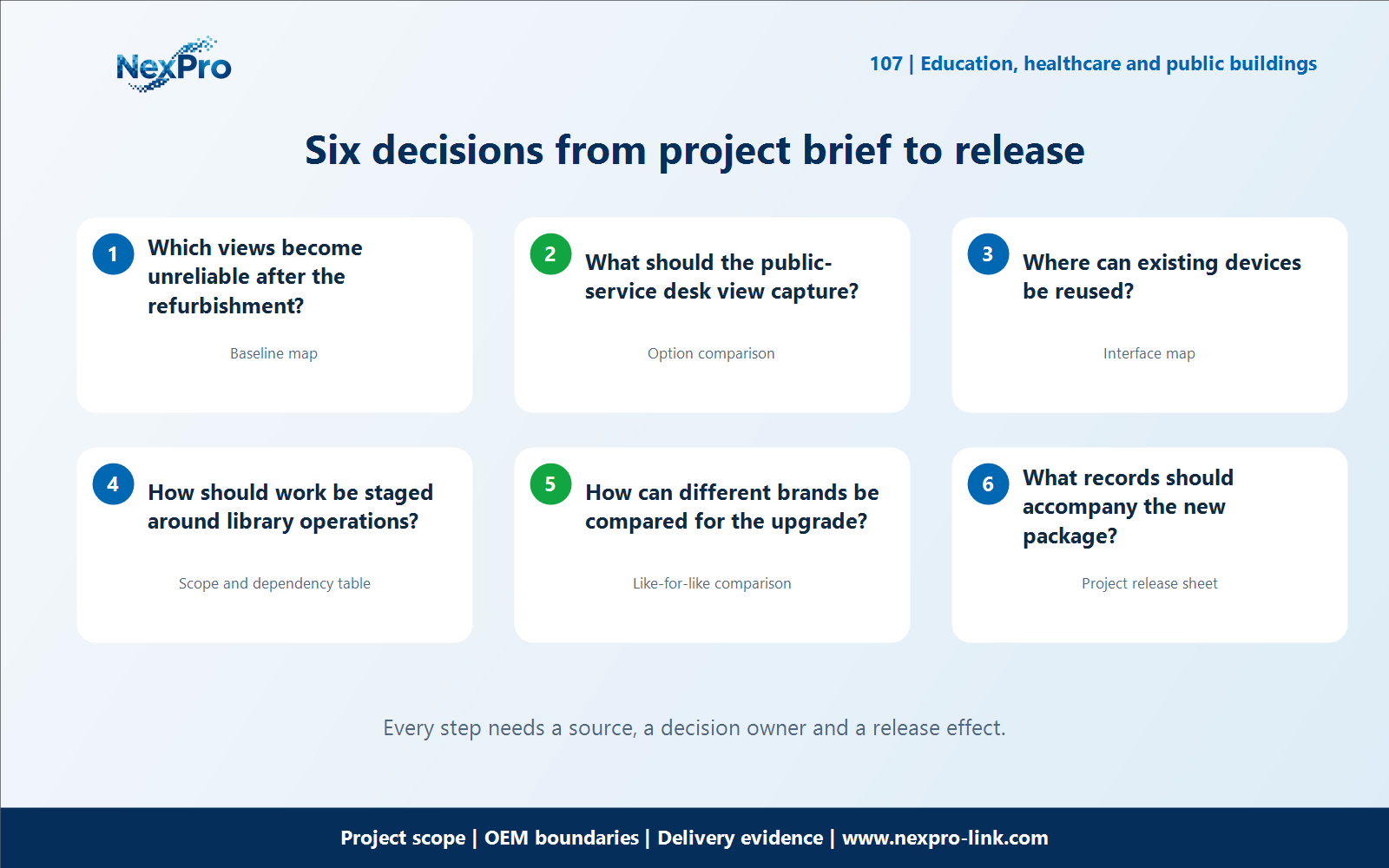
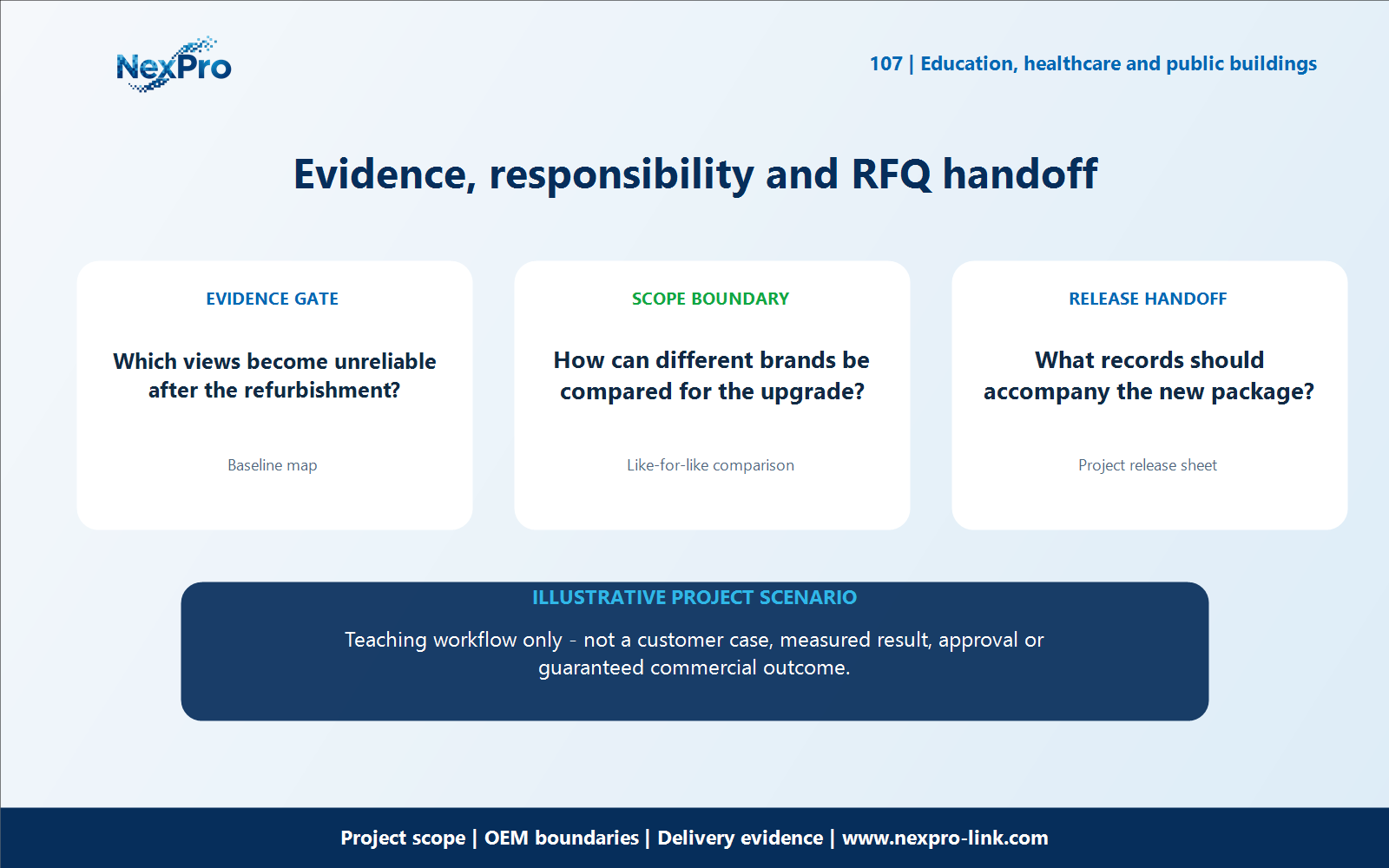
Which views become unreliable after the refurbishment?
A library refurbishes its public floor with taller shelving and relocated service counters while retaining part of the existing camera system. Compare the old views with the new shelving and counter layout. Taller shelves or moved desks can remove useful detail without any camera failing. Review coverage against the renovated space rather than assuming the previous device locations remain suitable.
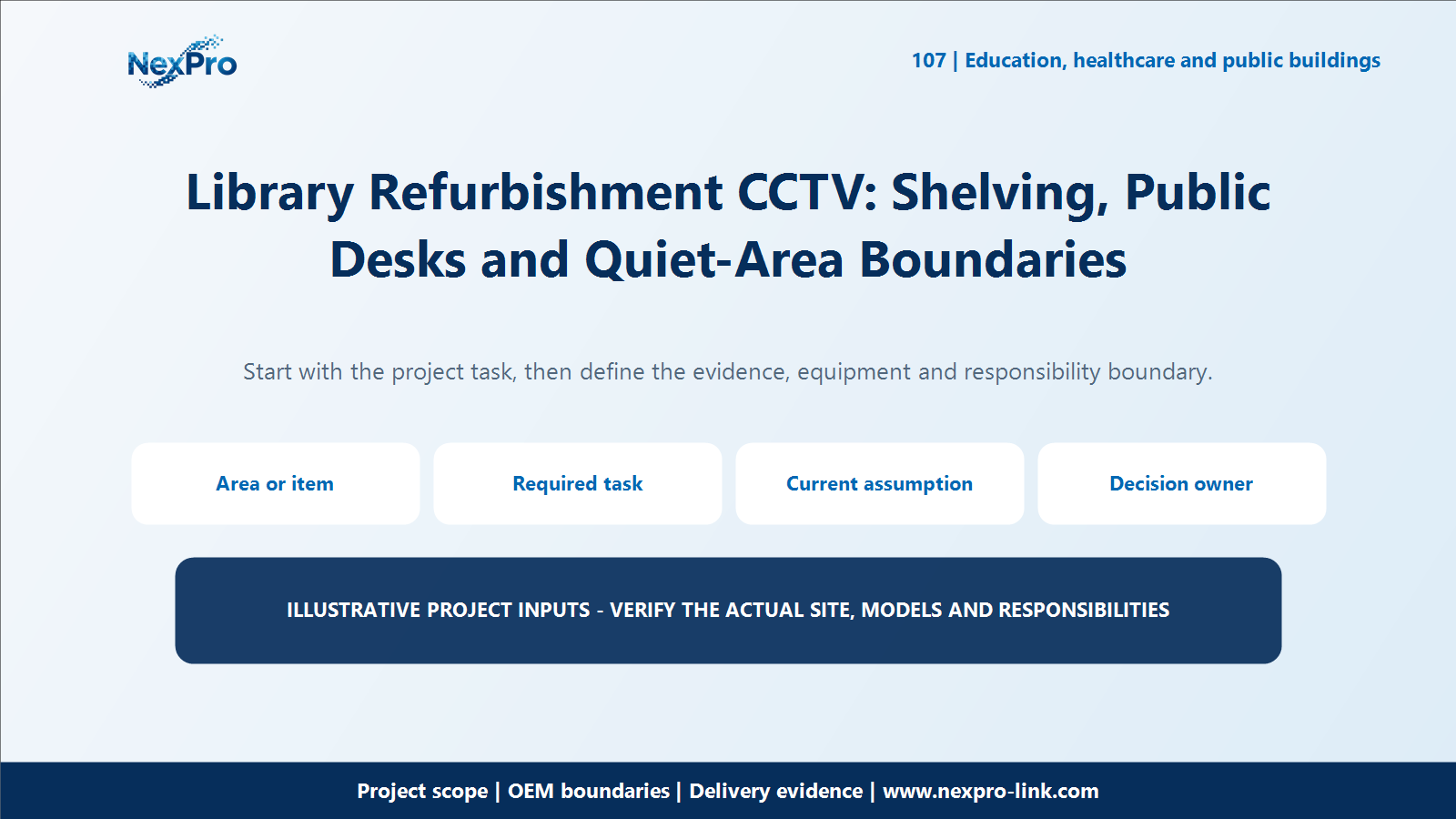
For the "Which views become unreliable after the refurbishment" decision, use the baseline map fields Area or item, Required task, Current assumption, Decision owner. Apply it to library redesign CCTV shelving so the buyer, supplier and local integrator can see which input is confirmed, who owns it and which evidence remains open.
Evaluate which views become unreliable after the refurbishment against the stated site task and the surrounding equipment, documentation, packing and handover dependencies for library redesign CCTV shelving. For which views become unreliable after the refurbishment in library redesign CCTV shelving, record the confirmed condition, chosen option and remaining evidence separately; an open value is not a price, test, approval or customer-result claim.
Carry the which views become unreliable after the refurbishment decision into the RFQ, BOQ, configuration or release record for library redesign CCTV shelving. For which views become unreliable after the refurbishment in library redesign CCTV shelving, name the equipment, artwork, network, installation and acceptance owner; site-specific work remains with the buyer or integrator unless the signed scope says otherwise.
Section 02
What should the public-service desk view capture?
What should the public-service desk view capture? Define the authorized security task around the desk and its approaches. Avoid unnecessary views of personal screens or detailed user records. The camera should support the agreed incident-review need, not become a general tool for observing what individual readers are doing. For Library Refurbishment CCTV: Shelving, Public Desks and Quiet-Area Boundaries, keep this decision tied to the same project brief rather than opening a separate generic specification exercise.
For the "What should the public-service desk view capture" decision, use the option comparison fields Position or option, Suitable condition, Trade-off, Next choice. Apply it to library redesign CCTV shelving so the buyer, supplier and local integrator can see which input is confirmed, who owns it and which evidence remains open.
Evaluate what should the public-service desk view capture against the stated site task and the surrounding equipment, documentation, packing and handover dependencies for library redesign CCTV shelving. For what should the public-service desk view capture in library redesign CCTV shelving, record the confirmed condition, chosen option and remaining evidence separately; an open value is not a price, test, approval or customer-result claim.
Carry the what should the public-service desk view capture decision into the RFQ, BOQ, configuration or release record for library redesign CCTV shelving. For what should the public-service desk view capture in library redesign CCTV shelving, name the equipment, artwork, network, installation and acceptance owner; site-specific work remains with the buyer or integrator unless the signed scope says otherwise.
Section 03
Where can existing devices be reused?
Where can existing devices be reused? Reuse devices that still deliver the required view and can be maintained within the new system. Replace or reposition those affected by the layout change. Lens adjustment can refine framing, but it cannot overcome a shelf that physically blocks the target. For Library Refurbishment CCTV: Shelving, Public Desks and Quiet-Area Boundaries, keep this decision tied to the same project brief rather than opening a separate generic specification exercise.
For the "Where can existing devices be reused" decision, use the interface map fields Device or record, Input, Output, Responsible party. Apply it to library redesign CCTV shelving so the buyer, supplier and local integrator can see which input is confirmed, who owns it and which evidence remains open.
Evaluate where can existing devices be reused against the stated site task and the surrounding equipment, documentation, packing and handover dependencies for library redesign CCTV shelving. For where can existing devices be reused in library redesign CCTV shelving, record the confirmed condition, chosen option and remaining evidence separately; an open value is not a price, test, approval or customer-result claim.
Carry the where can existing devices be reused decision into the RFQ, BOQ, configuration or release record for library redesign CCTV shelving. For where can existing devices be reused in library redesign CCTV shelving, name the equipment, artwork, network, installation and acceptance owner; site-specific work remains with the buyer or integrator unless the signed scope says otherwise.
| Project question | Project-oriented treatment | Keep equal when comparing offers |
|---|---|---|
| Which views become unreliable after the refurbishment? | Compare the old views with the new shelving and counter layout. | Authorized institutional security purpose |
| What should the public-service desk view capture? | Define the authorized security task around the desk and its approaches. | Mandatory system and procurement requirements |
| Where can existing devices be reused? | Reuse devices that still deliver the required view and can be maintained within the new system. | Network, recording and access scope |
| How should work be staged around library operations? | Plan installation by the areas available to the contractor and maintain agreed coverage where practical. | Actual delivery and operating support |
Section 04
How should work be staged around library operations?
How should work be staged around library operations? Plan installation by the areas available to the contractor and maintain agreed coverage where practical. Record any planned service interruption. A phased plan can reduce disruption, but it should not promise uninterrupted recording at every location without an achievable temporary arrangement. For Library Refurbishment CCTV: Shelving, Public Desks and Quiet-Area Boundaries, keep this decision tied to the same project brief rather than opening a separate generic specification exercise.
For the "How should work be staged around library operations" decision, use the scope and dependency table fields Item, Included, Dependency, Separate option. Apply it to library redesign CCTV shelving so the buyer, supplier and local integrator can see which input is confirmed, who owns it and which evidence remains open.
Evaluate how should work be staged around library operations against the stated site task and the surrounding equipment, documentation, packing and handover dependencies for library redesign CCTV shelving. For how should work be staged around library operations in library redesign CCTV shelving, record the confirmed condition, chosen option and remaining evidence separately; an open value is not a price, test, approval or customer-result claim.
Carry the how should work be staged around library operations decision into the RFQ, BOQ, configuration or release record for library redesign CCTV shelving. For how should work be staged around library operations in library redesign CCTV shelving, name the equipment, artwork, network, installation and acceptance owner; site-specific work remains with the buyer or integrator unless the signed scope says otherwise.
Section 05
How can different brands be compared for the upgrade?
How can different brands be compared for the upgrade? Compare alternatives against the same retained inventory and upgrade scope. Include the work required to connect, configure and document the changed devices. A full replacement and a small addition should not be compared as if their quoted equipment lists deliver identical outcomes. For Library Refurbishment CCTV: Shelving, Public Desks and Quiet-Area Boundaries, keep this decision tied to the same project brief rather than opening a separate generic specification exercise.
For the "How can different brands be compared for the upgrade" decision, use the like-for-like comparison fields Requirement, Baseline, Proposed treatment, Remaining difference. Apply it to library redesign CCTV shelving so the buyer, supplier and local integrator can see which input is confirmed, who owns it and which evidence remains open.
Evaluate how can different brands be compared for the upgrade against the stated site task and the surrounding equipment, documentation, packing and handover dependencies for library redesign CCTV shelving. For how can different brands be compared for the upgrade in library redesign CCTV shelving, record the confirmed condition, chosen option and remaining evidence separately; an open value is not a price, test, approval or customer-result claim.
Carry the how can different brands be compared for the upgrade decision into the RFQ, BOQ, configuration or release record for library redesign CCTV shelving. For how can different brands be compared for the upgrade in library redesign CCTV shelving, name the equipment, artwork, network, installation and acceptance owner; site-specific work remains with the buyer or integrator unless the signed scope says otherwise.
Section 06
What records should accompany the new package?
What records should accompany the new package? Provide an updated location map and a record of retained versus newly supplied devices. Area-labelled packaging supports the phased work. Any new contractor branding should preserve the original technical identities that future maintenance staff need to understand the mixed installation. For Library Refurbishment CCTV: Shelving, Public Desks and Quiet-Area Boundaries, keep this decision tied to the same project brief rather than opening a separate generic specification exercise.
For the "What records should accompany the new package" decision, use the project release sheet fields Configuration, Artwork, Quantity, Location, Release stage. Apply it to library redesign CCTV shelving so the buyer, supplier and local integrator can see which input is confirmed, who owns it and which evidence remains open.
Evaluate what records should accompany the new package against the stated site task and the surrounding equipment, documentation, packing and handover dependencies for library redesign CCTV shelving. For what records should accompany the new package in library redesign CCTV shelving, record the confirmed condition, chosen option and remaining evidence separately; an open value is not a price, test, approval or customer-result claim.
Carry the what records should accompany the new package decision into the RFQ, BOQ, configuration or release record for library redesign CCTV shelving. For what records should accompany the new package in library redesign CCTV shelving, name the equipment, artwork, network, installation and acceptance owner; site-specific work remains with the buyer or integrator unless the signed scope says otherwise.
Engineering references
These sources support the general planning principles. Always use the selected product's current datasheet and applicable project standards for final design.