A community center hosts classes, public events and rental activities with a small permanent facilities team. Start with the entrances, shared routes and equipment areas that have a stable approved security purpose.
Section 01
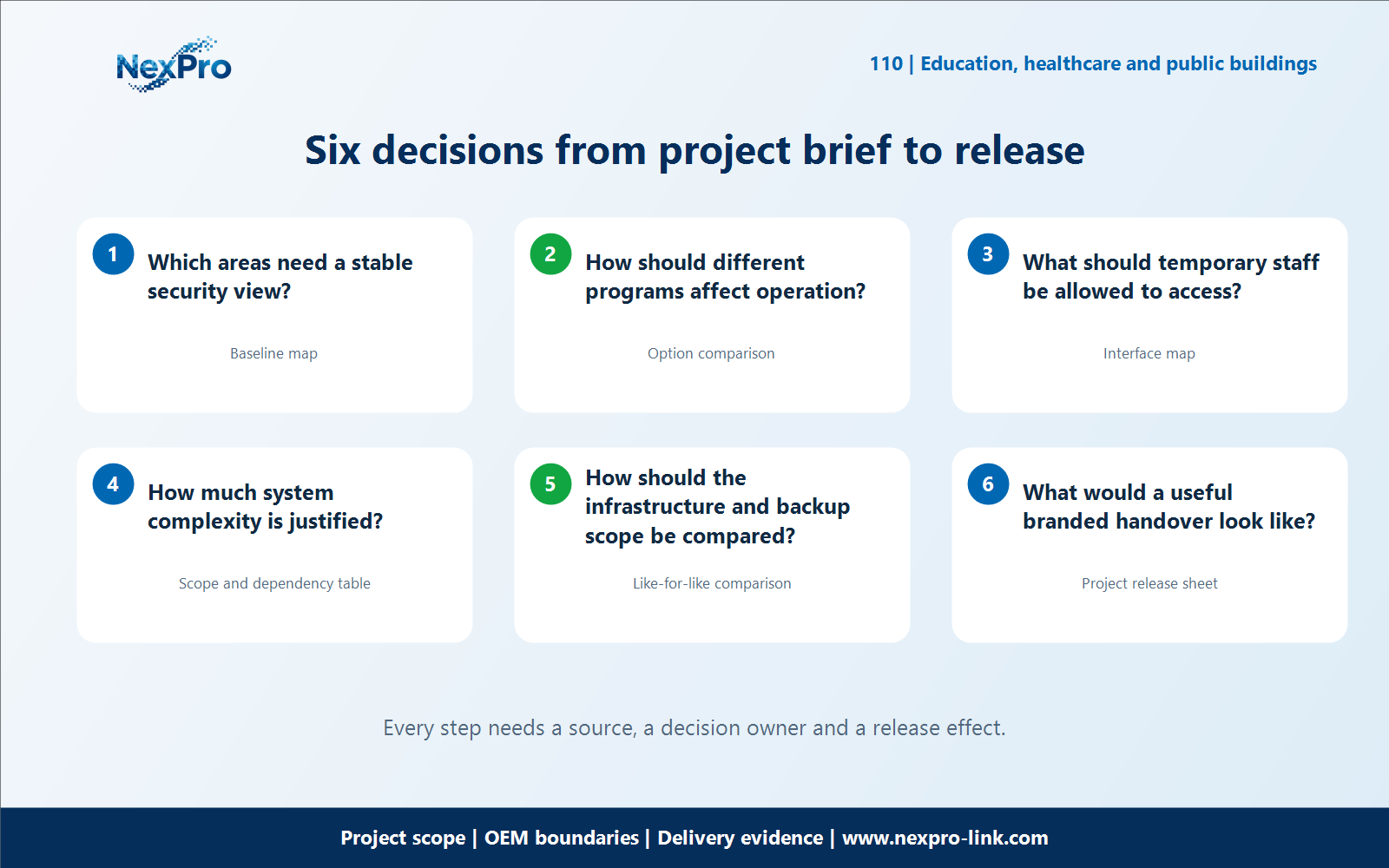
Which areas need a stable security view?
A community center hosts classes, public events and rental activities with a small permanent facilities team. Start with the entrances, shared routes and equipment areas that have a stable approved security purpose. Activity rooms may have changing uses and should not automatically become continuous recording zones. Define the purpose for each space before adding it to the schedule.
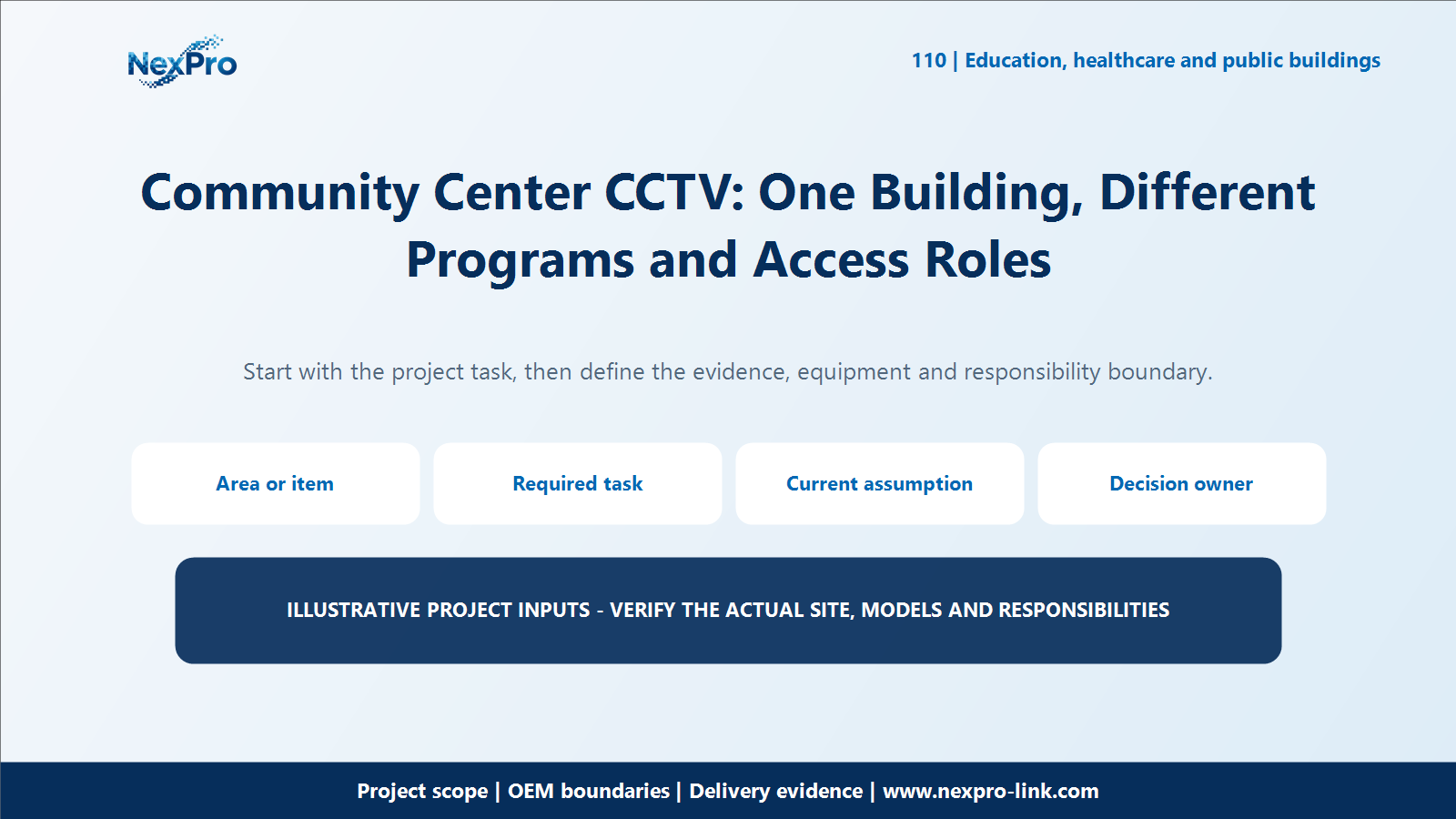
For the "Which areas need a stable security view" decision, use the baseline map fields Area or item, Required task, Current assumption, Decision owner. Apply it to community center multi use CCTV so the buyer, supplier and local integrator can see which input is confirmed, who owns it and which evidence remains open.
Evaluate which areas need a stable security view against the stated site task and the surrounding equipment, documentation, packing and handover dependencies for community center multi use CCTV. For which areas need a stable security view in community center multi use CCTV, record the confirmed condition, chosen option and remaining evidence separately; an open value is not a price, test, approval or customer-result claim.
Carry the which areas need a stable security view decision into the RFQ, BOQ, configuration or release record for community center multi use CCTV. For which areas need a stable security view in community center multi use CCTV, name the equipment, artwork, network, installation and acceptance owner; site-specific work remains with the buyer or integrator unless the signed scope says otherwise.
Section 02
How should different programs affect operation?
How should different programs affect operation? Use program schedules to organize authorized staff duties and any agreed changes in operation. Do not build the system around sensitive assumptions about participants. The relevant question is what security task applies to the space at that time, not who the people are inferred to be. For Community Center CCTV: One Building, Different Programs and Access Roles, keep this decision tied to the same project brief rather than opening a separate generic specification exercise.
For the "How should different programs affect operation" decision, use the option comparison fields Position or option, Suitable condition, Trade-off, Next choice. Apply it to community center multi use CCTV so the buyer, supplier and local integrator can see which input is confirmed, who owns it and which evidence remains open.
Evaluate how should different programs affect operation against the stated site task and the surrounding equipment, documentation, packing and handover dependencies for community center multi use CCTV. For how should different programs affect operation in community center multi use CCTV, record the confirmed condition, chosen option and remaining evidence separately; an open value is not a price, test, approval or customer-result claim.
Carry the how should different programs affect operation decision into the RFQ, BOQ, configuration or release record for community center multi use CCTV. For how should different programs affect operation in community center multi use CCTV, name the equipment, artwork, network, installation and acceptance owner; site-specific work remains with the buyer or integrator unless the signed scope says otherwise.
Section 03
What should temporary staff be allowed to access?
What should temporary staff be allowed to access? Give temporary staff only the access authorized for their role. Renting a room or organizing an event does not automatically grant access to all recordings. Include a clear process for ending temporary access when the event or staff assignment is over. For Community Center CCTV: One Building, Different Programs and Access Roles, keep this decision tied to the same project brief rather than opening a separate generic specification exercise.
For the "What should temporary staff be allowed to access" decision, use the interface map fields Device or record, Input, Output, Responsible party. Apply it to community center multi use CCTV so the buyer, supplier and local integrator can see which input is confirmed, who owns it and which evidence remains open.
Evaluate what should temporary staff be allowed to access against the stated site task and the surrounding equipment, documentation, packing and handover dependencies for community center multi use CCTV. For what should temporary staff be allowed to access in community center multi use CCTV, record the confirmed condition, chosen option and remaining evidence separately; an open value is not a price, test, approval or customer-result claim.
Carry the what should temporary staff be allowed to access decision into the RFQ, BOQ, configuration or release record for community center multi use CCTV. For what should temporary staff be allowed to access in community center multi use CCTV, name the equipment, artwork, network, installation and acceptance owner; site-specific work remains with the buyer or integrator unless the signed scope says otherwise.
| Project question | Project-oriented treatment | Keep equal when comparing offers |
|---|---|---|
| Which areas need a stable security view? | Start with the entrances, shared routes and equipment areas that have a stable approved security purpose. | Authorized institutional security purpose |
| How should different programs affect operation? | Use program schedules to organize authorized staff duties and any agreed changes in operation. | Mandatory system and procurement requirements |
| What should temporary staff be allowed to access? | Give temporary staff only the access authorized for their role. | Network, recording and access scope |
| How much system complexity is justified? | Match the system to the facilities team's actual work: checking views, finding incidents and obtaining support. | Actual delivery and operating support |
Section 04
How much system complexity is justified?
How much system complexity is justified? Match the system to the facilities team's actual work: checking views, finding incidents and obtaining support. A simple complete package may be preferable to a complex platform that adds no required function. The decision should still preserve necessary permissions and recording capability. For Community Center CCTV: One Building, Different Programs and Access Roles, keep this decision tied to the same project brief rather than opening a separate generic specification exercise.
For the "How much system complexity is justified" decision, use the scope and dependency table fields Item, Included, Dependency, Separate option. Apply it to community center multi use CCTV so the buyer, supplier and local integrator can see which input is confirmed, who owns it and which evidence remains open.
Evaluate how much system complexity is justified against the stated site task and the surrounding equipment, documentation, packing and handover dependencies for community center multi use CCTV. For how much system complexity is justified in community center multi use CCTV, record the confirmed condition, chosen option and remaining evidence separately; an open value is not a price, test, approval or customer-result claim.
Carry the how much system complexity is justified decision into the RFQ, BOQ, configuration or release record for community center multi use CCTV. For how much system complexity is justified in community center multi use CCTV, name the equipment, artwork, network, installation and acceptance owner; site-specific work remains with the buyer or integrator unless the signed scope says otherwise.
Section 05
How should the infrastructure and backup scope be compared?
How should the infrastructure and backup scope be compared? Compare the same locations, recording policy and protected equipment chain. Do not depend on an event organizer's temporary network for the building's core recording unless that arrangement is explicitly designed. Every quoted option should identify which infrastructure is permanent and who manages it. For Community Center CCTV: One Building, Different Programs and Access Roles, keep this decision tied to the same project brief rather than opening a separate generic specification exercise.
For the "How should the infrastructure and backup scope be compared" decision, use the like-for-like comparison fields Requirement, Baseline, Proposed treatment, Remaining difference. Apply it to community center multi use CCTV so the buyer, supplier and local integrator can see which input is confirmed, who owns it and which evidence remains open.
Evaluate how should the infrastructure and backup scope be compared against the stated site task and the surrounding equipment, documentation, packing and handover dependencies for community center multi use CCTV. For how should the infrastructure and backup scope be compared in community center multi use CCTV, record the confirmed condition, chosen option and remaining evidence separately; an open value is not a price, test, approval or customer-result claim.
Carry the how should the infrastructure and backup scope be compared decision into the RFQ, BOQ, configuration or release record for community center multi use CCTV. For how should the infrastructure and backup scope be compared in community center multi use CCTV, name the equipment, artwork, network, installation and acceptance owner; site-specific work remains with the buyer or integrator unless the signed scope says otherwise.
Section 06
What would a useful branded handover look like?
What would a useful branded handover look like? Provide a concise operating card, device schedule and support contact that the small team can use. Optional branding can make the supplier or contractor easy to identify. Keep credentials outside those general documents and make access ownership part of the authorized handover. For Community Center CCTV: One Building, Different Programs and Access Roles, keep this decision tied to the same project brief rather than opening a separate generic specification exercise.
For the "What would a useful branded handover look like" decision, use the project release sheet fields Configuration, Artwork, Quantity, Location, Release stage. Apply it to community center multi use CCTV so the buyer, supplier and local integrator can see which input is confirmed, who owns it and which evidence remains open.
Evaluate what would a useful branded handover look like against the stated site task and the surrounding equipment, documentation, packing and handover dependencies for community center multi use CCTV. For what would a useful branded handover look like in community center multi use CCTV, record the confirmed condition, chosen option and remaining evidence separately; an open value is not a price, test, approval or customer-result claim.
Carry the what would a useful branded handover look like decision into the RFQ, BOQ, configuration or release record for community center multi use CCTV. For what would a useful branded handover look like in community center multi use CCTV, name the equipment, artwork, network, installation and acceptance owner; site-specific work remains with the buyer or integrator unless the signed scope says otherwise.
Engineering references
These sources support the general planning principles. Always use the selected product's current datasheet and applicable project standards for final design.