A public service building is opening with shared entrances, service counters and restricted equipment rooms. Define ordinary building-security tasks such as entrance review and authorized incident reconstruction.
Section 01
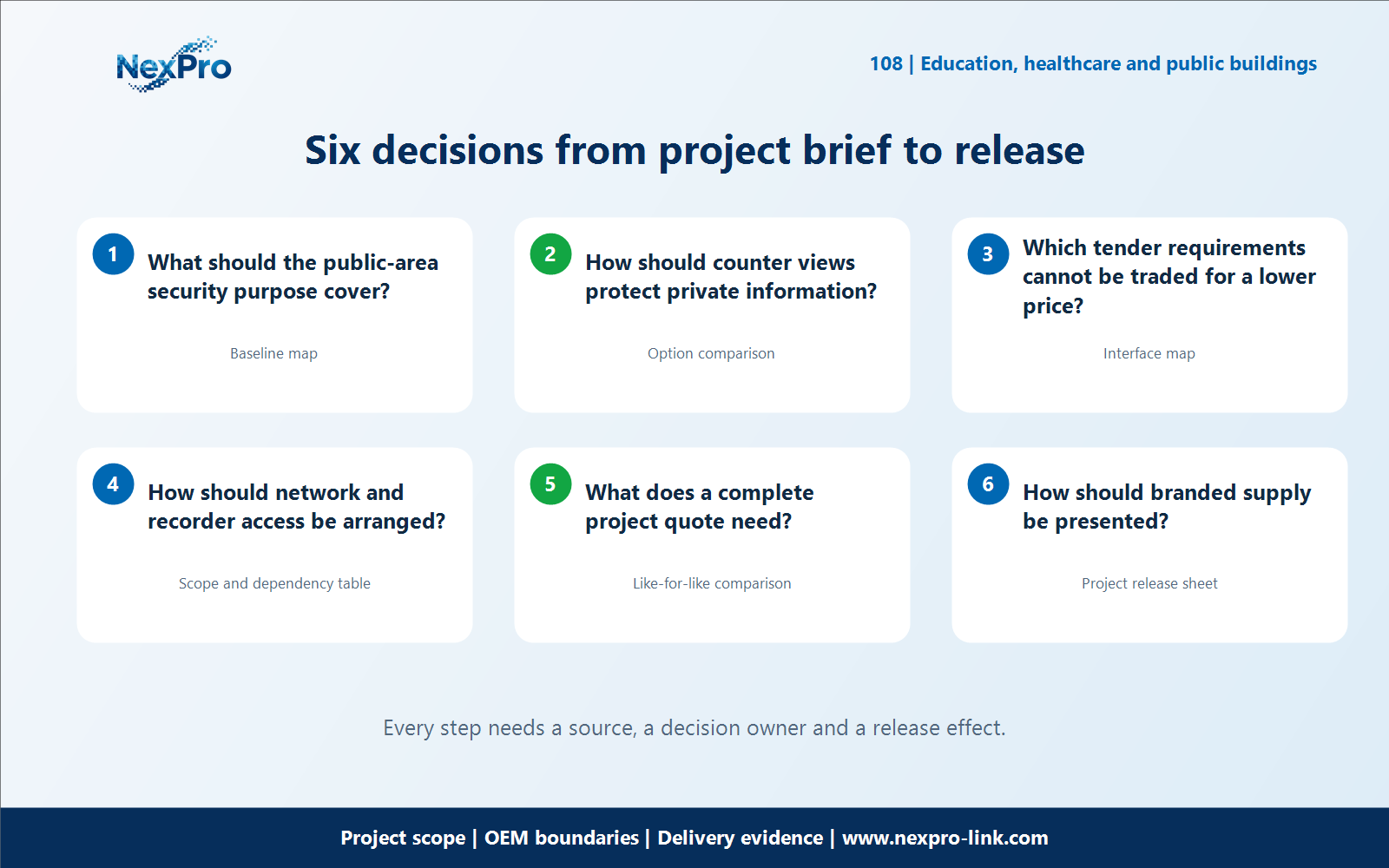
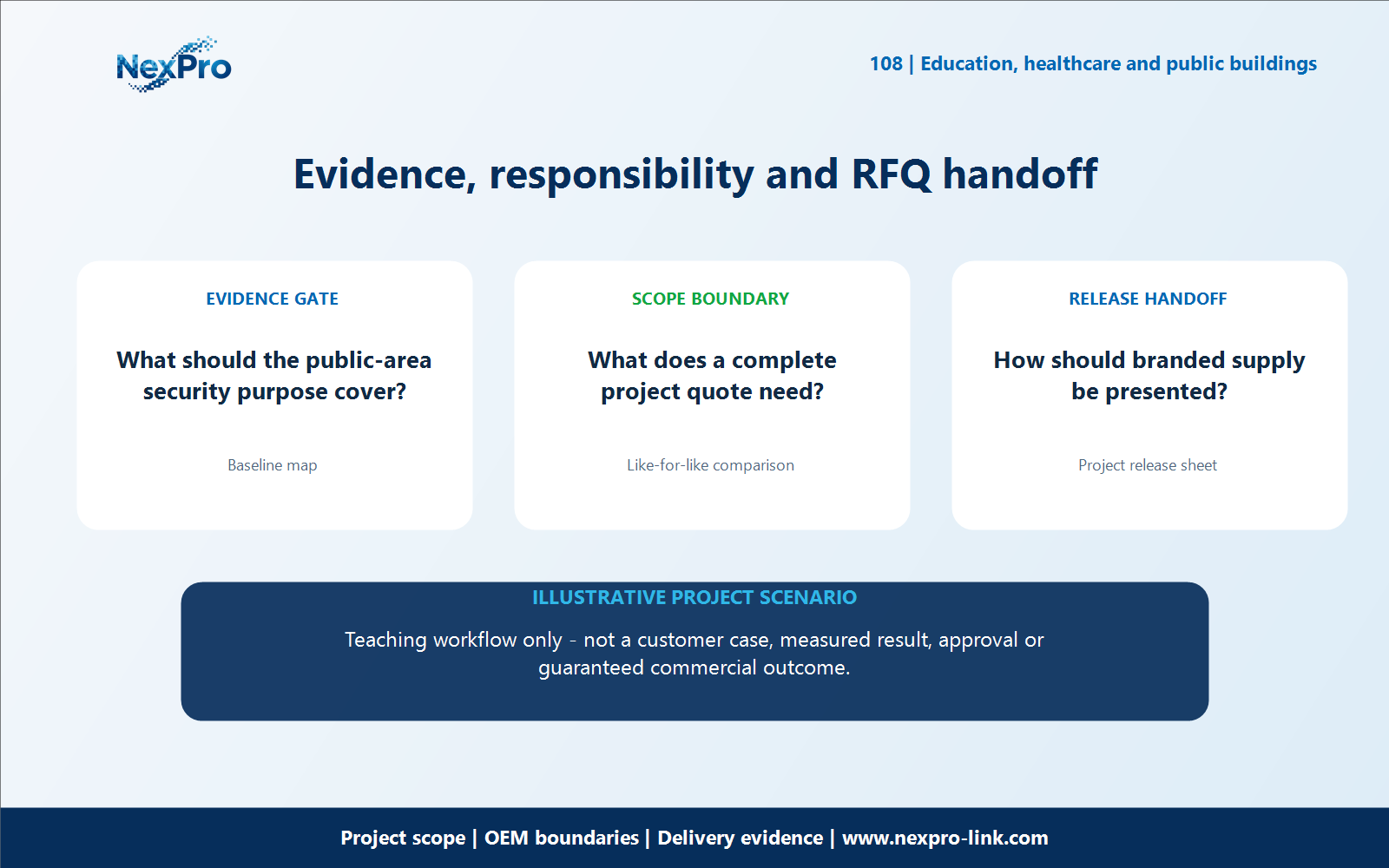
What should the public-area security purpose cover?
A public service building is opening with shared entrances, service counters and restricted equipment rooms. Define ordinary building-security tasks such as entrance review and authorized incident reconstruction. Do not expand the project into profiling visitors' beliefs or activities unrelated to that purpose. The equipment schedule should reflect the approved physical-security scope of the building.
For the "What should the public-area security purpose cover" decision, use the baseline map fields Area or item, Required task, Current assumption, Decision owner. Apply it to public service center security CCTV so the buyer, supplier and local integrator can see which input is confirmed, who owns it and which evidence remains open.
Evaluate what should the public-area security purpose cover against the stated site task and the surrounding equipment, documentation, packing and handover dependencies for public service center security CCTV. For what should the public-area security purpose cover in public service center security CCTV, record the confirmed condition, chosen option and remaining evidence separately; an open value is not a price, test, approval or customer-result claim.
Carry the what should the public-area security purpose cover decision into the RFQ, BOQ, configuration or release record for public service center security CCTV. For what should the public-area security purpose cover in public service center security CCTV, name the equipment, artwork, network, installation and acceptance owner; site-specific work remains with the buyer or integrator unless the signed scope says otherwise.
Section 02
How should counter views protect private information?
How should counter views protect private information? Position views to support the security task without unnecessarily recording documents, screens or private consultations. The operator should define access and retention requirements. Equipment suppliers can describe viewing limits, but cannot supply a universal policy for every jurisdiction and service type. For Public Service Center CCTV: Entrance Queues, Counters and Equipment Rooms, keep this decision tied to the same project brief rather than opening a separate generic specification exercise.
For the "How should counter views protect private information" decision, use the option comparison fields Position or option, Suitable condition, Trade-off, Next choice. Apply it to public service center security CCTV so the buyer, supplier and local integrator can see which input is confirmed, who owns it and which evidence remains open.
Evaluate how should counter views protect private information against the stated site task and the surrounding equipment, documentation, packing and handover dependencies for public service center security CCTV. For how should counter views protect private information in public service center security CCTV, record the confirmed condition, chosen option and remaining evidence separately; an open value is not a price, test, approval or customer-result claim.
Carry the how should counter views protect private information decision into the RFQ, BOQ, configuration or release record for public service center security CCTV. For how should counter views protect private information in public service center security CCTV, name the equipment, artwork, network, installation and acceptance owner; site-specific work remains with the buyer or integrator unless the signed scope says otherwise.
Section 03
Which tender requirements cannot be traded for a lower price?
Which tender requirements cannot be traded for a lower price? Identify mandatory brand, platform and procurement requirements before making an alternative offer. Requirements that are not open to substitution cannot simply be discounted away. A NexPro-Link proposal should target the permitted scope and clearly state any remaining differences. For Public Service Center CCTV: Entrance Queues, Counters and Equipment Rooms, keep this decision tied to the same project brief rather than opening a separate generic specification exercise.
For the "Which tender requirements cannot be traded for a lower price" decision, use the interface map fields Device or record, Input, Output, Responsible party. Apply it to public service center security CCTV so the buyer, supplier and local integrator can see which input is confirmed, who owns it and which evidence remains open.
Evaluate which tender requirements cannot be traded for a lower price against the stated site task and the surrounding equipment, documentation, packing and handover dependencies for public service center security CCTV. For which tender requirements cannot be traded for a lower price in public service center security CCTV, record the confirmed condition, chosen option and remaining evidence separately; an open value is not a price, test, approval or customer-result claim.
Carry the which tender requirements cannot be traded for a lower price decision into the RFQ, BOQ, configuration or release record for public service center security CCTV. For which tender requirements cannot be traded for a lower price in public service center security CCTV, name the equipment, artwork, network, installation and acceptance owner; site-specific work remains with the buyer or integrator unless the signed scope says otherwise.
| Project question | Project-oriented treatment | Keep equal when comparing offers |
|---|---|---|
| What should the public-area security purpose cover? | Define ordinary building-security tasks such as entrance review and authorized incident reconstruction. | Authorized institutional security purpose |
| How should counter views protect private information? | Position views to support the security task without unnecessarily recording documents, screens or private consultations. | Mandatory system and procurement requirements |
| Which tender requirements cannot be traded for a lower price? | Identify mandatory brand, platform and procurement requirements before making an alternative offer. | Network, recording and access scope |
| How should network and recorder access be arranged? | Coordinate the network boundary and authorized recorder access with the building's IT team. | Actual delivery and operating support |
Section 04
How should network and recorder access be arranged?
How should network and recorder access be arranged? Coordinate the network boundary and authorized recorder access with the building's IT team. Remote services are a project decision, not a default requirement. Distinguish system administration from routine incident viewing and keep the ownership of each task explicit. For Public Service Center CCTV: Entrance Queues, Counters and Equipment Rooms, keep this decision tied to the same project brief rather than opening a separate generic specification exercise.
For the "How should network and recorder access be arranged" decision, use the scope and dependency table fields Item, Included, Dependency, Separate option. Apply it to public service center security CCTV so the buyer, supplier and local integrator can see which input is confirmed, who owns it and which evidence remains open.
Evaluate how should network and recorder access be arranged against the stated site task and the surrounding equipment, documentation, packing and handover dependencies for public service center security CCTV. For how should network and recorder access be arranged in public service center security CCTV, record the confirmed condition, chosen option and remaining evidence separately; an open value is not a price, test, approval or customer-result claim.
Carry the how should network and recorder access be arranged decision into the RFQ, BOQ, configuration or release record for public service center security CCTV. For how should network and recorder access be arranged in public service center security CCTV, name the equipment, artwork, network, installation and acceptance owner; site-specific work remains with the buyer or integrator unless the signed scope says otherwise.
Section 05
What does a complete project quote need?
What does a complete project quote need? Quote the complete agreed camera, recording and infrastructure scope, including the required operating and handover work. Use different camera roles where the views justify them. The comparison should show whether each package achieves the same approved outcome rather than only its equipment total. For Public Service Center CCTV: Entrance Queues, Counters and Equipment Rooms, keep this decision tied to the same project brief rather than opening a separate generic specification exercise.
For the "What does a complete project quote need" decision, use the like-for-like comparison fields Requirement, Baseline, Proposed treatment, Remaining difference. Apply it to public service center security CCTV so the buyer, supplier and local integrator can see which input is confirmed, who owns it and which evidence remains open.
Evaluate what does a complete project quote need against the stated site task and the surrounding equipment, documentation, packing and handover dependencies for public service center security CCTV. For what does a complete project quote need in public service center security CCTV, record the confirmed condition, chosen option and remaining evidence separately; an open value is not a price, test, approval or customer-result claim.
Carry the what does a complete project quote need decision into the RFQ, BOQ, configuration or release record for public service center security CCTV. For what does a complete project quote need in public service center security CCTV, name the equipment, artwork, network, installation and acceptance owner; site-specific work remains with the buyer or integrator unless the signed scope says otherwise.
Section 06
How should branded supply be presented?
How should branded supply be presented? Use only authorized branding and accurate model information on the supplied package. Do not add an official approval seal or claim approved-vendor status through packaging. Project labels should help the contractor receive, install and document equipment without implying institutional endorsement. For Public Service Center CCTV: Entrance Queues, Counters and Equipment Rooms, keep this decision tied to the same project brief rather than opening a separate generic specification exercise.
For the "How should branded supply be presented" decision, use the project release sheet fields Configuration, Artwork, Quantity, Location, Release stage. Apply it to public service center security CCTV so the buyer, supplier and local integrator can see which input is confirmed, who owns it and which evidence remains open.
Evaluate how should branded supply be presented against the stated site task and the surrounding equipment, documentation, packing and handover dependencies for public service center security CCTV. For how should branded supply be presented in public service center security CCTV, record the confirmed condition, chosen option and remaining evidence separately; an open value is not a price, test, approval or customer-result claim.
Carry the how should branded supply be presented decision into the RFQ, BOQ, configuration or release record for public service center security CCTV. For how should branded supply be presented in public service center security CCTV, name the equipment, artwork, network, installation and acceptance owner; site-specific work remains with the buyer or integrator unless the signed scope says otherwise.
Engineering references
These sources support the general planning principles. Always use the selected product's current datasheet and applicable project standards for final design.