A CAT6 label leaves important purchasing details unresolved. Qualify conductor construction, installation environment and the complete channel before comparing costs.
Section 01
Define the complete cable specification
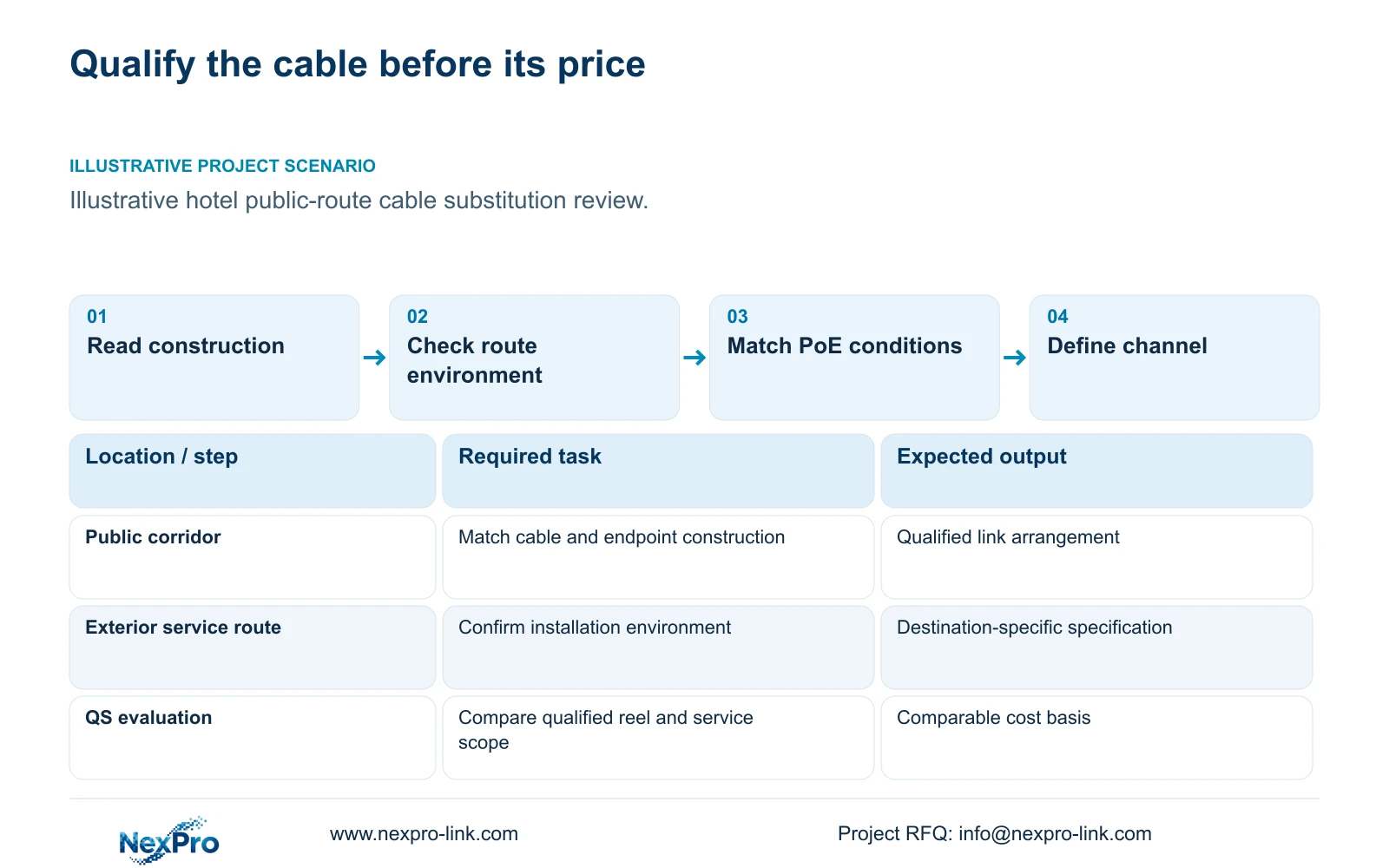
Choose cable candidates that meet the required conductor construction, installation environment and complete-link performance before comparing their prices. A CAT6 category label alone does not settle those purchasing details. Request a fuller specification when offers omit conductor material, size or jacket requirements; a cheaper incomplete offer cannot yet be treated as an equivalent alternative.
Start with the actual route schedule for public corridors, reception and service areas. State the permanent route length separately from patch cords and identify the installation environment along that route. Indoor and exterior-service sections need their own review. Destination requirements belong in the specification and should be resolved by the responsible project professionals.
Keep material supply and installed-channel acceptance distinct. A cable can be described adequately for purchasing while its installation still needs specified terminations and tests. NexPro-Link's structured-cabling record identifies related panel and module candidates, but it does not supply a verified bulk cable SKU for this comparison. The RFQ should therefore use functional cable requirements without inventing a model.
| Required task | Given information | Decision still needed |
|---|---|---|
| Supply public-route cable | CAT6 category requested | Conductor construction and size |
| Suit the installed route | Indoor and exterior sections identified | Jacket and destination requirements |
| Accept the complete link | Camera and cabinet positions | Connections, cords and test basis |
Section 02
Read conductor and construction details
Read the supplier's construction description alongside its category claim. Record the stated conductor material, size and solid or stranded construction, together with the intended use. These fields prevent two different cable constructions from being grouped under a single CAT6 rate. Missing detail should remain a technical clarification rather than being inferred from packaging. Fluke Networks identifies copper-clad aluminum (CCA) as a non-standard substitute for all-copper category cabling and explains why conductor resistance and imbalance matter to PoE. Request the declared conductor material and size, traceable cable identity, DC loop resistance and resistance-unbalance evidence for the specified test arrangement. A category label, a box weight or an ordinary continuity pass cannot establish that complete requirement. Agree the relevant field tests with the designer and cable manufacturer rather than asserting that every project uses the same test limits.
Ask for the proposed cable's own documentation. A data sheet for a patch panel or module does not establish the cable's construction. Keep product references and supplied reel descriptions connected so the quotation, delivery record and installed material can be reconciled. If a supplier changes the offered construction, evaluate it as a substitution with an explicit scope difference.
Normalize the commercial boundary at the same time. Compare the same destination, delivery basis and quantity, and identify whether installation and tests are included. A material-rate advantage may disappear once missing endpoint components or delivery costs are restored. No conductor choice in this article is assigned a measured loss, failure rate or brand-price advantage.
Section 03
Match the PoE design conditions
Give the cable review the actual camera power requirement and planned route conditions. Check the device-side peak demand, per-port supply capability and switch's total usable output budget separately. Group the cameras by their real access switch. An adequate system-wide average can conceal a heavily loaded local node.
Keep camera PD power, PSE output and switch AC input in separate columns. Cable delivery loss connects the first two boundaries, while the complete switch input belongs in the protected-power calculation. The supplied camera PDFs do not list a verified maximum wattage, so a hypothetical camera power cannot be presented as a product fact.
NexPro SW-POE1618G is a 16-PoE-port candidate with two uplinks and an af/at description. Its supplied record has conflicting access-port speed fields and no numerical total PoE budget. It cannot be declared suitable merely from that description. Request explicit values for the required configuration, and reopen the cable and power assessment when the camera group, route or selected equipment changes.
Section 04
Compare complete channel compatibility
Evaluate the cable with its intended modules, patch panel, cords and connection arrangement. SP5648 is a Cat6 48-port data patch panel; DT968MX is a Cat6 tool-free module. Those descriptions identify components. They do not prove that every proposed cable and cord combination forms an accepted installed channel.
Keep the permanent-link and complete-channel test bases visible. The supplied Fluke guidance uses typical 90 m permanent-link and 100 m channel limits, with the project's configuration and requirements still needing confirmation. Length compliance alone does not complete the performance assessment. A candidate requiring different endpoint materials should include those materials in its evaluated cost.
Assign acceptance responsibilities before procurement. The supplier can provide component and configuration information; the installer must document the actual installed arrangement and required tests. If a proposed alternative changes the connections, test object or installation method, compare its full revised scope. A nominal cable saving should not be evaluated while the additional channel work remains an unknown charge.
Section 05
Normalize supplied reel lengths
Convert quotations to a common purchased-length basis, then check whether the reels can provide every required continuous run. A lower reel price is meaningful only with its stated length and qualified cable construction. Keep installed metres, purchased metres and usable remaining pieces distinguishable so the cost manager can see the purchasing consequence.
Use the endpoint cut list to allocate complete runs. Total metres divided by reel length provides a lower bound, not a feasible cutting plan. Short tails may remain even when the procurement is correctly sized. Record their individual lengths and use them only where a legitimate continuous route fits.
Separate reserve stock from the quantity needed to complete the scheduled links. A spare unopened reel offers a different resource from distributed tails. Where the supplier proposes a different reel format, rerun the allocation before judging the purchase cost. Do not join the independent life-cycle figures below to the CASE01 route schedule or treat them as an installed cable quotation.
Section 06
Select on qualified cost
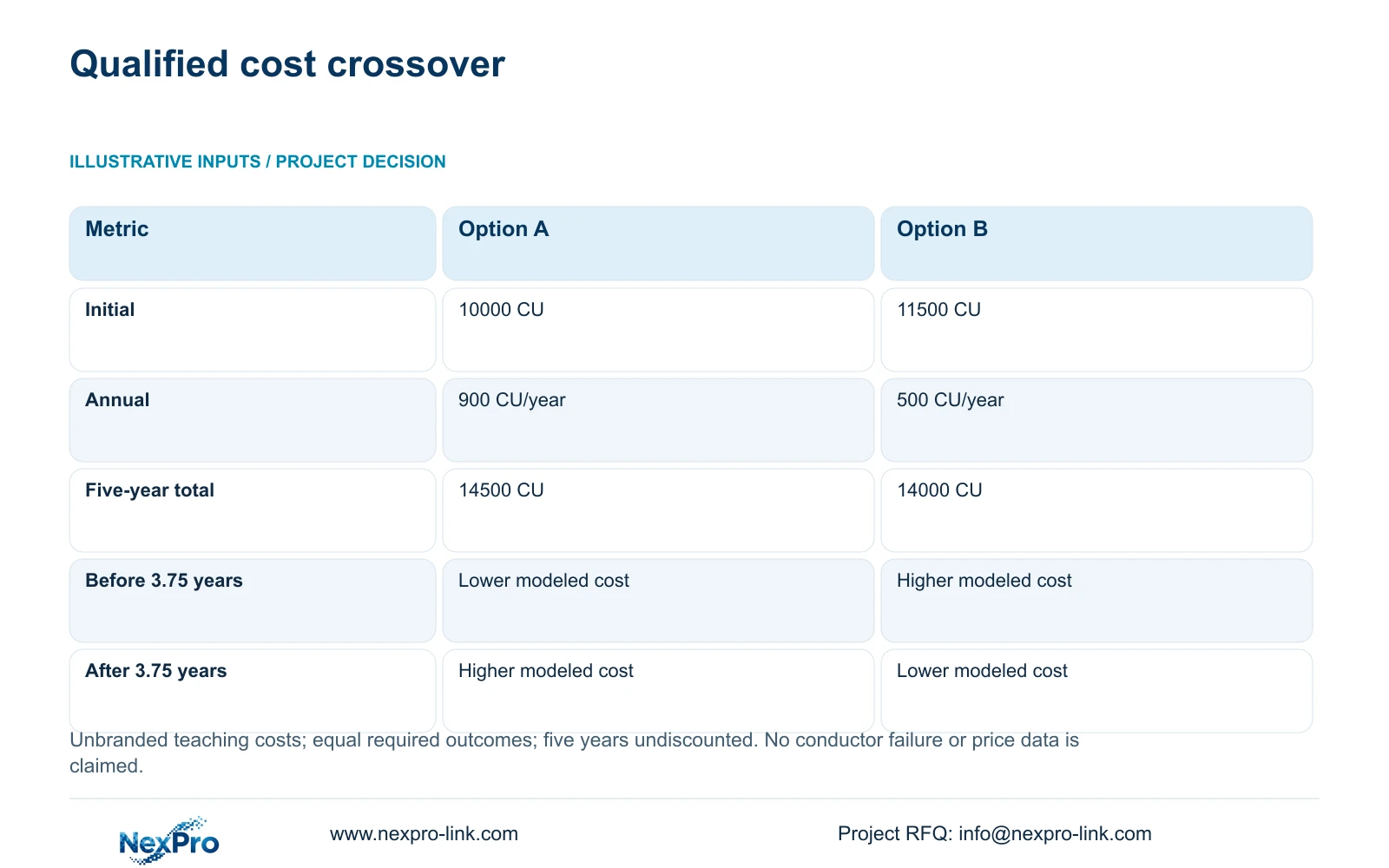
After technical qualification, compare one-time and recurring costs over an agreed period. The unbranded teaching alternatives assume equal required outcomes: A costs 10,000 CU initially and 900 CU annually; B costs 11,500 CU initially and 500 CU annually. These figures describe a procurement-and-service model, not measured properties of different conductors.
Five-year total = initial cost + 5 × annual cost. A totals 14,500 CU and B totals 14,000 CU. The crossover is (11,500 − 10,000) ÷ (900 − 500) = 3.75 years. B is preferable under the stated five-year assumptions; A is lower before the crossover. At 3.75 years their modeled totals are equal. No discounting is applied.
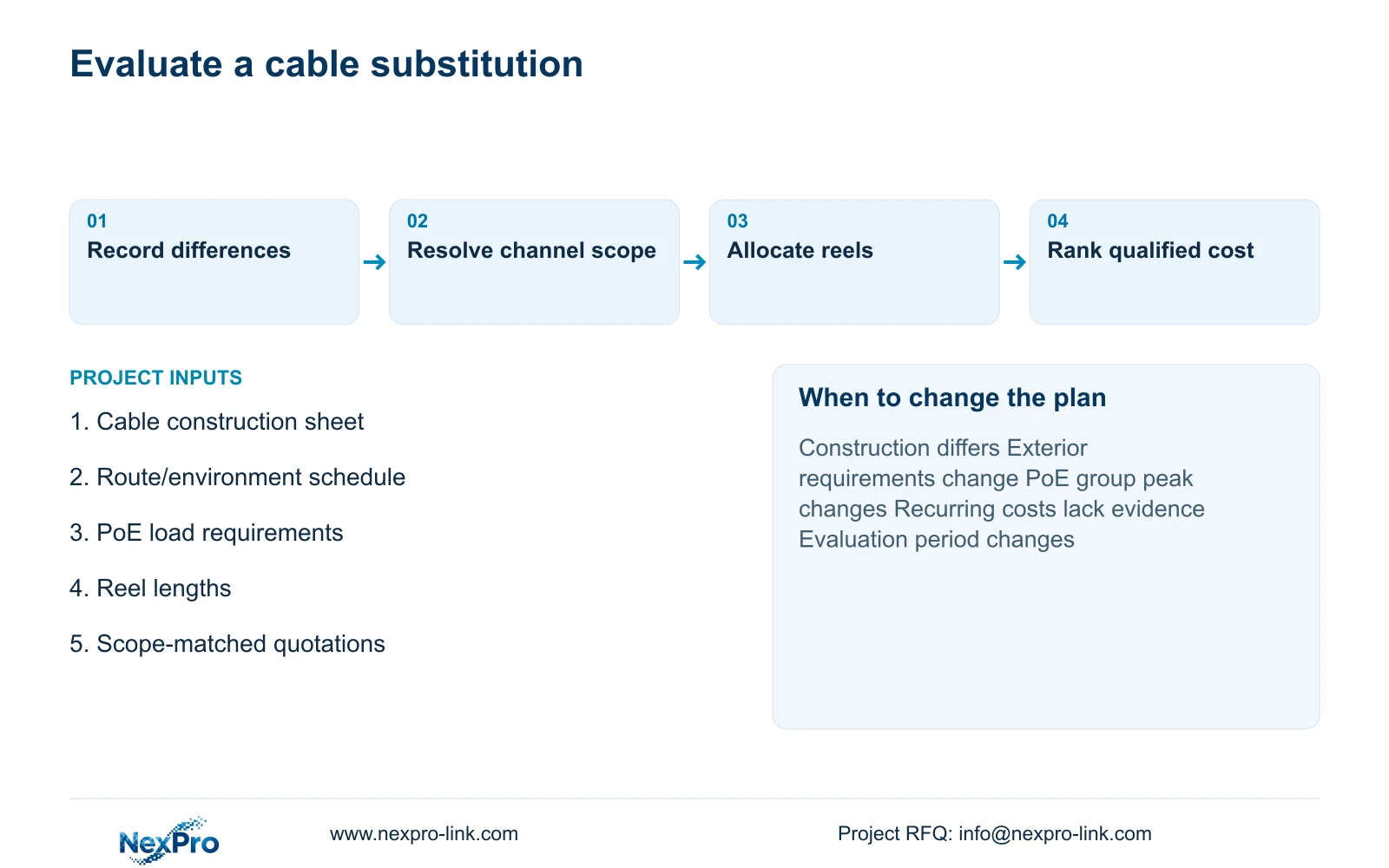
Recommend the economical technically qualified offer using actual scope-matched quotations. Change the selection when the evaluation period or documented recurring costs change, or when a candidate fails the required construction, environment or channel basis. If recurring savings are unsupported, do not credit them. Send info@nexpro-link.com the cable specification, route list, reel lengths and proposed channel components for a scoped comparison through BOQ support.
| Metric / condition | Option A | Option B |
|---|---|---|
| Initial teaching cost (CU) | 10000 | 11500 |
| Annual assumed cost (CU/year) | 900 | 500 |
| 5-year undiscounted total (CU) | 14500 | 14000 |
| Break-even time | Before 3.75 years: A lower | After 3.75 years: B lower |
| Actual tender ranking | Requires actual scope-matched quotes | Not established by this example |
Section 07
Buyer questions
Is a CAT6 label enough to approve a cable substitution? No. Compare the stated conductor construction, installation environment and intended channel components. Record unresolved differences and obtain the project decision before treating the substitution as equivalent.
Does a PoE+ switch label settle the cable and power design? No. The actual device demand, per-port capability and total output budget must match the camera group. Route conditions and the complete connection arrangement remain separate inputs.
Should we pay more for assumed lower maintenance costs? Only when the recurring-cost difference has a usable basis and the evaluation period supports it. The teaching crossover is 3.75 years; actual quotations and service terms can change or remove that advantage.
Engineering references
These sources support the general planning principles. Always use the selected product's current datasheet and applicable project standards for final design.