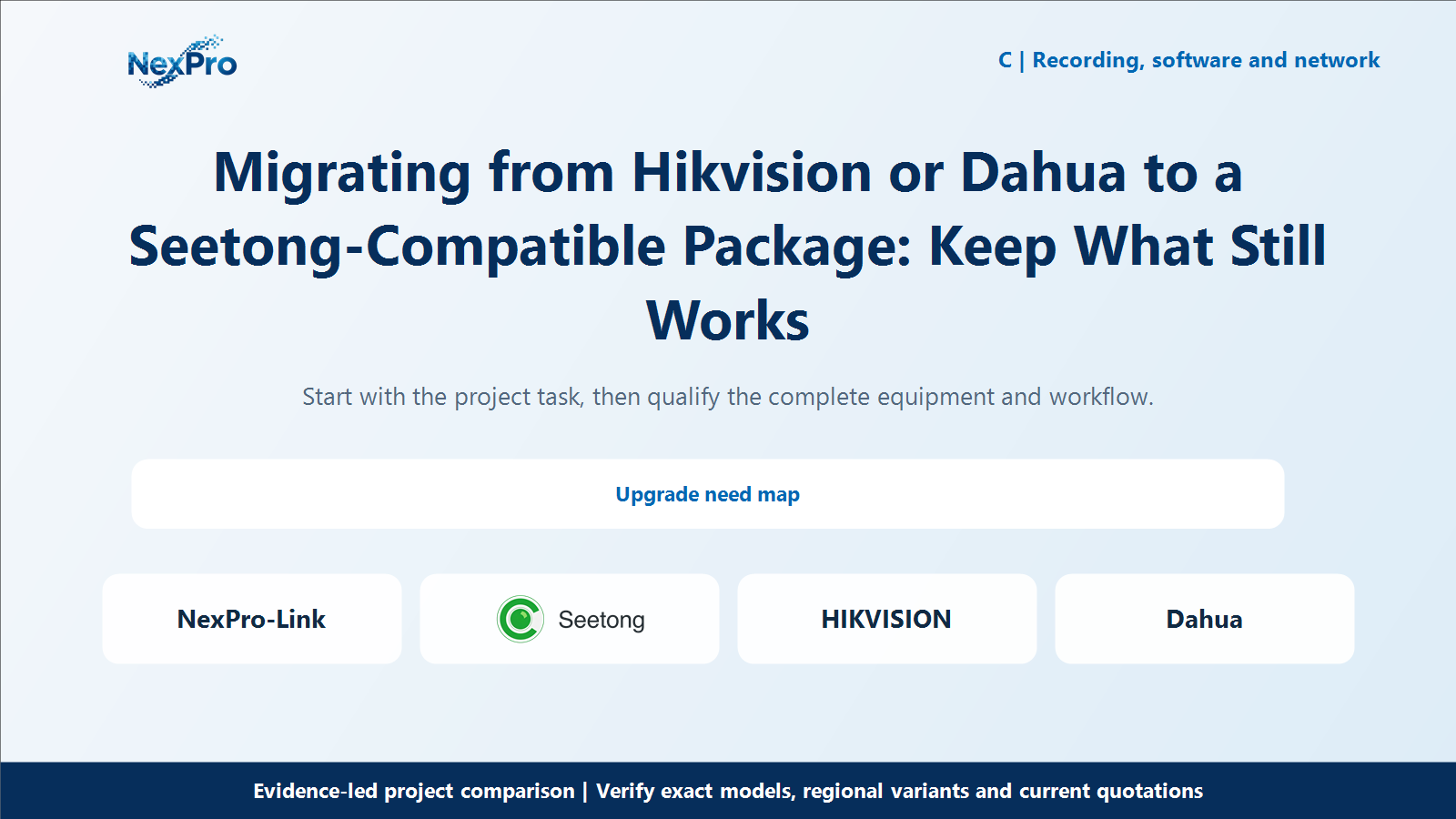
A CCTV migration does not have to begin by replacing every camera. Review what the existing Hikvision or Dahua system still does well, then identify the specific gap a Seetong-compatible package is intended to solve. Compare reuse, partial replacement and full replacement with clear compatibility tests, recording continuity and transition costs.
Section 01
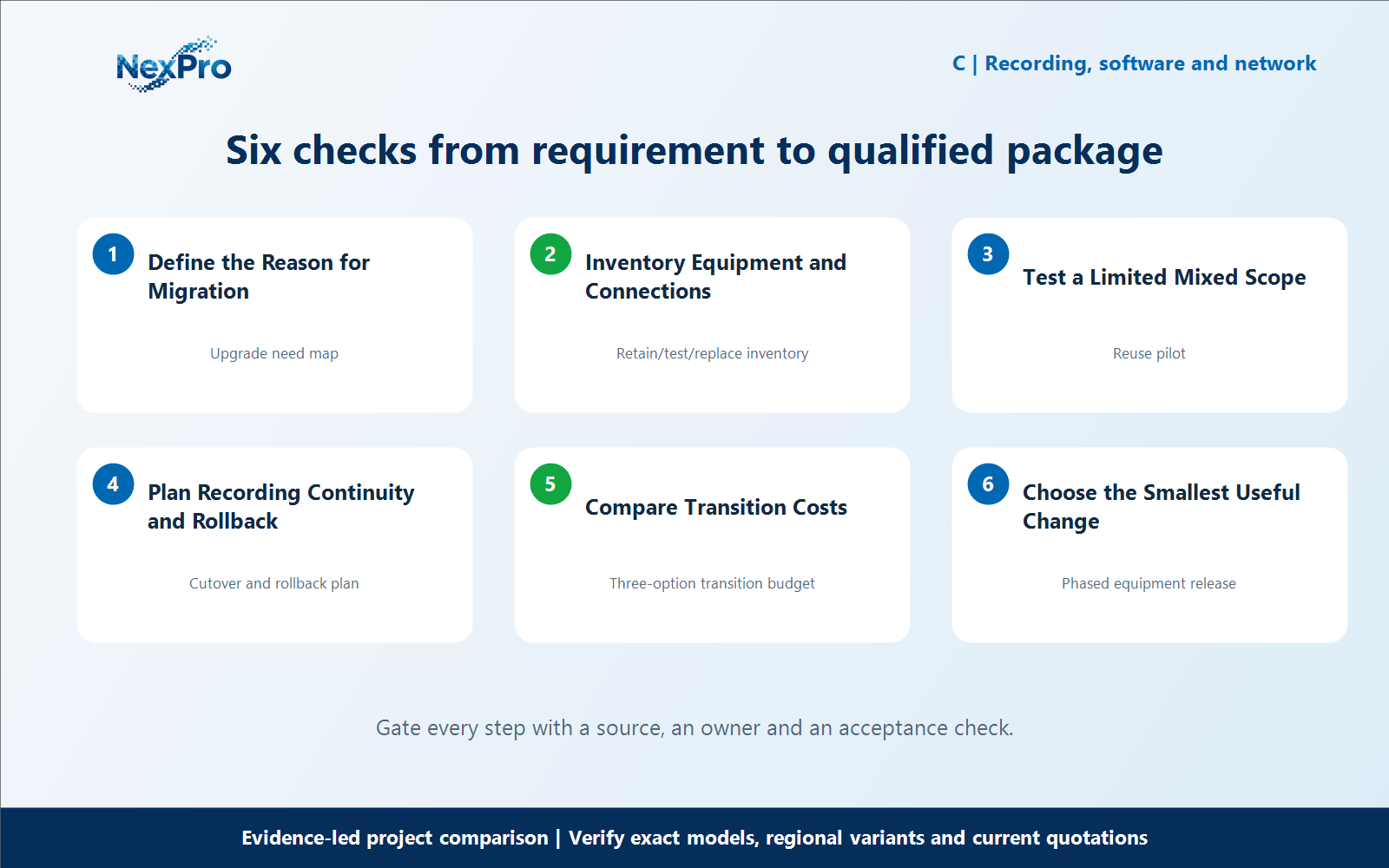
Define the Reason for Migration
A CCTV migration does not have to begin by replacing every camera. Review what the existing Hikvision or Dahua system still does well, then identify the specific gap a Seetong-compatible package is intended to solve. Compare reuse, partial replacement and full replacement with clear compatibility tests, recording continuity and transition costs. What should trigger a replacement decision? A documented gap such as missing coverage, insufficient recording capacity or an unsupported operational requirement. Do not begin with the assumption that an entire brand must be removed. Identify what is failing to meet the task and which existing assets remain useful.
For define the reason for migration, build a working record around Upgrade need map. For Hikvision to Seetong CCTV migration, record the current project condition, candidate response, evidence source and unresolved boundary before comparing offers.
Review Upgrade need map separately from the downstream workflow. This prevents one attractive specification from deciding the complete Hikvision to Seetong CCTV migration question without considering recording, installation, operation and support consequences.
Carry the Upgrade need map record into the RFQ, BOQ review or pilot checklist. For Hikvision to Seetong CCTV migration, keep product capability, project assumptions and supplier responsibility beside the define the reason for migration decision; site measurements, network policy, installation safety and acceptance remain project inputs unless the signed scope says otherwise.
- Record upgrade need map with a named source, owner or acceptance check; do not leave it as an unqualified brochure phrase.
Section 02
Inventory Equipment and Connections
What should the reuse survey include? List exact devices, relevant firmware, cable routes, power arrangements and the current viewing and recording paths. Inspect what can be confirmed rather than assuming all installed cable or devices are reusable. Keep account and network information in a controlled project record, not public marketing examples.
For inventory equipment and connections, build a working record around Retain, test, replace inventory. For Hikvision to Seetong CCTV migration, record the current project condition, candidate response, evidence source and unresolved boundary before comparing offers.
Review Retain and test separately from replace inventory. This prevents one attractive specification from deciding the complete Hikvision to Seetong CCTV migration question without considering recording, installation, operation and support consequences.
Carry the Retain/test/replace inventory record into the RFQ, BOQ review or pilot checklist. For Hikvision to Seetong CCTV migration, keep product capability, project assumptions and supplier responsibility beside the inventory equipment and connections decision; site measurements, network policy, installation safety and acceptance remain project inputs unless the signed scope says otherwise.
- Record retain with a named source, owner or acceptance check; do not leave it as an unqualified brochure phrase.
- Verify test with a named source, owner or acceptance check; do not leave it as an unqualified brochure phrase.
- Compare replace inventory with a named source, owner or acceptance check; do not leave it as an unqualified brochure phrase.
Section 03
Test a Limited Mixed Scope
How can reuse be evaluated before a large order? Use a representative device combination and test the required streams, playback, events and controls. Keep the existing critical service intact during evaluation. A successful sample establishes evidence for that scope; it is not permission to generalize across all models in the site.
For test a limited mixed scope, build a working record around Reuse pilot. For Hikvision to Seetong CCTV migration, record the current project condition, candidate response, evidence source and unresolved boundary before comparing offers.
Review Reuse pilot separately from the downstream workflow. This prevents one attractive specification from deciding the complete Hikvision to Seetong CCTV migration question without considering recording, installation, operation and support consequences.
Carry the Reuse pilot record into the RFQ, BOQ review or pilot checklist. For Hikvision to Seetong CCTV migration, keep product capability, project assumptions and supplier responsibility beside the test a limited mixed scope decision; site measurements, network policy, installation safety and acceptance remain project inputs unless the signed scope says otherwise.
- Record reuse pilot with a named source, owner or acceptance check; do not leave it as an unqualified brochure phrase.
| Comparison factor | Object or condition | Evidence-led action | Do not infer |
|---|---|---|---|
| Reuse | Keep a qualified asset | Test the needed functions | No blanket compatibility |
| Partial replacement | Solve the identified gap | Preserve necessary native functions | Include configuration work |
| Full replacement | Compare complete new scope | Count training and cutover | Not the default |
| Value | Smallest change that works | Record accepted limits | No zero-downtime promise |
Section 04
Plan Recording Continuity and Rollback
What should a migration plan protect? The required recording and retrieval service during the change. Define when work may occur, what temporary coverage is needed and how the team returns to the prior arrangement if a test fails. Do not promise zero downtime without a supported architecture and approved procedure.
For plan recording continuity and rollback, build a working record around Cutover and rollback plan. For Hikvision to Seetong CCTV migration, record the current project condition, candidate response, evidence source and unresolved boundary before comparing offers.
Review Cutover and rollback plan separately from the downstream workflow. This prevents one attractive specification from deciding the complete Hikvision to Seetong CCTV migration question without considering recording, installation, operation and support consequences.
Carry the Cutover and rollback plan record into the RFQ, BOQ review or pilot checklist. For Hikvision to Seetong CCTV migration, keep product capability, project assumptions and supplier responsibility beside the plan recording continuity and rollback decision; site measurements, network policy, installation safety and acceptance remain project inputs unless the signed scope says otherwise.
- Record cutover and rollback plan with a named source, owner or acceptance check; do not leave it as an unqualified brochure phrase.
Section 05
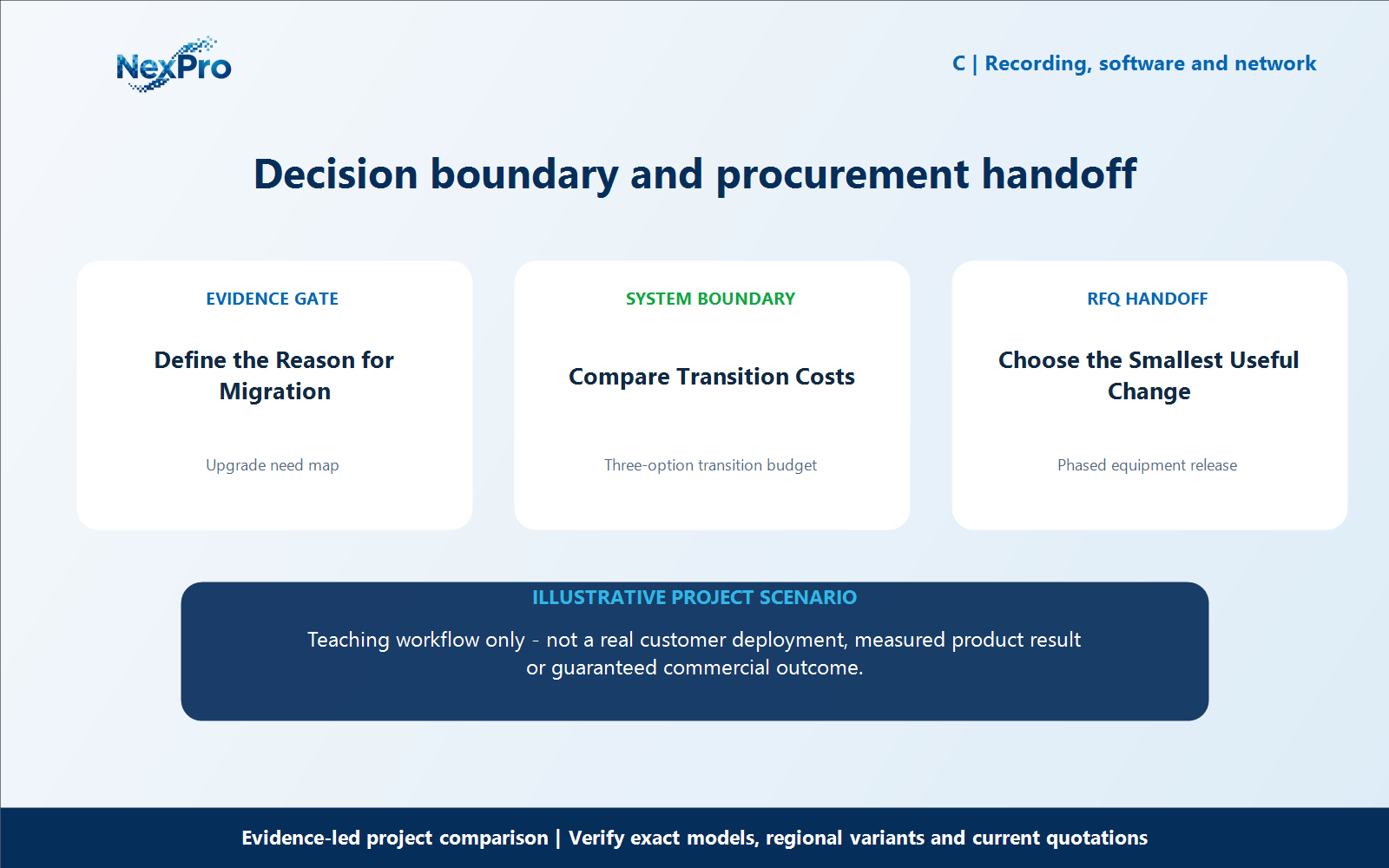
Compare Transition Costs
What costs can erase a camera-price saving? Reconfiguration, integration, retraining, temporary equipment and the loss of useful native functions can offset lower hardware prices. Compare these with the cost of retaining or expanding the current system. Include only supported estimates or actual quotes, not presumed migration savings.
For compare transition costs, build a working record around Three-option transition budget. For Hikvision to Seetong CCTV migration, record the current project condition, candidate response, evidence source and unresolved boundary before comparing offers.
Review Three-option transition budget separately from the downstream workflow. This prevents one attractive specification from deciding the complete Hikvision to Seetong CCTV migration question without considering recording, installation, operation and support consequences.
Carry the Three-option transition budget record into the RFQ, BOQ review or pilot checklist. For Hikvision to Seetong CCTV migration, keep product capability, project assumptions and supplier responsibility beside the compare transition costs decision; site measurements, network policy, installation safety and acceptance remain project inputs unless the signed scope says otherwise.
- Record three-option transition budget with a named source, owner or acceptance check; do not leave it as an unqualified brochure phrase.
Section 06
Choose the Smallest Useful Change
How should NexPro-Link position a migration proposal? Offer a bounded change that solves the identified problem and preserves qualified assets where practical. Show the supported Seetong access path and any limitations. Recommend expansion only after the initial scope performs as required rather than treating brand replacement itself as the project’s benefit.
For choose the smallest useful change, build a working record around Phased equipment release. For Hikvision to Seetong CCTV migration, record the current project condition, candidate response, evidence source and unresolved boundary before comparing offers.
Review Phased equipment release separately from the downstream workflow. This prevents one attractive specification from deciding the complete Hikvision to Seetong CCTV migration question without considering recording, installation, operation and support consequences.
Carry the Phased equipment release record into the RFQ, BOQ review or pilot checklist. For Hikvision to Seetong CCTV migration, keep product capability, project assumptions and supplier responsibility beside the choose the smallest useful change decision; site measurements, network policy, installation safety and acceptance remain project inputs unless the signed scope says otherwise.
What should the buyer include in an RFQ for Hikvision to Seetong CCTV migration? Provide the camera schedule, required workflows, candidate equipment lists, mandatory brand or integration constraints, and the evidence still needed for choose the smallest useful change. Keep access credentials out of the inquiry. For Hikvision to Seetong CCTV migration, this defines the next comparison; it does not promise identical performance, fixed savings or automatic approval.
- Record phased equipment release with a named source, owner or acceptance check; do not leave it as an unqualified brochure phrase.
Engineering references
These sources support the general planning principles. Always use the selected product's current datasheet and applicable project standards for final design.