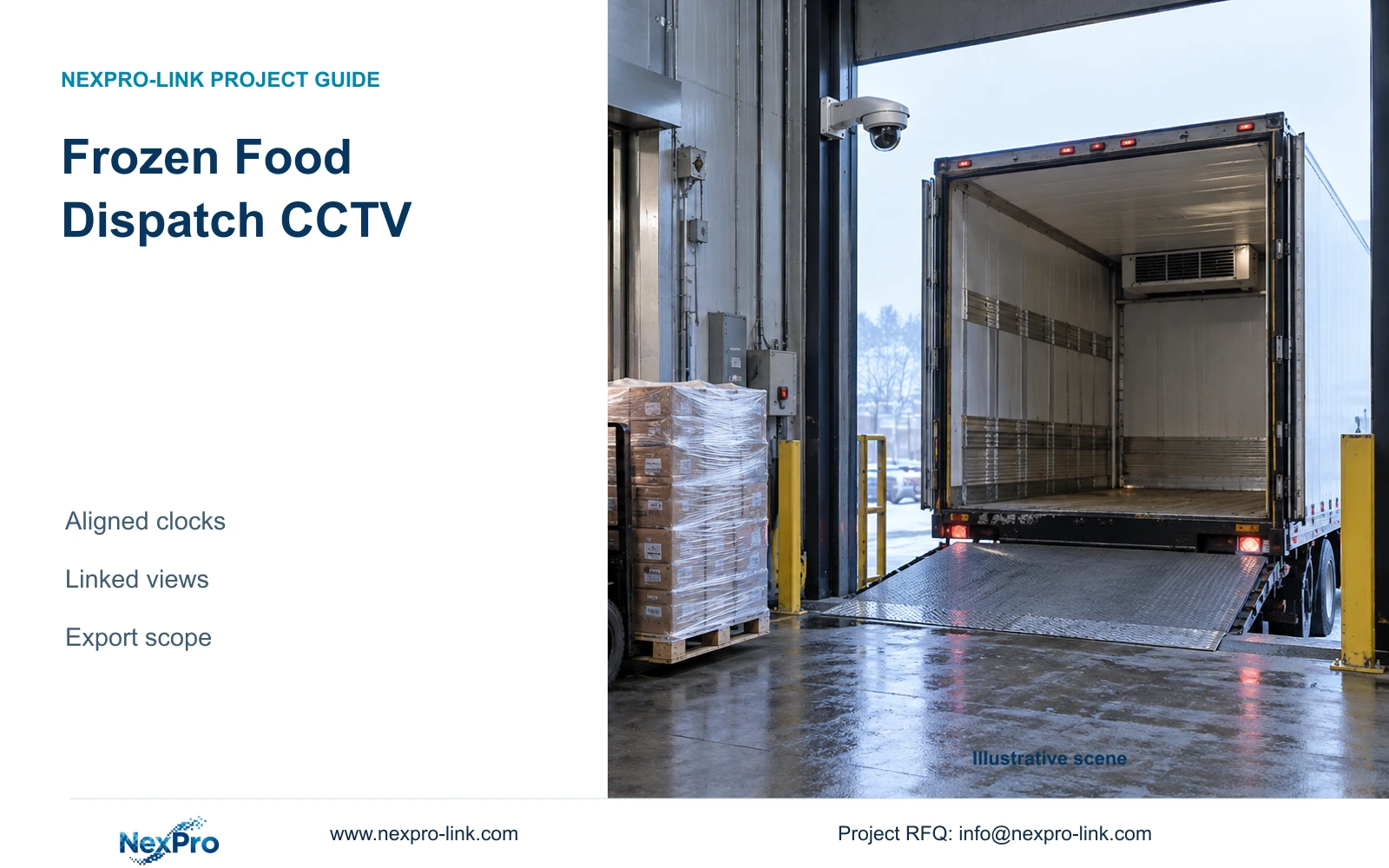
Following a frozen-food pallet requires suitable views, consistent timestamps and a clear retrieval map. A smaller export request is useful only when it preserves the full transfer from doorway to trailer.
Section 01
Link the transfer with named views and aligned clocks
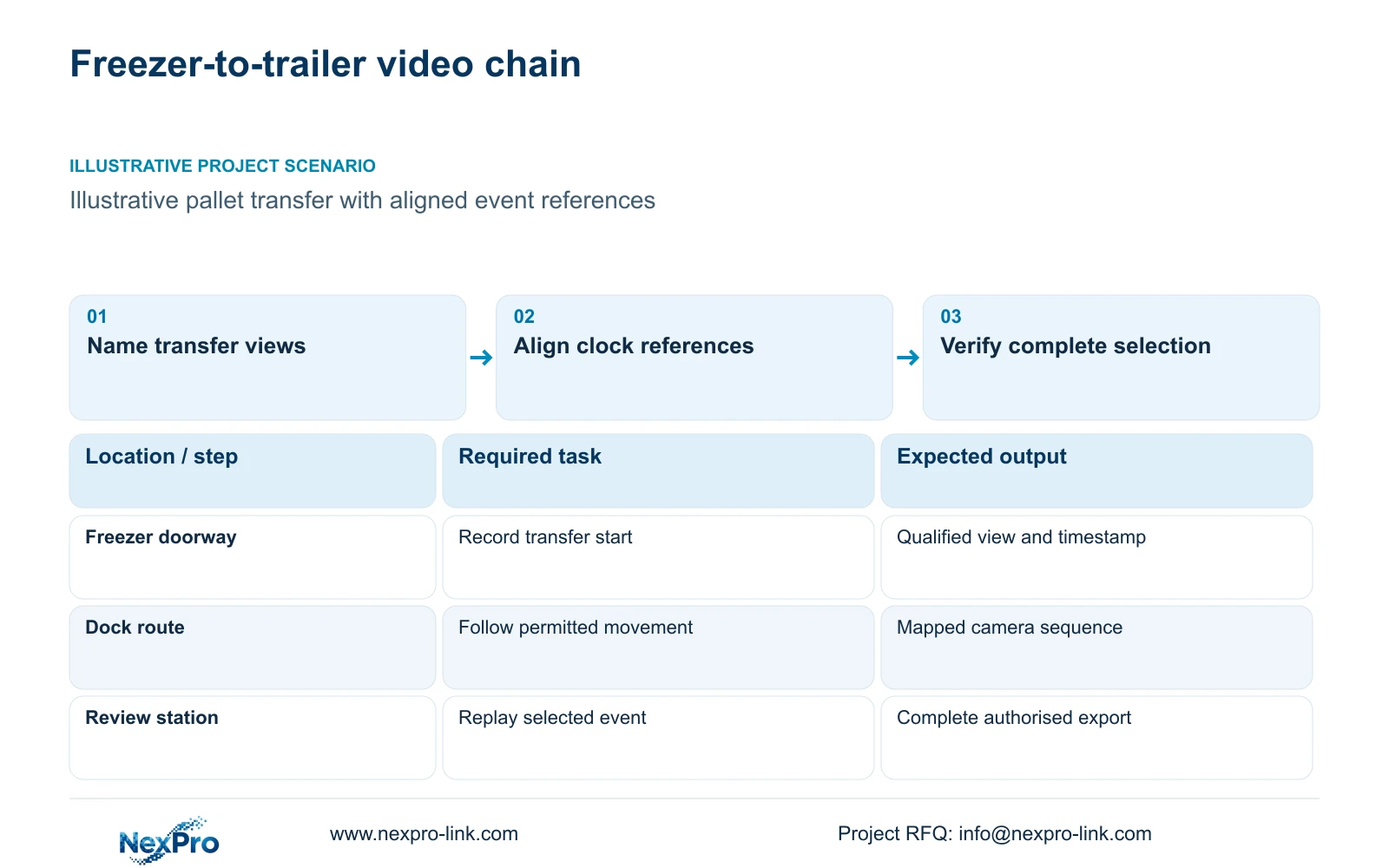
Frozen food dispatch CCTV should use a chain of suitable views with aligned clocks and location names that match dispatch records. Footage can establish movement context between a cold doorway and loading position. It does not replace temperature logging or prove the condition of the product during the transfer.
Illustrative project scenario: The owner needs to follow a pallet from a freezer doorway to a refrigerated trailer. Assume the review starts from a dispatch reference and follows the doorway, staging route and assigned dock. These are hypothetical planning tasks, not evidence of an installed integration or an automatic pallet-tracking capability.
For the quantity surveyor, the measurable scope is the complete accepted transfer chain. List each required action, camera location, recording node and retrieval responsibility. Give the time source and displayed time basis an owner. During acceptance, compare the same transfer across views and document discrepancies instead of assuming that matching clock settings prove alignment.
Section 02
Separate temperature zones without breaking the evidence sequence
Distinguish freezer-side, doorway-transition and warmer dock positions. The ordinary BL2812M and DM2812M 5MP references list -20 to +60°C and IP66, with the listed 2880×1620 output and 2.8–12mm motorized lenses. Actual freezer conditions must be compared with the documented scope; the figures do not establish specialist cold-door or washdown performance.
Begin with a suitable warmer-side view where it preserves the doorway action. Check open doors, loaded pallets and condensation-sensitive periods. Where that position cannot capture the transfer, retain a separately qualified cold-side or transition assembly. The environmental split should change the equipment scope without leaving a gap in the movement record.
Price the mount, connection method and cleaning access alongside the camera. A substitute that moves the view may require another route or complementary camera. Keep temperature logging as a retained independent system with its own records, even when operators use a timestamp to compare those records with video.
Section 03
Size retained footage from the actual operating schedule
Ask whether recording must cover only a working shift or also staging, delayed loading and access outside that shift. Do not reduce recording hours until the owner accepts the resulting boundary. All views required for an older transfer should have compatible retention, or the reviewer may find the doorway clip after the dock clip has been overwritten.
CASE03 provides an illustrative 48-camera continuous-recording baseline: 4 Mbps average per camera, 24 hours/day and 30 days. Its formula, video_TB = cameras × Mbps × 10^6 × 86400 × days / 8 / 10^12, gives 62.208 TB overall, or 31.104 TB per 24-camera node.
Each reference node installs four 12 TB disks: 48 TB raw × 0.95 formatting allowance × 0.80 recording allocation = 36.48 TB video budget. Compare 31.104 TB with 36.48 TB directly; the reserve is already included. These assumptions are separate from the export exercise below. Any different shift schedule or measured bitrate requires a revised recording calculation.
Section 04
Measure export scope without promising retrieval speed
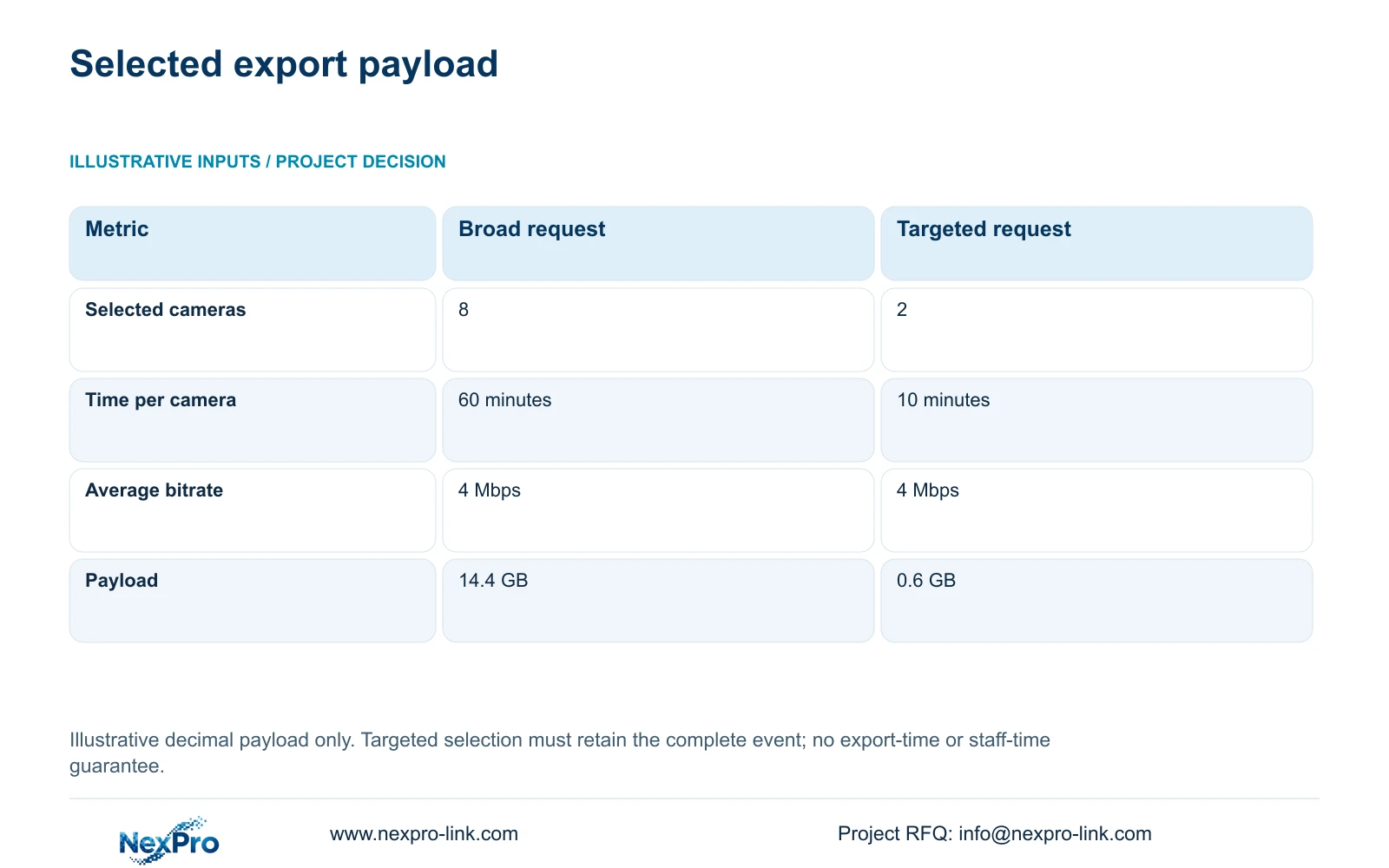
For the supplied illustrative export comparison, the broad request selects eight cameras for 60 minutes each at 4 Mbps. The targeted request selects two relevant cameras for ten minutes each at the same bitrate. Use decimal GB = cameras × Mbps × seconds / 8 / 1000.
The broad payload is 8 × 4 × 3600 / 8 / 1000 = 14.4 GB. The targeted payload is 2 × 4 × 600 / 8 / 1000 = 0.6 GB. The smaller selection removes unrelated camera-time only when the approved event map establishes that the two views and ten-minute windows contain the complete required transfer.
Do not force every investigation into the targeted request. A staging delay, uncertain dock or missing timestamp may require more views or a longer window. Payload size does not establish export duration, staff-time saving or legal evidence status. Authorised selection, playback verification and handling records remain separate work items.
| Metric | Broad request | Targeted request |
|---|---|---|
| Cameras selected | 8 | 2 |
| Time per camera | 60 minutes / 3600 seconds | 10 minutes / 600 seconds |
| Average bitrate | 4 Mbps | 4 Mbps |
| Estimated payload | 14.4 decimal GB | 0.6 decimal GB |
| Selection condition | Uncertain or wider event scope | Complete event retained by approved map |
Section 05
Compare bids on the complete transfer and review workflow
Recommend a mapped chain of qualified views, aligned time references and an authorised playback-and-export workflow. Use targeted exports after the event map is confirmed, while retaining broader selection when necessary. This gives the cost team a defined package without treating a smaller file as a substitute for missing evidence.
Compare camera assemblies, recording hours, usable storage and review access across offers. The NexPro-NVR4449-4K reference has 320 Mbps input and four SATA bays up to 18 TB per bay, but channel count does not prove every mixed specialist stream or simultaneous playback arrangement. Required workflows need confirmation with the actual models and firmware.
Separate local recording continuity from central viewing. Backup power must cover the relevant camera power, switches and recorder at each actual node; a central UPS alone does not establish remote protection. A suitable review display may be sufficient. Price a larger LCD wall only when the owner requires simultaneous operational monitoring.
Section 06
Make the retrieval map part of the priced handover
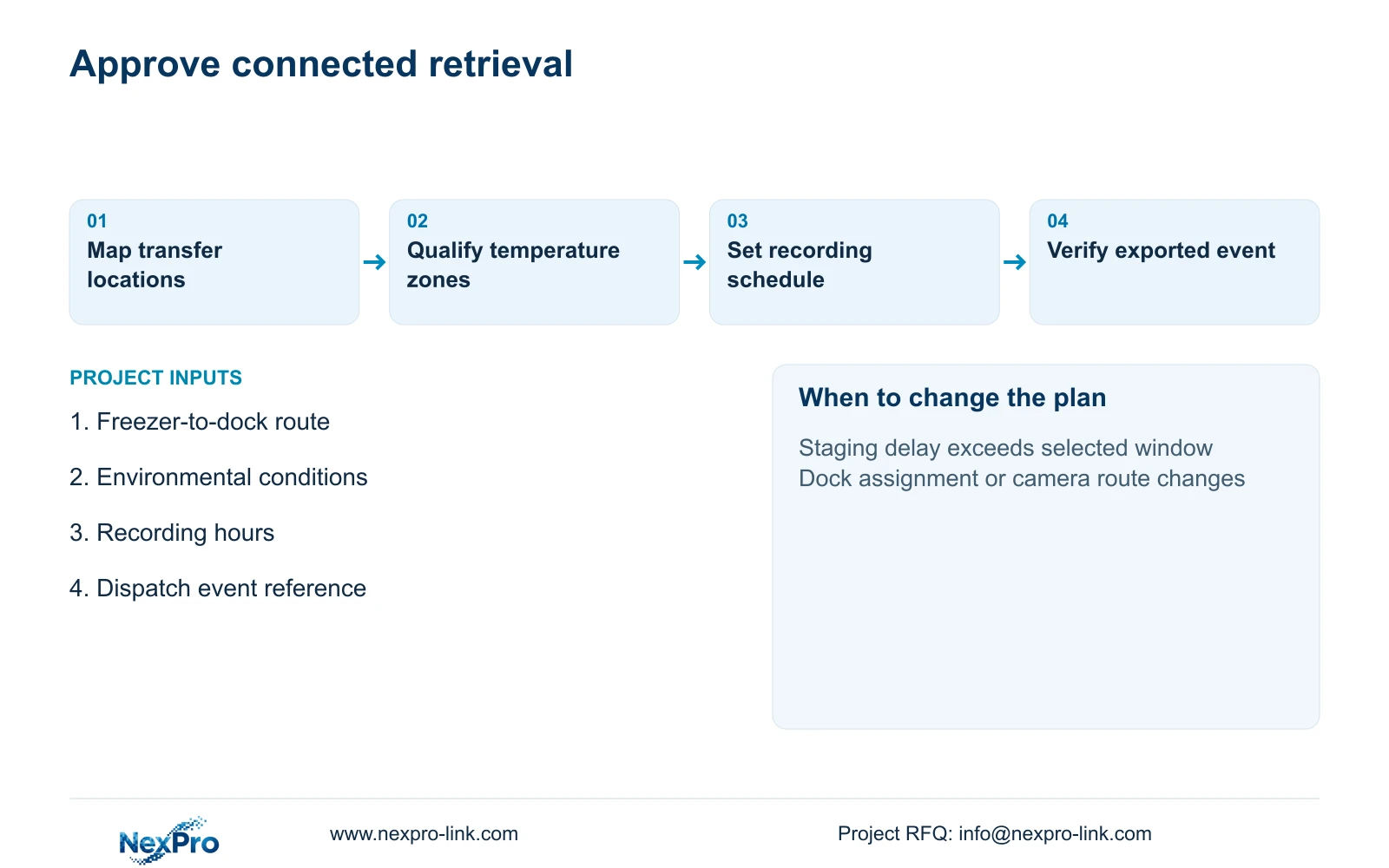
Include the doorway-to-dock camera map, location names, recording-node references and time configuration records in the handover scope. Assign who prepares the map, who verifies clock alignment and who authorises exports. These are tangible deliverables that a quantity surveyor can compare rather than assume are included in equipment supply.
NexPro-Link's BOQ & Tender Support can discuss equipment matching and scope deviations around the transfer schedule. Project labels and packing can preserve camera identities through delivery. Local environmental installation, temperature-record responsibilities and final workflow acceptance remain with their assigned project parties.
Demonstrate a representative transfer and replay the exported selection at handover. Confirm that it includes the required beginning, movement and loading context. A changed dock assignment, staging route or recording schedule should update the retrieval map and affected resources, rather than leave operators following an obsolete camera list.
Section 07
Buyer questions
Must we buy automatic pallet tracking to connect the footage? Not necessarily. A usable camera map, consistent location names and aligned timestamps may support manual investigation. Automatic identification or tracking is additional scope and requires its own supported workflow and acceptance criteria.
Can the ten-minute targeted export be a standard rule? Only where it contains the complete event. Delayed loading or uncertainty about the route may require longer windows and more cameras. Keep the selection adjustable to the approved investigation task.
Does continuous recording mean every view needs a permanent live display? No. Recording and authorised review can be planned independently from continuous live monitoring. Specify a permanent display only where an operator has an accepted monitoring duty.
Section 08
Price a connected frozen-dispatch record
Send the freezer-to-dock route, camera temperature and cleaning conditions, recording-hours requirement and a sample dispatch event reference to info@nexpro-link.com. NexPro-Link can discuss the equipment and retrieval deliverables needed for the complete transfer chain.
Engineering references
These sources support the general planning principles. Always use the selected product's current datasheet and applicable project standards for final design.