A farm cooperative is building a packhouse with receiving lanes, packing stations and an outdoor loading area. Use video to support the agreed review of material handoffs and movements.
Section 01
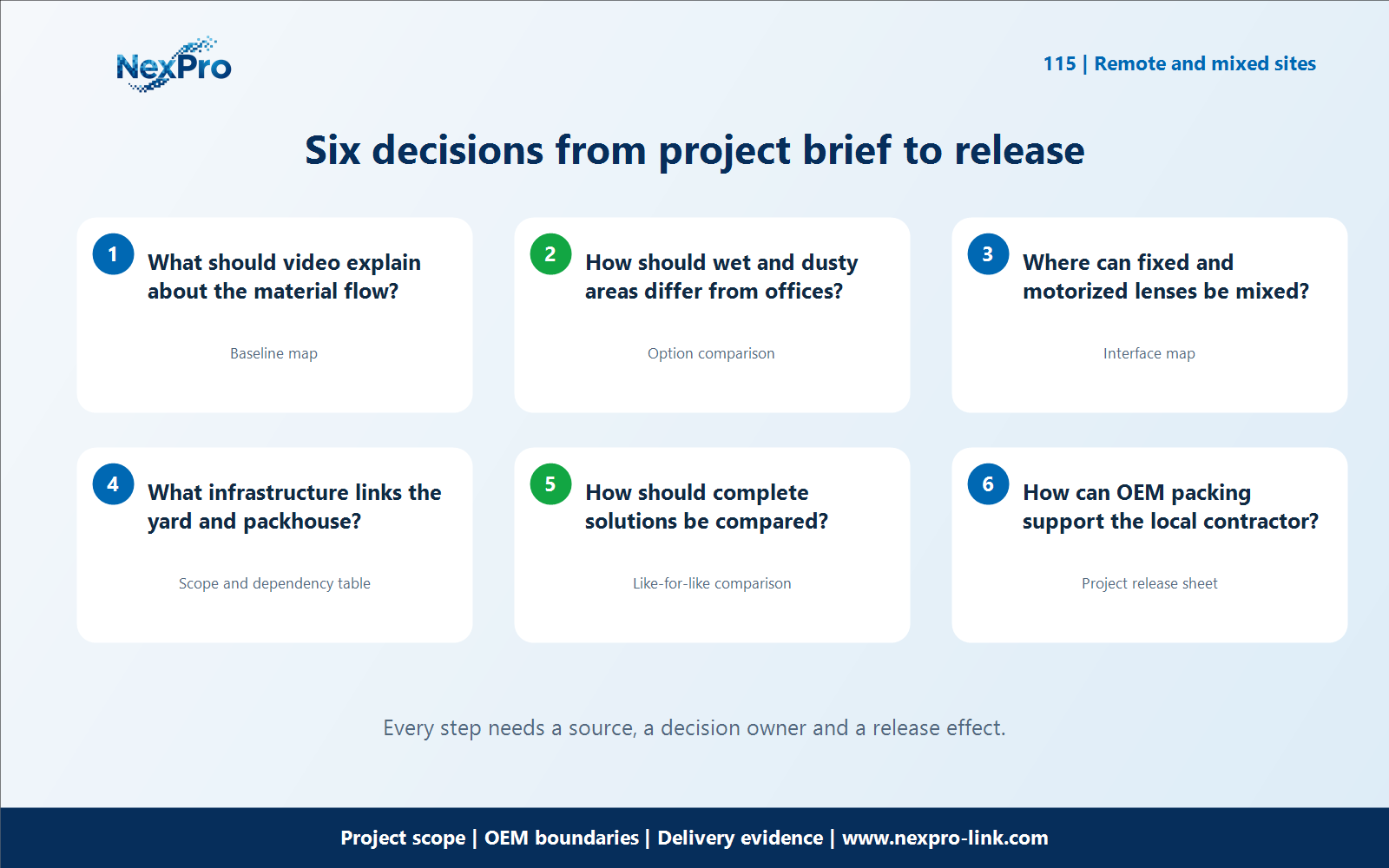
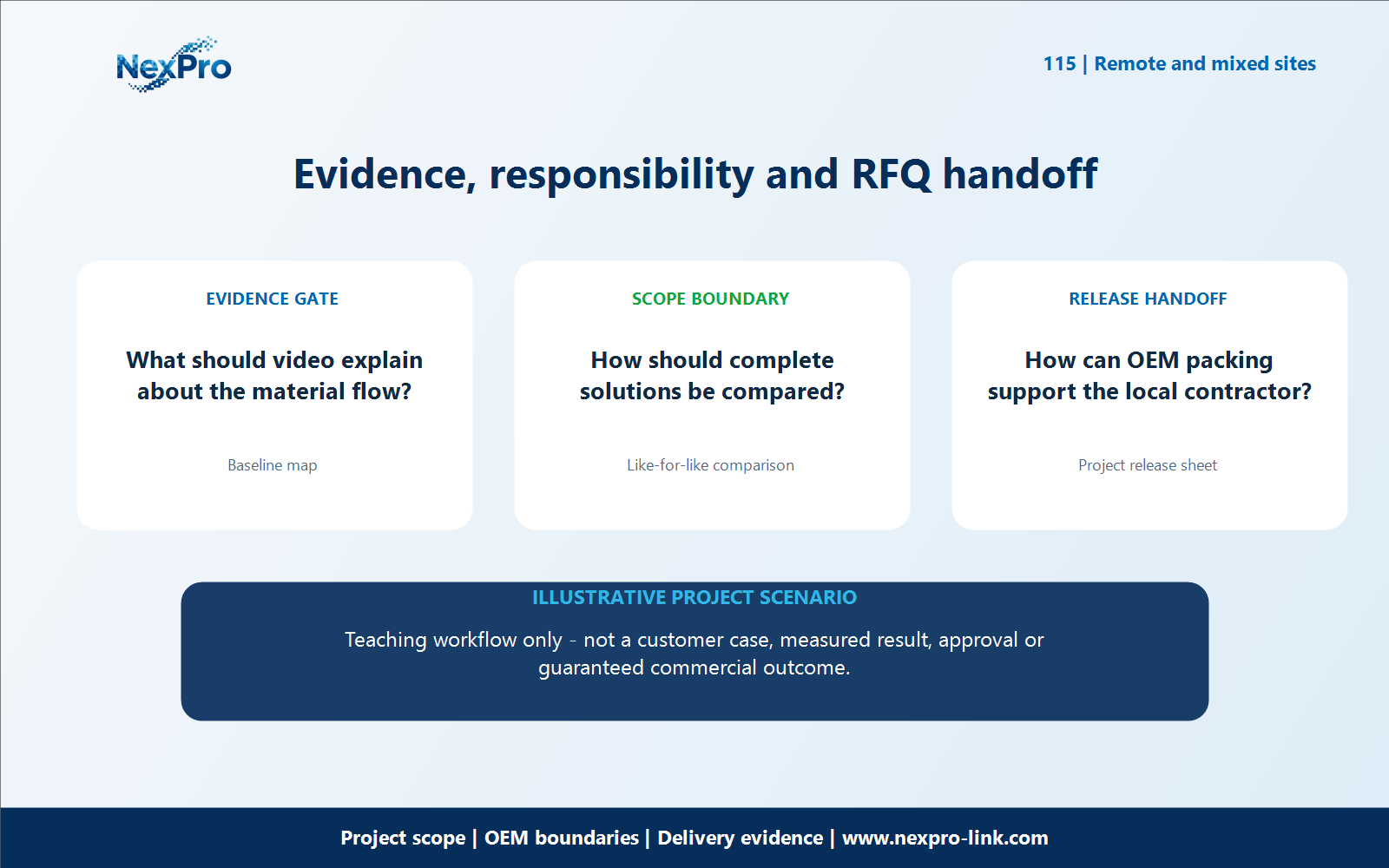
What should video explain about the material flow?
A farm cooperative is building a packhouse with receiving lanes, packing stations and an outdoor loading area. Use video to support the agreed review of material handoffs and movements. It is not automatically a counting, grading or quality-inspection system. Defining the security task avoids buying or promising analytics that belong to a separate production application.
For the "What should video explain about the material flow" decision, use the baseline map fields Area or item, Required task, Current assumption, Decision owner. Apply it to farm packhouse CCTV project so the buyer, supplier and local integrator can see which input is confirmed, who owns it and which evidence remains open.
Evaluate what should video explain about the material flow against the stated site task and the surrounding equipment, documentation, packing and handover dependencies for farm packhouse CCTV project. For what should video explain about the material flow in farm packhouse CCTV project, record the confirmed condition, chosen option and remaining evidence separately; an open value is not a price, test, approval or customer-result claim.
Carry the what should video explain about the material flow decision into the RFQ, BOQ, configuration or release record for farm packhouse CCTV project. For what should video explain about the material flow in farm packhouse CCTV project, name the equipment, artwork, network, installation and acceptance owner; site-specific work remains with the buyer or integrator unless the signed scope says otherwise.
Section 02
How should wet and dusty areas differ from offices?
How should wet and dusty areas differ from offices? Separate environmental conditions by zone rather than applying one camera specification to the whole site. Cleaning methods and temperature transitions can matter alongside dust or water exposure. Keep special-area requirements explicit instead of inferring suitability from a single ingress label. For Farm Packhouse CCTV: Receiving, Packing, Loading and Shared Yard Areas, keep this decision tied to the same project brief rather than opening a separate generic specification exercise.
For the "How should wet and dusty areas differ from offices" decision, use the option comparison fields Position or option, Suitable condition, Trade-off, Next choice. Apply it to farm packhouse CCTV project so the buyer, supplier and local integrator can see which input is confirmed, who owns it and which evidence remains open.
Evaluate how should wet and dusty areas differ from offices against the stated site task and the surrounding equipment, documentation, packing and handover dependencies for farm packhouse CCTV project. For how should wet and dusty areas differ from offices in farm packhouse CCTV project, record the confirmed condition, chosen option and remaining evidence separately; an open value is not a price, test, approval or customer-result claim.
Carry the how should wet and dusty areas differ from offices decision into the RFQ, BOQ, configuration or release record for farm packhouse CCTV project. For how should wet and dusty areas differ from offices in farm packhouse CCTV project, name the equipment, artwork, network, installation and acceptance owner; site-specific work remains with the buyer or integrator unless the signed scope says otherwise.
Section 03
Where can fixed and motorized lenses be mixed?
Where can fixed and motorized lenses be mixed? Use fixed views where the task and geometry are stable, and consider an adjustable lens where framing needs justify it. The decision should follow each position. A mixed schedule can be economical without lowering the detail required at the important loading and handover points. For Farm Packhouse CCTV: Receiving, Packing, Loading and Shared Yard Areas, keep this decision tied to the same project brief rather than opening a separate generic specification exercise.
For the "Where can fixed and motorized lenses be mixed" decision, use the interface map fields Device or record, Input, Output, Responsible party. Apply it to farm packhouse CCTV project so the buyer, supplier and local integrator can see which input is confirmed, who owns it and which evidence remains open.
Evaluate where can fixed and motorized lenses be mixed against the stated site task and the surrounding equipment, documentation, packing and handover dependencies for farm packhouse CCTV project. For where can fixed and motorized lenses be mixed in farm packhouse CCTV project, record the confirmed condition, chosen option and remaining evidence separately; an open value is not a price, test, approval or customer-result claim.
Carry the where can fixed and motorized lenses be mixed decision into the RFQ, BOQ, configuration or release record for farm packhouse CCTV project. For where can fixed and motorized lenses be mixed in farm packhouse CCTV project, name the equipment, artwork, network, installation and acceptance owner; site-specific work remains with the buyer or integrator unless the signed scope says otherwise.
| Project question | Project-oriented treatment | Keep equal when comparing offers |
|---|---|---|
| What should video explain about the material flow? | Use video to support the agreed review of material handoffs and movements. | Site-specific task and environmental boundary |
| How should wet and dusty areas differ from offices? | Separate environmental conditions by zone rather than applying one camera specification to the whole site. | Remote infrastructure and power scope |
| Where can fixed and motorized lenses be mixed? | Use fixed views where the task and geometry are stable, and consider an adjustable lens where framing needs justify it. | Local versus remote operating outcome |
| What infrastructure links the yard and packhouse? | Plan the indoor access network and the yard connection together. | Complete project and maintenance arrangement |
Section 04
What infrastructure links the yard and packhouse?
What infrastructure links the yard and packhouse? Plan the indoor access network and the yard connection together. Include the power and environmental arrangements for remote equipment. The full recording path, not just the central NVR, determines which views remain available during a power or link interruption. For Farm Packhouse CCTV: Receiving, Packing, Loading and Shared Yard Areas, keep this decision tied to the same project brief rather than opening a separate generic specification exercise.
For the "What infrastructure links the yard and packhouse" decision, use the scope and dependency table fields Item, Included, Dependency, Separate option. Apply it to farm packhouse CCTV project so the buyer, supplier and local integrator can see which input is confirmed, who owns it and which evidence remains open.
Evaluate what infrastructure links the yard and packhouse against the stated site task and the surrounding equipment, documentation, packing and handover dependencies for farm packhouse CCTV project. For what infrastructure links the yard and packhouse in farm packhouse CCTV project, record the confirmed condition, chosen option and remaining evidence separately; an open value is not a price, test, approval or customer-result claim.
Carry the what infrastructure links the yard and packhouse decision into the RFQ, BOQ, configuration or release record for farm packhouse CCTV project. For what infrastructure links the yard and packhouse in farm packhouse CCTV project, name the equipment, artwork, network, installation and acceptance owner; site-specific work remains with the buyer or integrator unless the signed scope says otherwise.
Section 05
How should complete solutions be compared?
How should complete solutions be compared? Compare the same handling tasks and operating periods across proposals. Calculate storage from the stated streams and retention requirement rather than assigning a standard agricultural retention period. Include the installation and maintenance scope needed for both indoor and yard devices. For Farm Packhouse CCTV: Receiving, Packing, Loading and Shared Yard Areas, keep this decision tied to the same project brief rather than opening a separate generic specification exercise.
For the "How should complete solutions be compared" decision, use the like-for-like comparison fields Requirement, Baseline, Proposed treatment, Remaining difference. Apply it to farm packhouse CCTV project so the buyer, supplier and local integrator can see which input is confirmed, who owns it and which evidence remains open.
Evaluate how should complete solutions be compared against the stated site task and the surrounding equipment, documentation, packing and handover dependencies for farm packhouse CCTV project. For how should complete solutions be compared in farm packhouse CCTV project, record the confirmed condition, chosen option and remaining evidence separately; an open value is not a price, test, approval or customer-result claim.
Carry the how should complete solutions be compared decision into the RFQ, BOQ, configuration or release record for farm packhouse CCTV project. For how should complete solutions be compared in farm packhouse CCTV project, name the equipment, artwork, network, installation and acceptance owner; site-specific work remains with the buyer or integrator unless the signed scope says otherwise.
Section 06
How can OEM packing support the local contractor?
How can OEM packing support the local contractor? Pack equipment by receiving, packing and loading zones, with the relevant accessories and optional local-language operating inserts. Contractor logos can identify the delivered package. Keep application identity and model records accurate so local support can distinguish branding from technical configuration. For Farm Packhouse CCTV: Receiving, Packing, Loading and Shared Yard Areas, keep this decision tied to the same project brief rather than opening a separate generic specification exercise.
For the "How can OEM packing support the local contractor" decision, use the project release sheet fields Configuration, Artwork, Quantity, Location, Release stage. Apply it to farm packhouse CCTV project so the buyer, supplier and local integrator can see which input is confirmed, who owns it and which evidence remains open.
Evaluate how can oem packing support the local contractor against the stated site task and the surrounding equipment, documentation, packing and handover dependencies for farm packhouse CCTV project. For how can oem packing support the local contractor in farm packhouse CCTV project, record the confirmed condition, chosen option and remaining evidence separately; an open value is not a price, test, approval or customer-result claim.
Carry the how can oem packing support the local contractor decision into the RFQ, BOQ, configuration or release record for farm packhouse CCTV project. For how can oem packing support the local contractor in farm packhouse CCTV project, name the equipment, artwork, network, installation and acceptance owner; site-specific work remains with the buyer or integrator unless the signed scope says otherwise.
Engineering references
These sources support the general planning principles. Always use the selected product's current datasheet and applicable project standards for final design.