A contractor supplies compact security packages to a network of small service kiosks with limited cabinet space. Define the actual entrance and counter tasks before choosing the smallest package.
Section 01
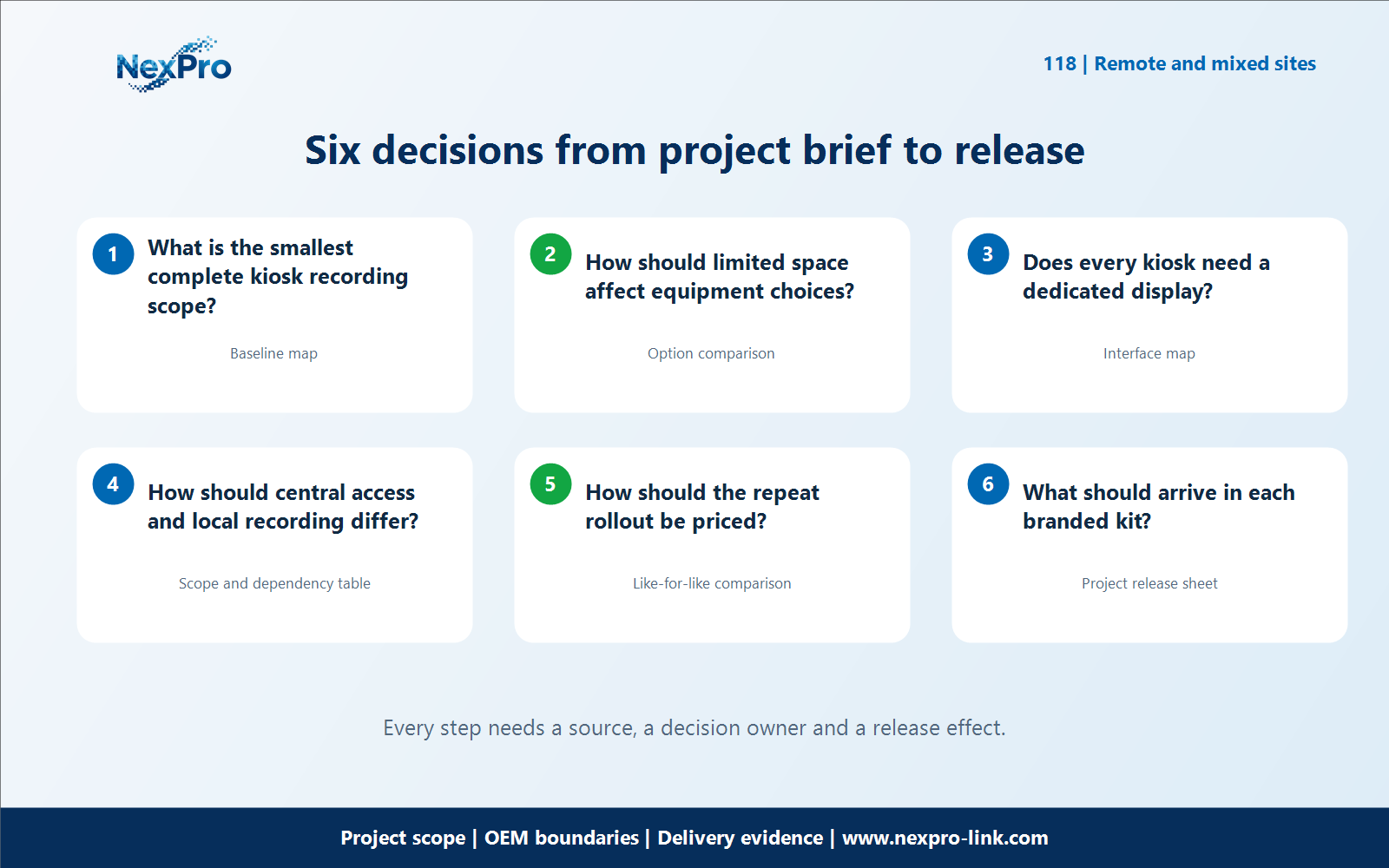
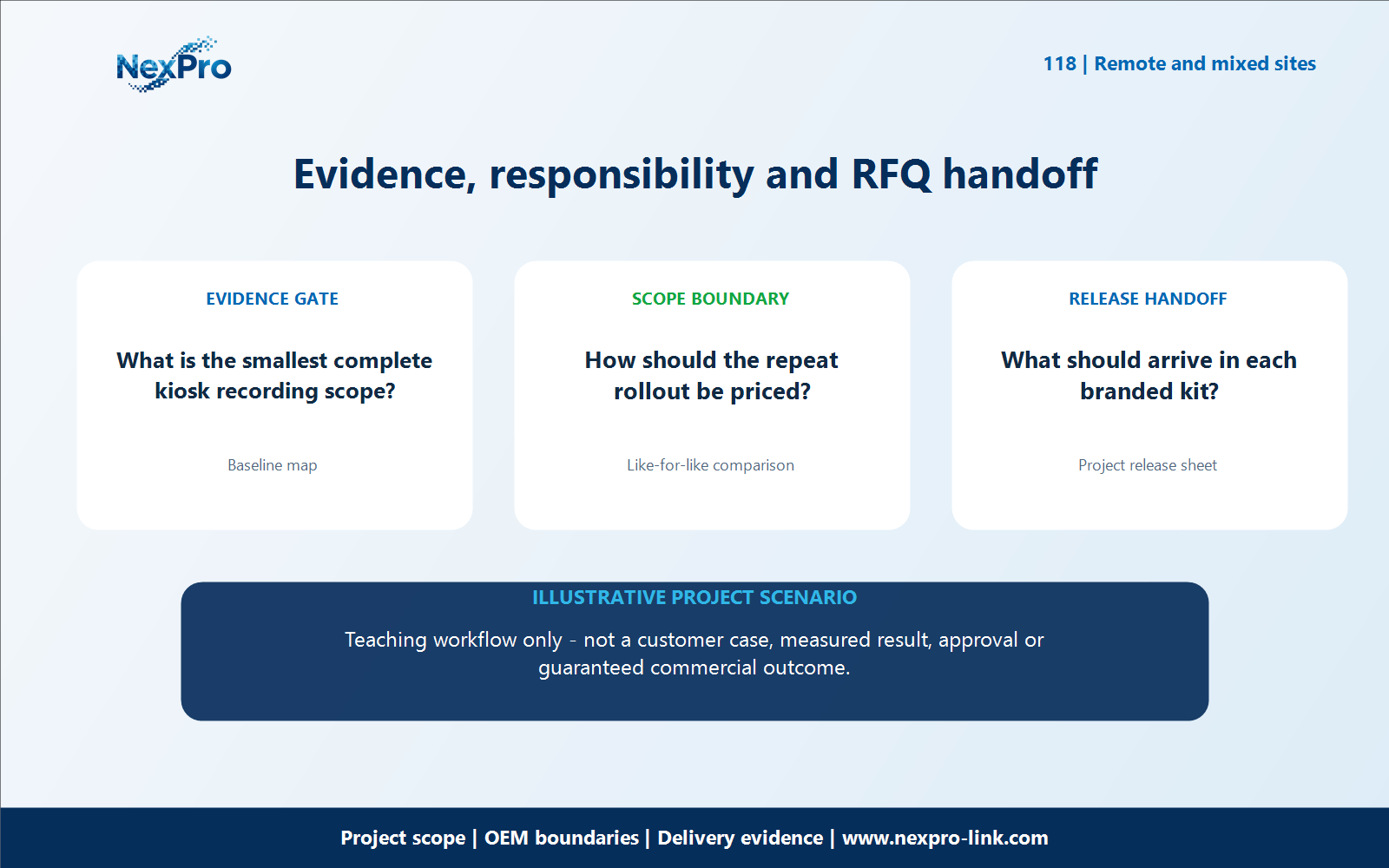
What is the smallest complete kiosk recording scope?
A contractor supplies compact security packages to a network of small service kiosks with limited cabinet space. Define the actual entrance and counter tasks before choosing the smallest package. A complete scope still includes recording media, network power and the required connections. Small size is not a reason to quote only cameras and leave the kiosk operator to assemble the rest.
For the "What is the smallest complete kiosk recording scope" decision, use the baseline map fields Area or item, Required task, Current assumption, Decision owner. Apply it to kiosk branch compact CCTV so the buyer, supplier and local integrator can see which input is confirmed, who owns it and which evidence remains open.
Evaluate what is the smallest complete kiosk recording scope against the stated site task and the surrounding equipment, documentation, packing and handover dependencies for kiosk branch compact CCTV. For what is the smallest complete kiosk recording scope in kiosk branch compact CCTV, record the confirmed condition, chosen option and remaining evidence separately; an open value is not a price, test, approval or customer-result claim.
Carry the what is the smallest complete kiosk recording scope decision into the RFQ, BOQ, configuration or release record for kiosk branch compact CCTV. For what is the smallest complete kiosk recording scope in kiosk branch compact CCTV, name the equipment, artwork, network, installation and acceptance owner; site-specific work remains with the buyer or integrator unless the signed scope says otherwise.
Section 02
How should limited space affect equipment choices?
How should limited space affect equipment choices? Allow for the equipment dimensions, ventilation and service access, not just the footprint of the recorder. Keep cable connections reachable. A compact kit should be maintainable in the kiosk rather than tightly packed into a space where routine work requires dismantling everything. For Small Kiosk Networks: Compact CCTV Packages for Repeat Project Rollouts, keep this decision tied to the same project brief rather than opening a separate generic specification exercise.
For the "How should limited space affect equipment choices" decision, use the option comparison fields Position or option, Suitable condition, Trade-off, Next choice. Apply it to kiosk branch compact CCTV so the buyer, supplier and local integrator can see which input is confirmed, who owns it and which evidence remains open.
Evaluate how should limited space affect equipment choices against the stated site task and the surrounding equipment, documentation, packing and handover dependencies for kiosk branch compact CCTV. For how should limited space affect equipment choices in kiosk branch compact CCTV, record the confirmed condition, chosen option and remaining evidence separately; an open value is not a price, test, approval or customer-result claim.
Carry the how should limited space affect equipment choices decision into the RFQ, BOQ, configuration or release record for kiosk branch compact CCTV. For how should limited space affect equipment choices in kiosk branch compact CCTV, name the equipment, artwork, network, installation and acceptance owner; site-specific work remains with the buyer or integrator unless the signed scope says otherwise.
Section 03
Does every kiosk need a dedicated display?
Does every kiosk need a dedicated display? A permanent display is optional if the agreed operating workflow does not require one. Separate routine local viewing from occasional service access and central review. The proposal should describe how those tasks are performed instead of automatically adding a screen to every kiosk. For Small Kiosk Networks: Compact CCTV Packages for Repeat Project Rollouts, keep this decision tied to the same project brief rather than opening a separate generic specification exercise.
For the "Does every kiosk need a dedicated display" decision, use the interface map fields Device or record, Input, Output, Responsible party. Apply it to kiosk branch compact CCTV so the buyer, supplier and local integrator can see which input is confirmed, who owns it and which evidence remains open.
Evaluate does every kiosk need a dedicated display against the stated site task and the surrounding equipment, documentation, packing and handover dependencies for kiosk branch compact CCTV. For does every kiosk need a dedicated display in kiosk branch compact CCTV, record the confirmed condition, chosen option and remaining evidence separately; an open value is not a price, test, approval or customer-result claim.
Carry the does every kiosk need a dedicated display decision into the RFQ, BOQ, configuration or release record for kiosk branch compact CCTV. For does every kiosk need a dedicated display in kiosk branch compact CCTV, name the equipment, artwork, network, installation and acceptance owner; site-specific work remains with the buyer or integrator unless the signed scope says otherwise.
| Project question | Project-oriented treatment | Keep equal when comparing offers |
|---|---|---|
| What is the smallest complete kiosk recording scope? | Define the actual entrance and counter tasks before choosing the smallest package. | Site-specific task and environmental boundary |
| How should limited space affect equipment choices? | Allow for the equipment dimensions, ventilation and service access, not just the footprint of the recorder. | Remote infrastructure and power scope |
| Does every kiosk need a dedicated display? | A permanent display is optional if the agreed operating workflow does not require one. | Local versus remote operating outcome |
| How should central access and local recording differ? | Specify what central users must view and how many sites they manage. | Complete project and maintenance arrangement |
Section 04
How should central access and local recording differ?
How should central access and local recording differ? Specify what central users must view and how many sites they manage. Treat that as separate from local recording. An internet interruption may affect remote access differently, so the package should explain the selected system's behavior rather than promise all functions remain available. For Small Kiosk Networks: Compact CCTV Packages for Repeat Project Rollouts, keep this decision tied to the same project brief rather than opening a separate generic specification exercise.
For the "How should central access and local recording differ" decision, use the scope and dependency table fields Item, Included, Dependency, Separate option. Apply it to kiosk branch compact CCTV so the buyer, supplier and local integrator can see which input is confirmed, who owns it and which evidence remains open.
Evaluate how should central access and local recording differ against the stated site task and the surrounding equipment, documentation, packing and handover dependencies for kiosk branch compact CCTV. For how should central access and local recording differ in kiosk branch compact CCTV, record the confirmed condition, chosen option and remaining evidence separately; an open value is not a price, test, approval or customer-result claim.
Carry the how should central access and local recording differ decision into the RFQ, BOQ, configuration or release record for kiosk branch compact CCTV. For how should central access and local recording differ in kiosk branch compact CCTV, name the equipment, artwork, network, installation and acceptance owner; site-specific work remains with the buyer or integrator unless the signed scope says otherwise.
Section 05
How should the repeat rollout be priced?
How should the repeat rollout be priced? Separate first-site setup work, per-site equipment and recurring services. Compare those categories consistently across brand options. The cost of one pilot does not always represent the unit cost of a repeat rollout, especially when artwork or site configuration work is included. For Small Kiosk Networks: Compact CCTV Packages for Repeat Project Rollouts, keep this decision tied to the same project brief rather than opening a separate generic specification exercise.
For the "How should the repeat rollout be priced" decision, use the like-for-like comparison fields Requirement, Baseline, Proposed treatment, Remaining difference. Apply it to kiosk branch compact CCTV so the buyer, supplier and local integrator can see which input is confirmed, who owns it and which evidence remains open.
Evaluate how should the repeat rollout be priced against the stated site task and the surrounding equipment, documentation, packing and handover dependencies for kiosk branch compact CCTV. For how should the repeat rollout be priced in kiosk branch compact CCTV, record the confirmed condition, chosen option and remaining evidence separately; an open value is not a price, test, approval or customer-result claim.
Carry the how should the repeat rollout be priced decision into the RFQ, BOQ, configuration or release record for kiosk branch compact CCTV. For how should the repeat rollout be priced in kiosk branch compact CCTV, name the equipment, artwork, network, installation and acceptance owner; site-specific work remains with the buyer or integrator unless the signed scope says otherwise.
Section 06
What should arrive in each branded kit?
What should arrive in each branded kit? Pack the approved devices and accessories with a site reference and concise installation card. Optional logo and packaging customization can make the contractor package recognizable. Keep credentials out of general inserts and avoid using one shared account pattern across all sites. For Small Kiosk Networks: Compact CCTV Packages for Repeat Project Rollouts, keep this decision tied to the same project brief rather than opening a separate generic specification exercise.
For the "What should arrive in each branded kit" decision, use the project release sheet fields Configuration, Artwork, Quantity, Location, Release stage. Apply it to kiosk branch compact CCTV so the buyer, supplier and local integrator can see which input is confirmed, who owns it and which evidence remains open.
Evaluate what should arrive in each branded kit against the stated site task and the surrounding equipment, documentation, packing and handover dependencies for kiosk branch compact CCTV. For what should arrive in each branded kit in kiosk branch compact CCTV, record the confirmed condition, chosen option and remaining evidence separately; an open value is not a price, test, approval or customer-result claim.
Carry the what should arrive in each branded kit decision into the RFQ, BOQ, configuration or release record for kiosk branch compact CCTV. For what should arrive in each branded kit in kiosk branch compact CCTV, name the equipment, artwork, network, installation and acceptance owner; site-specific work remains with the buyer or integrator unless the signed scope says otherwise.
Engineering references
These sources support the general planning principles. Always use the selected product's current datasheet and applicable project standards for final design.