
Record each evaluated adjustment beside the bidder's original quantity, price and written clarification. Separate confirmed corrections from evaluator allowances.
Section 01
Rebuild one comparison scope before ranking prices
Record each evaluated adjustment beside the bidder's original quantity, price and written clarification. Separate confirmed corrections from evaluator allowances. Before order release, reconcile accepted adjustments with the actual supply obligation. An evaluation total used for ranking does not itself establish that the bidder agreed to deliver an omitted item.
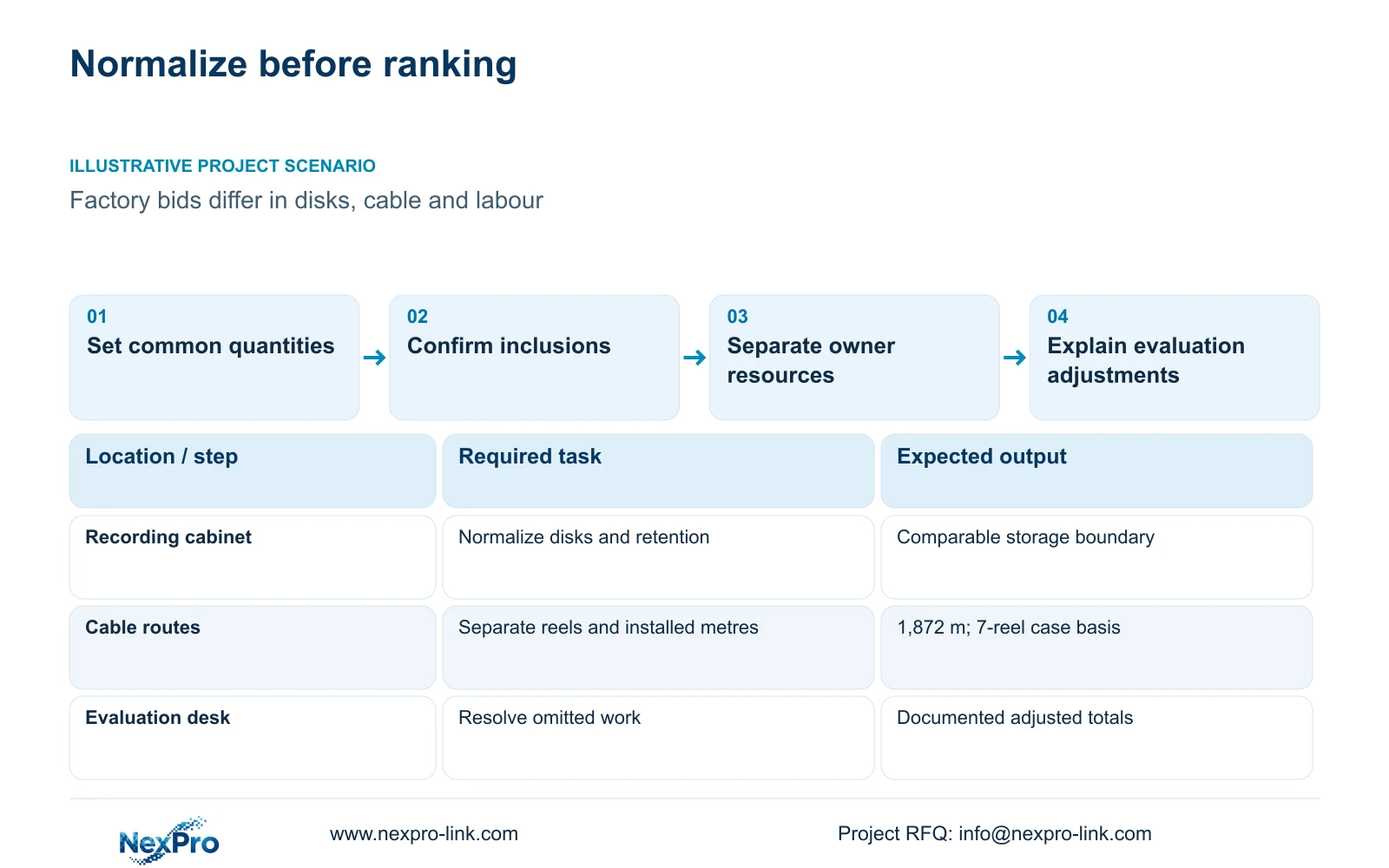
Quantity surveyors should compare factory security bids on a common operating and delivery scope before calculating a saving. Normalize units, quantities, inclusions and installation responsibilities while retaining every bidder's original references. An absent line is a clarification need. It should not be entered as zero cost unless the required item is demonstrably included elsewhere or supplied under an agreed separate boundary.
Illustrative project scenario: Several tenders differ in HDDs, cable, configuration and onsite labour. Use the supplied CNC reference as an evaluation baseline for 32 ordinary-area cameras with local recording, a 30-day planning target and a retrieval display. Assume the bids refer to that same task, but do not treat the reference as a completed installation or the fictional cost example as actual bidder pricing.
Start with the tender BOQ and a baseline model schedule. Keep equipment each-counts, installed cable metres, purchased reels and defined system sets distinct. Add an inclusion column for mounting accessories, configuration, testing and handover. Two offers can quote the same camera quantity while leaving very different amounts of necessary work outside their totals.
Section 02
Separate owner resources from bidder omissions
An owner-provided network, cabinet or workstation can reduce a bidder's supply scope legitimately. Record the exact resource, available capacity, access permission and responsible party. Apply the same assumption to every evaluated offer. A bidder who expects an owner workstation should not be compared directly with one supplying a workstation unless the evaluation restores a common boundary.
Owner-provided equipment may still require site work. Disk fitting, network configuration, account setup or mounting can remain with a contractor even when the hardware belongs to the buyer. Identify who performs and prices that work. Retained assets also need the relevant condition and compatibility checks before procurement treats them as available resources.
The CASE01 baseline is new supply, not a retrofit with approved retained links. Its 32 new cable routes cannot be reduced on an assumption that existing cable will pass testing. If a real project has retained resources, create a separate accepted-retention schedule. Keep the owner allocation visible so missing goods and legitimately excluded goods do not share the same status.
Section 03
Explain differences through the resource that changes
Compare storage as a recording outcome and disk configuration, not merely as a drive count. CASE01 assumes 32 cameras at 4 Mbps continuously for 30 days: video_TB = 32 × 4 × 10^6 × 86400 × 30 / 8 / 10^12 = 41.472 TB. Its four 16 TB disks provide an illustrative budget of 64 × 0.95 × 0.80 = 48.64 TB. The reserve is already applied.
The NexPro-NVR4449-4K lists four SATA bays and 320 Mbps input, with recording modes distinguished in its summary. Evaluate the offered stream arrangement, disks and retrieval requirements separately. A larger channel label does not prove equivalent decoding or RAID. If one bid includes disk fault tolerance and another does not, resolve whether that function is required before normalizing the price.
Cable and labour differences need similar explanation. The reference's 1,872 m uses a feasible seven-reel cutting plan, while installation includes route access, containment, termination and testing as allocated. Configuration should identify the actual tasks performed. A price variance described only as a supplier discount hides whether the offered work has changed.
Section 04
Keep quoted totals and evaluation totals side by side
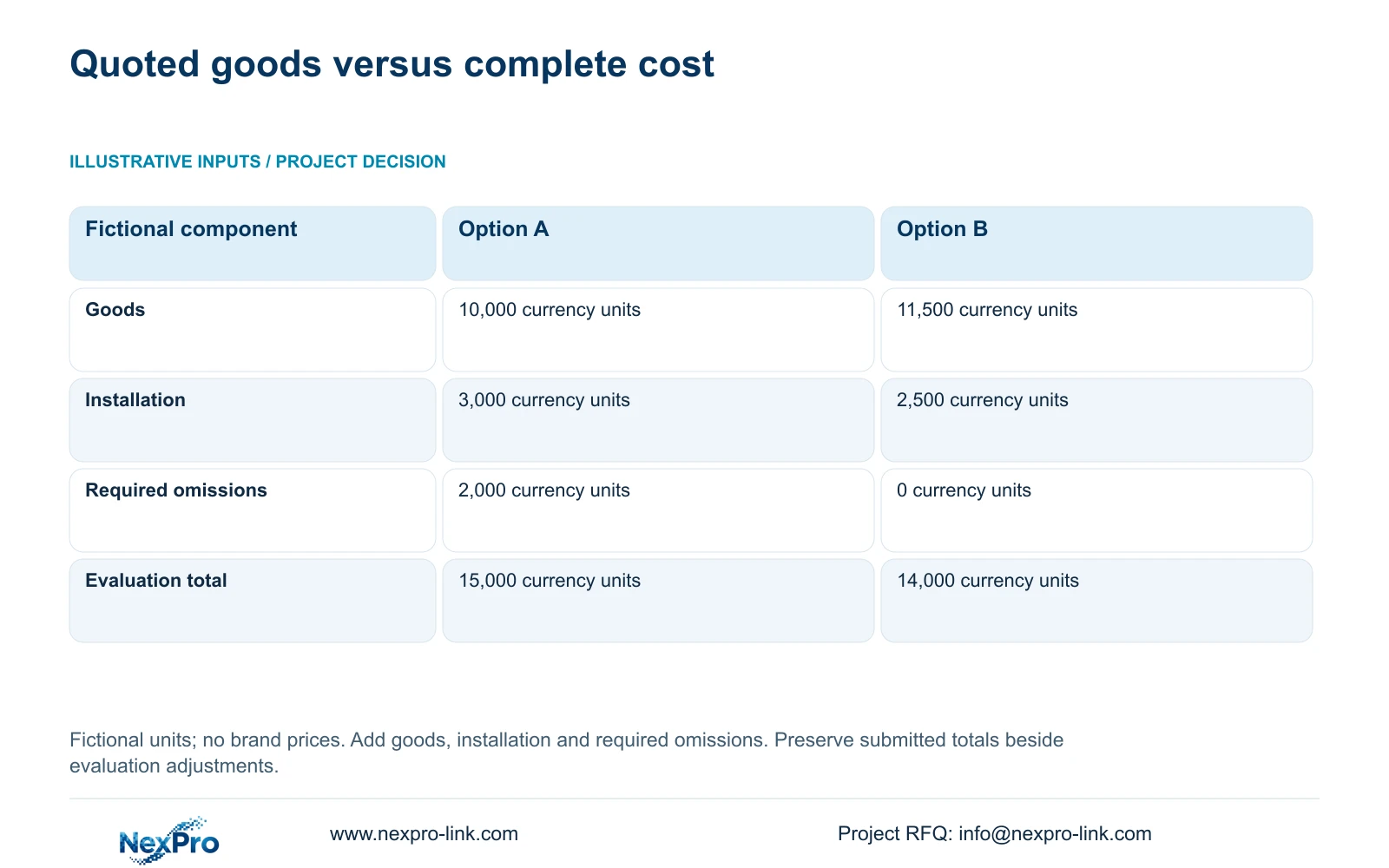
The supplied example uses fictional currency units with no brand attribution. Option A quotes goods at 10,000 and installation at 3,000, while 2,000 of required scope is omitted. Option B quotes goods at 11,500 and installation at 2,500, with required omitted scope of zero. The comparison is a method example independent of the CNC equipment quantities.
Calculate normalized_total = goods + installation + required_omitted_items. A_total = 10,000 + 3,000 + 2,000 = 15,000 currency units. B_total = 11,500 + 2,500 + 0 = 14,000 currency units. Difference = A_total - B_total = 1,000 currency units. A's goods figure is lower by 1,500, but its complete evaluation total is higher by 1,000.
The decisive difference is the combination of installation and required omitted scope. In a live evaluation, use an evidenced clarification or allowance rather than inventing an amount for a blank line. Preserve the bidder's submitted total and show evaluation adjustments separately. Replace all example inputs with same-date, same-quantity, same-currency and same-delivery-scope quotations.
| Evaluation component | Option A | Option B |
|---|---|---|
| Goods | 10,000 currency units | 11,500 currency units |
| Installation | 3,000 currency units | 2,500 currency units |
| Required omitted scope | 2,000 currency units | 0 currency units |
| Normalized total | 15,000 currency units | 14,000 currency units |
Section 05
Rank eligible offers with their unresolved conditions visible
Complete the technical eligibility review before recommending the lowest normalized total. Mandatory brand, interface and specialist-environment conditions remain controlling project inputs. A technically incomplete offer should not be presented as an equivalent low-cost option merely because the worksheet contains a plausible allowance for missing goods.
Then show the owner the principal cost drivers: equipment quantities, storage arrangement, network and protected-power resources, configuration, local labour and optional additions. Keep the optional LCD wall outside the required total unless the viewing task makes it mandatory. This preserves a clear choice without comparing a recording-only package against an expanded control-room arrangement.
If key clarifications are still open, issue a conditional comparison rather than a definitive saving. State which item could change the ranking and who must resolve it. NexPro-Link and other bidders should be evaluated under the same baseline; no matched market price or brand-wide economic advantage is established by the fictional arithmetic.
Section 06
Carry the accepted comparison into the purchase schedule
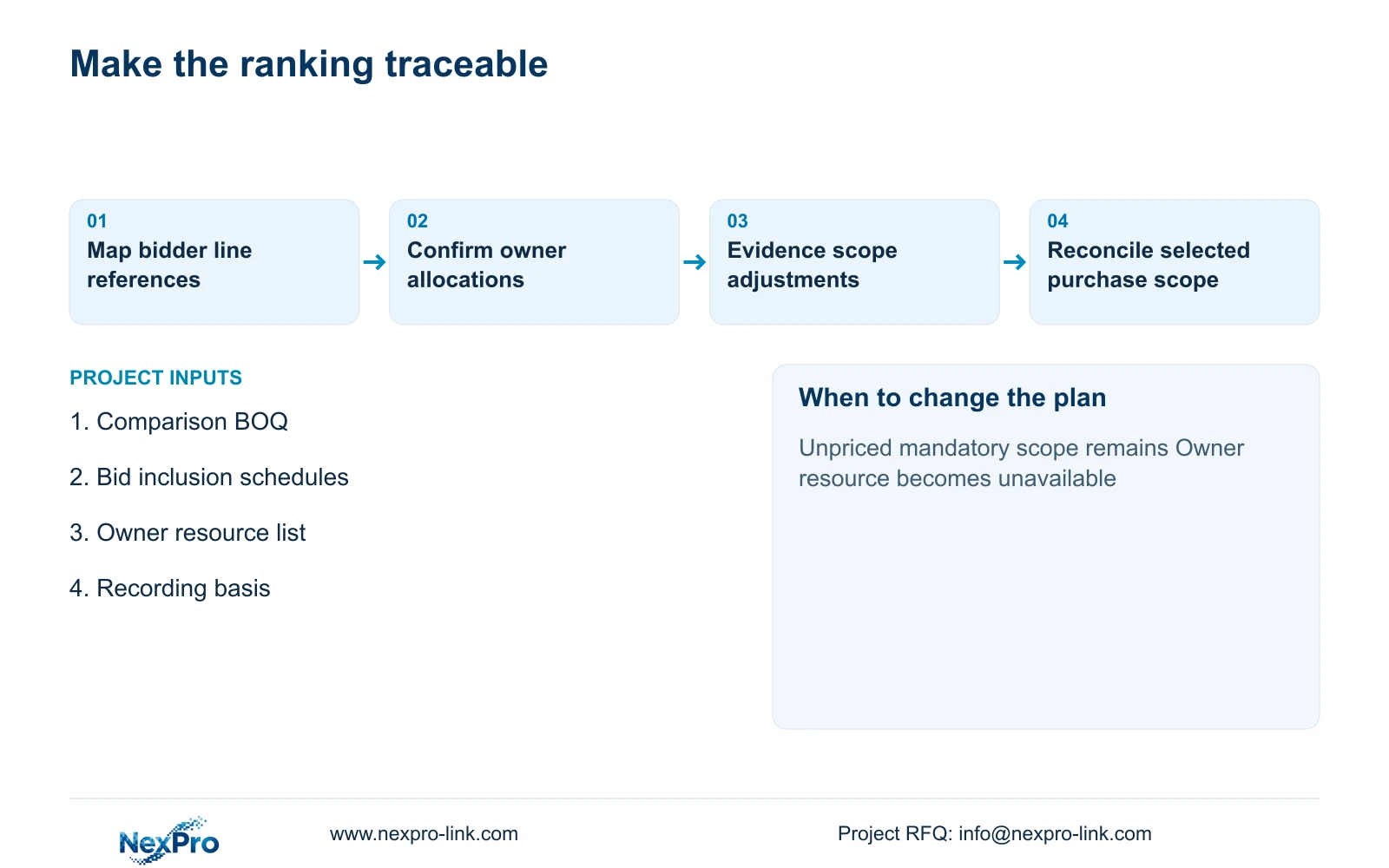
Keep an evaluation record linking the baseline line, bidder reference, inclusion response, adjustment basis and selected scope. Attach the short clarification correspondence that supports each adjustment. The accepted offer should identify the final model and quantity revision, not merely refer to a worksheet total that mixes submitted prices with provisional assumptions.
NexPro-Link's BOQ & Tender Support scope is relevant to mapped quotations, model differences and technical clarifications. Its project-supply scope can support preparation and packing of the accepted equipment package. Local installation, owner infrastructure and specialist integration should retain their named responsibility and commercial boundary.
Before order release, reconcile supplied components and site work with the selected evaluation option. Remove rejected enhancements, restore any required exclusions and confirm that owner-provided resources remain available. Supplier registration, product approval and purchase authorisation each need their own record. The bid comparison supports the commercial decision by making the subject of that decision precise.
Section 07
Buyer questions
How should a bidder's blank price line be treated? Ask whether it is included elsewhere, excluded or awaiting information. Keep it unresolved until the bidder responds or the evaluator records a justified allowance; do not silently assign zero.
Can different installation methods be compared? Yes, after engineering confirms both methods meet the task. Normalize their complete materials, access work, testing and handover scope rather than forcing identical component lists.
Should options be included in the headline bid total? Use the same required option for every evaluated bid. Show discretionary additions separately so the owner can see their cost without changing the core comparison.
Section 08
Build a common factory security bid comparison
Send the comparison BOQ, bidders' inclusion and exclusion schedules, owner-supplied resource list and required recording basis to info@nexpro-link.com for a scope-mapped quotation and targeted clarifications.
Engineering references
These sources support the general planning principles. Always use the selected product's current datasheet and applicable project standards for final design.