Preserve each offer's original currency, validity and delivery boundary beside the evaluation basis. If freight or exchange inputs change, revise only affected comparison lines and show the source date.
Section 01
Compare prices at the same named delivery point
Preserve each offer's original currency, validity and delivery boundary beside the evaluation basis. If freight or exchange inputs change, revise only affected comparison lines and show the source date. Ask the relevant commercial adviser about destination obligations; do not invent current duties or convert an evaluation allowance into an agreed supplier charge.
A factory export quotation should be compared with another offer only after both are aligned to the same equipment quantity and delivery scope. Name the delivery location, identify destination work and record exclusions. Do not treat an origin equipment subtotal as equivalent to a delivered and installed project price.
Illustrative project scenario: A buyer compares a factory-origin price with a destination-delivered installation proposal. CASE01's hypothetical 32-camera CNC factory supplies the technical background, with one recorder, four switch groups and a local UPS candidate. Assume both bidders are asked to support the same ordinary-area recording task. The price figures used later are fictional and are not quotations for this case.
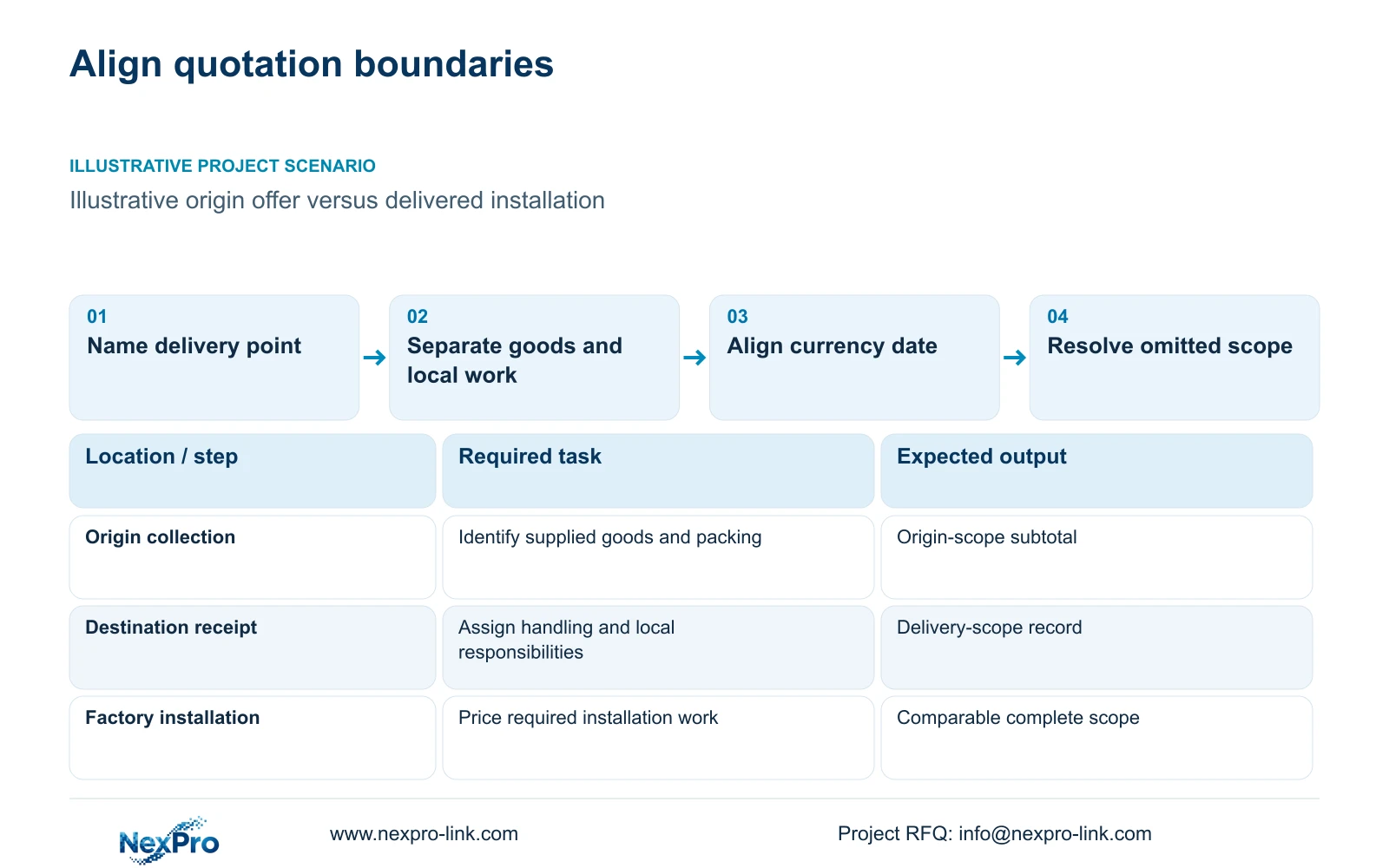
Ask each bidder to describe where its responsibility stops. An origin collection point, destination warehouse and installed equipment room are different comparison boundaries. Record any agreed trade term and named place accurately, then have the buyer's commercial team confirm the intended responsibilities. A vague 'delivery included' statement is insufficient for determining what remains to be purchased.
Section 02
Separate equipment from destination work and options
Build a common scope schedule with equipment, preparation, packing, transport, destination handling, installation and commissioning on separate lines. Mark each line as included, excluded, optional or awaiting clarification. Unknown cost is not zero. The quantity surveyor should be able to trace each normalisation adjustment to a required task and an identified provider.
In CASE01, the recording-first option and optional four-panel LCD wall should not be mixed between bids. Hold the selected option constant before evaluating price. Likewise, compare the same disk provision and camera roles. A cheaper offer that excludes required storage or assumes a different operating task needs adjustment before it can support a purchasing decision.
OEM work belongs on its own schedule. Customer artwork, packaging languages and building allocation can affect preparation, but a hardware logo does not include software changes. Keep actual model identity visible in the goods list. NexPro-Link's BOQ and tender support can help record model matches and deviations while the buyer confirms the destination-side scope.
Section 03
Use one documented currency and comparison date
Retain each original quotation currency, issue date and validity period. Choose a common comparison currency and record the conversion basis supplied or approved by the buyer's commercial team. Do not insert an assumed exchange rate or compare an expired offer with a current one without requesting confirmation.
Separate the converted tender comparison from the payment obligation. An evaluation conversion can make offers readable on one basis, while the actual order remains payable under its agreed currency and terms. Record any quoted adjustment condition rather than assuming the comparison freezes freight, exchange exposure or later delivery charges.
For taxes and duties, ask who has included them and which destination assumptions underpin the offer. Obtain current confirmation from the relevant local adviser or logistics party before assigning amounts. This article provides a procurement comparison method, not a tax determination. If a material item remains unresolved, show a provisional total and the open exposure rather than reporting a final landed cost.
Section 04
Calculate the complete scope before reporting a difference
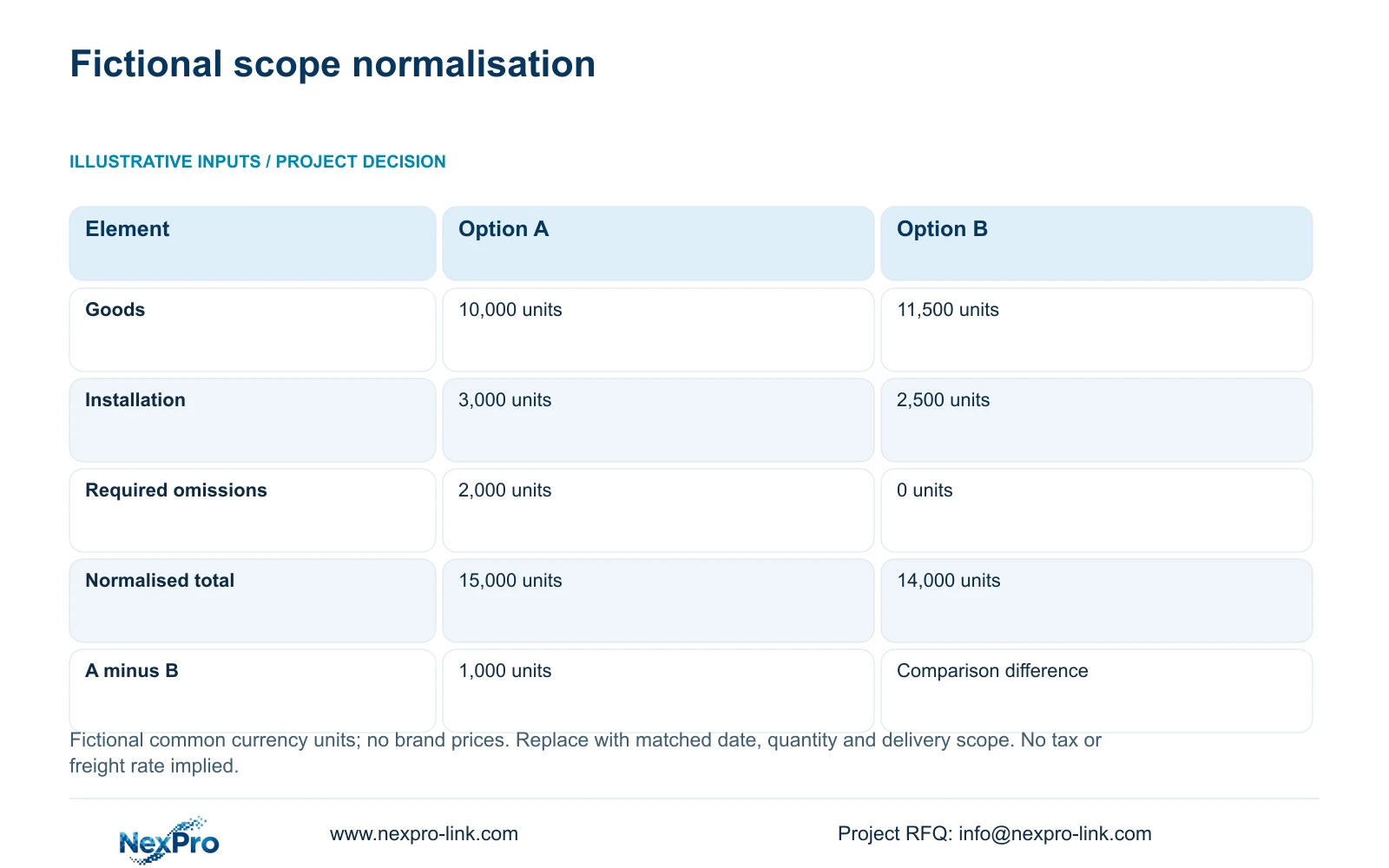
The supplied example uses purely fictional currency units and no brand prices. Option A has goods of 10,000, installation of 3,000 and required omitted scope of 2,000. Option B has goods of 11,500, installation of 2,500 and required omitted scope of 0. Apply normalized_total = goods + installation + required_omitted_items.
Option A therefore totals 10,000 + 3,000 + 2,000 = 15,000 units. Option B totals 11,500 + 2,500 + 0 = 14,000 units. Difference = A_total - B_total = 1,000 units. A starts with the lower goods quote, yet becomes the higher normalised total. The decisive change is the installation and missing required work.
The zero for B is an explicit illustration input, not a rule that a complete-looking quotation has no omissions. Replace every figure with confirmed same-date, same-quantity, same-currency and same-delivery-scope inputs. Do not infer actual freight, duty or tax treatment from the example's 2,000-unit adjustment. It demonstrates how a comparison can reverse without establishing a supplier saving.
| Cost element | Option A | Option B |
|---|---|---|
| Goods | 10,000 units | 11,500 units |
| Installation | 3,000 units | 2,500 units |
| Required omitted scope | 2,000 units | 0 units |
| Normalised total | 15,000 units | 14,000 units |
Section 05
Choose a supply arrangement the project can manage
Within the fictional matched scope, B has the lower normalised total. A real award still needs confirmation that technical requirements, delivery responsibilities and support are acceptable. Do not report the original 1,500-unit goods difference as a project saving when the completed comparison shows A costing 1,000 units more.
Direct equipment procurement can be appropriate when the buyer already has a capable local installer and a clear import and receiving arrangement. A more complete local package can be preferable when the buyer needs one provider to coordinate installation and commissioning. Compare the actual accepted scope of those arrangements instead of treating either purchasing route as universally cheaper.
Change the comparison when an owner requires a specific platform, specialist equipment or local service commitment. Retain those requirements and request a compliant alternative or a documented deviation. NexPro-Link's equipment, technical-document and packing coordination can be evaluated as explicit deliverables; it should not be described as included local construction unless that work has actually been agreed.
Section 06
Issue an RFQ with a controlled comparison schedule
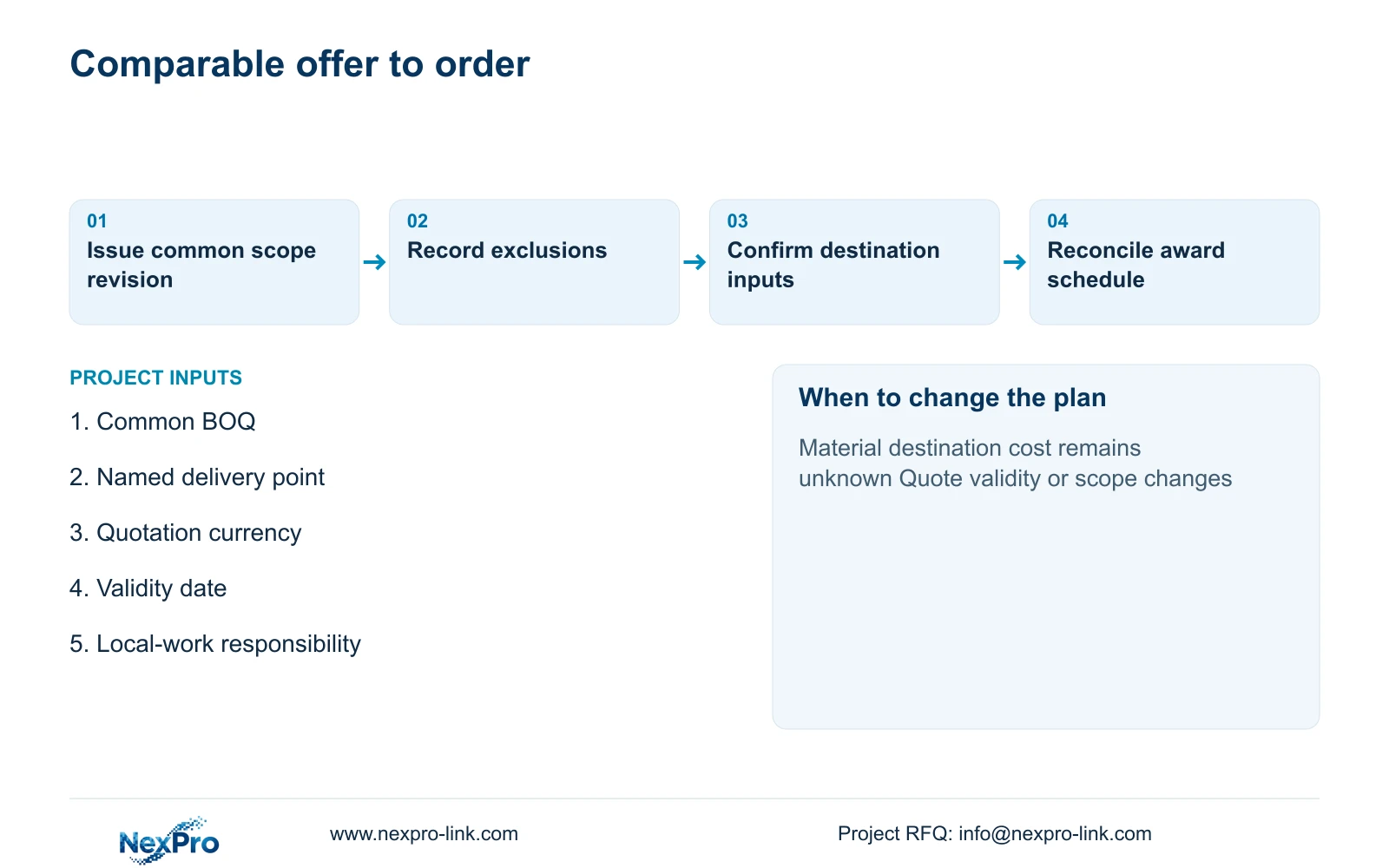
Send all bidders the same revision of the equipment and responsibility schedule. State the named delivery point, required packaging languages and allocation method, requested quotation currency and intended receipt sequence. Keep optional display or OEM items separate so a bidder cannot improve its subtotal by silently omitting an accepted requirement.
Request a line-by-line response to exclusions and unresolved destination inputs. The quotation should identify the actual goods and quantities, preparation scope and validity period. The buyer's local contractor should price physical installation against the same point schedule. Where a supply or service line is already retained, label it as retained rather than buying it twice.
Before order release, reconcile the accepted quotation with the normalisation sheet. Convert open adjustments into confirmed order scope or named buyer responsibilities. Retain the original offers and the dated comparison basis, so later changes can be evaluated against the actual award rather than against an incomplete early subtotal.
Section 07
Buyer questions
Can we compare offers before destination taxes are confirmed? You can compare confirmed scope provisionally, but show the unresolved destination exposure separately. Do not rank an incomplete total as final or assign unknown amounts a value of zero.
Should retained network equipment appear in the comparison? Yes. Identify it as retained and show any connection or configuration work that remains required. This prevents one bidder from including replacement equipment while another assumes the existing network is ready.
How should optional branding be treated? Keep the approved base package comparable and show branding as a separate option unless the owner requires it. Identify setup, marking, labels and packaging independently, with software changes outside the hardware-logo assumption.
Section 08
Build a comparable export quotation
Send your common BOQ, named delivery point, requested currency and comparison date, and destination-work responsibility schedule to info@nexpro-link.com for an equipment offer with explicit inclusions and exclusions.
Engineering references
These sources support the general planning principles. Always use the selected product's current datasheet and applicable project standards for final design.