Attach repeat-order eligibility to the pilot's exact equipment role, versions and accepted deviations. When a new order changes the retained platform or task, reopen only the affected qualification.
Section 01
Choose a permitted package before proposing substitution
Attach repeat-order eligibility to the pilot's exact equipment role, versions and accepted deviations. When a new order changes the retained platform or task, reopen only the affected qualification. Keep independent expansion approval separate from replacement-spare approval. Supplier diversification cannot silently widen the scope of a successful initial trial.
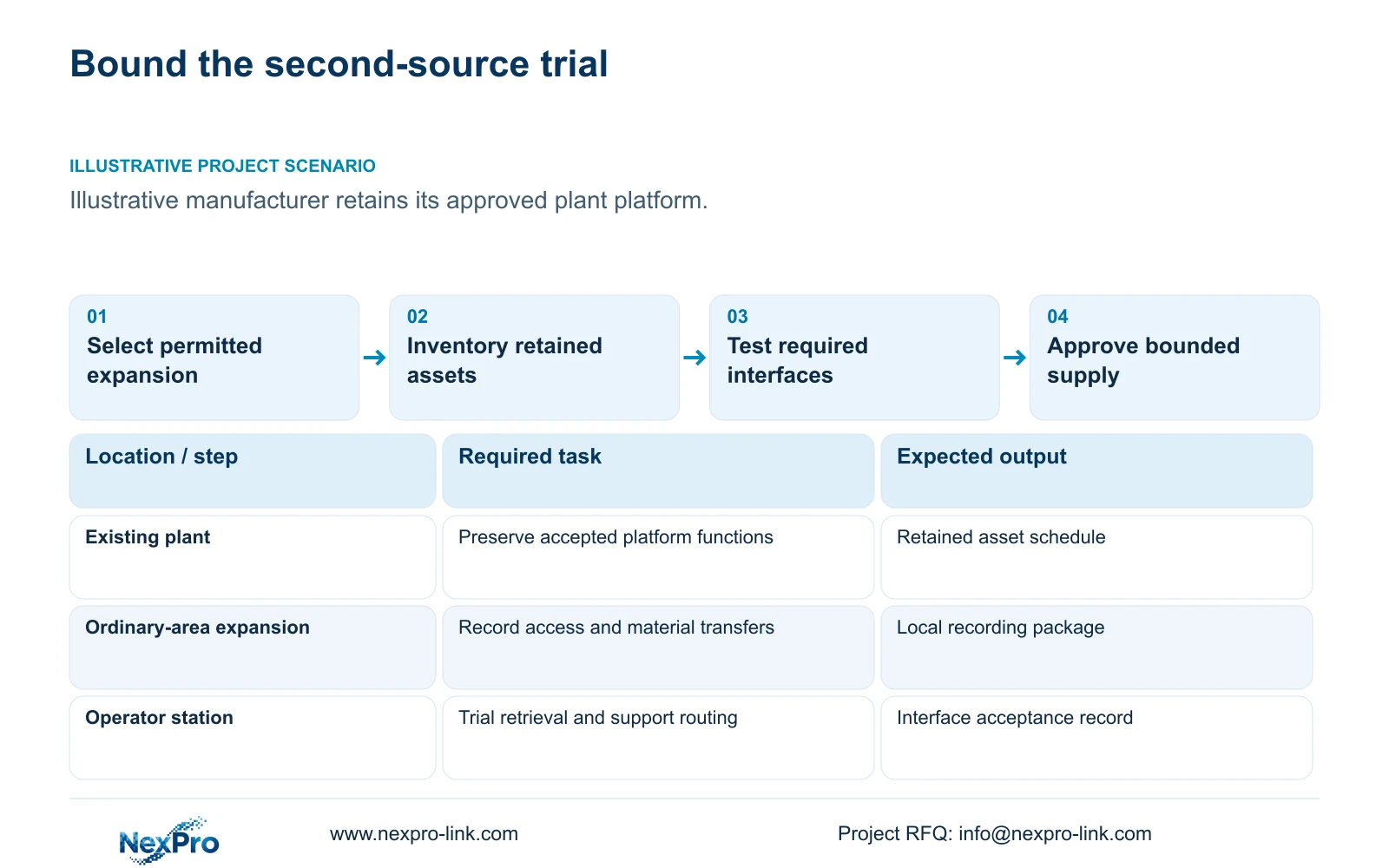
An existing Hikvision or Dahua plant should add NexPro-Link first through an approved expansion, ordinary-area package or tested compatible equipment role. Define what the second source will supply and what the installed platform must continue doing. Supply flexibility is useful only if the new boundary preserves mandatory recording, retrieval, permissions and support functions.
Illustrative project scenario: A manufacturer wants supply flexibility without replacing its whole approved platform. Assume it is considering a separate ordinary-area expansion whose planning workload follows CASE01: 32 cameras for access and material-transfer review. The existing plant platform remains in service. This proposed use of the reference case is hypothetical; its new-build quantities do not describe the manufacturer's installed assets.
Ask the owner whether a separately operated package is permitted, whether central viewing is essential and who can approve an alternative. If every new camera must participate in an established proprietary event workflow, begin with that interface requirement. If the expansion only needs local recording and authorized incident retrieval, an independent package offers a clearer qualification boundary and avoids unnecessary changes to the operating plant.
Section 02
Preserve assets through an evidence-based reuse schedule
Inventory the installed cameras, recorders, switches, displays and protected-power circuits by exact model, firmware and location. Add the tasks each asset currently supports, including playback, export and account control. Mark equipment as retained only after its condition, capacity and proposed role have been reviewed. An available port or an apparently working camera does not establish spare capacity for the expansion.
Separate reuse decisions by interface. A display may remain useful while its decoder needs a qualified new input path. An owner-managed network may carry approved viewing traffic while the expansion records locally. Existing power protection can be retained only if its actual connected loads and backup objective accommodate the addition. Trace data connections and electrical supply separately so a shared network diagram does not imply shared battery protection.
For any camera alternative, compare the required view and accepted stream rather than megapixels alone. The NexPro-BL2812M55-5MP-DIC-AI lists 2880×1620 in its 5MP-family output fields and a 2.8–12mm motorized lens. Use those listed fields in the schedule without substituting a different resolution. Existing cabling also needs its own acceptance evidence; CASE01 assumes all-new links and supplies no proof that this plant's old links can be retained.
Section 03
Test the workflow and the support handoff
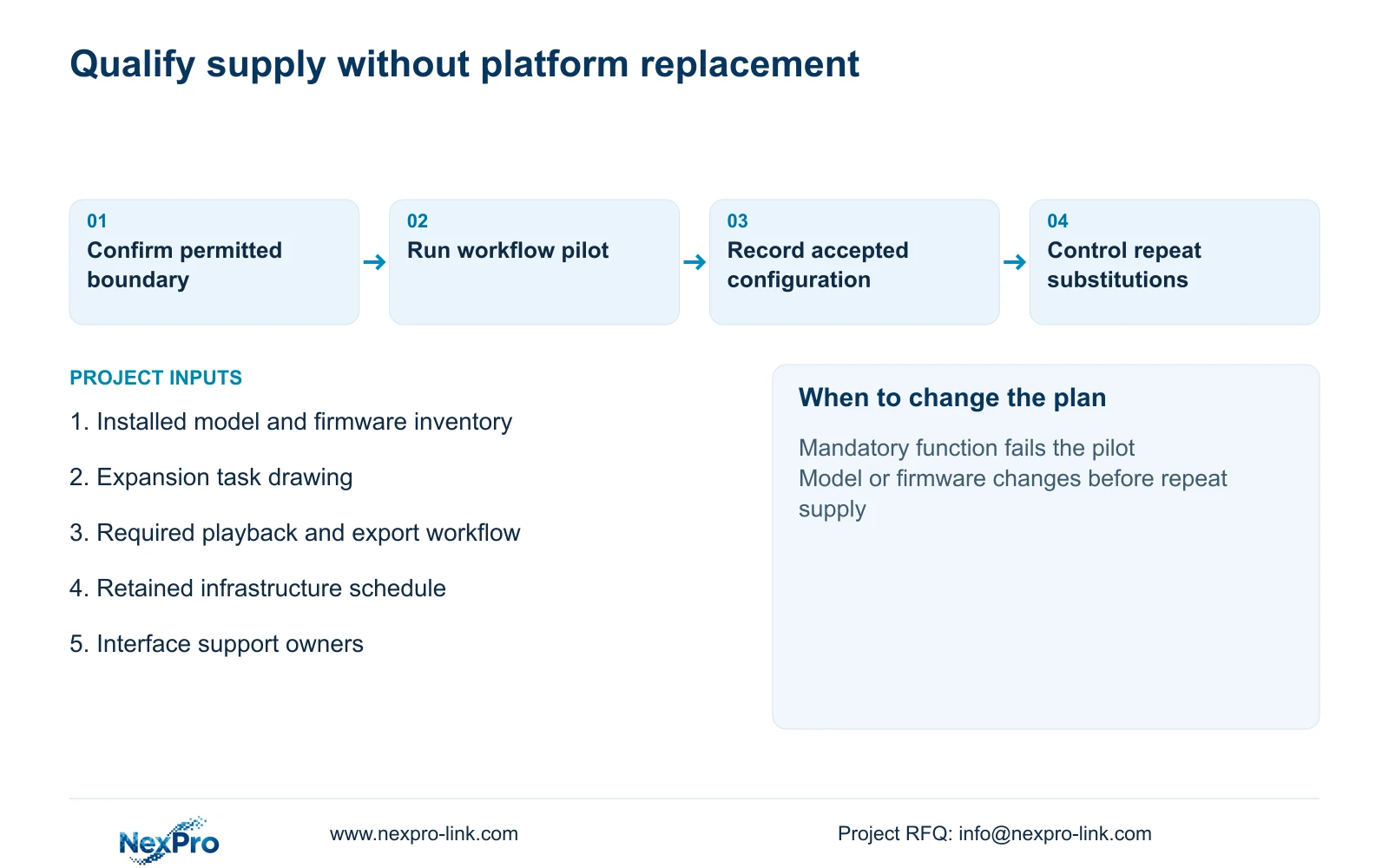
Select a pilot that represents the proposed supplier boundary. For a camera feeding an existing recorder, test connection, agreed stream settings, recording, time-based playback and export. Add audio, event retrieval or other features only where required. For an independent recorder feeding central viewing, test the actual client or decoder path instead. A successful trial in one arrangement should not be treated as approval for another.
ONVIF profiles provide a framework for applicable device and client functions, but the precise models and firmware still matter. Basic live video is insufficient evidence for an event-search workflow. Record each required function as passed, failed or unresolved, together with the configuration and test conditions. A missing specification is an information gap; it is not automatically proof of incompatibility.
Include a planned support exercise: identify an offline camera, determine whether recording stopped and route the issue to the responsible party. The local integrator should own site diagnosis, the owner should control network access and permissions, and each supplier should handle its defined equipment scope. Capture logs and configuration identifiers without publishing credentials. The resulting trial record should show both technical acceptance and a usable escalation path.
Section 04
Distinguish local operation from added platform integration
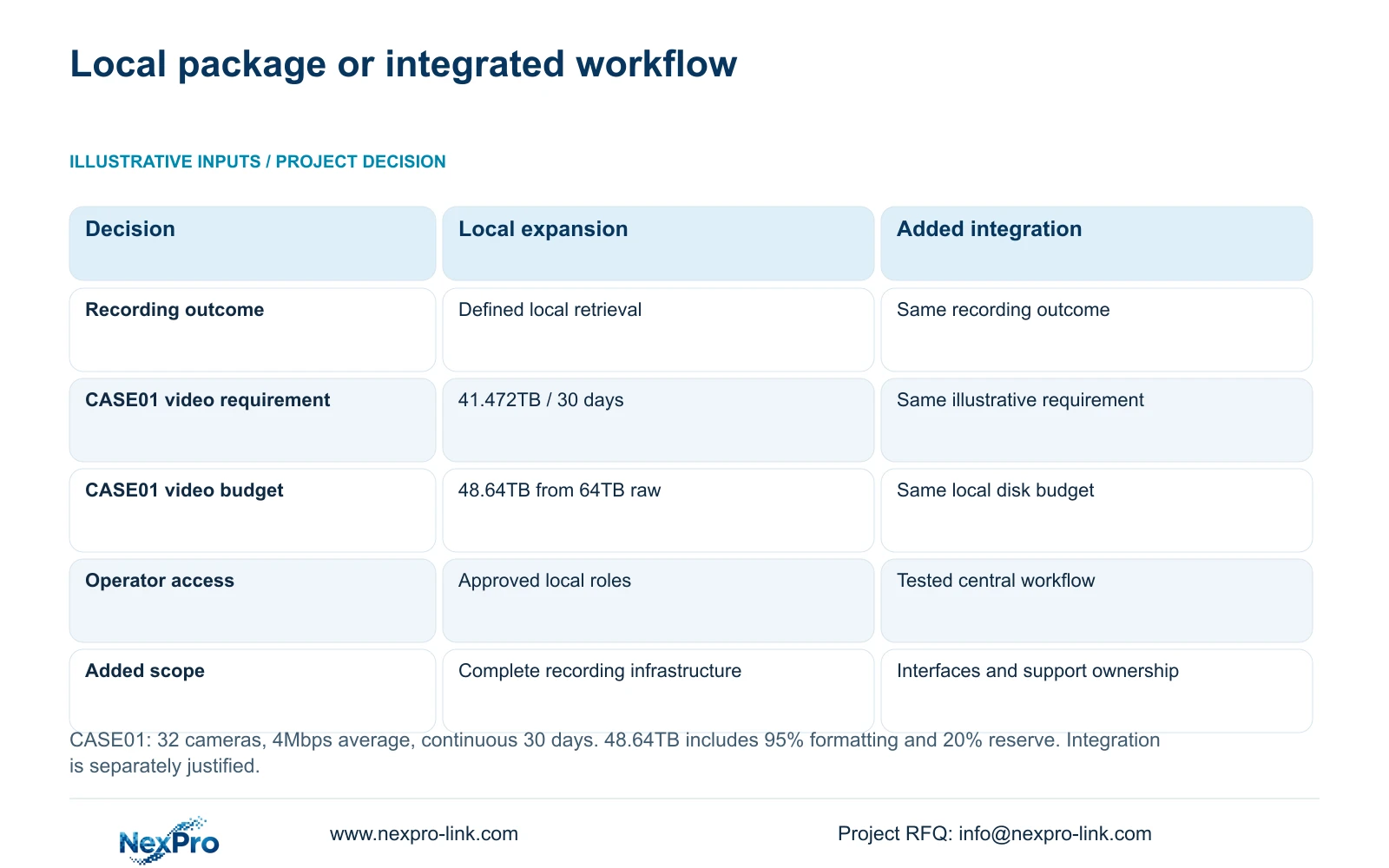
Hold the owner's recording task constant when comparing the minimum operational package with an integrated alternative. In Option A below, the expansion records locally while the approved plant platform is retained. Option B preserves that recording outcome and adds a specifically justified central workflow. Each item needs a supply status and one interface owner; the integration column should never become an undefined allowance.
CASE01 gives a concrete scale for Option A. With 32 cameras averaging an illustrative 4Mbps and recording continuously for 30 days, video_TB = 32 × 4 × 10^6 × 86400 × 30 / 8 / 10^12 = 41.472TB. Its four 16TB drives provide 64TB raw and a recording budget of 64 × 0.95 × 0.80 = 48.64TB. Compare 41.472TB directly with 48.64TB; the budget already includes formatting and reserve.
The associated NexPro-NVR4449-4K reference lists 320Mbps input and four SATA bays up to 18TB each. CASE01's illustrative input is 128Mbps, with streams assumed within supported 5MP-class modes. Its 49-channel catalog designation does not establish all-8MP recording, wall decoding or RAID. The decisive difference between the options is the additional operating interface and its responsibilities, not a different storage objective.
| Item and required task | Option A: local expansion | Option B: added central workflow | Responsible interface party |
|---|---|---|---|
| Existing platform: preserve accepted operation | Retained, unchanged | Retained, approved connection only | Owner platform administrator |
| New recording: access and transfer review | Supplied local cameras, recorder and disks | Same recording package retained | Local CCTV integrator |
| Network and power: support required nodes | Installer-provided links and verified circuits | Added interface equipment accounted for | Owner IT and electrical leads, by interface |
| Access: retrieve permitted incidents | Supplied local user roles and export workflow | Optional central viewing after successful trial | Owner security administrator |
| Documents: identify delivered configuration | Supplied model, tag and configuration schedule | Additional interface record and support procedure | Project manager |
Section 05
Expand only after the pilot supports the intended role
For this scenario, prefer a complete local expansion package if the owner permits separate operation and central integration has no defined benefit. This preserves the operating platform while creating a bounded second-source qualification. If operators genuinely need one central incident workflow, carry the tested connection into Option B and price the additional equipment, configuration and support.
Change the recommendation if the pilot cannot deliver a mandatory function, if the owner requires a particular platform or if a location needs specialist equipment beyond the ordinary-camera scope. A failed integration trial may still leave an independent package viable, but only if the owner accepts that operating arrangement. Do not relax a required event function or environmental scope simply to keep a preferred supplier in the bid.
Normalize quotations around identical observation tasks, retention, protected nodes and installation responsibilities. Separate new equipment from retained assets, migration labor, software and ongoing support. NexPro-Link's BOQ and tender support can help document the model/scope differences. Without matching quotations and trial results, the project has no basis for claiming that either the new source or the incumbent brand is universally cheaper or better.
Section 06
Make repeat orders preserve the approved boundary
Release the first order against the accepted pilot configuration and a location-tagged equipment schedule. Record firmware, stream settings, interfaces and substitutions that require approval. Before repeat supply, compare the proposed batch with that record. A camera that looks identical can still require a new compatibility check if its relevant firmware or supplied interface changes.
The handover should let the owner find a recording, export an incident and identify which supplier supports each item. Keep separate platform accounts and permissions explicit where the expansion remains independent. Supply configuration records through an appropriate project channel, while public manuals and packing labels contain no passwords or private device identifiers.
NexPro-Link's project-supply and OEM scope can support equipment coordination, project labels, manuals and packaging. Optional hardware branding must retain the technical model and serial traceability needed for service; it does not imply permission to rename third-party software. Local installation, owner-network authorization and final vendor acceptance remain assigned project responsibilities. That boundary should remain visible in subsequent quotations as the second source grows.
Section 07
Buyer questions
Does an independent expansion create a plant-wide spare-camera standard? No. It qualifies the equipment for the approved expansion role. Substitution into existing recorder or platform combinations needs evidence for those combinations, and replacement units must preserve the required environmental and viewing task.
Can a supplier quote while our firmware inventory is incomplete? A provisional equipment offer can proceed, with integration identified as unresolved. Avoid pricing an unverified central workflow as included and fully accepted. Complete the relevant inventory before approving a connected alternative.
What happens if local recording passes but central event search fails? Keep the results separate. The independent recording package may remain suitable if the owner accepts local retrieval. If central event search is mandatory, resolve that function or retain equipment that supports it before expanding the order.
Section 08
Define your first second-source package
Send the installed model/firmware inventory, proposed expansion drawing, mandatory retrieval and integration tasks, and retained-versus-new scope schedule to info@nexpro-link.com. NexPro-Link can discuss a bounded pilot package and the evidence needed before repeat supply.
Engineering references
These sources support the general planning principles. Always use the selected product's current datasheet and applicable project standards for final design.