
A hotel uses the same camera family at a glass entrance, an indoor corridor and a dim service doorway. Use a preset as a starting point, not as proof that every view is correct.
Section 01
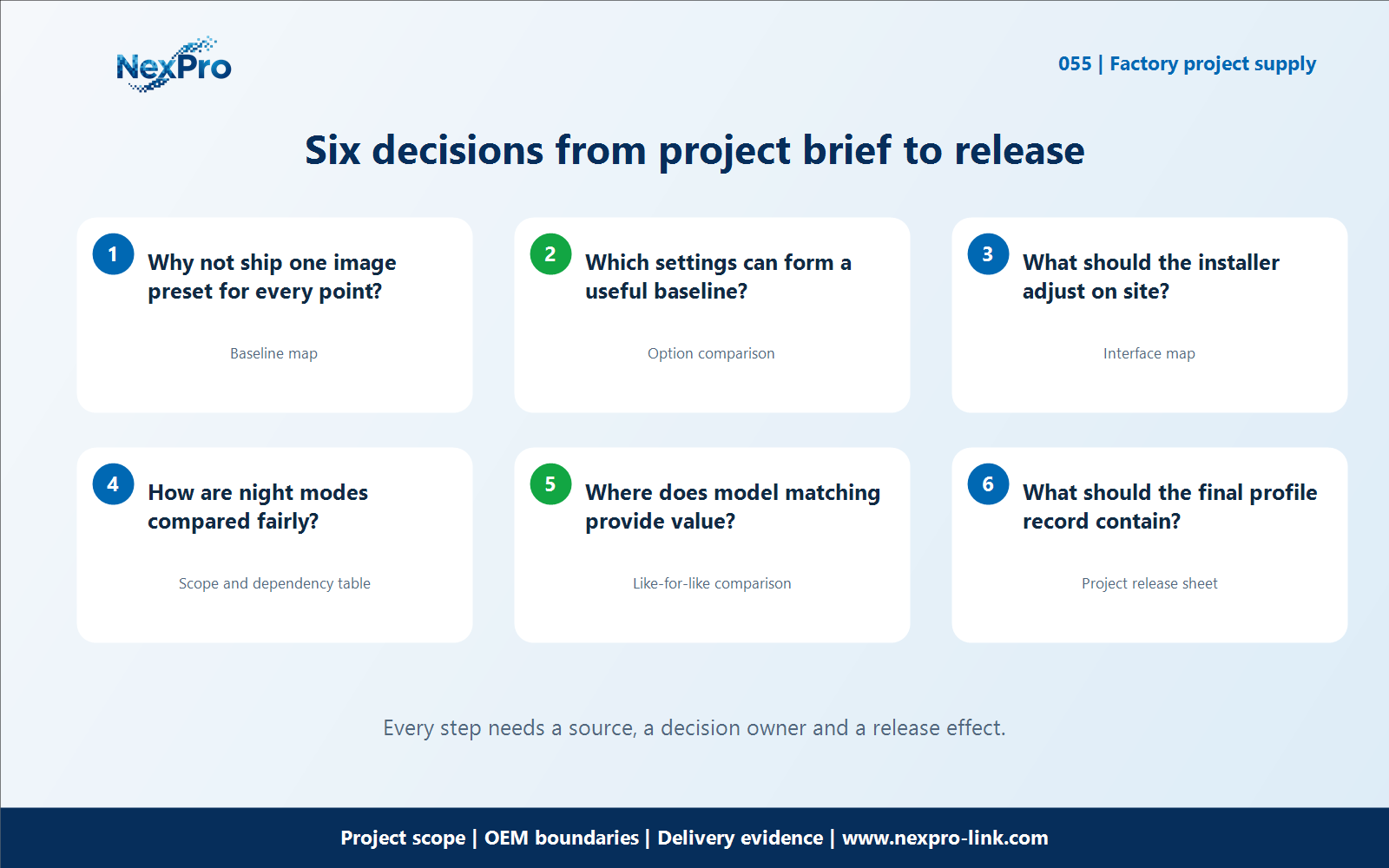
Why not ship one image preset for every point?
A hotel uses the same camera family at a glass entrance, an indoor corridor and a dim service doorway. Use a preset as a starting point, not as proof that every view is correct. A bright entrance and a dim service door demand different exposure choices. Describe the required recorded detail before deciding which settings should be shared.
For the "Why not ship one image preset for every point" decision, use the baseline map fields Area or item, Required task, Current assumption, Decision owner. Apply it to CCTV factory image settings site tuning so the buyer, supplier and local integrator can see which input is confirmed, who owns it and which evidence remains open.
Evaluate why not ship one image preset for every point against the stated site task and the surrounding equipment, documentation, packing and handover dependencies for CCTV factory image settings site tuning. For why not ship one image preset for every point in CCTV factory image settings site tuning, record the confirmed condition, chosen option and remaining evidence separately; an open value is not a price, test, approval or customer-result claim.
Carry the why not ship one image preset for every point decision into the RFQ, BOQ, configuration or release record for CCTV factory image settings site tuning. For why not ship one image preset for every point in CCTV factory image settings site tuning, name the equipment, artwork, network, installation and acceptance owner; site-specific work remains with the buyer or integrator unless the signed scope says otherwise.
Section 02
Which settings can form a useful baseline?
Which settings can form a useful baseline? A baseline can organize encoding choices, time settings and agreed event options. Record the profile used for each scene group. Compression settings should be judged by recorded usefulness and actual bitrate rather than a fixed promised saving. For Factory Image Settings vs Site Tuning: A Practical CCTV Delivery Split, keep this decision tied to the same project brief rather than opening a separate generic specification exercise.
For the "Which settings can form a useful baseline" decision, use the option comparison fields Position or option, Suitable condition, Trade-off, Next choice. Apply it to CCTV factory image settings site tuning so the buyer, supplier and local integrator can see which input is confirmed, who owns it and which evidence remains open.
Evaluate which settings can form a useful baseline against the stated site task and the surrounding equipment, documentation, packing and handover dependencies for CCTV factory image settings site tuning. For which settings can form a useful baseline in CCTV factory image settings site tuning, record the confirmed condition, chosen option and remaining evidence separately; an open value is not a price, test, approval or customer-result claim.
Carry the which settings can form a useful baseline decision into the RFQ, BOQ, configuration or release record for CCTV factory image settings site tuning. For which settings can form a useful baseline in CCTV factory image settings site tuning, name the equipment, artwork, network, installation and acceptance owner; site-specific work remains with the buyer or integrator unless the signed scope says otherwise.
Section 03
What should the installer adjust on site?
What should the installer adjust on site? The installer should confirm framing, focus and moving detail under the actual lighting. Check recorded playback as well as live view. A picture that looks attractive on a small preview may not retain the detail required for an incident review. For Factory Image Settings vs Site Tuning: A Practical CCTV Delivery Split, keep this decision tied to the same project brief rather than opening a separate generic specification exercise.
For the "What should the installer adjust on site" decision, use the interface map fields Device or record, Input, Output, Responsible party. Apply it to CCTV factory image settings site tuning so the buyer, supplier and local integrator can see which input is confirmed, who owns it and which evidence remains open.
Evaluate what should the installer adjust on site against the stated site task and the surrounding equipment, documentation, packing and handover dependencies for CCTV factory image settings site tuning. For what should the installer adjust on site in CCTV factory image settings site tuning, record the confirmed condition, chosen option and remaining evidence separately; an open value is not a price, test, approval or customer-result claim.
Carry the what should the installer adjust on site decision into the RFQ, BOQ, configuration or release record for CCTV factory image settings site tuning. For what should the installer adjust on site in CCTV factory image settings site tuning, name the equipment, artwork, network, installation and acceptance owner; site-specific work remains with the buyer or integrator unless the signed scope says otherwise.
| Project question | Project-oriented treatment | Keep equal when comparing offers |
|---|---|---|
| Why not ship one image preset for every point? | Use a preset as a starting point, not as proof that every view is correct. | Exact configuration and accessory scope |
| Which settings can form a useful baseline? | A baseline can organize encoding choices, time settings and agreed event options. | Preparation versus on-site work |
| What should the installer adjust on site? | The installer should confirm framing, focus and moving detail under the actual lighting. | Branding process and artwork scope |
| How are night modes compared fairly? | Compare the selected cameras under the same lighting and movement conditions. | Delivery and support responsibilities |
Section 04
How are night modes compared fairly?
How are night modes compared fairly? Compare the selected cameras under the same lighting and movement conditions. Separate the effect of added visible light from the camera's low-light imaging. A dual-light label alone does not establish that one recorded scene will outperform another. For Factory Image Settings vs Site Tuning: A Practical CCTV Delivery Split, keep this decision tied to the same project brief rather than opening a separate generic specification exercise.
For the "How are night modes compared fairly" decision, use the scope and dependency table fields Item, Included, Dependency, Separate option. Apply it to CCTV factory image settings site tuning so the buyer, supplier and local integrator can see which input is confirmed, who owns it and which evidence remains open.
Evaluate how are night modes compared fairly against the stated site task and the surrounding equipment, documentation, packing and handover dependencies for CCTV factory image settings site tuning. For how are night modes compared fairly in CCTV factory image settings site tuning, record the confirmed condition, chosen option and remaining evidence separately; an open value is not a price, test, approval or customer-result claim.
Carry the how are night modes compared fairly decision into the RFQ, BOQ, configuration or release record for CCTV factory image settings site tuning. For how are night modes compared fairly in CCTV factory image settings site tuning, name the equipment, artwork, network, installation and acceptance owner; site-specific work remains with the buyer or integrator unless the signed scope says otherwise.
Section 05
Where does model matching provide value?
Where does model matching provide value? Allocate stronger performance only where the scene needs it. A mixed schedule can reserve suitable entrance cameras for difficult views while using economical models elsewhere. The value comes from meeting each task without applying the most expensive specification everywhere. For Factory Image Settings vs Site Tuning: A Practical CCTV Delivery Split, keep this decision tied to the same project brief rather than opening a separate generic specification exercise.
For the "Where does model matching provide value" decision, use the like-for-like comparison fields Requirement, Baseline, Proposed treatment, Remaining difference. Apply it to CCTV factory image settings site tuning so the buyer, supplier and local integrator can see which input is confirmed, who owns it and which evidence remains open.
Evaluate where does model matching provide value against the stated site task and the surrounding equipment, documentation, packing and handover dependencies for CCTV factory image settings site tuning. For where does model matching provide value in CCTV factory image settings site tuning, record the confirmed condition, chosen option and remaining evidence separately; an open value is not a price, test, approval or customer-result claim.
Carry the where does model matching provide value decision into the RFQ, BOQ, configuration or release record for CCTV factory image settings site tuning. For where does model matching provide value in CCTV factory image settings site tuning, name the equipment, artwork, network, installation and acceptance owner; site-specific work remains with the buyer or integrator unless the signed scope says otherwise.
Section 06
What should the final profile record contain?
What should the final profile record contain? Record the final settings profile against each camera tag, including the conditions under which it was accepted. Keep sensitive access information separate. That record gives maintenance teams a practical baseline when lighting or the room layout changes later. For Factory Image Settings vs Site Tuning: A Practical CCTV Delivery Split, keep this decision tied to the same project brief rather than opening a separate generic specification exercise.
For the "What should the final profile record contain" decision, use the project release sheet fields Configuration, Artwork, Quantity, Location, Release stage. Apply it to CCTV factory image settings site tuning so the buyer, supplier and local integrator can see which input is confirmed, who owns it and which evidence remains open.
Evaluate what should the final profile record contain against the stated site task and the surrounding equipment, documentation, packing and handover dependencies for CCTV factory image settings site tuning. For what should the final profile record contain in CCTV factory image settings site tuning, record the confirmed condition, chosen option and remaining evidence separately; an open value is not a price, test, approval or customer-result claim.
Carry the what should the final profile record contain decision into the RFQ, BOQ, configuration or release record for CCTV factory image settings site tuning. For what should the final profile record contain in CCTV factory image settings site tuning, name the equipment, artwork, network, installation and acceptance owner; site-specific work remains with the buyer or integrator unless the signed scope says otherwise.
Engineering references
These sources support the general planning principles. Always use the selected product's current datasheet and applicable project standards for final design.