Use returnable-rack handover views and a separate identity workflow to investigate loading disputes, with pixel-density calculations that preserve actual source outputs.
Section 01
Record rack condition at the actual custody exchange
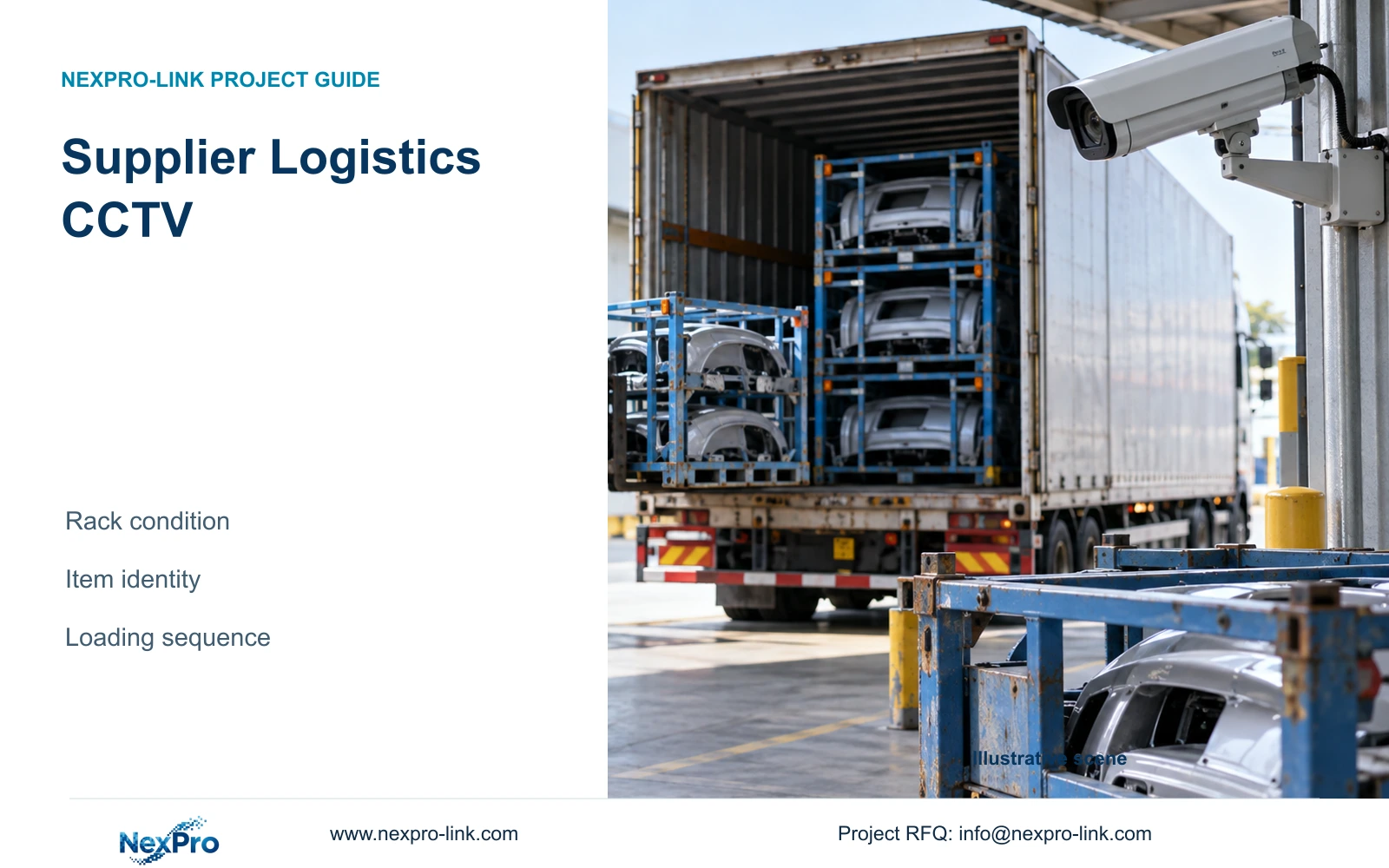
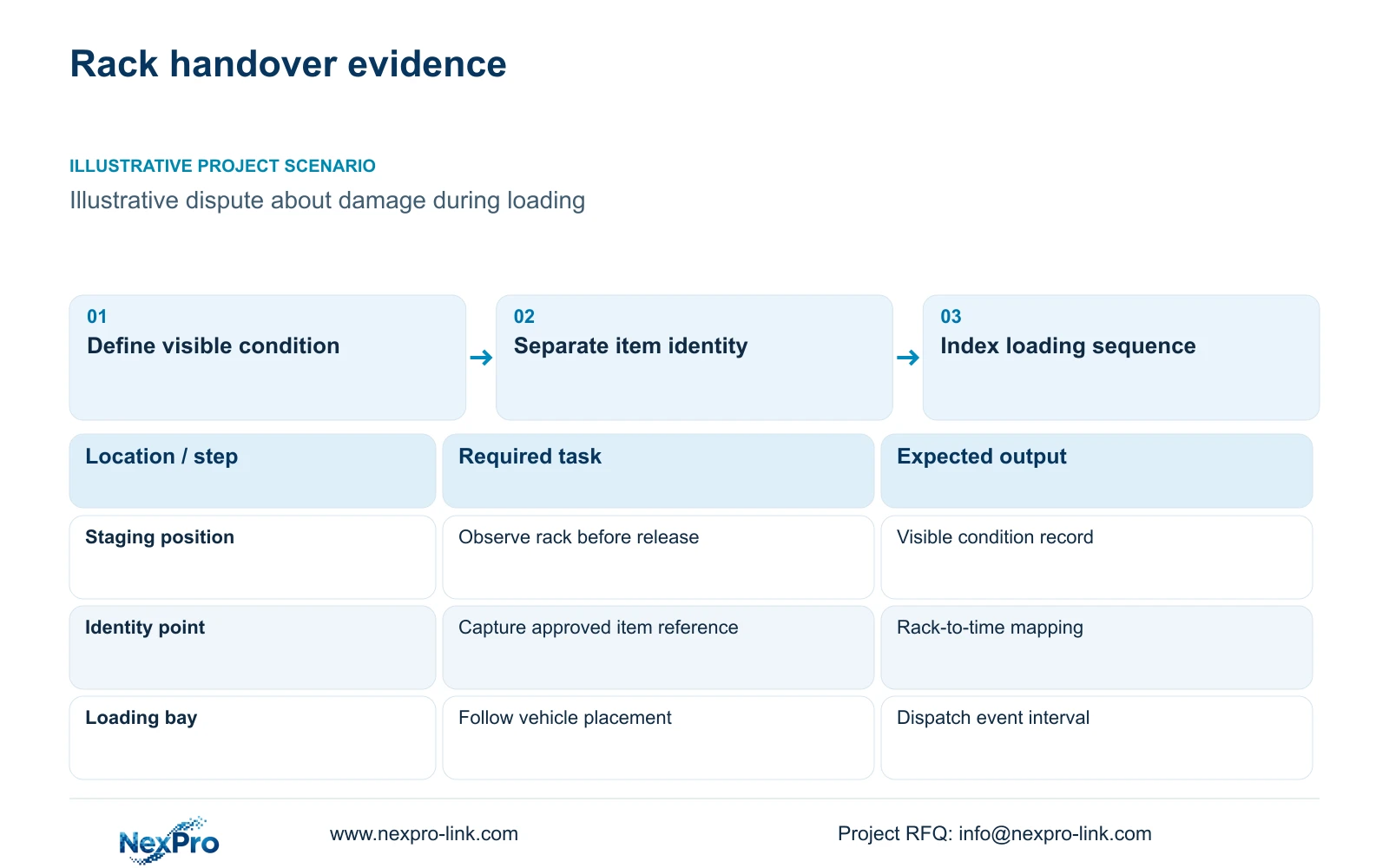
Automotive supplier logistics CCTV should capture returnable racks at defined handover stages and link those views to a separate identification task. A truck plate identifies a vehicle, not every rack aboard it. The design needs enough context to follow loading and enough task-specific detail to assess the visible condition being disputed.
Illustrative project scenario: A supplier disputes whether a returnable rack was damaged before or after loading. Assume the site can identify a dispatch booking and loading bay but needs to connect those records to rack movements. The planned views and workflow below are hypothetical; they are not a finding about a real damage claim.
Define the exchange before selecting the camera: arrival at staging, release to the loading team or placement on the vehicle. Specify which surfaces must be visible and what obstructions are expected. A view of one side cannot prove the condition of a concealed corner or underside. Record those limits so the buyer can decide whether another angle or a separate inspection record is needed.
Section 02
Give identity capture its own geometry and workflow
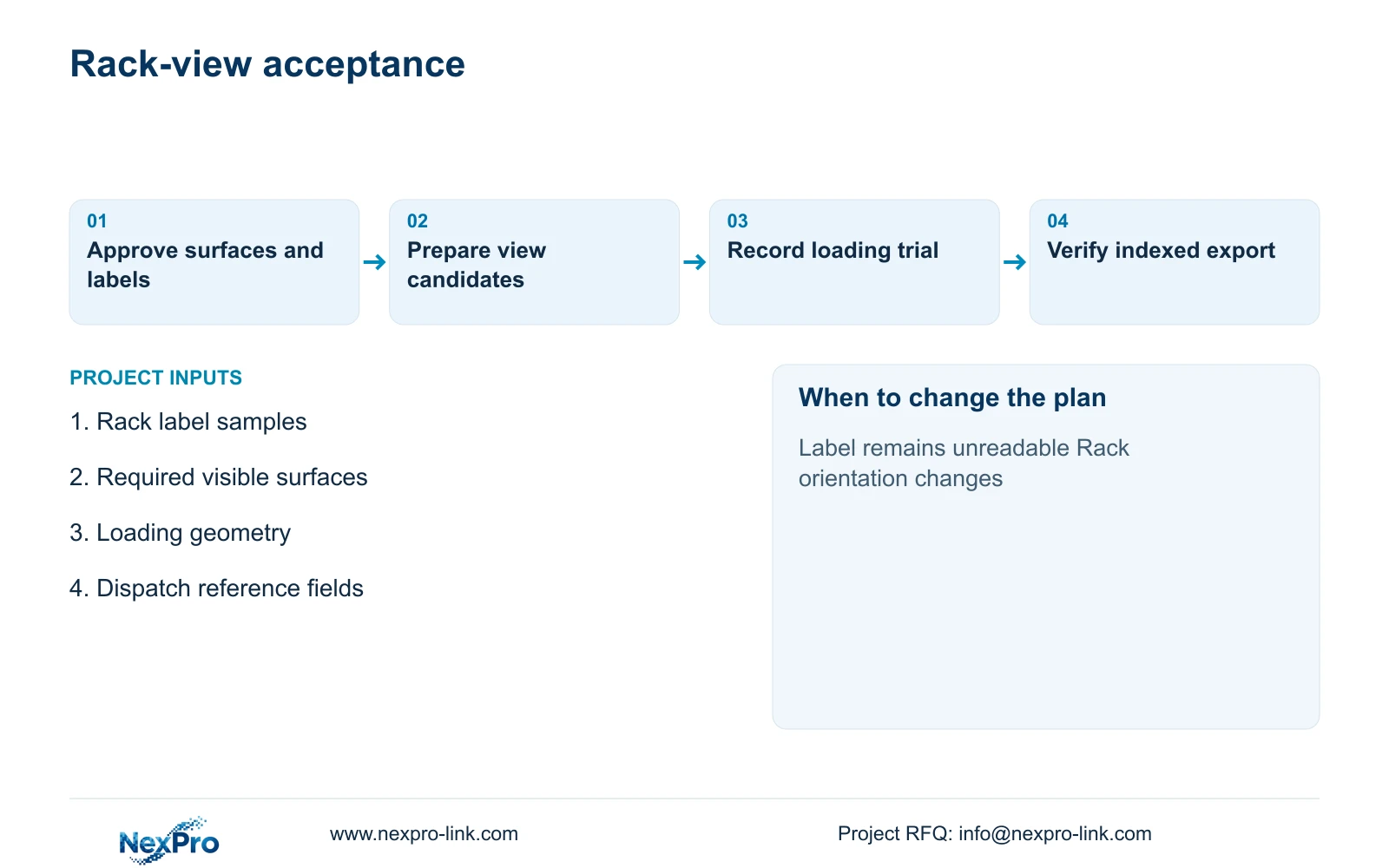
Obtain representative rack and container labels, including their size, position, contrast and likely orientation during transfer. Decide whether the task is human reading from recorded video or capture by a separately specified scanner. Do not convert a general security camera into an assumed barcode or rack-recognition system.
A broad loading view may preserve the vehicle, forklift and bay sequence while rendering a small label unusable. Compare a narrower dedicated view at a repeatable handover point with a documented scan-and-time reference. The choice depends on how the rack is presented and whether operations can preserve that position without disrupting loading.
NexPro-BL2812M55-5MP-DIC-AI and NexPro-BL2812M88-8MP-DIC-AI list 2.8–12mm motorized lenses. Their source outputs include 2880×1620 for the 5MP family and 3840×2160 at 25fps for the 8MP model. These provide arithmetic inputs for planning, but label acceptance still needs the actual angle, motion, illumination and recorded compression settings.
Section 03
Index dispatch records without assuming automatic recognition
Use a stable loading-bay view name and an approved common time reference. Associate the dispatch booking, rack identifier where available, loading interval and relevant channels in the operating procedure. A manual record may be adequate for the initial scope if it is consistently maintained and can locate the necessary footage.
For automatic linking, list the required identifier and event timestamp, the source system, the receiving application and the appointed interface owner. Keep vehicle identification, rack identification and condition review as separate fields. A successful plate capture does not establish which rack was loaded or what its hidden surfaces looked like.
Test the sequence with more than one rack moving through the bay. Ask the authorized operator to locate a nominated item, distinguish it from adjacent movements and export the relevant handover stages. Preserve the recording channel map and any observed timestamp offset. The output should be a handover-view schedule plus a separate process-interface list, with optional automation clearly distinguished from supplied recording.
Section 04
Compare horizontal density using the listed output dimensions
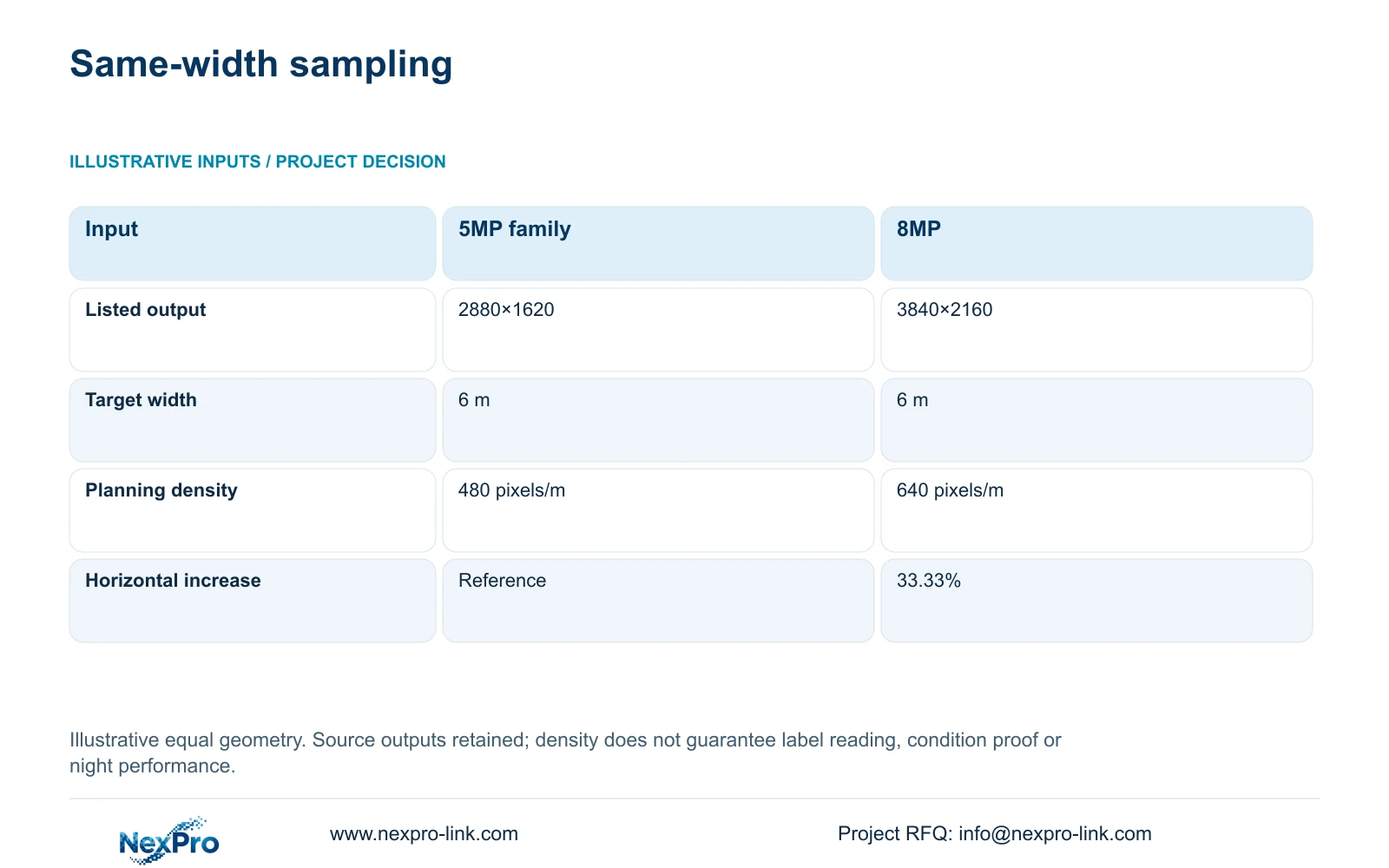
At an illustrative six-metre target plane, compare the listed horizontal outputs of 2880 and 3840 pixels. The formula is planning pixels per metre = horizontal_pixels / target_width_m. Therefore 2880 / 6 = 480 pixels per metre and 3840 / 6 = 640 pixels per metre. Relative increase = (3840 / 2880 - 1) × 100 = 33.33%.
The decisive difference is horizontal sampling at the same assumed geometry. It is not a 60% detail guarantee inferred from the 5MP and 8MP labels. Preserve the supplied 2880×1620 field rather than replacing it with a different presumed 5MP output. The six-metre width is a planning input, not a guaranteed field of view at any lens setting.
Use the calculation to identify which option deserves a recorded trial. Higher density may help a detail task, but it cannot reveal an obscured label or remove motion blur. Exposure, optics, compression and target presentation remain material. If both candidates fail the label task, reconsider the viewing geometry or use the separately specified identification workflow instead of continuing to increase resolution without a defined acceptance result.
| Planning input | 5MP-family output | 8MP output |
|---|---|---|
| Listed output | 2880×1620 | 3840×2160 |
| Horizontal pixels | 2880 | 3840 |
| Target width | 6 m | 6 m |
| Planning density | 480 pixels/m | 640 pixels/m |
| Horizontal-density increase | Reference | 33.33% |
Section 05
Choose paired tasks rather than a uniform upgrade
Recommend an overview for the loading sequence and dedicated condition or identity coverage where the acceptance task requires it. Retain a separate scan or dispatch record when it provides the reliable item reference. Upgrading every overview to 8MP does not demonstrate that every rack surface or label becomes usable.
Recheck supporting resources when detail cameras or additional angles are introduced. The supplied CASE01 assumes all 32 streams remain within a supported 5MP-class recording basis at an average 4 Mbps. Its 128 Mbps payload and 41.472 TB 30-day estimate cannot be carried unchanged into a different mixed-resolution schedule without confirming the actual stream settings and recorder modes.
Map the revised cameras to their PoE groups, cable routes and protected power nodes. Peak camera power is absent from the supplied camera specifications, so replace illustrative power inputs before final selection. A search workstation can remain the operator interface when it meets the review task; a display wall adds a separate decoding and electrical scope without improving rack identification.
Section 06
Put the rack trial into the equipment submission
The RFQ should describe the visible condition features and identity task, with representative label material and the intended transfer position. State which bay views are existing, which dedicated cameras are proposed and who provides the dispatch reference. This prevents suppliers from pricing different outcomes under the same camera quantity.
NexPro-Link's BOQ and tender support can coordinate the selected models, technical documents and deviations. Project packing and labels can distinguish overview units from detail-view units while retaining their assigned task IDs. Agree mounting, site adjustment and operator training separately from equipment supply and overseas shipment.
At acceptance, review recorded samples from representative loading movements and normal shifts. Document visible surfaces, readable identifiers where required, retrieval steps and any gaps. Compare other brand proposals using the same rack, geometry and complete workflow. Without matched samples and quotations, the density calculation supports a design choice but does not establish a brand winner or prove liability for damage.
Section 07
Buyer questions
Can one view prove that a rack was undamaged? Only the visible condition can be assessed. Define the required surfaces and consider additional angles or a separate inspection record for concealed areas. Do not promise a complete condition finding from a single overview.
Must rack labels be readable in the overview? No, if another approved workflow supplies the item identity and connects it reliably to the handover interval. Keep that identification responsibility explicit and demonstrate the lookup before acceptance.
Is an 8MP camera always the better loading-bay choice? Its listed horizontal output provides more planning density at the same width, but placement, movement and light can dominate the result. Choose it where the recorded trial demonstrates a useful improvement for the specified task.
Section 08
Specify a returnable-rack handover trial
Send your loading and staging plan, representative rack labels and required condition views, transfer geometry and shift lighting, and dispatch-index workflow to info@nexpro-link.com for a task-specific CCTV proposal.
Engineering references
These sources support the general planning principles. Always use the selected product's current datasheet and applicable project standards for final design.