A residential care operator is planning security coverage for reception and shared service routes at a new facility. Keep entrance and shared-area security separate from clinical observation or care alarms.
Section 01
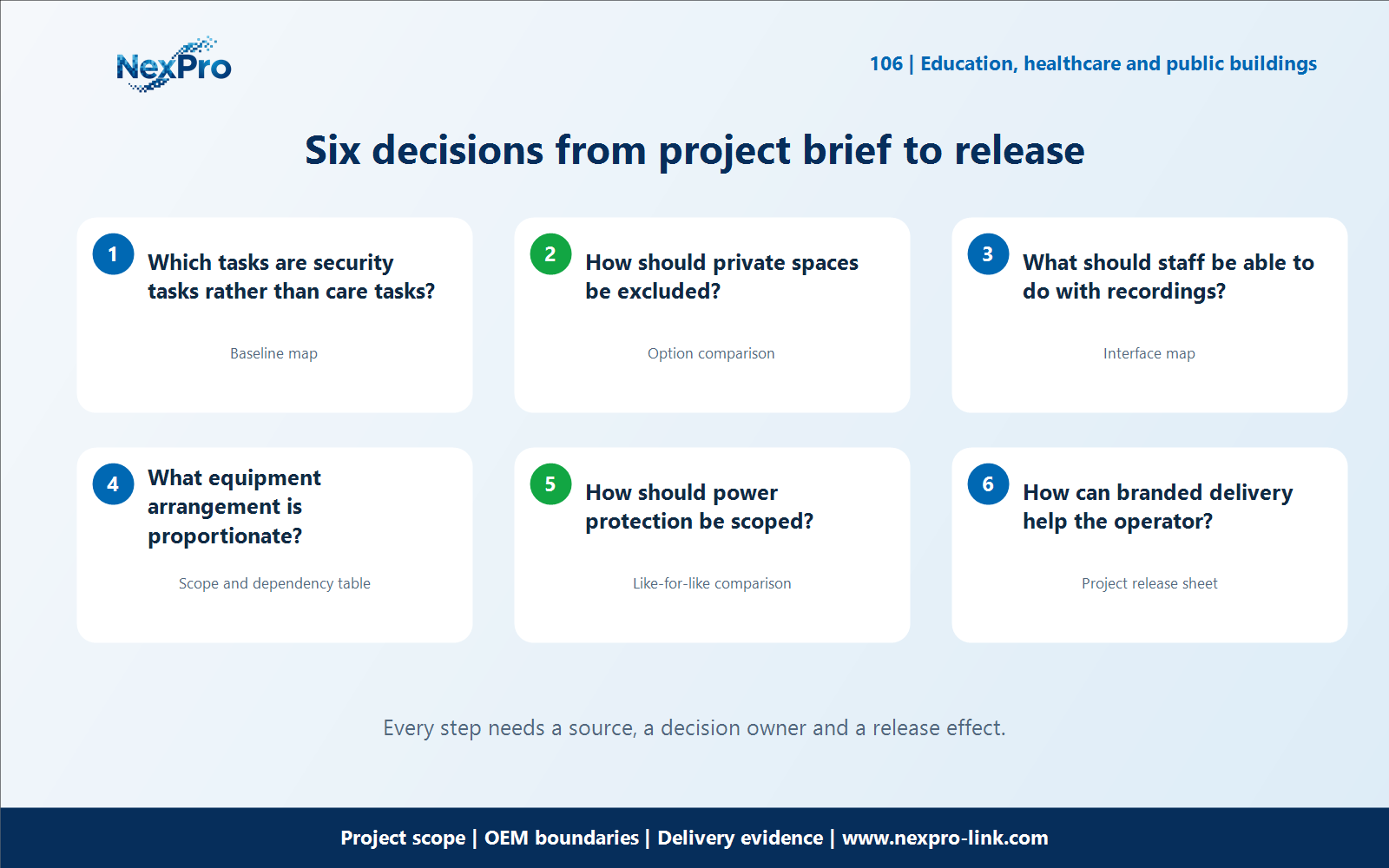
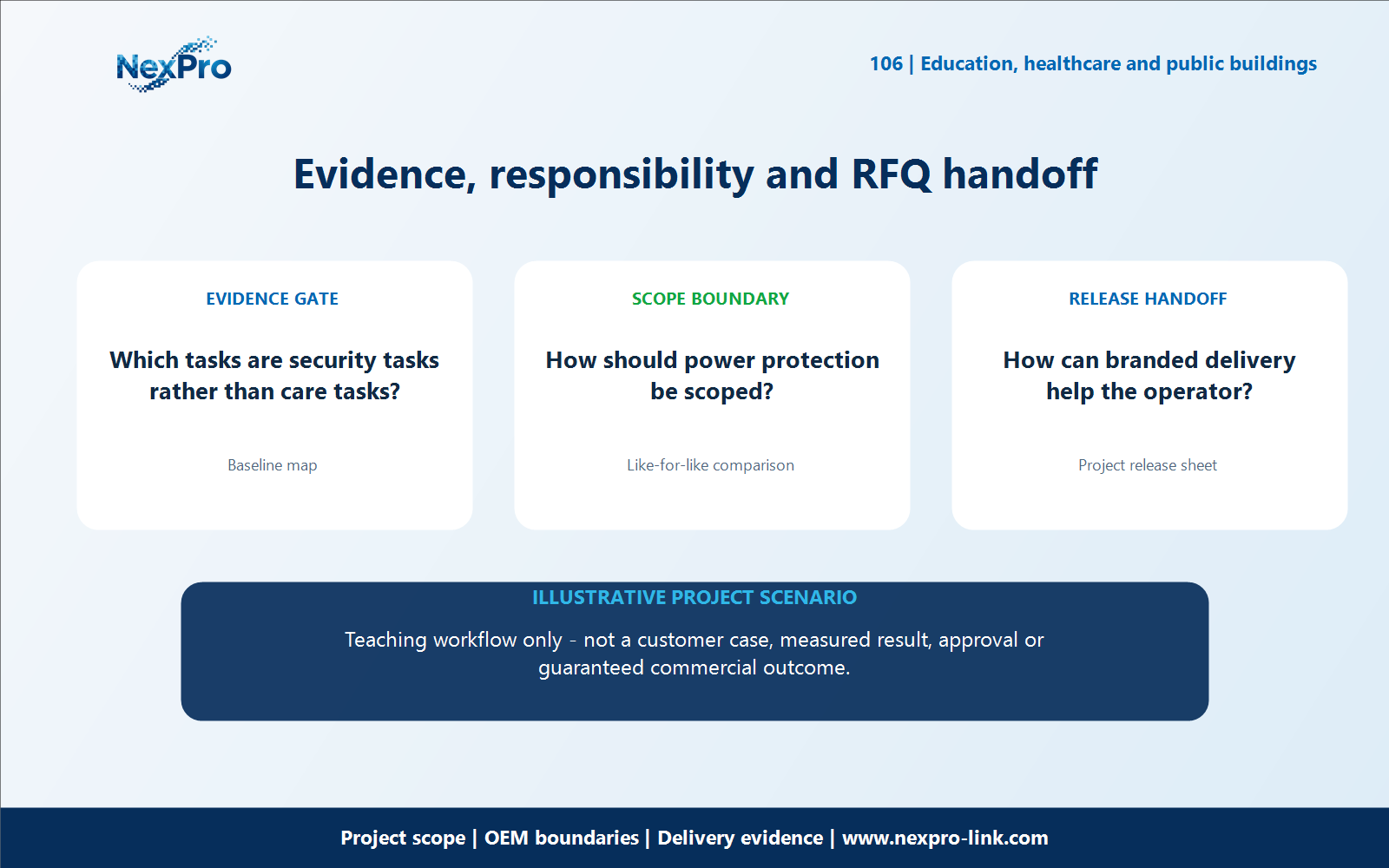
Which tasks are security tasks rather than care tasks?
A residential care operator is planning security coverage for reception and shared service routes at a new facility. Keep entrance and shared-area security separate from clinical observation or care alarms. Human detection in a camera does not automatically provide reliable fall detection or medical monitoring. Define the intended use before introducing any product feature into the proposal.
For the "Which tasks are security tasks rather than care tasks" decision, use the baseline map fields Area or item, Required task, Current assumption, Decision owner. Apply it to senior residence common area CCTV so the buyer, supplier and local integrator can see which input is confirmed, who owns it and which evidence remains open.
Evaluate which tasks are security tasks rather than care tasks against the stated site task and the surrounding equipment, documentation, packing and handover dependencies for senior residence common area CCTV. For which tasks are security tasks rather than care tasks in senior residence common area CCTV, record the confirmed condition, chosen option and remaining evidence separately; an open value is not a price, test, approval or customer-result claim.
Carry the which tasks are security tasks rather than care tasks decision into the RFQ, BOQ, configuration or release record for senior residence common area CCTV. For which tasks are security tasks rather than care tasks in senior residence common area CCTV, name the equipment, artwork, network, installation and acceptance owner; site-specific work remains with the buyer or integrator unless the signed scope says otherwise.
Section 02
How should private spaces be excluded?
How should private spaces be excluded? Use the facility's approved policy to define private exclusions and authorized shared views. Review camera angles near those boundaries. A supplier should not use a general safety objective to justify recording residents' private activities without an appropriate basis and explicit scope. For Senior Residence CCTV: Shared-Area Security and Care-System Boundaries, keep this decision tied to the same project brief rather than opening a separate generic specification exercise.
For the "How should private spaces be excluded" decision, use the option comparison fields Position or option, Suitable condition, Trade-off, Next choice. Apply it to senior residence common area CCTV so the buyer, supplier and local integrator can see which input is confirmed, who owns it and which evidence remains open.
Evaluate how should private spaces be excluded against the stated site task and the surrounding equipment, documentation, packing and handover dependencies for senior residence common area CCTV. For how should private spaces be excluded in senior residence common area CCTV, record the confirmed condition, chosen option and remaining evidence separately; an open value is not a price, test, approval or customer-result claim.
Carry the how should private spaces be excluded decision into the RFQ, BOQ, configuration or release record for senior residence common area CCTV. For how should private spaces be excluded in senior residence common area CCTV, name the equipment, artwork, network, installation and acceptance owner; site-specific work remains with the buyer or integrator unless the signed scope says otherwise.
Section 03
What should staff be able to do with recordings?
What should staff be able to do with recordings? Assign viewing, export and administration to authorized staff roles. The system should support the operator's actual incident-handling process. Giving every employee full access may be convenient during setup, but it is not a sound definition of the operational requirement. For Senior Residence CCTV: Shared-Area Security and Care-System Boundaries, keep this decision tied to the same project brief rather than opening a separate generic specification exercise.
For the "What should staff be able to do with recordings" decision, use the interface map fields Device or record, Input, Output, Responsible party. Apply it to senior residence common area CCTV so the buyer, supplier and local integrator can see which input is confirmed, who owns it and which evidence remains open.
Evaluate what should staff be able to do with recordings against the stated site task and the surrounding equipment, documentation, packing and handover dependencies for senior residence common area CCTV. For what should staff be able to do with recordings in senior residence common area CCTV, record the confirmed condition, chosen option and remaining evidence separately; an open value is not a price, test, approval or customer-result claim.
Carry the what should staff be able to do with recordings decision into the RFQ, BOQ, configuration or release record for senior residence common area CCTV. For what should staff be able to do with recordings in senior residence common area CCTV, name the equipment, artwork, network, installation and acceptance owner; site-specific work remains with the buyer or integrator unless the signed scope says otherwise.
| Project question | Project-oriented treatment | Keep equal when comparing offers |
|---|---|---|
| Which tasks are security tasks rather than care tasks? | Keep entrance and shared-area security separate from clinical observation or care alarms. | Authorized institutional security purpose |
| How should private spaces be excluded? | Use the facility's approved policy to define private exclusions and authorized shared views. | Mandatory system and procurement requirements |
| What should staff be able to do with recordings? | Assign viewing, export and administration to authorized staff roles. | Network, recording and access scope |
| What equipment arrangement is proportionate? | Use task-based camera roles and a monitoring arrangement suited to the facility. | Actual delivery and operating support |
Section 04
What equipment arrangement is proportionate?
What equipment arrangement is proportionate? Use task-based camera roles and a monitoring arrangement suited to the facility. Consider night lighting and maintenance access. A complex wall or movable camera is not automatically necessary, and a simpler package can be appropriate when it meets the agreed viewing and recording tasks. For Senior Residence CCTV: Shared-Area Security and Care-System Boundaries, keep this decision tied to the same project brief rather than opening a separate generic specification exercise.
For the "What equipment arrangement is proportionate" decision, use the scope and dependency table fields Item, Included, Dependency, Separate option. Apply it to senior residence common area CCTV so the buyer, supplier and local integrator can see which input is confirmed, who owns it and which evidence remains open.
Evaluate what equipment arrangement is proportionate against the stated site task and the surrounding equipment, documentation, packing and handover dependencies for senior residence common area CCTV. For what equipment arrangement is proportionate in senior residence common area CCTV, record the confirmed condition, chosen option and remaining evidence separately; an open value is not a price, test, approval or customer-result claim.
Carry the what equipment arrangement is proportionate decision into the RFQ, BOQ, configuration or release record for senior residence common area CCTV. For what equipment arrangement is proportionate in senior residence common area CCTV, name the equipment, artwork, network, installation and acceptance owner; site-specific work remains with the buyer or integrator unless the signed scope says otherwise.
Section 05
How should power protection be scoped?
How should power protection be scoped? Specify backup power for the agreed CCTV chain while keeping specialist care and life-safety systems separately engineered. The power plan should state which security functions remain available. It must not imply that one ordinary CCTV UPS protects every critical service in the building. For Senior Residence CCTV: Shared-Area Security and Care-System Boundaries, keep this decision tied to the same project brief rather than opening a separate generic specification exercise.
For the "How should power protection be scoped" decision, use the like-for-like comparison fields Requirement, Baseline, Proposed treatment, Remaining difference. Apply it to senior residence common area CCTV so the buyer, supplier and local integrator can see which input is confirmed, who owns it and which evidence remains open.
Evaluate how should power protection be scoped against the stated site task and the surrounding equipment, documentation, packing and handover dependencies for senior residence common area CCTV. For how should power protection be scoped in senior residence common area CCTV, record the confirmed condition, chosen option and remaining evidence separately; an open value is not a price, test, approval or customer-result claim.
Carry the how should power protection be scoped decision into the RFQ, BOQ, configuration or release record for senior residence common area CCTV. For how should power protection be scoped in senior residence common area CCTV, name the equipment, artwork, network, installation and acceptance owner; site-specific work remains with the buyer or integrator unless the signed scope says otherwise.
Section 06
How can branded delivery help the operator?
How can branded delivery help the operator? A branded handover can identify the supplied devices and the support route clearly. Keep resident information and credentials out of general manuals. Packaging and markings should improve maintenance organization, while the operator retains responsibility for authorized use of the system. For Senior Residence CCTV: Shared-Area Security and Care-System Boundaries, keep this decision tied to the same project brief rather than opening a separate generic specification exercise.
For the "How can branded delivery help the operator" decision, use the project release sheet fields Configuration, Artwork, Quantity, Location, Release stage. Apply it to senior residence common area CCTV so the buyer, supplier and local integrator can see which input is confirmed, who owns it and which evidence remains open.
Evaluate how can branded delivery help the operator against the stated site task and the surrounding equipment, documentation, packing and handover dependencies for senior residence common area CCTV. For how can branded delivery help the operator in senior residence common area CCTV, record the confirmed condition, chosen option and remaining evidence separately; an open value is not a price, test, approval or customer-result claim.
Carry the how can branded delivery help the operator decision into the RFQ, BOQ, configuration or release record for senior residence common area CCTV. For how can branded delivery help the operator in senior residence common area CCTV, name the equipment, artwork, network, installation and acceptance owner; site-specific work remains with the buyer or integrator unless the signed scope says otherwise.
Engineering references
These sources support the general planning principles. Always use the selected product's current datasheet and applicable project standards for final design.