A contractor has a brand-mandatory CCTV contract but is free to source certain separately specified accessories and future independent additions. Keep the brand-mandatory equipment outside the substitution proposal.
Section 01
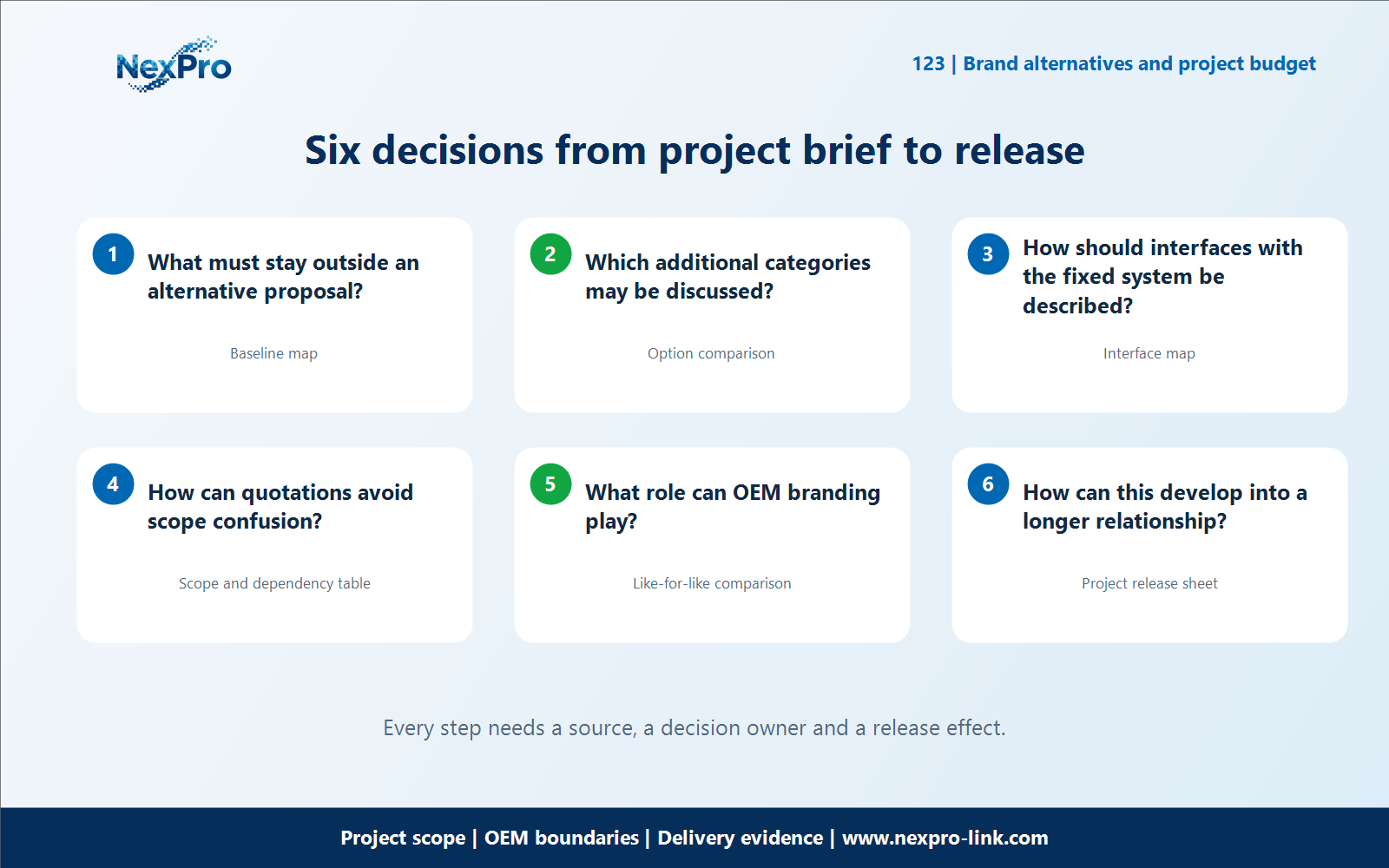
What must stay outside an alternative proposal?
A contractor has a brand-mandatory CCTV contract but is free to source certain separately specified accessories and future independent additions. Keep the brand-mandatory equipment outside the substitution proposal. A private label does not change the underlying device or remove a procurement condition. The useful commercial question is which other scope the buyer is actually permitted to source separately.
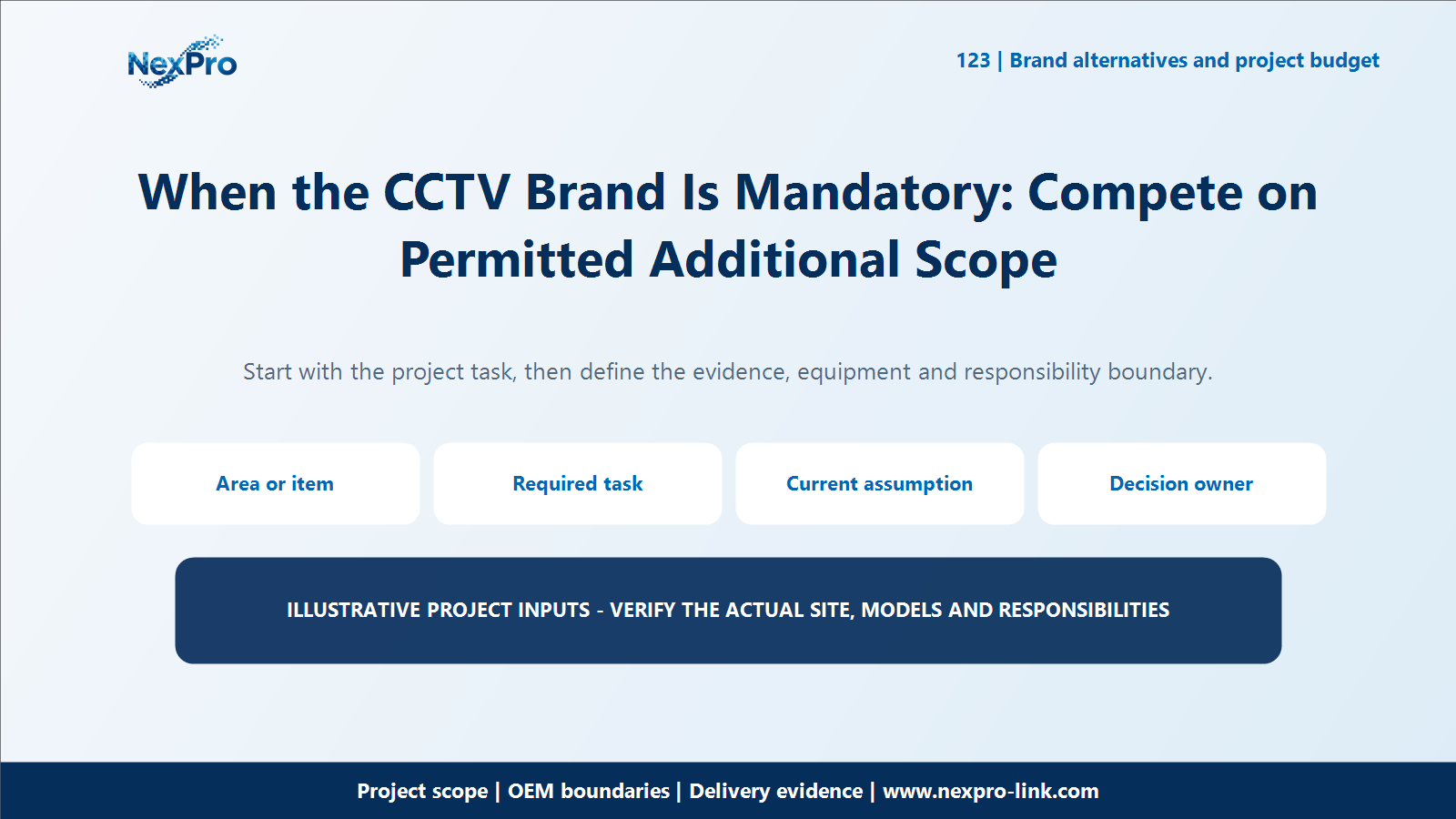
For the "What must stay outside an alternative proposal" decision, use the baseline map fields Area or item, Required task, Current assumption, Decision owner. Apply it to brand mandatory CCTV additional scope so the buyer, supplier and local integrator can see which input is confirmed, who owns it and which evidence remains open.
Evaluate what must stay outside an alternative proposal against the stated site task and the surrounding equipment, documentation, packing and handover dependencies for brand mandatory CCTV additional scope. For what must stay outside an alternative proposal in brand mandatory CCTV additional scope, record the confirmed condition, chosen option and remaining evidence separately; an open value is not a price, test, approval or customer-result claim.
Carry the what must stay outside an alternative proposal decision into the RFQ, BOQ, configuration or release record for brand mandatory CCTV additional scope. For what must stay outside an alternative proposal in brand mandatory CCTV additional scope, name the equipment, artwork, network, installation and acceptance owner; site-specific work remains with the buyer or integrator unless the signed scope says otherwise.
Section 02
Which additional categories may be discussed?
Which additional categories may be discussed? Review the categories the contract leaves open, such as separately specified infrastructure or later independent work. Each still has its own requirements. Do not assume an accessory is unrestricted simply because it is less visible than a camera or recorder. For When the CCTV Brand Is Mandatory: Compete on Permitted Additional Scope, keep this decision tied to the same project brief rather than opening a separate generic specification exercise.
For the "Which additional categories may be discussed" decision, use the option comparison fields Position or option, Suitable condition, Trade-off, Next choice. Apply it to brand mandatory CCTV additional scope so the buyer, supplier and local integrator can see which input is confirmed, who owns it and which evidence remains open.
Evaluate which additional categories may be discussed against the stated site task and the surrounding equipment, documentation, packing and handover dependencies for brand mandatory CCTV additional scope. For which additional categories may be discussed in brand mandatory CCTV additional scope, record the confirmed condition, chosen option and remaining evidence separately; an open value is not a price, test, approval or customer-result claim.
Carry the which additional categories may be discussed decision into the RFQ, BOQ, configuration or release record for brand mandatory CCTV additional scope. For which additional categories may be discussed in brand mandatory CCTV additional scope, name the equipment, artwork, network, installation and acceptance owner; site-specific work remains with the buyer or integrator unless the signed scope says otherwise.
Section 03
How should interfaces with the fixed system be described?
How should interfaces with the fixed system be described? Describe the physical, power and network interfaces with the retained system. Identify the responsible parties for configuration and acceptance. A separately sourced item should fit a known interface rather than be presented as compatible merely because its connector appears suitable. For When the CCTV Brand Is Mandatory: Compete on Permitted Additional Scope, keep this decision tied to the same project brief rather than opening a separate generic specification exercise.
For the "How should interfaces with the fixed system be described" decision, use the interface map fields Device or record, Input, Output, Responsible party. Apply it to brand mandatory CCTV additional scope so the buyer, supplier and local integrator can see which input is confirmed, who owns it and which evidence remains open.
Evaluate how should interfaces with the fixed system be described against the stated site task and the surrounding equipment, documentation, packing and handover dependencies for brand mandatory CCTV additional scope. For how should interfaces with the fixed system be described in brand mandatory CCTV additional scope, record the confirmed condition, chosen option and remaining evidence separately; an open value is not a price, test, approval or customer-result claim.
Carry the how should interfaces with the fixed system be described decision into the RFQ, BOQ, configuration or release record for brand mandatory CCTV additional scope. For how should interfaces with the fixed system be described in brand mandatory CCTV additional scope, name the equipment, artwork, network, installation and acceptance owner; site-specific work remains with the buyer or integrator unless the signed scope says otherwise.
| Project question | Project-oriented treatment | Keep equal when comparing offers |
|---|---|---|
| What must stay outside an alternative proposal? | Keep the brand-mandatory equipment outside the substitution proposal. | Unchanged required project outcome |
| Which additional categories may be discussed? | Review the categories the contract leaves open, such as separately specified infrastructure or later independent work. | Exact equipment and interface scope |
| How should interfaces with the fixed system be described? | Describe the physical, power and network interfaces with the retained system. | Comparable quotation date and delivery basis |
| How can quotations avoid scope confusion? | Keep the contracted baseline and the additional package clearly separated. | Separately priced branding and support |
Section 04
How can quotations avoid scope confusion?
How can quotations avoid scope confusion? Keep the contracted baseline and the additional package clearly separated. Use distinct item references and approvals where needed. This lets the buyer compare the permitted scope without implying that the new quotation replaces the fixed-brand contract or reduces its obligations. For When the CCTV Brand Is Mandatory: Compete on Permitted Additional Scope, keep this decision tied to the same project brief rather than opening a separate generic specification exercise.
For the "How can quotations avoid scope confusion" decision, use the scope and dependency table fields Item, Included, Dependency, Separate option. Apply it to brand mandatory CCTV additional scope so the buyer, supplier and local integrator can see which input is confirmed, who owns it and which evidence remains open.
Evaluate how can quotations avoid scope confusion against the stated site task and the surrounding equipment, documentation, packing and handover dependencies for brand mandatory CCTV additional scope. For how can quotations avoid scope confusion in brand mandatory CCTV additional scope, record the confirmed condition, chosen option and remaining evidence separately; an open value is not a price, test, approval or customer-result claim.
Carry the how can quotations avoid scope confusion decision into the RFQ, BOQ, configuration or release record for brand mandatory CCTV additional scope. For how can quotations avoid scope confusion in brand mandatory CCTV additional scope, name the equipment, artwork, network, installation and acceptance owner; site-specific work remains with the buyer or integrator unless the signed scope says otherwise.
Section 05
What role can OEM branding play?
What role can OEM branding play? Apply authorized buyer branding only within the permitted supply scope. Preserve technical identity and necessary labels. OEM customization can make a contractor package recognizable, but it must never be used to imitate the mandatory brand or disguise an unapproved substitution. For When the CCTV Brand Is Mandatory: Compete on Permitted Additional Scope, keep this decision tied to the same project brief rather than opening a separate generic specification exercise.
For the "What role can OEM branding play" decision, use the like-for-like comparison fields Requirement, Baseline, Proposed treatment, Remaining difference. Apply it to brand mandatory CCTV additional scope so the buyer, supplier and local integrator can see which input is confirmed, who owns it and which evidence remains open.
Evaluate what role can oem branding play against the stated site task and the surrounding equipment, documentation, packing and handover dependencies for brand mandatory CCTV additional scope. For what role can oem branding play in brand mandatory CCTV additional scope, record the confirmed condition, chosen option and remaining evidence separately; an open value is not a price, test, approval or customer-result claim.
Carry the what role can oem branding play decision into the RFQ, BOQ, configuration or release record for brand mandatory CCTV additional scope. For what role can oem branding play in brand mandatory CCTV additional scope, name the equipment, artwork, network, installation and acceptance owner; site-specific work remains with the buyer or integrator unless the signed scope says otherwise.
Section 06
How can this develop into a longer relationship?
How can this develop into a longer relationship? Start with a clearly bounded supply task and review its actual delivery and support performance. Use that experience to discuss later independent projects. Completing an accessory order can build a working relationship, but it is not automatic approval for every future product category. For When the CCTV Brand Is Mandatory: Compete on Permitted Additional Scope, keep this decision tied to the same project brief rather than opening a separate generic specification exercise.
For the "How can this develop into a longer relationship" decision, use the project release sheet fields Configuration, Artwork, Quantity, Location, Release stage. Apply it to brand mandatory CCTV additional scope so the buyer, supplier and local integrator can see which input is confirmed, who owns it and which evidence remains open.
Evaluate how can this develop into a longer relationship against the stated site task and the surrounding equipment, documentation, packing and handover dependencies for brand mandatory CCTV additional scope. For how can this develop into a longer relationship in brand mandatory CCTV additional scope, record the confirmed condition, chosen option and remaining evidence separately; an open value is not a price, test, approval or customer-result claim.
Carry the how can this develop into a longer relationship decision into the RFQ, BOQ, configuration or release record for brand mandatory CCTV additional scope. For how can this develop into a longer relationship in brand mandatory CCTV additional scope, name the equipment, artwork, network, installation and acceptance owner; site-specific work remains with the buyer or integrator unless the signed scope says otherwise.
Engineering references
These sources support the general planning principles. Always use the selected product's current datasheet and applicable project standards for final design.