Allocate CCTV detail to controlled frame stock and packing handovers, then price retention and infrastructure separately from battery-process protection.
Section 01
Give controlled stock exchanges a distinct recording task
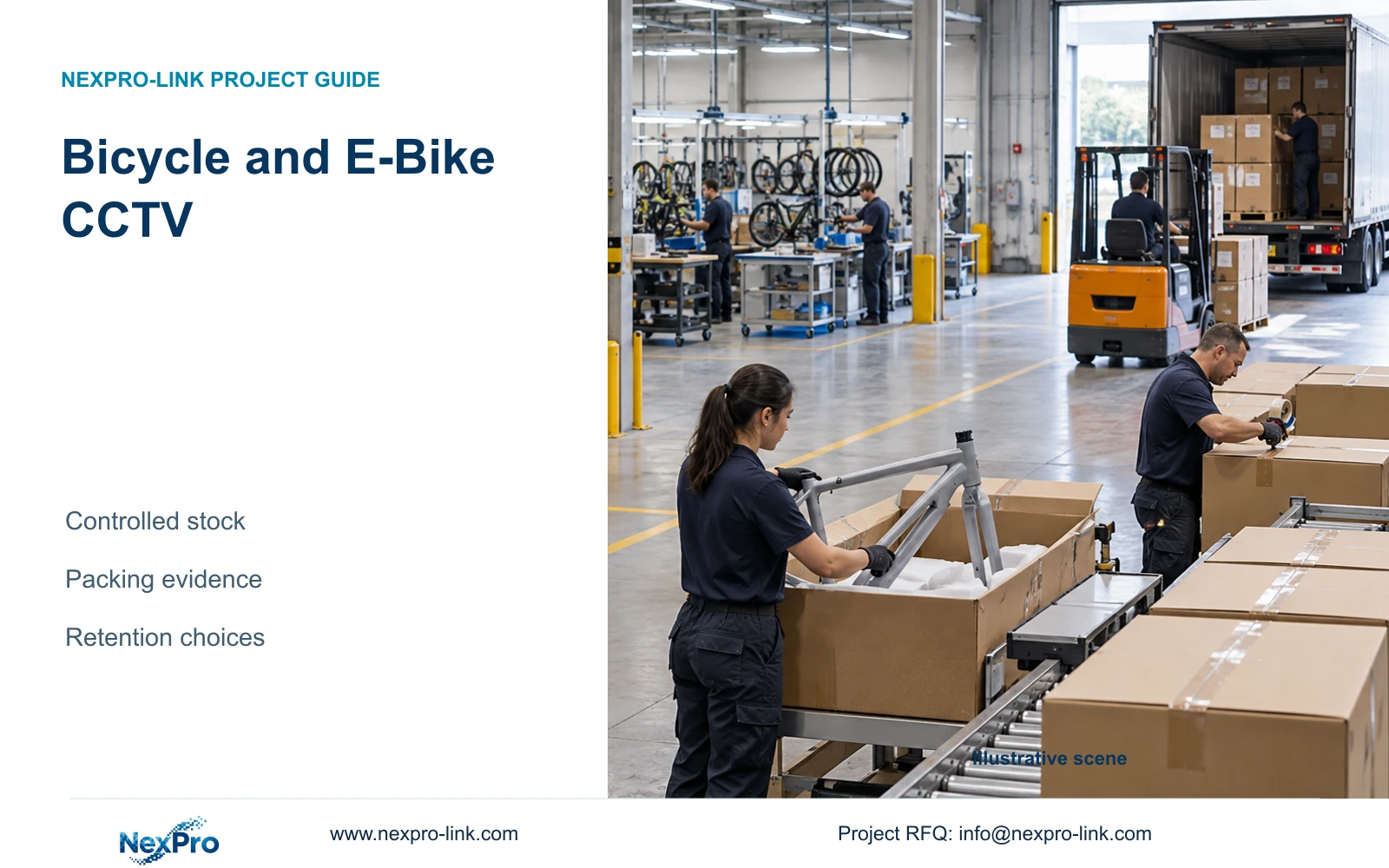
Bicycle and e-bike factory CCTV should allocate stronger task-specific detail to controlled stock and dispatch exchanges, with economical overviews elsewhere. Start with the frame-store release and finished-carton handover rather than apply one specification across every assembly bench. Any battery-process hazard assessment remains a separate project responsibility.
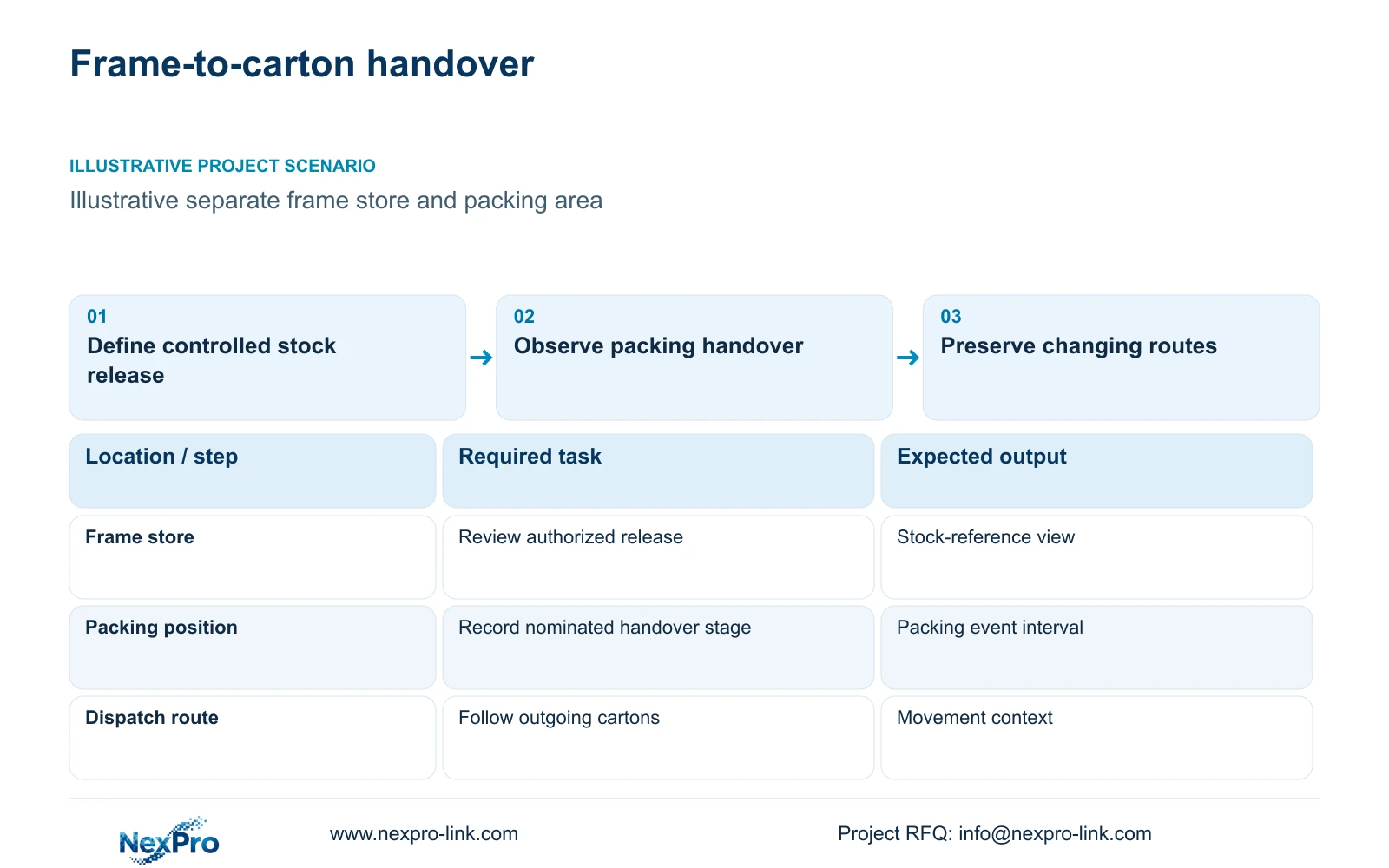
Illustrative project scenario: A two-wheeler plant stores finished frames separately from its assembly and carton-packing area. Assume the stores team records frame releases and dispatch staff record outgoing cartons. The project needs video context for those exchanges, but automatic item recognition and production-system integration have not been established.
Identify the store boundary, issue position, receiving person or route, and the record used to find an exchange later. The owner should decide whether the required outcome is movement review, visible handling detail or readable identification. These differ in framing and acceptance. The quantity surveyor can then compare a targeted stock-and-dispatch package with a uniform upgrade using the same accepted tasks.
Section 02
Capture packing handover before cartons hide the product
Map the stages the owner actually needs to review: placement into the carton, closure where relevant and release to dispatch. A camera aimed at stacked closed cartons cannot reconstruct concealed packing activity. Decide which stage belongs in the security recording scope and which remains supported by production or quality records.
Obtain the workstation orientation, carton dimensions, movement and shift lighting. For suitable ordinary positions, NexPro-BL2812M55-5MP-DIC-AI lists a 2.8–12mm motorized lens and 2880×1620 output in the 5MP-family source. A recorded trial should determine whether that framing shows the nominated handover detail. The family name alone does not prove product or label identification.
Keep the packing reference and time mapping alongside the camera schedule. If the owner wants a carton number to open video automatically, state the interface separately, including its source fields and responsible integrator. Manual lookup can remain a defined initial workflow. Ordinary security recording is not component inspection, proof of packing completeness or an automatic traceability system.
Section 03
Route infrastructure independently of movable workstations
Use the assembly and packing layout to distinguish stable backbone routes from final camera drops. Record where workstations may move and whether proposed supports remain accessible after relocation. A cable schedule based only on the current bench arrangement can create avoidable changes when the packing flow is revised.
The supplied CASE01 has 32 assumed new continuous links totaling 1872 m and a feasible seven-reel cutting plan. Those quantities belong to that reference geometry. For the two-wheeler plant, measure each route, add declared termination allowance and specify the actual installation method. A global cable total cannot establish that every required continuous cut fits the purchased reels.
Keep recording, switches and battery equipment in suitable accessible service space. Identify the power node supplying each access group and maintain the approved boundary from production controls. The NexPro-Link structured-cabling references include Cat6 patch panels and tool-less modules; they are termination products, not bulk cable reel specifications or proof that an installed link passes its required test.
Section 04
Choose retention before fixing the disk arrangement
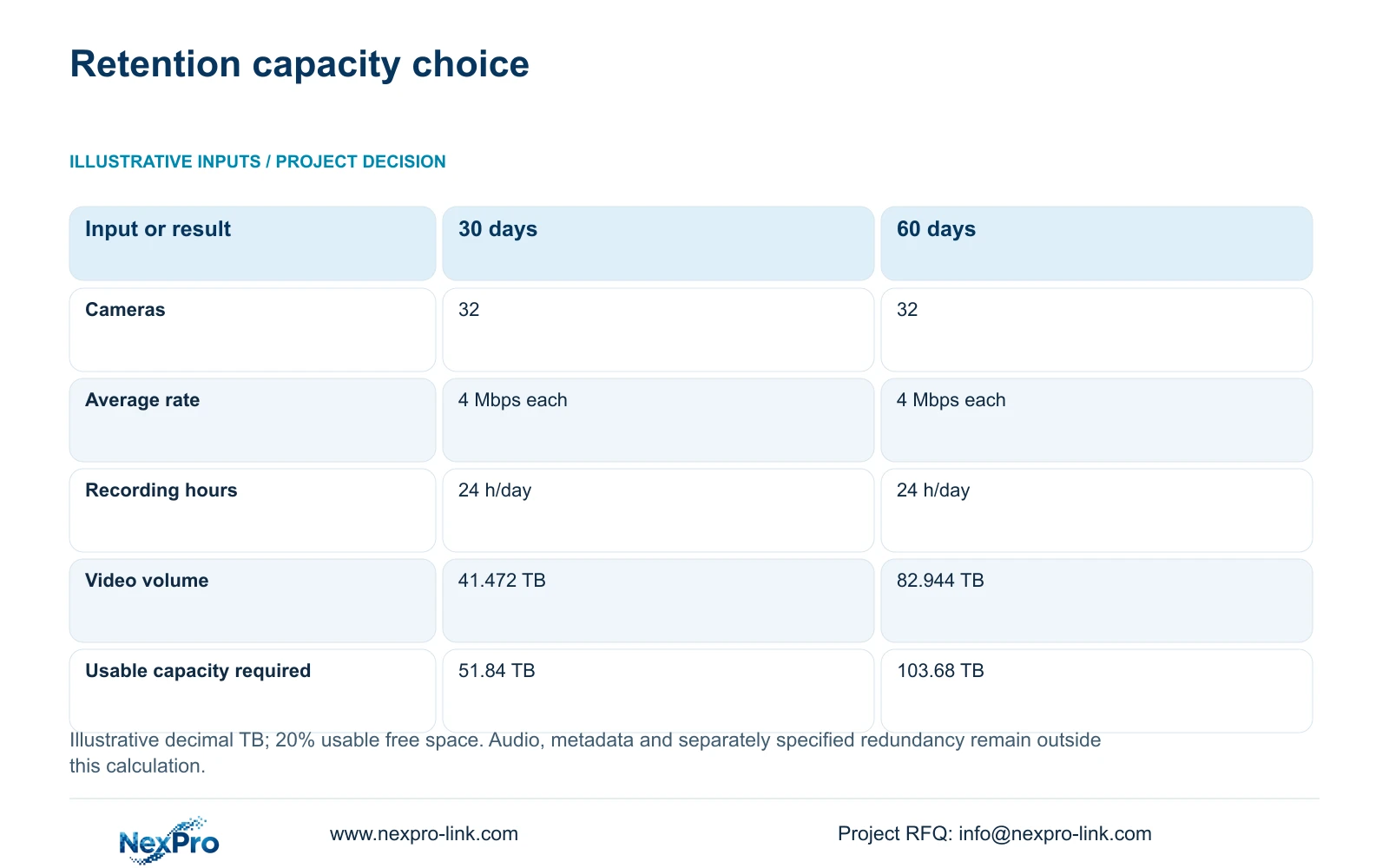
The illustrative comparison uses 32 cameras averaging 4 Mbps each, recording 24 hours per day for either 30 or 60 days. Video_TB = n × Mbps × 10^6 × 86400 × days / 8 / 10^12. Required usable_TB = video_TB / 0.8, preserving 20% of usable space as free space. The results are 41.472 and 82.944 TB of video, requiring 51.84 and 103.68 TB usable capacity.
The decisive difference is retention duration at unchanged assumed recording quality. Doubling the days doubles this video allowance; it does not demonstrate better compression by any brand. Choose the period from the owner's investigation and record-reconciliation needs, then verify any applicable local requirements separately. Do not present either duration as a universal industry obligation.
CASE01's four 16 TB drives provide 64 TB raw, 60.8 TB under its 95% usable assumption and a 48.64 TB recording budget after reserve. Compare 41.472 TB with 48.64 TB for the 30-day basis; the 60-day 82.944 TB does not fit. The reserve is already included in that budget. Audio, additional metadata, actual bitrate variation and any separately supported redundancy architecture require their own allowances.
| Input or result | 30 days | 60 days |
|---|---|---|
| Cameras | 32 | 32 |
| Average bitrate each | 4 Mbps | 4 Mbps |
| Daily recording | 24 hours | 24 hours |
| Video volume | 41.472 TB | 82.944 TB |
| Required usable capacity | 51.84 TB | 103.68 TB |
Section 05
Compare detail and retention as separate budget choices
Recommend accepted detail at stock release and packing handover, supported by route overviews. Price 30-day and 60-day retention as separate resource options with the same view schedule. If only selected tasks need longer retention, obtain an approved group schedule and recalculate it rather than apply the all-camera comparison unchanged.
NexPro-NVR4449-4K lists four SATA bays up to 18 TB each. NexPro-NVR8864-4K lists eight bays up to 18 TB each. Both references list 320 Mbps input, but their published 5MP and 4K summary modes remain distinct. More bays may provide a capacity candidate; they do not establish RAID, every stream combination or simultaneous decoding performance.
Compare complete quotations, including compatible drives, switch and cable resources, protected power and the operator's retrieval task. If battery handling or charging areas are present, obtain their separate environmental and protective-system assessment. An ordinary camera provides access context only within its qualified location. It does not become thermal-runaway detection, fire protection or process monitoring because the finished product is an e-bike.
Section 06
Keep the stock, packing and retention schedules aligned
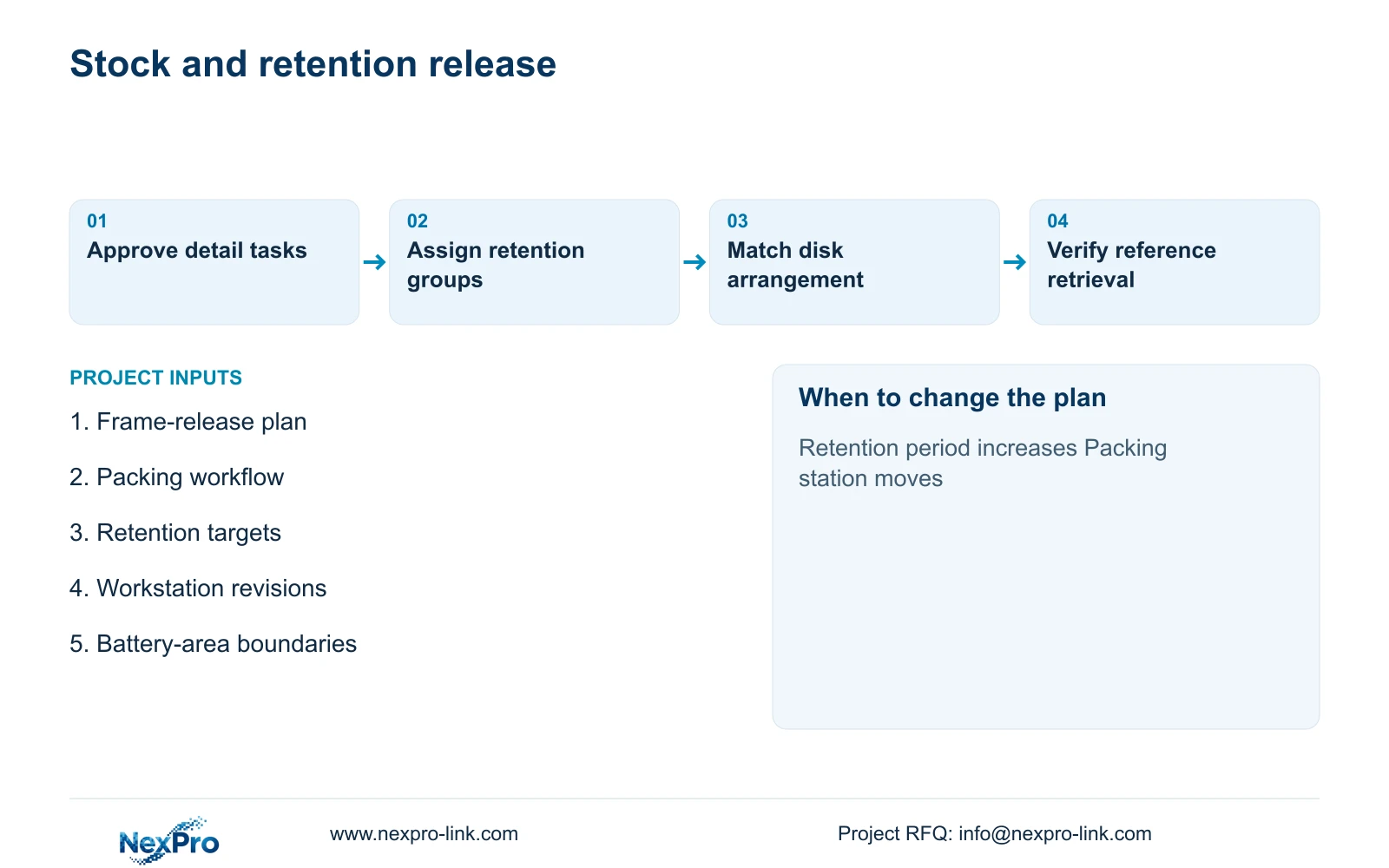
The procurement package should list stock and packing views, assigned output modes, retention groups and the supporting cabinet. Mark retained systems, new supply and optional integrations explicitly. Include compatible storage and its assumed usable allowance in the equipment schedule so a disk substitution does not quietly alter the selected retention option.
NexPro-Link's BOQ and tender support can coordinate model matching, technical documents and quotation deviations. Structured-cabling items and project packing can be organized by the approved routes and view IDs. Agree site installation, frame alignment, network approval and operational training with the appointed local parties rather than assume they are included in an export equipment price.
At handover, locate a frame-release reference and a packing event using the authorized client, then export the required interval. Verify the configured retention and actual recording rate against the planning basis. Preserve the workstation-layout revision and any unresolved interface fields with the records. That gives the owner a controlled starting point for future production changes and storage reviews.
Section 07
Buyer questions
Can we keep packing footage longer than assembly overviews? Yes if the selected system supports the required configuration and the owner approves the grouping. Recalculate each group's bitrate, recording hours and period, then verify its actual storage allocation.
Does the eight-bay recorder automatically solve 60-day retention? It provides a capacity reference, not an unconditional solution. Confirm compatible disks, usable space, selected recording modes and additional data or redundancy requirements against the 103.68 TB illustrative usable target.
Do frame-store cameras need automatic serial-number recognition? Only if that function is an explicit requirement with a separately supported solution. A release record and approved timestamp mapping may provide a workable lookup without promising recognition from ordinary CCTV.
Section 08
Compare a two-wheeler stock and packing package
Send your frame-store release and packing layout, required detail tasks, camera-group retention targets, and network or battery-area boundaries to info@nexpro-link.com for a scoped equipment and storage quotation.
Engineering references
These sources support the general planning principles. Always use the selected product's current datasheet and applicable project standards for final design.