Equal 8MP output does not establish equal factory performance. Compare documented model fields, preserve regional modes and qualify recorded detail at the same target plane before choosing a camera.
Section 01
Lock the exact camera identity before comparing suitability
Compare 8MP motorized factory cameras by exact model, regional mode and the same recorded-image task. Published sensor and output fields can establish a shortlist, but equal pixels do not establish equal night detail, analytics or reliability. Keep untested outcomes unresolved until a common trial supplies evidence.
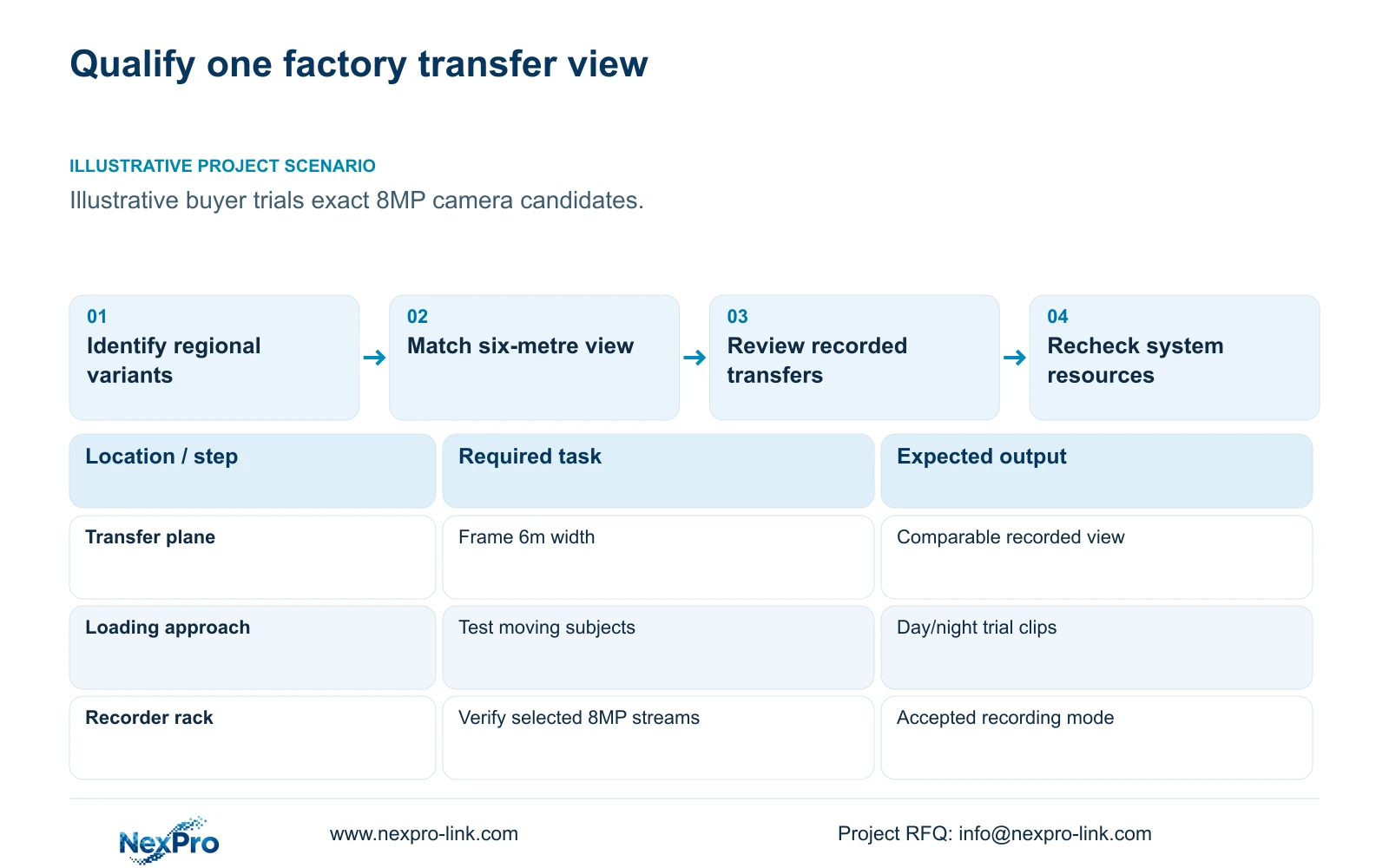
Illustrative project scenario: A buyer compares the NexPro-Link 8MP varifocal source with named Hikvision and Dahua candidates for an ordinary factory transfer view. Assume a six-metre-wide target plane for the planning calculation. The documented pair here is NexPro-BL2812M88-8MP-DIC-AI and Dahua IPC-HFW3849T1-ZAS-PV-PRO from the supplied MENA source.
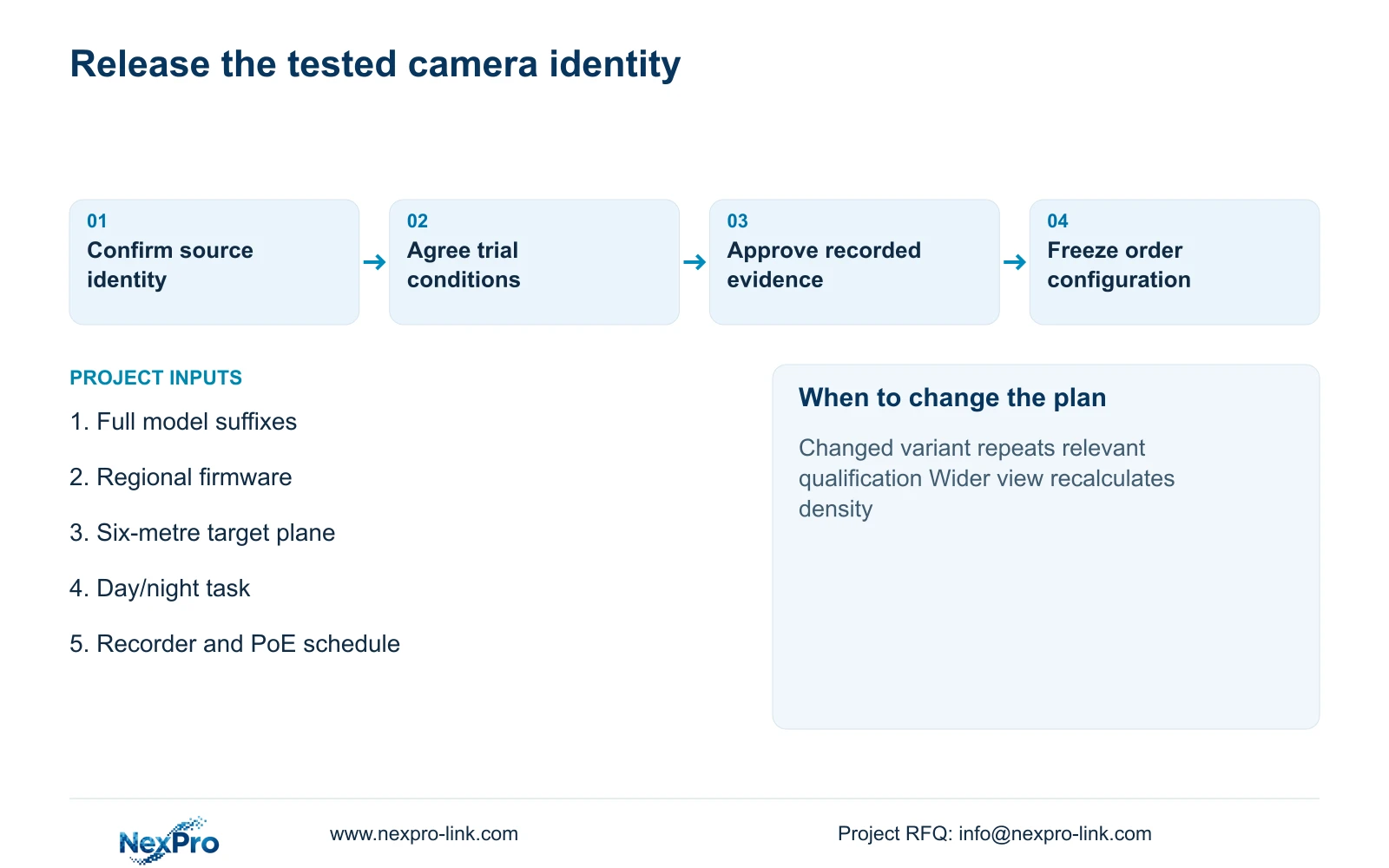
The Hikvision DS-2CD2686G2-IZS(C) entry remains a research pointer because its contents were not supplied as inspected evidence. Keep it in the buyer's candidate register without assigning unseen specifications. Record the full model suffix, firmware, source region and proposed recording mode for every sample; a different variant needs its own qualification.
Section 02
Use lens and output fields to plan the same view
Both documented cameras list 1/1.8-inch CMOS and 3840×2160 output. NexPro-Link lists 25fps at 8MP and a 2.8–12mm motorized lens; the Dahua source lists 25/30fps, subject to its regional mode, and a 2.7–12mm motorized lens. Preserve these distinctions rather than reducing the comparison to a shared 8MP label.
Set the accepted scene width at the event plane, then adjust each sample to that view. Matching focal-length numbers alone does not document the resulting coverage. Check that the proposed mounting position and available lens adjustment can frame the required handover without depending on a later digital crop to recover missing detail.
The environment can decide suitability before image comparison. The supplied NexPro-Link fields are IP66 and minus 20 to plus 60°C; the Dahua fields are IP67 and minus 30 to plus 60°C. A site requirement below minus 20°C excludes the ordinary NexPro-Link candidate on the available rating. Neither ingress field establishes every cleaning or chemical-exposure condition.
Section 03
Record a common event instead of scoring untested images
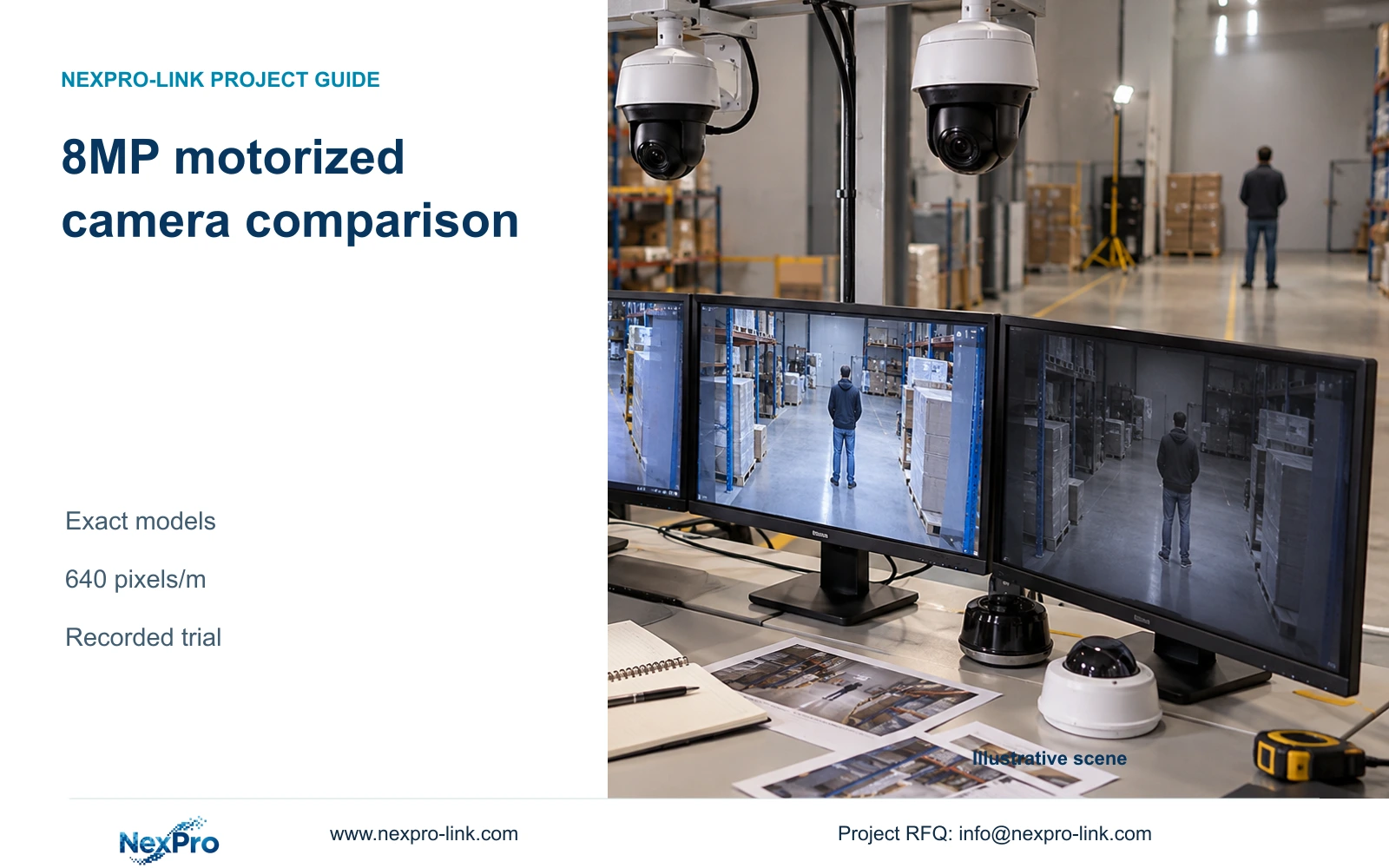
Write a trial around the buyer's evidence task: follow an authorized material transfer across the defined plane and retrieve the recording later. Use the same scene, mounting geometry and test periods, documenting any unavoidable differences. Include ordinary lighting, the agreed low-light condition and moving subjects relevant to the task.
Record exposure settings, illumination state, frame rate, codec, bitrate behavior and firmware with each clip. Review exported recordings through the intended playback route. A live preview may look acceptable while compression or recording settings remove the detail required for review. A stationary scene alone also leaves moving-object performance unanswered.
Use an evidence register with outcomes such as accepted, rejected or unresolved against the agreed task. Do not invent numerical image-quality scores. Where alerts matter, define the event and review both useful alerts and missed events separately from picture detail. Matching a sensor format is not proof that analytics behavior is equivalent.
Section 04
Calculate equal-width density while retaining source differences
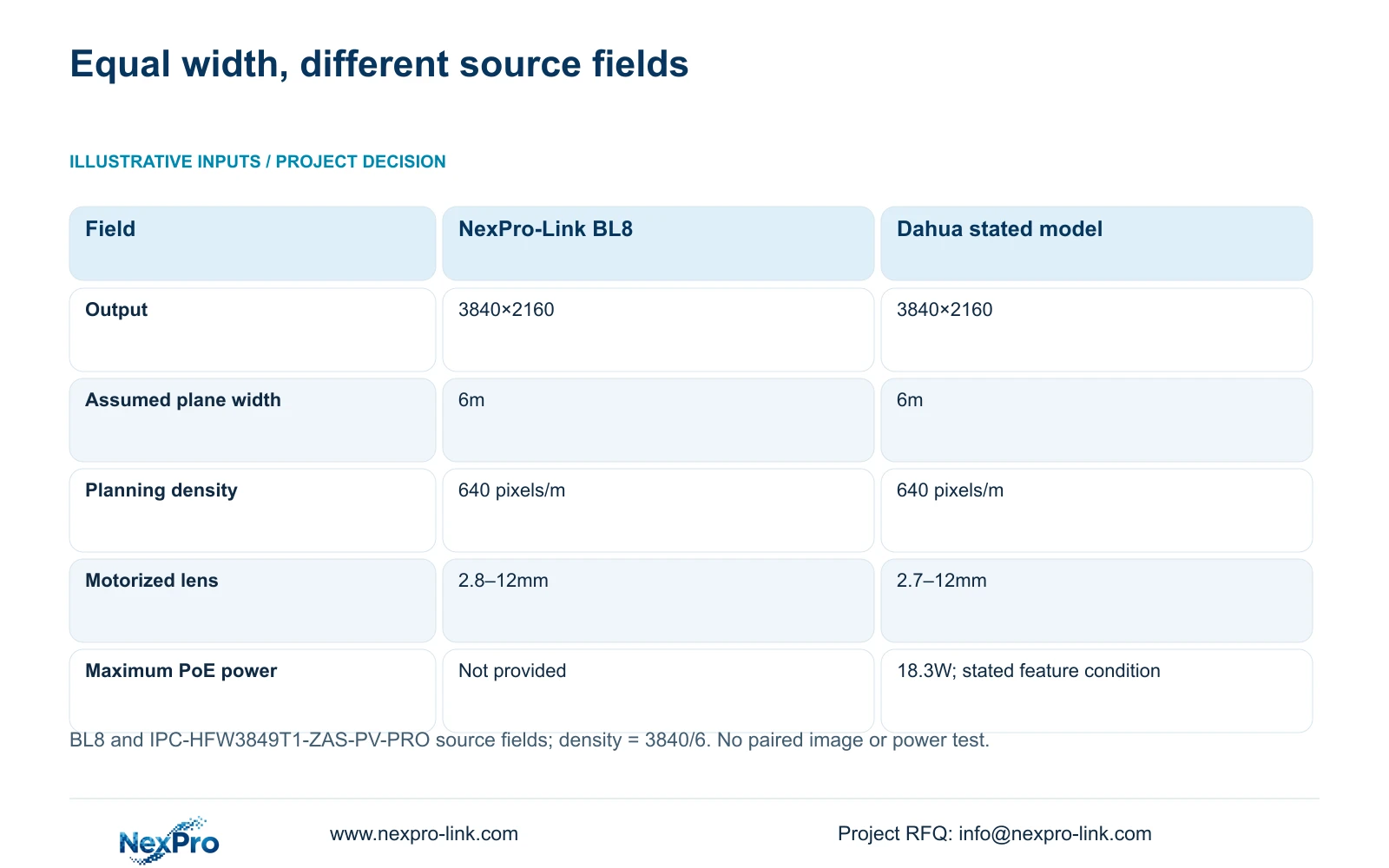
For this illustrative six-metre plane, planning_horizontal_density = horizontal_pixels / target_width_m = 3840 / 6 = 640 pixels/m for each camera. The calculation uses published output width and assumed scene width. It does not set a guaranteed recognition threshold or establish that either camera resolves all those pixels usefully.
The table preserves the source fields that can change the choice. Equal planning density leaves differences in frame-rate modes, lens range and environmental envelope intact. If the target plane is widened, recalculate the density and repeat the recorded-detail trial. Exposure, optical focus and compression still affect the accepted result.
Power is an unresolved comparison for NexPro-Link. Dahua lists maximum PoE consumption of 18.3W under its stated enabled-feature condition and PoE+ supply. The NexPro-Link PDF provides no maximum consumption. The CASE01 teaching assumption of 12W cannot fill that blank or demonstrate a lower-power result.
| Field | NexPro-BL2812M88-8MP-DIC-AI | Dahua IPC-HFW3849T1-ZAS-PV-PRO |
|---|---|---|
| Sensor format | 1/1.8-inch CMOS | 1/1.8-inch CMOS |
| Listed output | 3840×2160 | 3840×2160 |
| Listed 8MP frame rate | 25fps | 25/30fps; verify regional mode |
| Motorized lens | 2.8–12mm | 2.7–12mm |
| Density at assumed 6m width | 640 pixels/m | 640 pixels/m |
| Ingress field | IP66 | IP67 |
| Operating temperature | −20 to +60°C | −30 to +60°C |
| Maximum PoE consumption | Not provided | 18.3W at stated feature condition |
Section 05
Requalify the recorder and power path for the selected camera
Recommend NexPro-Link as a candidate for suitable ordinary locations when its documented envelope fits and its sample passes the required recorded-image task. Retain another qualified model where a lower-temperature rating, mandatory interface or demonstrated scene result controls the choice. No brand-wide winner follows from this pair of specifications.
CASE01 provides useful system context, but assumes all 32 streams fit supported 5MP-class modes. It cannot be relabeled as a 32-camera 8MP design. NexPro-NVR4449-4K's summary distinguishes 49×5MP and 9×4K; verify the actual mixed-stream mode, input budget and playback task before changing any cameras.
Rebuild storage from the selected stream groups using their agreed average bitrates. Obtain documented camera power values for the chosen illumination and audio states, then update per-port and total PoE requirements. Keep camera-side watts separate from complete switch AC load, so a power change reaches the UPS calculation without double counting.
Section 06
Tie the approved sample to the order schedule
The model/scope delta record should connect the camera decision to its recorder, mounting accessories and commissioning settings. State whether the order supplies the tested model and firmware, whether infrastructure is retained, and which adjustments remain with the site installer. Attach the accepted clips or trial record to the procurement review.
NexPro-Link's BOQ support can help coordinate the proposed models and technical submittal. Ask for the missing maximum-power field before final switch selection. If the quoted variant differs from the sample, identify the changed fields and decide which trial steps need repeating rather than assuming the same family name preserves the result.
Freeze project tags and packing references only after that technical identity is accepted. Optional OEM markings should remain separate from performance approval. The purchase decision then rests on a specific, reproducible configuration, while future replacements retain enough information to avoid substituting an apparently similar camera with a different operating boundary.
Section 07
Buyer questions
Can the slightly wider Dahua lens replace a site view trial? No. The listed 2.7mm and 2.8mm endpoints are source fields, while accepted coverage depends on the installed scene. Frame the same event plane and review recorded detail.
Should both samples use identical bitrate settings? Document a common recording-quality objective and the chosen test settings. If equal bitrate is one trial condition, also record each camera's behavior and any task-relevant detail lost under that constraint.
Does a published illumination distance settle night suitability? No. A manufacturer distance claim does not establish usable moving-object detail at the buyer's target plane. Test the agreed lighting and exposure conditions through the recording path.
Section 08
Prepare an exact-model camera comparison
Send the full candidate models and regional variants, target-plane width and mounting drawing, required day/night evidence task, and recorder/PoE schedule to info@nexpro-link.com for a task-matched camera and system review.
Engineering references
These sources support the general planning principles. Always use the selected product's current datasheet and applicable project standards for final design.